Author: Bbo I XHunt Operation Team, Amelia, Denise I Biteye Content Team
On March 1, 2026, X (Twitter) significantly updated its "Declare paid promotion" rules, with accounts that fail to comply with commercial promotion disclosure facing severe penalties starting next week.
This move was once interpreted by outsiders as a precursor to Twitter creating an official agency system, even causing collective panic in the Web3 community. However, as the official clarified the misunderstanding about the Crypto promotion rules, the true purpose of X's action surfaced: compared to the already well-established commercial agency system in the domestic market, X's move started relatively late. Its fundamental goal is not only to guide third parties to comply with the use of the X Ads official advertising system, but also to enable ordinary users to distinctly identify advertisements, purifying the timeline experience and reshaping a healthy content ecology.
For KOLs and practitioners in various fields, understanding the new regulatory lines has become an absolute prerequisite for safe monetization and sustainable operations going forward.
This article will deeply analyze from the following dimensions:
- New Definition and Penalty Mechanism: Clarifying which behaviors will be deemed commercial promotion and the consequences of violations.
- Misunderstandings in Cryptocurrency Promotion: Clarifying recent rumors about the Crypto ban and the real regional restrictions.
- Global Platform Benchmark Analysis: Comparing the commercialization evolution paths of platforms like Weibo, Xiaohongshu, TikTok, etc.
- AI Review Technology Underpinnings: Revealing how platforms automatically identify dark ads and the requirements for AIGC content.
1. Dissecting Twitter's New Rules: Not Banning Ads, but Rebuilding Trust
Twitter's new regulations are not a hard landing but a tiered governance based on the principle of transparency.
1️⃣ What is "Paid Promotion" Recognized by Official Standards?
According to Twitter's official "Paid Partnerships Policy", paid promotion refers to: third-party brands providing compensation or rewards to users (such as influencers or content creators) to promote their products or services. This covers the following four common scenarios:
- The products or services are given to users by the brand or a representative of the brand.
- The creator receives financial payment or compensation in physical form for promoting these products or services.
- These products or services can provide commissions to creators from sales (for example, through referral links or discount codes).
- The creator has a commercial agreement regarding these products or services (e.g., serving as a brand ambassador).
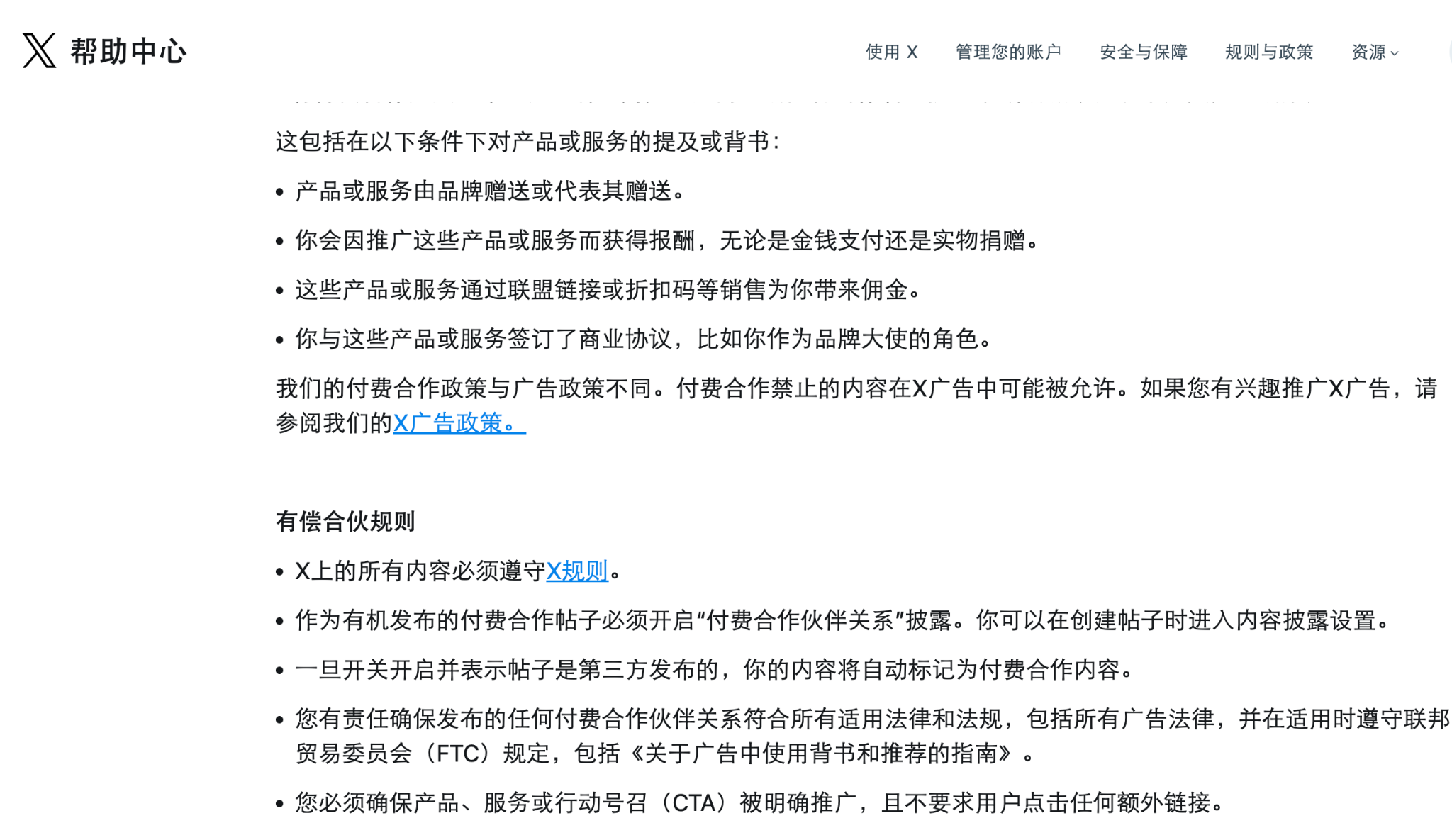
Core Disclosure Requirement: All paid promotion content published as natural posts must contain clear and prominent language (such as "Ad" or "Promoted Content") to indicate its commercial nature. At the same time, the promoted products, services, or call-to-action (CTA) must be clear and should not require users to click additional links to understand.
2️⃣ Violation "Tiered Enforcement Options"
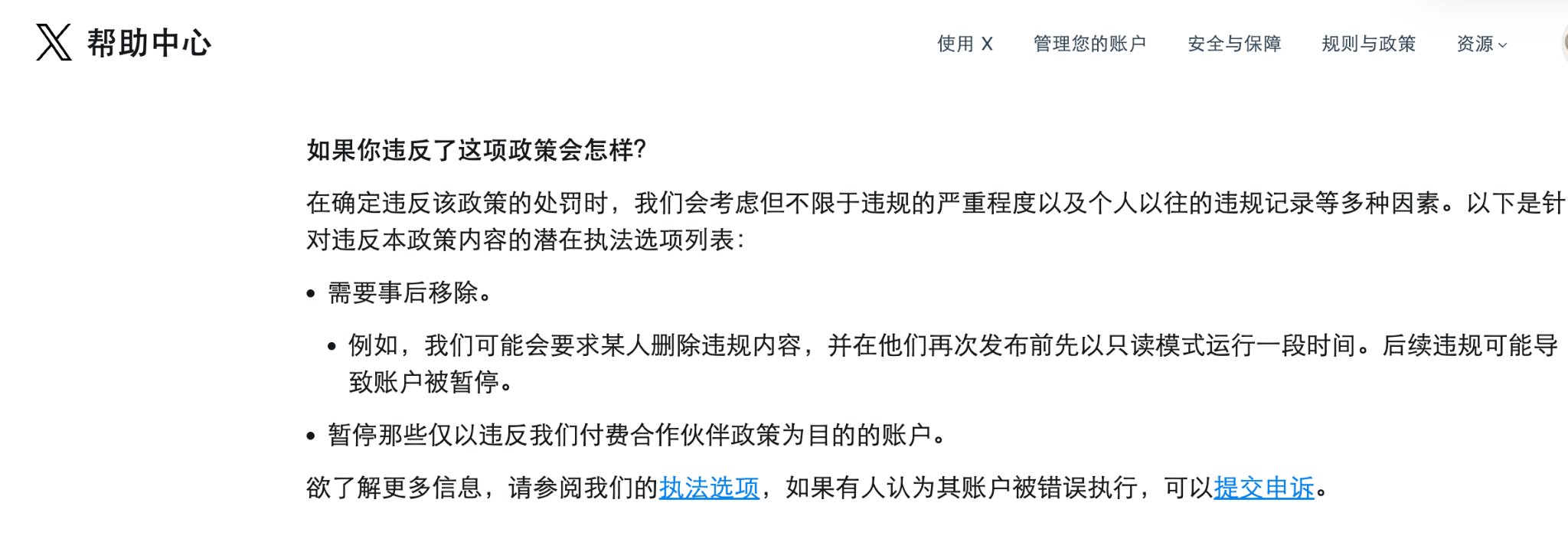
In determining penalties for violations of this policy, X will consider various factors, such as the severity of the violation and the individual’s past violation record, and take tiered enforcement options:
- Post-removal and Restrictions: The platform may require violators to delete the violating content and run in "read-only mode" for a period before they can publish again.
- Suspension for Repeated Violations: Accounts may be suspended (banned) only after multiple subsequent violations.
- Directly Banning Malicious Accounts: Accounts that exist solely for the purpose of violating the paid partnership policy will be directly suspended.
- Additionally, the platform also provides an appeal channel, where users who believe their accounts were wrongfully executed can submit an appeal.
2. A Shocking 12 Hours: The Misunderstanding of Crypto Promotion and Regional Compliance
At the beginning of the new rules' announcement, X's policy page directly listed "Cryptocurrency" as a category prohibited from conducting paid partner promotions, which triggered strong reactions in the Web3 community. Many KOLs were anxious and unable to sleep, fearing for their livelihoods.
However, this was just a misunderstanding. X's product leader Nikita Bier has publicly confirmed that the previous blanket restriction display was an error. This clause was updated in June 2024 and was not the latest version. The platform has now urgently fixed the clause.
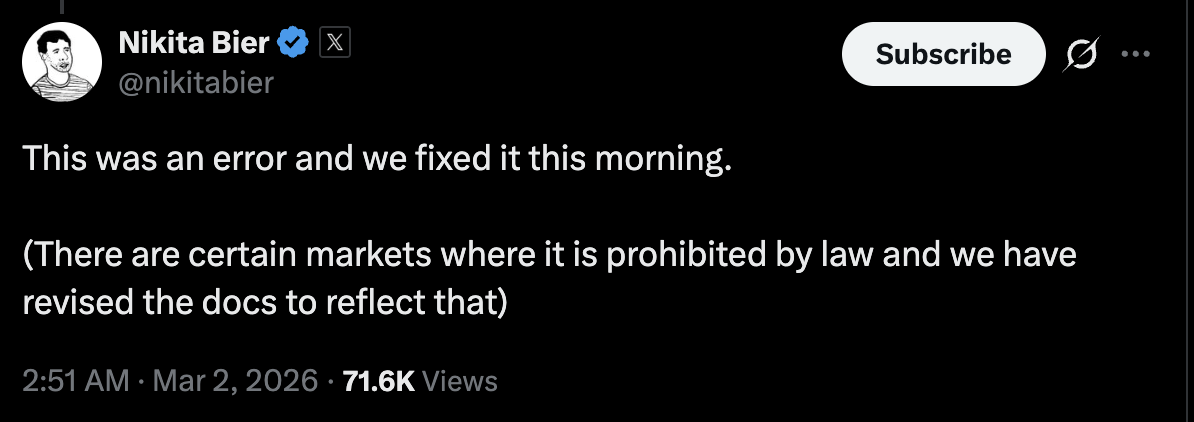
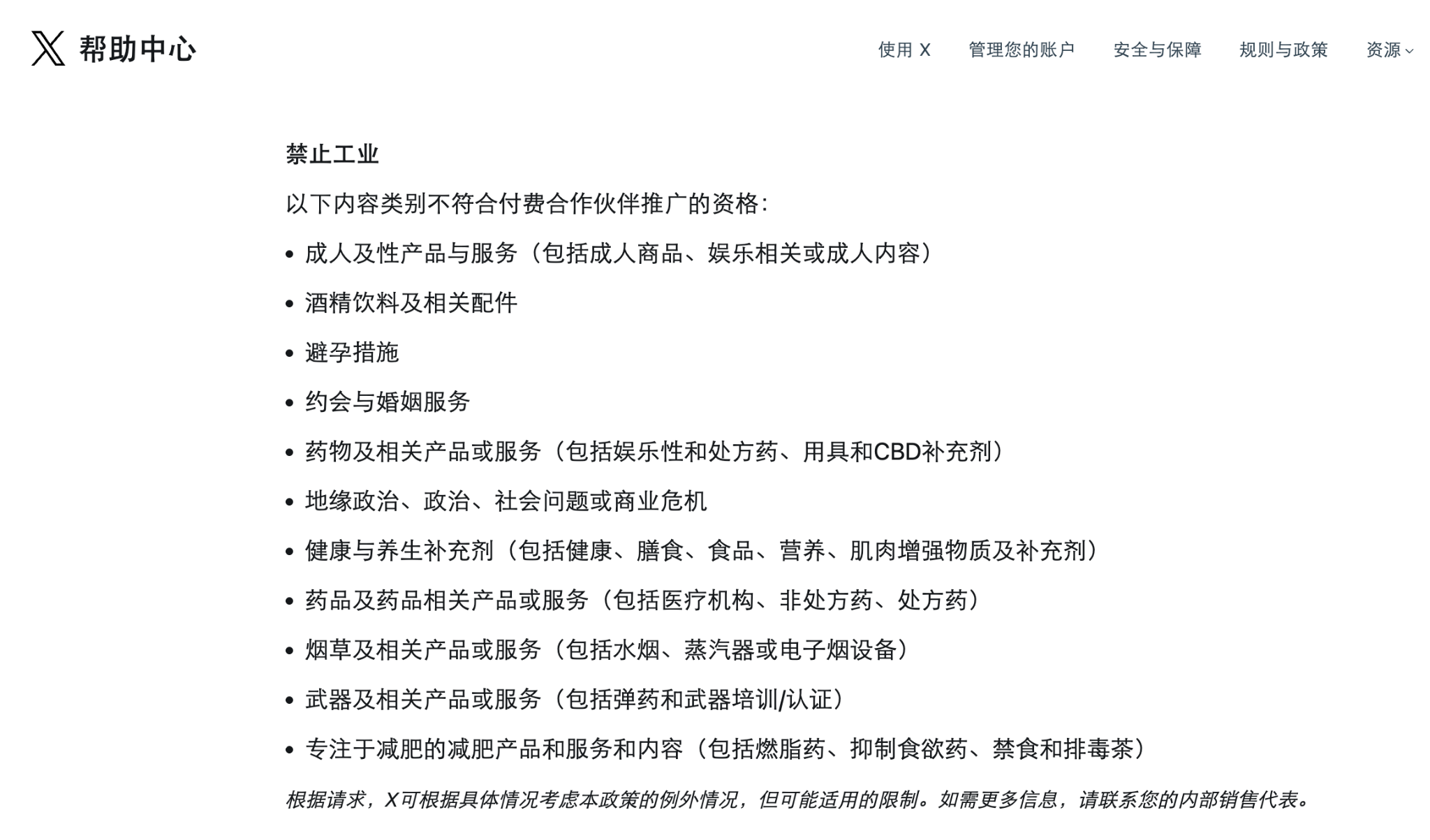
According to the latest updated policies, cryptocurrency has not been globally banned, but has entered a compliance disclosure state with regional restrictions. Specifically:
- Regional Isolation Red Line: Currently, Australia, the European Union, and the United Kingdom are restricted from conducting cryptocurrency paid promotions (affected by local financial regulatory laws). Apart from these three regions, X has not prohibited other countries or regions.
- Mandatory Transparent Disclosure: Although promotional channels remain open, KOLs receiving orders from non-restricted countries must absolutely adhere to the transparency principle - must clearly note cooperation promotion in their tweets. The previous hidden calls for promotions without tagging, disguised as personal investment insights, will face a high risk of account violations.
- Official X Ads is Still the Choice for Large Organizations: For large financial projects that need to cross regions or do not meet the promotional conditions for individual KOLs, they can still apply through the official X Ads (promoted posts) to obtain "pre-authorization approval" for formal purchases.
In short, KOL marketing channels in the Crypto industry still exist, but they have officially bid farewell to the chaotic era and fully entered a compliant new phase with clear labeling.
3. Three Categories of Global Content Platform Commercial Governance
Looking at X's new rules in the context of the evolution history of global platforms, it is not abrupt, but rather completes a long-delayed puzzle. From a governance model perspective, global content platforms can be classified into three categories: mandatory official matchmaking type, mandatory disclosure + non-mandatory matchmaking type, and only mandatory disclosure type.
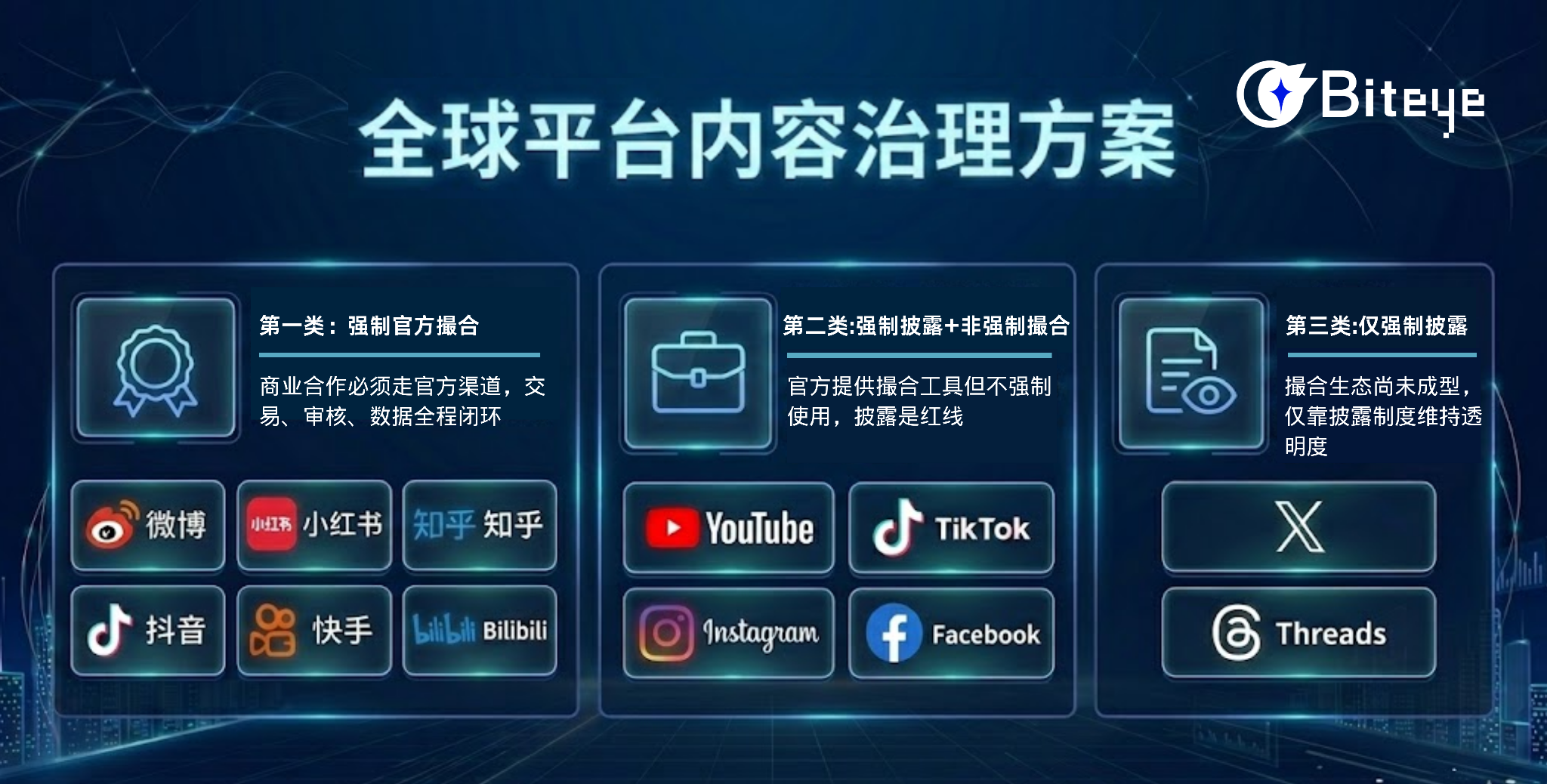
1️⃣ Mandatory Official Matchmaking - Commercial Must be Closed Loop
The core logic of such platforms is: all commercial cooperations must go through official established channels, with transactions, content reviews, and data tracking being managed in a closed loop. The platform bears joint responsibility for commercial content, hence must be fully controllable throughout.
Mainland China is a typical representative of this model.
- Weibo: Mandatory commercial advertisements must be published and tagged through official channels like "WeTask" or "Treasure Basin." Strict measures against rampant marketing accounts and traffic manipulation include tiered punishments starting with traffic restrictions, point deductions, and eventually account bans.
- Xiaohongshu: All influencer commercial orders must go through the official "Dandelion platform"; "disguised recommendations" are strictly prohibited. Notes will be directly restricted if not reported and commercial relationships disclosed, with severe cases leading to credit point deductions for accounts.
- Douyin: The most complete commercial system. It has established the "Giant Star Map" system, supplemented by the "Product Selection Square" and traffic flow system. Creators wanting to sell products or accept orders must link through the official product selection center. For unreported private orders (dark ads), Douyin’s AI review system will intercept through frame-by-frame video scanning and link analysis.
- Zhihu: Launched "Zh+” and commercial plugins, incorporating advertisements into the platform ecosystem. Zhihu has a strong crackdown on "disguised hardcore reviews". Once reported by users or judged as violating advertisements by the system, the account's "salt value" and weight will significantly decrease, potentially facing permanent silence.
- Kuaishou: Forms a closed loop with e-commerce through "Quick Order" and creates an integrated system of "content - transaction - revenue sharing." Kuaishou emphasizes the authenticity of the "iron buddy economy" and takes dual punitive measures of traffic suspension + reduction of e-commerce permissions against false advertising and undisclosed marketing content.
- Bilibili: Established the "Fireworks Platform," requiring UP masters with followers ≥ 10,000 to settle in. All non-private domain commercial orders must complete contract signing, content review, and settlement through the platform. Unregistered accounts cannot receive advertising demands distributed by the platform.
Summary: The rules of mainland platforms are very clear: commerce must occur within the platform system. From content to transaction, from seeding to pulling out, it is a fully closed loop, fully controllable. There is almost no boundary between content and commerce.
2️⃣ Mandatory Disclosure + Non-Mandatory Matchmaking - Platform Sets the Stage, Free to Perform
Such platforms take a "soft closed loop" approach: the official provides matchmaking tools (creator market) but does not mandate their use; brands and creators can still connect through email, private messages, and other external channels. However, regardless of the cooperation channel used, commercial disclosure is an absolute red line - as long as there’s no tagging, it is a violation.
- YouTube: Launched the "BrandConnect" platform, integrating the entire process of creator collaboration, with the newly launched "Open Call" feature allowing brands to publish creative briefs and solicit video proposals from over 3 million creators. It also established a mandatory declaration mechanism that "includes paid promotion". YouTube's logic is: long video users value credibility, tagging won't destroy traffic, only deception will.
- TikTok: Launched "TikTok Creator Marketplace," gathering quality creators from various verticals worldwide and supporting standardized processes like data screening, direct invites, and commission sharing. However, the official matchmaking platform is not mandatory - brands and creators can still connect directly through email and private messages. Nonetheless, regardless of the channel used for cooperation, commercial content disclosure is a mandatory red line: all brand cooperation content must be published through official invite links, ensuring they include paid partnership tags, otherwise, they will not gain For You recommendation traffic.
- Instagram: Established the "Creator Marketplace," allowing filtering based on country, content category, follower count, and providing a "prioritized private message" function to enhance response rates. It introduced the "Paid Partnership Label," requiring creators to clearly tag brand collaborations at the top of the posts. IG has proven that even with ads tagged, as long as the content is visually appealing, users will still make purchases.
- Facebook: Introduced the "Brand Collabs Manager" and "Creator Marketplace," helping brands search, filter, and contact creators, providing official first-hand data (such as follower counts, account coverage, engagement rates), and supporting multidimensional filtering based on country, age, interest tags, etc. However, the official matchmaking tools are not mandatory; disclosure is the mandatory red line. Facebook has made it clear: even when using the built-in Branded Collabs Manager, manual disclosure is still required.
3️⃣ Only Mandatory Disclosure - Matchmaking Ecosystem Not Yet Formed
These platforms currently have only reached the step of "mandatory disclosure"; official matchmaking channels have either not been launched or are still in the early exploratory stage.
- X (Twitter): This update mandates that all paid promotions must label "Paid Promotion"; otherwise, there is a risk of account suspension. Although Musk also pays content creators, there is currently no established official matchmaking system like "Star Map" or "Creator Marketplace".
- Threads: As a direct competitor to X, was extremely restrained toward commercialization in the early stages. Actively suppressing hard ads and strictly preventing machine-like promotional marketing, trying to convert users disappointed with X through a "pure feel," it has yet to open a formed commercial matchmaking system.
💡 Core Insight: Why do Chinese platforms tend to favor mandatory closed loops while overseas platforms (including TikTok) only adopt mandatory disclosure, unable to close loops?
- Different Legal Backgrounds: Domestic regulations require very strict entry and oversight for internet advertising. Platforms, as the primary responsible party, must bear joint responsibility for content. To reduce violation risks, the best method is to "close loop" all commercial activities, with all content being reviewed before release. In contrast, the core legal logic of the United States (FTC) and the European Union is based on "duty to inform." As long as you clearly tell users through tags (like #ad, #sponsored) that this is an advertisement, how you settle privately or sign contracts is generally not intervened by the platform.
- Anti-Monopoly Red Lines: In the European and American markets, if a platform follows a mandatory intervention route, it may touch upon two types of risks: antitrust investigations and market competition restriction accusations, with regulators believing the platform is monopolizing advertisements, excluding third-party agents, and limiting creators’ freedom. This behavior is considered high risk in both the United States and the European Union, which is why TikTok, incubated domestically, can only provide a Creator Marketplace but cannot mandate its use.
✍️ Key Point: Therefore, third-party matchmaking platforms will coexist with content platforms long-term and are indispensable.
Firstly, European and American laws do not allow platforms to form absolute monopolies; secondly, even in the highly closed-loop environment of the domestic market, there are still survival gaps. For example, although Xiaohongshu and Douyin have official Dandelion and Star Map systems, a large number of third-party data analysis and matchmaking intermediaries remain active.
4. AI Review: Intelligent Identification and Mandatory Labeling of AIGC Content
With so much content on Twitter, it's impossible for the official team to review it manually. The product leader mentioned the team only has over 30 people, which clearly lacks manpower for this task. Thus, the detection of dark ads largely relies on AI.
1️⃣ AI Principles and Applications for Identifying Dark Ads
The platform's AI model mainly locks onto violating content through cross-analysis of multidimensional features:
- Text Semantic Analysis (NLP): Precisely identifies whether specific praise, token solicitation phrases, and highly suspicious soft ad "calls to action" (like "buy now," "click to register," etc.) appear frequently in tweets.
- Link and Behavior Traceability: Automatically detects whether specific affiliate links, invitation codes are attached and determines the commercial attributes of the redirected domains.
- Account Relationship Diagram: Analyzes whether this account has an abnormal interaction frequency or correlation features with specific brands. Once the platform determines that a tweet has a high confidence for commercial promotion but lacks tagging, the system automatically triggers penalties.
2️⃣ Mandatory Labeling for AIGC Content
In addition to identifying dark ads, Twitter is simultaneously promoting regulations for AI-generated content. X is developing AI-generated content labels, and in the future, failing to proactively mark AI-generated text and images will likely violate platform rules.
This measure directly targets the rampant AI spam marketing accounts on Twitter. It not only protects users’ right to know but also leverages the rules to force creators to provide genuine "human insights and real narrative value." Low-quality AI-generated content will be filtered out, while high-quality vertical information will receive more exposure.
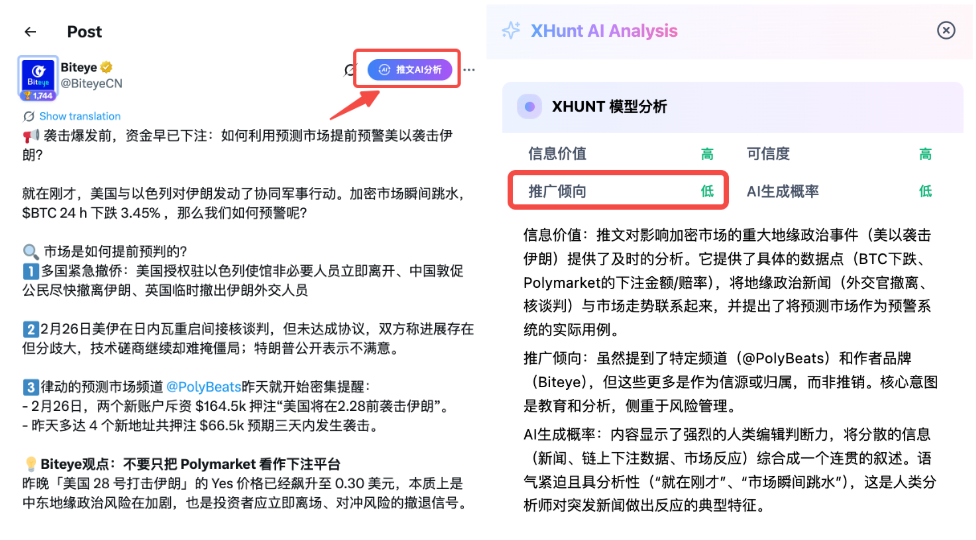
In the current environment where the official employs strong AI regulation, ordinary users and operators can also use AI tools for counter-surveillance. By utilizing XHunt's "Tweet AI Analysis" feature, trends in promotional tendencies of AI-generated tweets can be reported.
In Conclusion: Holding the Sword of Authority, Underneath the Sword of Damocles
The development of platforms often follows the same path: early reliance on the activity of creators and users for wild growth; later dependence on rules and commercialization to establish order; and when a platform becomes large enough, issues of governance and the boundaries of power will surface.
The transition of X from wild growth to commercial regulation is hard not to evoke memories of the large migration in 2022: a significant number of Chinese crypto users left Weibo, carrying their frustrations and distrust from being banned, flocking to a seemingly more open public square.
Back then, Twitter was like a large square, big enough for anyone to shout.
Now, Twitter resembles a great emperor, so massive that accounts can be suspended on a whim, just like an emperor executing a rebellious subject.
It is reasonable for platforms to set rules. For an ecology to grow, rules are essential.
However, at all times, remember: the platform is not an emperor above users. Holding the sword of authority, there must also be the sword of Damocles hanging above.
After all, no dynasty lasts forever. If public sentiment is lost, everything is lost.
免责声明:本文章仅代表作者个人观点,不代表本平台的立场和观点。本文章仅供信息分享,不构成对任何人的任何投资建议。用户与作者之间的任何争议,与本平台无关。如网页中刊载的文章或图片涉及侵权,请提供相关的权利证明和身份证明发送邮件到support@aicoin.com,本平台相关工作人员将会进行核查。


