Written by: Maher, Foresight News
On February 28, the United States and Israel jointly launched airstrikes against Iran, resulting in the death of Iran's Supreme Leader Ali Khamenei. This attack has shaken the geopolitical landscape of the Middle East, and in the 21st century, the flames of war continue to spread in various directions, with the impact of war creating huge waves in the crypto world’s prediction markets.
Polymarket and Kalshi have become another "battlefield" outside the war, where traders bet on the timing of the attack, regime changes, and ceasefire dates, with trading volumes skyrocketing to astronomical figures.
In war, there are always those who profit quietly.
Polymarket has become a "barometer" of the conflict. Since December of last year, they have opened markets on "When will the U.S. strike Iran," covering various date options.
The prediction market's "Will Khamenei step down before February 28?" saw a one-day trading volume of up to $95.93 million on February 28, becoming one of the largest geopolitical markets in the platform's history, with trading volume reaching $54.15 million on March 31.
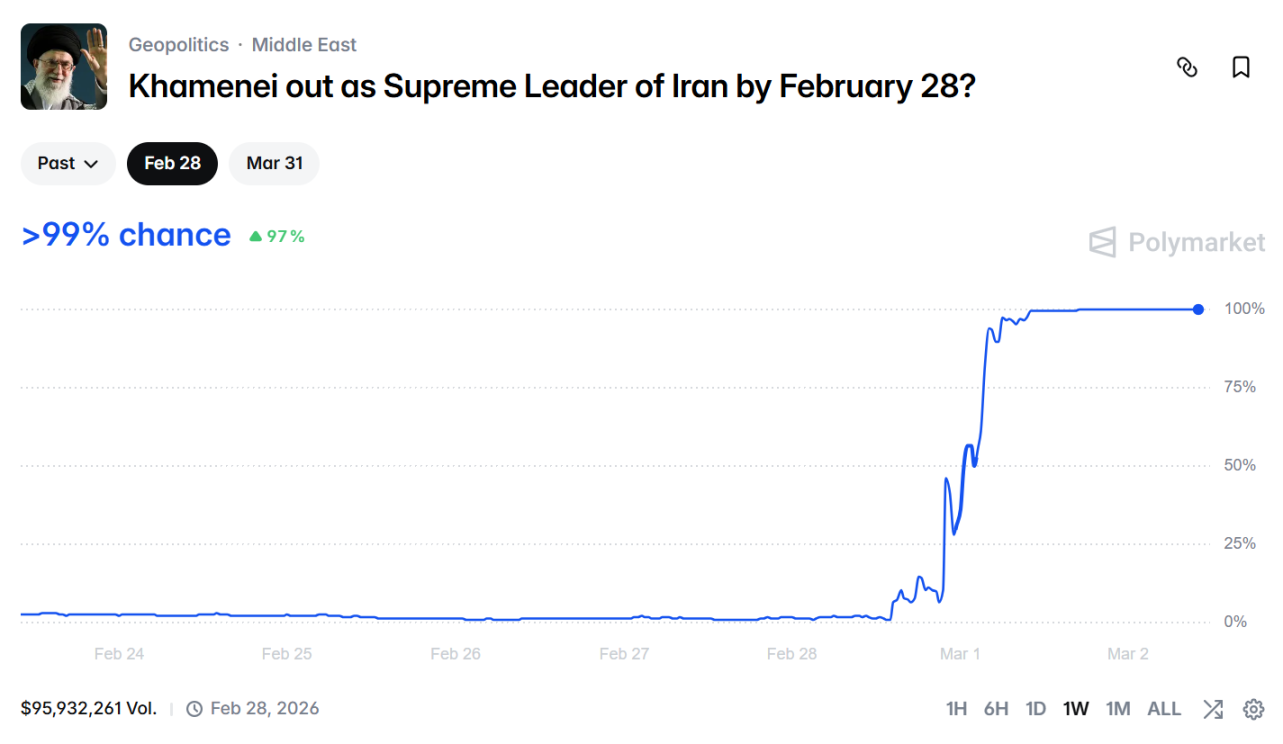
After the attack was confirmed, this market quickly settled to "Yes" (still in the final dispute period), as Khamenei's death directly led to his "stepping down."
Although Polymarket currently charges no trading fees on the majority of the regular markets on the platform (including all political, geopolitical, pop culture, and long-term macro events), at the beginning of 2026, Polymarket introduced fees for specific high-frequency trading markets, significantly positively affecting its revenue growth under brand influence expansion.
Moreover, Polymarket's global version employs a profit-based fee model. The core logic is that users do not need to pay fees when placing regular buy and sell orders, but when users take profits, the platform charges a 2% fee on net profits, taxing only "winners."
Taking the image as an example, if the total net profit for winners is $10 million, the revenue from just a single prediction market would reach $200,000.
Traders flock in not only for the excitement but also because these markets can reflect news in real-time—much faster than traditional media. Once the news of the attack broke, the contract prices jumped instantly, showcasing the market's "efficiency."
There are always winners in war. In the past, those who profited from conflicts were often arms dealers, oil tycoons, or intelligence traffickers—think of Lockheed during World War II or oil magnates during the Cold War, who amassed fortunes through contracts and resource monopolies. Ordinary people? At most, they are bystanders; war means loss and uncertainty for them. But today, crypto prediction markets have disrupted this pattern. Platforms like Polymarket allow retail investors to bet on geopolitical events, from the date of U.S.-Iran strikes to the probabilities of regime changes, with just a few clicks.
However, participating in this game also blurs moral boundaries. This shift evokes sentiment: the "dividends" of war have spread from physical supply chains to digital gambling tables. Arms dealers are still making money, but prediction markets have made ordinary users new players. They do not produce missiles, but they can "predict" explosions on the blockchain, reaping significant rewards.
As conflicts escalate, platform trading volumes surge—war economies have digitized.
Yet this has also raised many questions—will the thrill of making money dull empathy for real suffering?
Kalshi, as another player, has also taken a piece of the pie. Their "Will Khamenei step down?" market saw trading volumes ranging in the millions of dollars (with slight differences from various sources). On the day of the attack, trading volume spiked, reaching tens of millions of dollars in a single day.
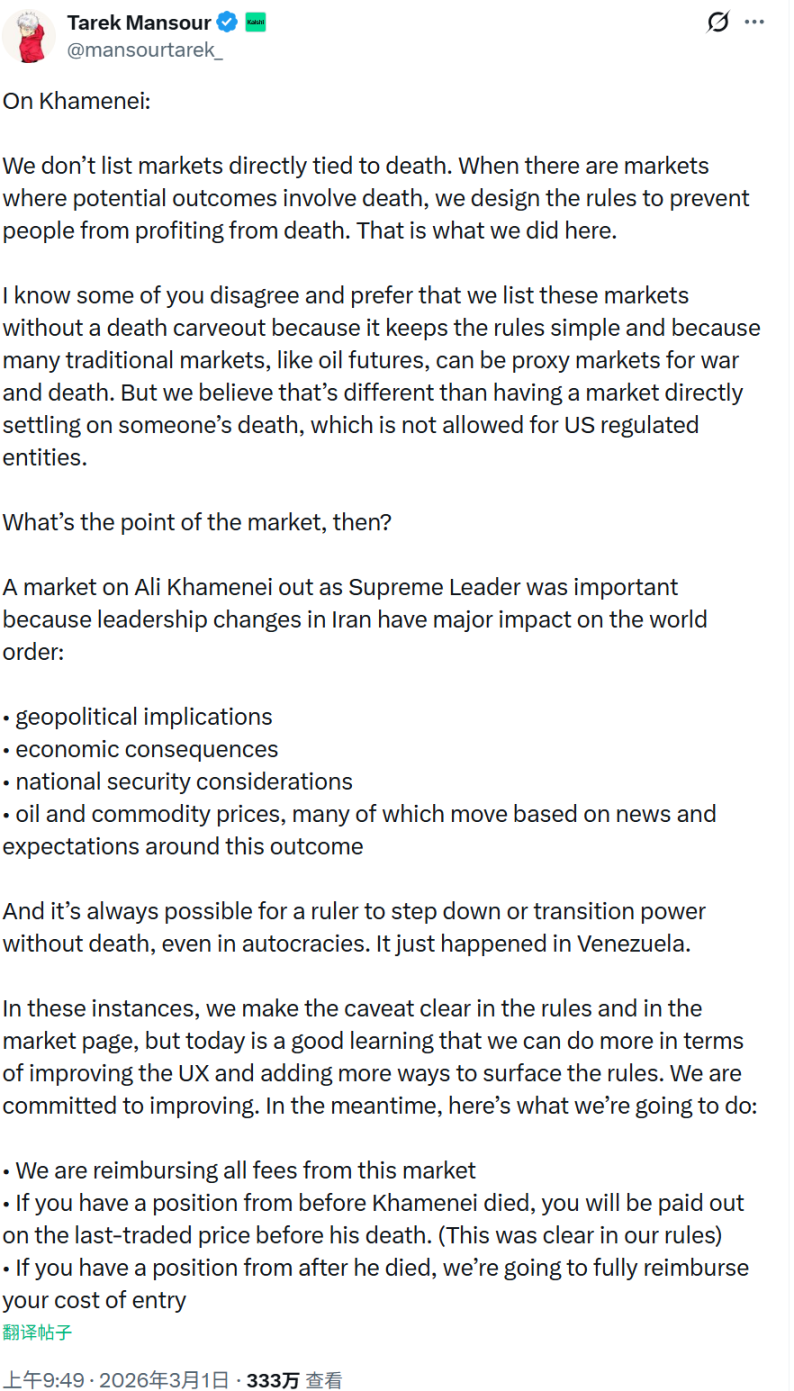
But Kalshi's approach sparked controversy. A rule in the platform states "No settlement for death," meaning that if stepping down is due to death, the "Yes" contract will not be paid in full.
After the attack, Kalshi suspended the market, and CEO Tarek Mansour posted on X explaining: they oppose profiting from individual deaths, so they would settle at the last transaction price before death and fully refund all fees. Mansour emphasized that this is to maintain a "moral baseline" and avoid the platform becoming a "death gambling game." Some users complained that this felt like a rule change on the fly, but Kalshi insisted it was a pre-set clause, only clarifying the details a day before the attack.
As a result, the platform lost money, but gained a reputation for "not profiting from dead people."
Polymarket users enjoy high anonymity, attracting global capital; Kalshi is more compliant but restricts markets related to war and assassination.
However, while most players are betting based on intuition, some insider players are quietly profiting.
On Polymarket, some accounts made bets with timing so precise that it raised suspicions of insider trading. Blockchain analysis company Bubblemaps discovered that six newly created wallets placed bets on February 28 U.S. strikes against Iran just hours before the attack, collectively earning around $1 million.
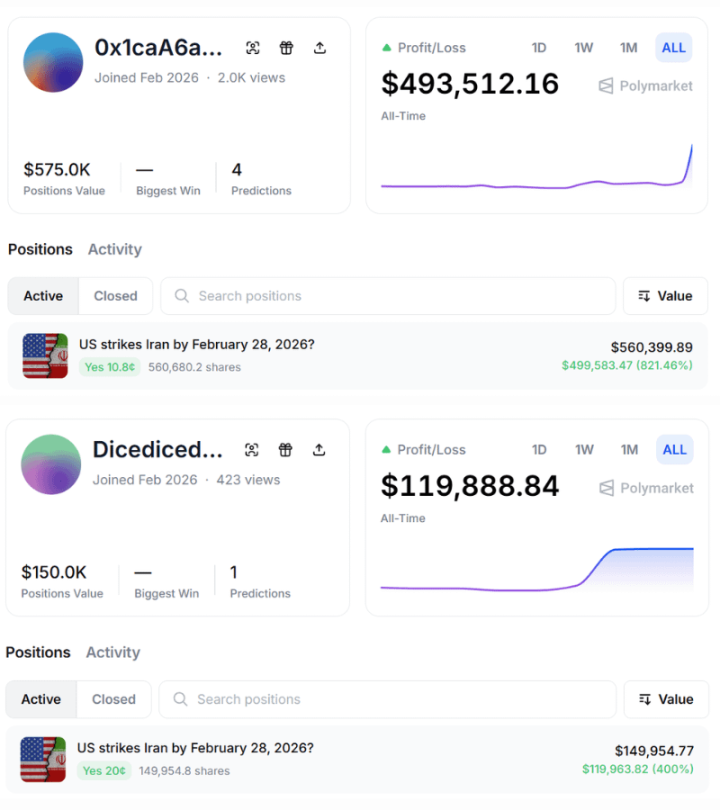
These six wallets were created in February this year, with almost all trades concentrated on contracts predicting the timing of the U.S. military attack, with some positions established mere hours before the first reports of explosions in Tehran, with contract buy price as low as about $0.10. Analysts say this kind of concentrated betting behavior before significant geopolitical events is characteristic of what was once suspected insider trading in prediction markets.
However, reports also pointed out that the related accounts had previously incurred losses in other predictions, and the U.S. government had publicly warned weeks prior that military action could be taken. Therefore, the timing of the trades alone is not sufficient to directly prove illegal activities.
These are not isolated cases. Polymarket has faced similar doubts historically, such as during the 2024 Super Bowl or the Venezuela incident. But this time the scale is larger and involves national security. The CFTC has warned about insider trading in the past, and Kalshi recently punished the well-known YouTube creator MrBeast's team editor Artem Kaptur for insider trading. Polymarket operates overseas with loose regulation, becoming a gray area.
U.S. Congressman Ritchie Torres is pushing for legislation called the "2026 Financial Prediction Market Public Integrity Act," which aims to restrict government officials with non-public information from participating in related prediction market transactions. Meanwhile, Polymarket has faced regulatory restrictions or bans in several countries including the Netherlands, France, Italy, and Singapore in recent years.
Of course, not everyone wins. Many bet on the wrong dates and suffer significant losses. Currently, Polymarket has updated its website to prominently display all prediction markets related to the situation in Iran.
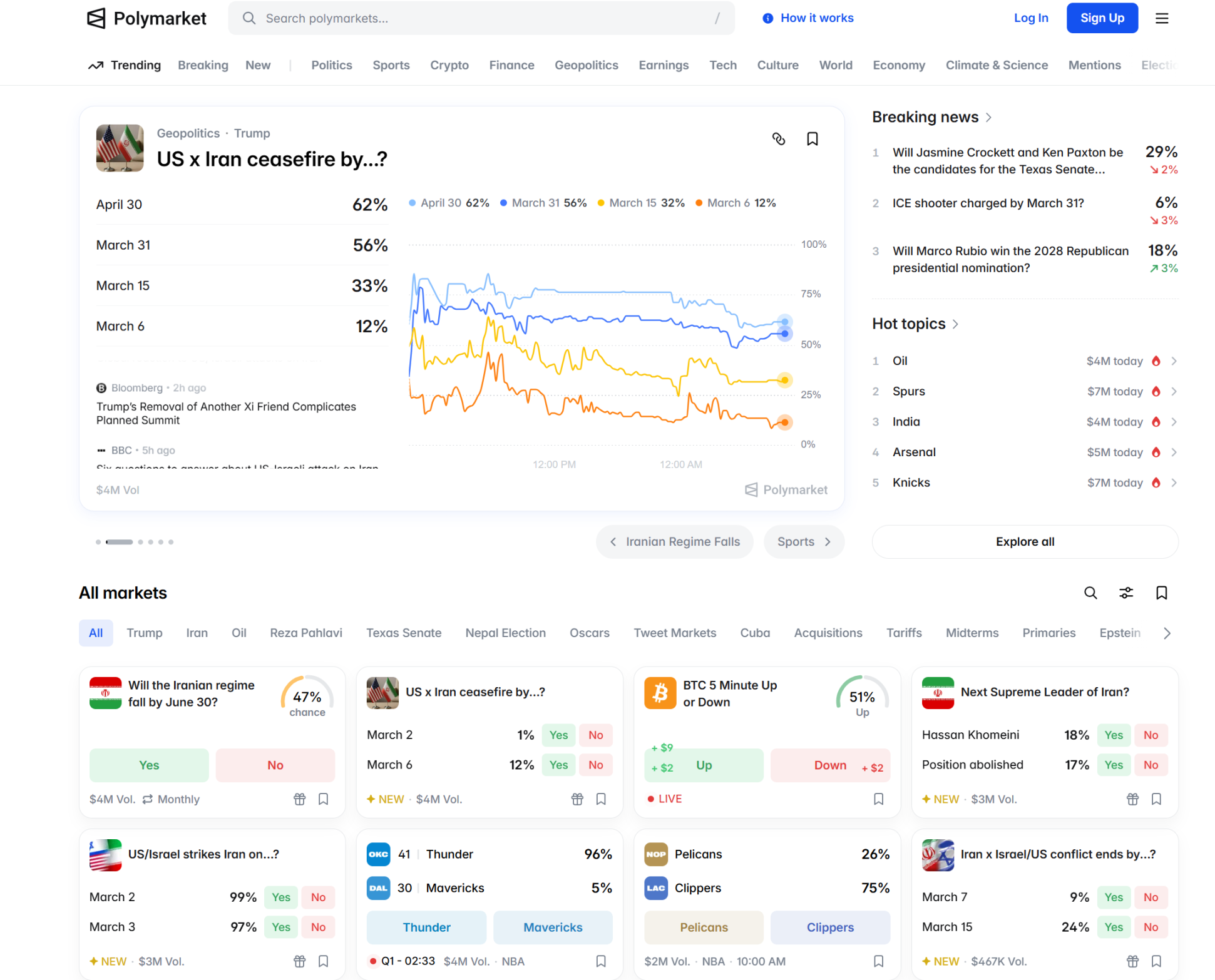
Overall, this "war profit" exposes the double-edged sword of prediction markets: on one hand, it provides real-time data intelligence and insights; on the other hand, it is easy to manipulate or exploit insider information.
With the trend of everything being bettable, some future betting in prediction markets may need stricter regulation and clearer rules. After all, the stakes are real money, but behind them are real lives.
免责声明:本文章仅代表作者个人观点,不代表本平台的立场和观点。本文章仅供信息分享,不构成对任何人的任何投资建议。用户与作者之间的任何争议,与本平台无关。如网页中刊载的文章或图片涉及侵权,请提供相关的权利证明和身份证明发送邮件到support@aicoin.com,本平台相关工作人员将会进行核查。