Personally, I recommend several countries and regions that I have investigated as potential places to settle — — Taxation Section
Last time I wrote about several articles suitable for Chinese cryptocurrency enthusiasts to migrate, from a physical location perspective, I have provided the answers. In Asia, Johor Bahru has the best cost-performance ratio, Ho Chi Minh City has the best overall quality, Thailand is great for transition, Japan has excellent livability, and Singapore is generally good apart from being expensive, plus I talked about the cost of living and medical expenses.
Address: https://x.com/Phyrex_Ni/status/2009535140960325771?s=20
But it is still necessary to pay attention to taxes. Although many friends say that as long as you register an exchange with a Chinese passport, there’s no need to pay taxes since the host country doesn’t know, and when spending money I just use USDT or OTC, taxes are completely unrelated to me, but is this really the case?
The answer is no.
Taxes are not just simple tax amounts; they extend in three directions: tax residency status, how cryptocurrency income is classified (investment, trading, or business), and the compliance path for inflows and outflows of money through banks. If any of these three directions are not handled well, it will become very troublesome later.
First, a big principle is that many countries do not simply “collect taxes” or “not collect taxes,” but whether you are holding long-term, high-frequency trading, or have already been recognized as professional trading or business activities, the tax outcome can be completely different.
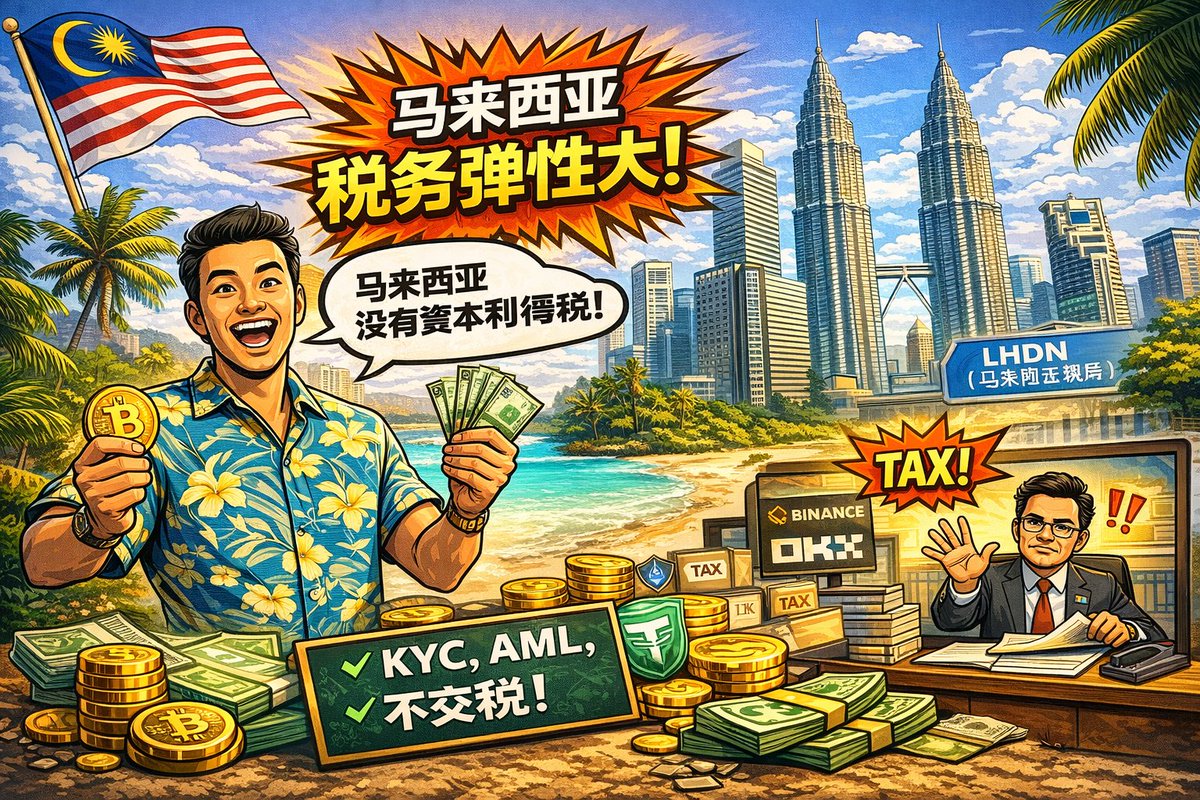
1. Malaysia (High Tax Flexibility)
In Malaysia, the taxation of cryptocurrencies depends on whether the profit is classified as capital nature or income nature. The LHDN (Malaysian Inland Revenue Board) has a special regulation for digital currency transactions; if it is primarily about long-term holding and asset allocation, there is no capital gains tax. This is why I have always recommended Malaysia as a first stop, as Malaysia has no capital gains tax.
Therefore, for non-high-frequency traders, whether trading stocks or cryptocurrencies, there is no need to pay additional taxes. However, if trading behavior is evident and belongs to high-frequency trading or organized trading, it will be classified as high-frequency trading requiring tax payment, but the tax rates vary cumulatively from 3% to 30%.
So, can one avoid paying taxes? The answer is no, because Malaysia has compliant OTC channels to legally convert USDT into Malaysian Ringgit. Of course, one can also use exchanges like Binance or OKX for OTC, which is not a problem, but if the amounts involved are large, banks may pursue AML. If found to be engaged in low-frequency trading, there’s no problem, but if deemed high-frequency trading, one has to pay tax.
Especially when recognized as a Malaysian tax resident, KYC and AML cannot be overlooked, and if tax evasion is discovered, fines will be imposed. However, for non-high-frequency trading friends, Malaysia allows for no tax payment while enabling compliant inflows and outflows, avoiding freezing, making life very convenient.
Additionally, if using an exchange registered as a business, profits earned by the business from cryptocurrency trading in Malaysia are considered business income and subject to a 24% corporate income tax. By the way, mining in Malaysia also incurs taxes.
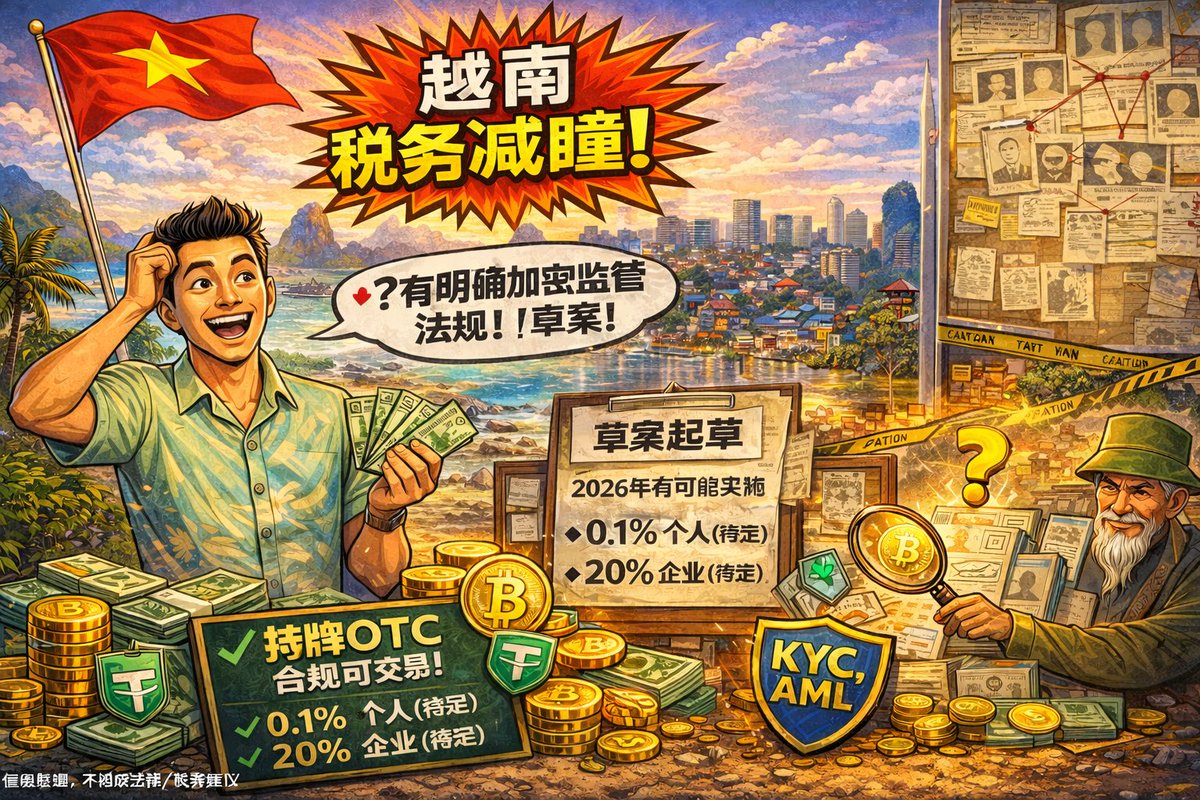
2. Vietnam (Unclear Regulations)
Currently, Vietnam, like China, has no clear cryptocurrency tax policies. There are only some drafts that have not been legislated; however, Vietnam is more lenient regarding OTC compared to China. Although there are no explicit laws, the Vietnamese government is considering drafting regulations, and there are licensed OTC operators for normal trading. But caution is needed as Vietnam is cracking down on P2P, requiring relatively strict KYC and AML.
Although Vietnam currently has no taxation, there is already a draft law likely to be passed in 2026, which would require 0.1% personal income tax on each transaction or transfer, while businesses must pay a 20% tax.
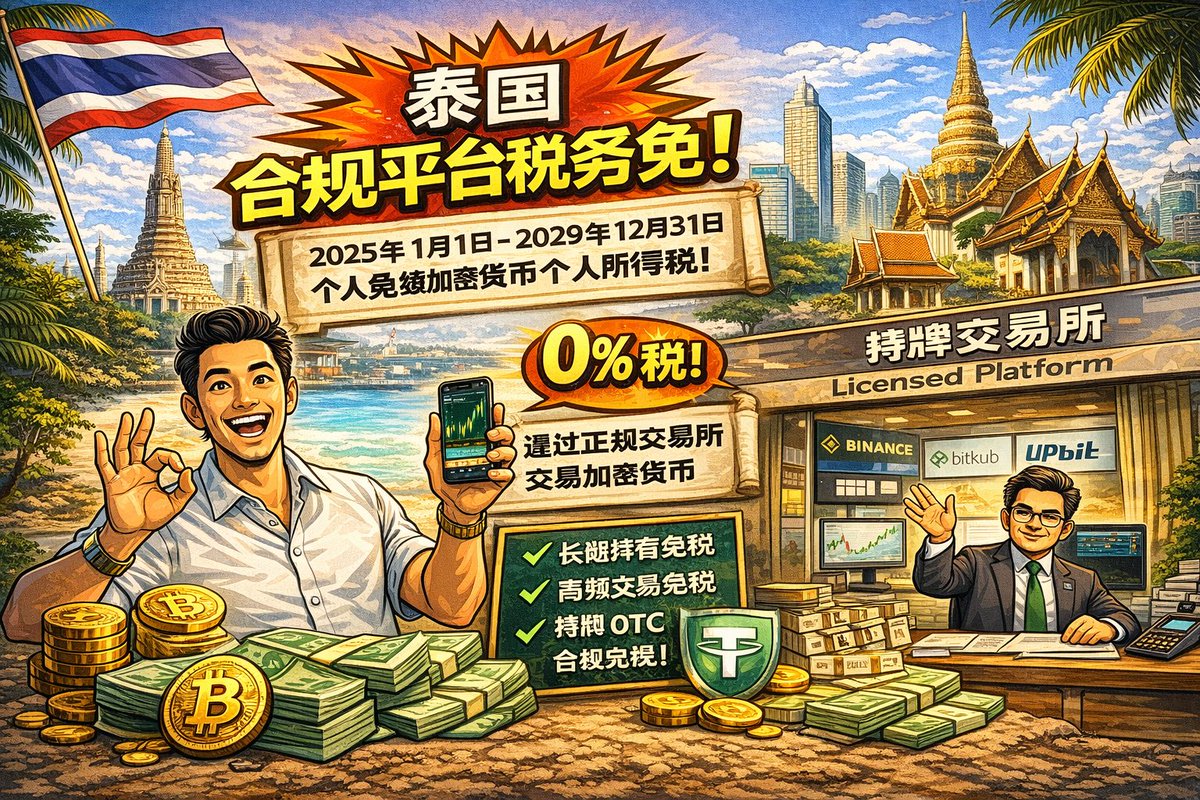
3. Thailand (Tax Exemptions for Compliant Platforms)
The ministerial regulation No. 399 effective in September 2025 in Thailand stipulates that individuals selling or transferring cryptocurrency or digital tokens through licensed digital asset exchanges, brokers, or dealers approved by the Thai SEC will be exempt from personal income tax on capital gains for 5 years (from January 1, 2025 to December 31, 2029).
This means that as long as trading is done on compliant exchanges in Thailand, regardless of whether it is long-term holding or high-frequency trading, personal transactions incur no tax. Moreover, compliant exchanges may also exempt the 7% VAT, but a declaration is still required - just that taxes do not need to be paid. Besides, Thailand’s system is quite stable and unlikely to change frequently.
Therefore, for high-frequency traders, settling in Thailand would be more appropriate than in Malaysia, Singapore, Japan, and Vietnam.
Additionally, Thailand has already prosecuted 5 individuals for engaging in unlicensed OTC trading (such as public advertising and personal matching of USDT, etc.) in January 2026. It appears quite strict, but in fact, Thailand has compliant licensed OTC channels, where USDT can be converted directly to Thai Baht and deposited in banks, and there is also a zero capital gains tax. However, if using non-licensed OTC, a 35% tax will be due. Furthermore, while USDT can be compliant OTC in Thailand, shopping with USDT is illegal.
Moreover, mining and DeFi operations, including staking, in Thailand are taxable as these are classified as income rather than capital gains, with tax rates ranging from 0% to 35%. This tax, frankly, cannot completely avoid, but as law-abiding individuals, we won’t discuss it.
4. Singapore (Similar to Malaysia)
The schemes are quite similar; non-high-frequency individual traders are exempt from capital gains tax, while high-frequency traders are required to pay between 0% to 24% in taxes, and corporations need to pay 17%. Staking and mining generally do not incur taxes, and OTC is extremely friendly, making it straightforward to convert from USDC to Singapore dollars, although high amounts may require AML checks. I won’t elaborate further.
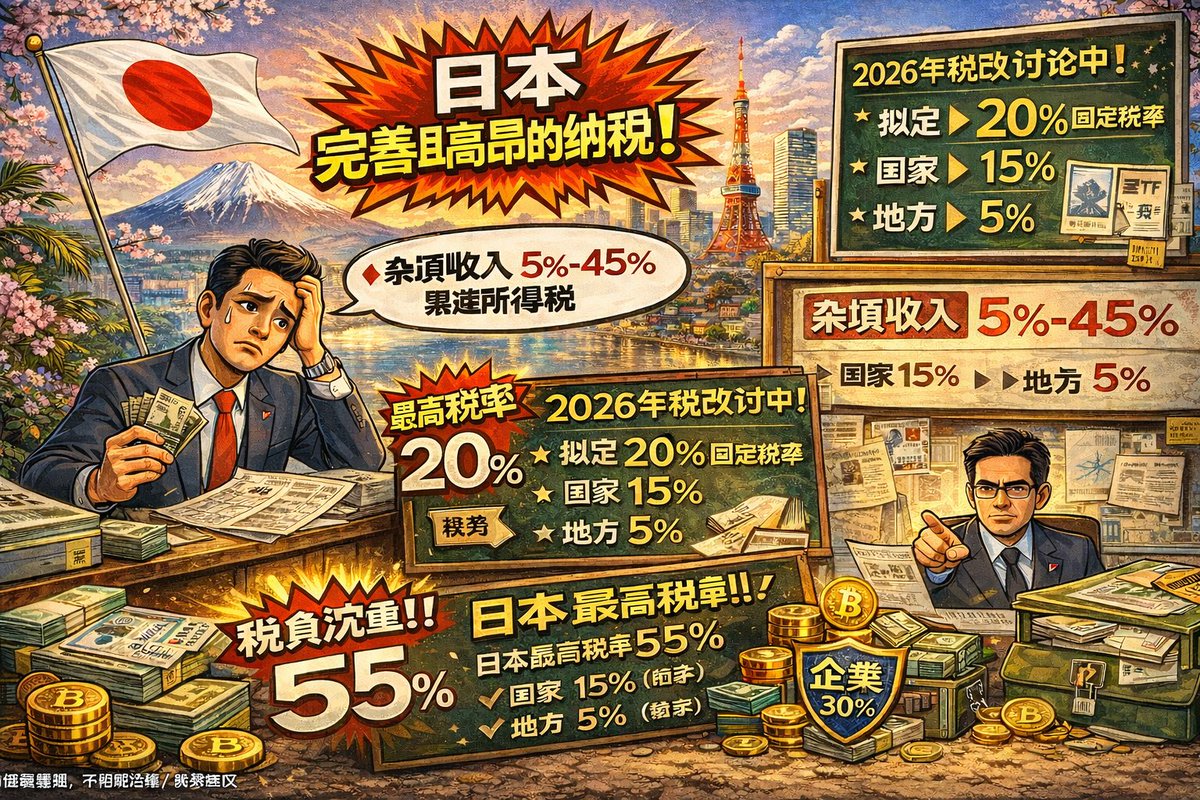
5. Japan (Comprehensive and High Tax System)
Japan has a very strict cryptocurrency tax system where the earnings from cryptocurrency trading are considered miscellaneous income. This income is combined with salaries and other income types and taxed at progressive rates ranging from 5% to 45%. In addition, a 10% resident tax is also applicable, so the maximum tax rate can reach up to 55%.
This is also why early U-cards were highly popular in Japan, as the cryptocurrency taxes there are severely high, leading to Japan proposing a tax reform plan in 2026.
For "specific digital assets" (which aid in the accumulation of national wealth, such as spot, derivatives, ETFs, etc.), it is proposed to change to a separate taxation of a fixed rate of 20% (15% national + 5% local) and allow loss carryforward for 3 years. This has not yet been officially implemented, but may take effect within or shortly after 2026.
Furthermore, what is most burdensome in Japan is the taxation on unrealized profits for corporations. Tokens held by companies at the end of the fiscal year may need to be taxed on unrealized gains based on market value calculation (end-of-period valuation). The tax rate is around 30%.
Thus, in Japan, registering a company and holding cryptocurrencies is highly unprofitable. Also, regarding taxes, Japan is the area that needs the most discussion, as many individuals residing in Japan are finding ways to evade taxes, even going so far as to use cash OTC.
However, Japan’s regulation is indeed very strict; although there are compliant OTC channels, it must be declared, which means compliant OTC must report taxes. Additionally, compared to Southeast Asia, the OTC market in Japan is extremely inactive; one could even say that it’s hard to use. The reason being Japan’s banking system has extremely strict anti-money laundering policies, and frequent large transfers between personal accounts are easily subjected to risk control.
While exchanges do provide deposit and withdrawal services, small amounts are usually not a big issue; however, large amounts or if being pursued by a bank for AML could lead to severe tax problems. Therefore, the biggest problem in Japan lies in solving financial issues. I’ve asked many friends, and they say they’ve been forced to use cash to live in Japan.
It is important to note that attempting to evade taxes through privately arranged OTC exchanges for cash in Japan is very dangerous; once discovered, individuals face heavy fines and criminal liability.
Lastly, it should be known that Japan is a member of CARF, and exchanges will report all trading information of Japanese users to the Japanese tax authorities.
Summary:
Overall, considering taxation, Malaysia remains in the top tier of livable places. Thailand, having a clear five-year tax exemption plan, is still very suitable as a transitional area, while Vietnam and Singapore have ambiguous laws and high living costs, but both regions have surprisingly good public safety.
As for Japan, it is indeed more livable compared to the above four regions that have only summer year-round; the living and medical costs are quite reasonable, and the social structure is very stable. However, the taxes and OTC regulations in Japan are the most unfriendly for cryptocurrency users. Even after the tax reform in 2026, personal cryptocurrency taxation may be as high as 20%.
If you have considered taxation properly before going to Japan, then Japan remains a very suitable place to live.
PS: Japan also has some small tax tricks, but still not friendly enough.
Finally, I will discuss the combination of PR + tax residency in my next post. I believe this direction will pique the interest of many friends.
@bitget VIP, lower rates, better benefits
免责声明:本文章仅代表作者个人观点,不代表本平台的立场和观点。本文章仅供信息分享,不构成对任何人的任何投资建议。用户与作者之间的任何争议,与本平台无关。如网页中刊载的文章或图片涉及侵权,请提供相关的权利证明和身份证明发送邮件到support@aicoin.com,本平台相关工作人员将会进行核查。


