Written by: Yue Xiaoyu
Dome is essentially a unified prediction market API that allows developers to access data, odds, transaction volumes, historical data, etc., from multiple platforms (like Polymarket, Kalshi, etc.) through a single interface.
By removing this middleware, Polymarket has effectively gained control over a large number of third-party tools, trading bots, data dashboards, aggregate websites, and research accounts' underlying data sources.
This is the second acquisition by Polymarket; the first was the acquisition of the US-licensed derivatives exchange QCEX.
The goals of each acquisition are very clear.
1.We can see that when a platform grows large, it tends to expand upstream and downstream, controlling the entire industry chain.
This type of expansion can be divided into two directions:
One is horizontal expansion, across different sectors/categories.
For example, Polymarket's acquisition of QCEX complements its compliance and derivatives capabilities, allowing it to penetrate traditional finance and the institutional market.
Collaboration with MLS, NHL, and Substack represents an expansion into event categories (sports/media).
The goal of horizontal expansion is to transform from a prediction market into a comprehensive event trading platform, comparable to traditional exchanges, gambling, and information.
The second is vertical expansion, controlling the upstream and downstream of the industry chain.
Upstream: Data/API infrastructure (acquisition of Dome).
Midstream: Trading engines, market-making, liquidity.
Downstream: User front-end, tools, analysis, investment research, copy trading, robots.
Acquiring Dome means taking over the data access layer, controlling the entry point of the developer ecosystem, and integrating the fragmented ecosystem onto its own API.
This is highly significant.
2. I have always believed that the prediction market sector can be compared to the meme coin sector.
Many data analysis platforms and trading tools within the meme coin ecosystem can be replicated in the prediction market.
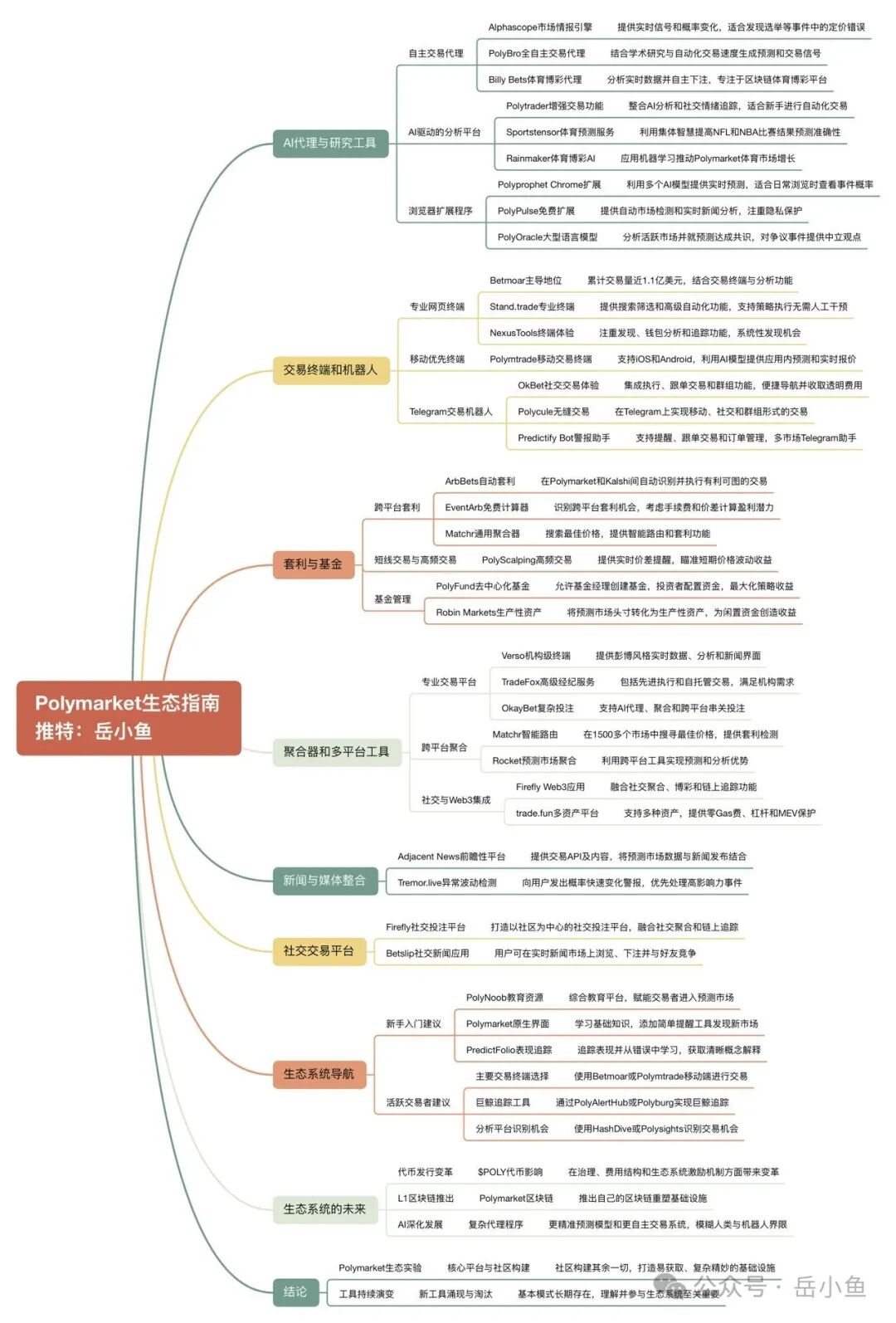
Here is a list of many tools needed in the prediction market:
- Data dashboards: Cross-platform market data, probability trends, capital flow, whale tracking.
- Quantitative/robots: Arbitrage, grids, copy trading, AI probability models.
- Investment research tools: Event attribution, winning rate backtesting, risk calculators.
- Infrastructure: Market-making robots, liquidity aggregation, clearing tools.
Polymarket already has hundreds of third-party tools; acquiring Dome is to unify the entry point and consolidate the ecosystem.
Polymarket has just set up the platform, but many services are still lacking.
These services do not need to be created by Polymarket itself; it just needs to nurture the ecosystem and allow third parties to provide them.
These tools can help Polymarket enhance data analysis and assist user decision-making.
3. In conclusion,
Polymarket's acquisition of Dome is a key step in upgrading from a trading platform to a prediction market infrastructure.
Polymarket's expansion path is horizontal in compliance and categories and vertical in controlling data and tools.
The ultimate goal is to become the infrastructure of the entire industry, similar to how e-commerce controls supply chains and traffic in the Web2 industry.
Lower-level products create tools, while higher-level products create ecosystems.
This is the highest barrier and the deepest moat.
This article is for learning and communication purposes only and does not constitute any investment advice.
免责声明:本文章仅代表作者个人观点,不代表本平台的立场和观点。本文章仅供信息分享,不构成对任何人的任何投资建议。用户与作者之间的任何争议,与本平台无关。如网页中刊载的文章或图片涉及侵权,请提供相关的权利证明和身份证明发送邮件到support@aicoin.com,本平台相关工作人员将会进行核查。


