Author: Blockworks
Translation: Shenchao TechFlow
Introduction by Shenchao: The case of Venezuela is the most powerful real-world footnote for stablecoins—not because they chose crypto, but because they had no other choice. This article demonstrates the complete path of a sovereign nation being forced to adopt USDT under the pressure of sanctions, and reveals the true limitations of stablecoins in large-scale money laundering scenarios.
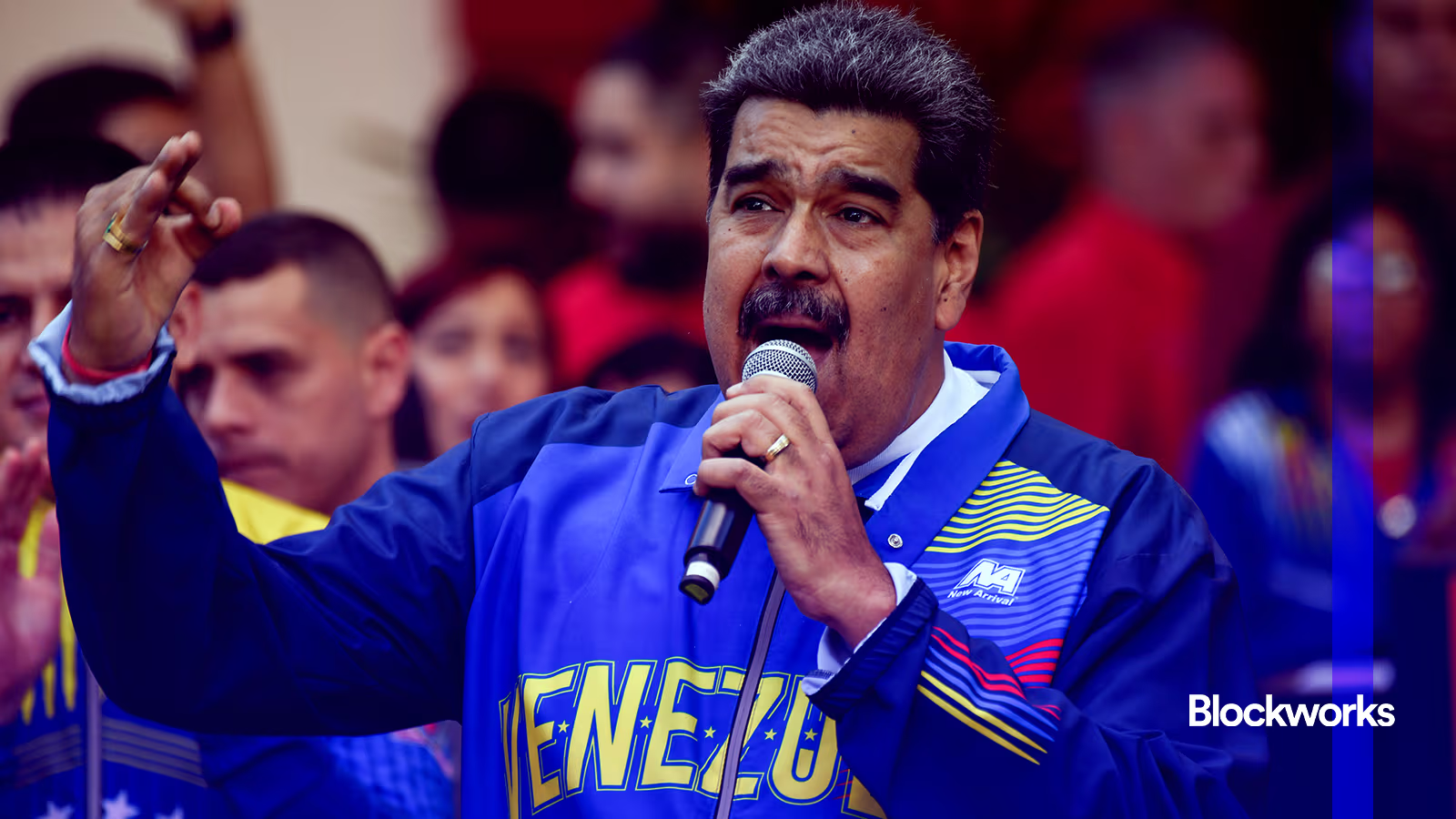
"I don’t think this is a bad thing; their so-called 'dollarization' process… thank God it exists."
—— Nicolás Maduro
The New York Times recently reported that Venezuela has become "the first country to manage a large part of its fiscal revenue with cryptocurrency."
But this was not a proactive choice.
About half of Venezuela's revenue comes from oil sales priced in dollars. As a sanctioned country, Venezuela cannot legally receive or send dollars.
Previously, sanctioned governments would usually convert oil into dollars through a network of shell companies and offshore banks—or exchange oil for goods or infrastructure investments.
Now, they have a simpler choice: to accept payments in stablecoins. Economist Asdrúbal Oliveros estimates that Tether's USDT is the medium of exchange for about 80% of Venezuela's oil sales.
The Venezuelan government had previously banned trading in stablecoins, viewing them as a threat to the bolívar. However, the devastating impact of US sanctions left it with little choice but to embrace stablecoins.
Acting Venezuelan President Delcy Rodriguez acknowledged last August that crypto-driven dollarization was inevitable. She told business leaders that "non-traditional management mechanisms" were being implemented to better manage the bolívar exchange rate.
Shortly thereafter, Reuters reported: "The Venezuelan government has allowed more use of USDT since June." With national approval, banks are now selling USDT obtained from oil sales to local businesses, which use this USDT to pay domestic and international suppliers.
They also hope to circulate stablecoins at the retail level: the head of the National Supermarket Association of Venezuela recently stated on national television that grocery stores are advancing system reforms to accept USDT payments.
In other words, the Venezuelan government is encouraging the use of dollars issued by Tether to replace the bolívar issued by the government itself.
As a result, USDT—which many Venezuelans refer to as "Binance dollar"—is now used in various scenarios "from buying groceries, paying apartment management fees, to paying salaries and suppliers."
So for someone like me, a stablecoin enthusiast, it was quite disappointing to see that the indictment against Nicolás Maduro by the US government did not even mention cryptocurrency or stablecoins.
The indictment described illegal money flows following old paths: planes returning from Mexico "loaded with drug proceeds"; grenades and other weapons exchanged for cocaine; paying protection money through cocaine transported; and a $2.5 million cash bribe.
Why was cryptocurrency not mentioned?
There are two possibilities: 1) The US government has stopped publicly criticizing crypto, and prosecutors understand to omit it in due course; 2) Cryptocurrency and stablecoins still fall short in terms of the scale of funds needed by Maduro and his associates. The former is more interesting, while the latter is more likely the truth.
"It is difficult for the state to quickly liquidate these (crypto) assets," Asdrúbal Oliveros explained, "because transferring crypto funds requires various controls, which are currently not being satisfied."
TRM Labs' report reached similar conclusions: "Large-scale drug trafficking organizations still heavily rely on physical cash, trade-based money laundering methods, and protection from state or quasi-state agents when transferring core revenue, with cryptocurrency typically playing a secondary or supplemental role, rather than replacing these mechanisms."
Analysts from national security think tank Lawfare also agree with this: "Sanctions evasion based on cryptocurrency, compared to traditional illegal financial channels, is still a drop in the bucket."
Some are more optimistic about the practicality of stablecoins and crypto in the realm of "international payments."
For example, InSight Crime reported that Mexican drug cartels are being sustained by an "industrial-scale crypto money laundering pipeline" that delivers dirty money to Chinese chemical suppliers through digital networks.
They detailed a niche market found by stablecoins: acting as intermediaries connecting Chinese fund brokers needing to sell dollars to clients circumventing China's capital controls, and Mexican drug cartels needing to purchase precursors for fentanyl from China.
This isn't the product-market fit anticipated by crypto enthusiasts, but in practical terms, the fit is quite strong. For instance, the DEA has stated that the amount of illegal cash seized has significantly decreased because criminal groups are "placing cryptocurrency above traditional cash laundering schemes."
Correspondingly, the seizure of "virtual currency" has significantly increased: between 2020 and 2024, the DEA seized $2.5 billion in cryptocurrency, compared to just $2.2 billion in cash.
This may explain why Maduro and his associates insist on using more traditional payment methods—traceable cryptocurrencies and freezeable stablecoins are not yet prepared to handle the maximum scale of money laundering demands.
Nonetheless, Venezuela's embrace of digital dollars is setting a precedent. Lawfare concluded: "America’s adversaries have established a workable proof of concept that emerging financial technologies may further reinforce."
If that’s the case, the dollar itself may further solidify as well.
The prohibition on using dollars has not led Venezuela to turn to the renminbi for settling oil—but rather has led the government to adopt digital dollars.
免责声明:本文章仅代表作者个人观点,不代表本平台的立场和观点。本文章仅供信息分享,不构成对任何人的任何投资建议。用户与作者之间的任何争议,与本平台无关。如网页中刊载的文章或图片涉及侵权,请提供相关的权利证明和身份证明发送邮件到support@aicoin.com,本平台相关工作人员将会进行核查。


