Author: Jianwei Zhizhu Talks
I listened to a podcast in the evening, which was very interesting. Especially the alternative mineral investment model. The essence of investing in minerals is that the real phase of making big money on minerals is after production when the price of metals rises. Therefore, in terms of cycles, initial projects before going public are difficult to attract funds (risks include cycles, liquidity, and exit time).
However, under another model, through financial instruments, the cyclical risks of minerals can be separated. Many places are currently exploring this, including the mineral investment model mentioned in this article based on royalty structures, which is more common overseas.
This conversation's host, Rob Tyson, is the founder and director of Mining International and Mining International Executive, a leading global mining recruitment and headhunting agency.
And guest Jeremy Gray, as a very active mining executive and entrepreneur, currently serves as CEO of several companies, including Pilar Gold, Pure Tungsten, Tuscano Gold, and Gold Road, and is also the founder of Chancery Royalty.
Jeremy's business spans various commodities, jurisdictions, and business models, and currently, gold, critical minerals (like tungsten), and alternative financing structures are back in focus.
In this conversation, they discussed how Jeremy thinks about simultaneously building and running multiple companies, why gold and tungsten are crucial now, what advantages the royalty model provides that traditional mining does not, and his views on the next phase of the mining cycle.
Key Points:
1. Views on Gold Prices and the Market
Jeremy predicts that gold prices will reach $5,000 in the short term and rise to $5,500 before the Chinese New Year (February 17), potentially reaching $7,000 by the end of the year.
He believes the current rise in gold prices is driven by multiple factors:
1) Chinese Demand: Actual consumption may be ten times higher than official data.
2) Indian Demand: Continues to be strong.
3) Emerging Players: Such as Tether and various central banks increasing their gold holdings.
4) Physical Gold Shortage: For example, the Turkish government is purchasing gold at a premium 357% above spot prices, and Dubai refineries are starting to offer premiums (instead of discounts) to buy gold.
He advises against selling gold easily, believing that gold is still in the early stages of rising.
2. Views on the Silver Market
Silver prices are expected to reach $18-$20 per ounce by the end of the year.
The market has been in a supply shortage for 5-6 years, with significant short positions (equivalent to 4-5 years of global production).
Chancery Royalty specifically included silver in their portfolio to increase diversity.
3. The Importance of Tungsten and Pure Tungsten's Positioning
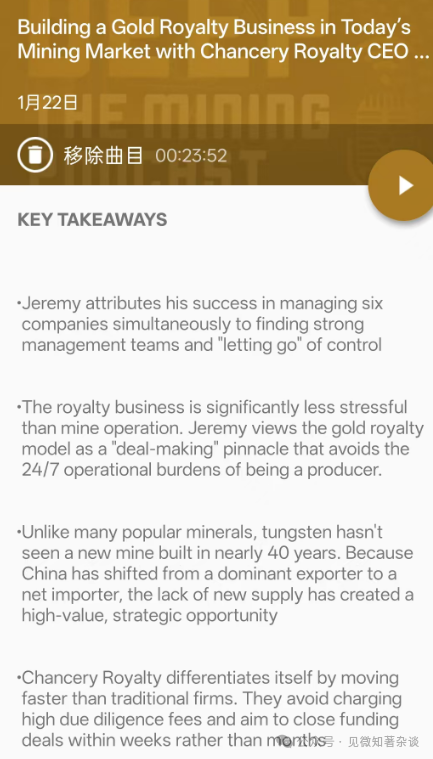
Tungsten is under pressure due to a lack of new mines being developed in 40 years, and China has shifted from being an exporter to a net importer, causing supply tightness.
Prices have risen from $320/10 kg 18 months ago to $1,050/10 kg (i.e., $100,000/ton), far above copper (approximately $14,000/ton).
Pure Tungsten has an upcoming tungsten mine in South Korea (near Almonty's mining area) and is collaborating with a high-grade tungsten mine in Tajikistan.
4. What is the Royalty Model
The royalty model has lower risks and pressures, especially compared to traditional mining operations.
Features of Chancery Royalty:
1) Quick Transactions: For example, the transaction with Ethiopia's Kefi Mining took only 6 weeks from initial contact to signing.
2) Low Cost: Does not charge due diligence fees to mining companies (traditional companies may charge $300,000 to $400,000).
3) Retail Investor Support: Relies on retail funds (with 1,400-1,500 investors), believing that retail investors are more reliable than large funds.
The goal is to surpass midstream royalty companies like Versamet or Elemental in the medium term.
The so-called "royalty business" is a very important financial and investment model in the mining sector, often referred to in Chinese as "mining royalties" or "mining rights payments". Royalty companies pay an upfront sum to a mining project in exchange for a portion of rights to the minerals produced from that mine in the future.
The core operational model of royalty investments:
1) Upfront Investment: A royalty company (like Jeremy's Chancery Royalty) provides a one-time, non-repayable cash advance to the mine owner.
2) Exchange for Future Earnings: In return, the royalty company obtains a long-term right:
· Royalty: A small percentage of the future total sales revenue from the mine (for example, 1%-3%). As long as the mine is in production and selling minerals, payments are made proportionally.
· Metal Stream: The rights to purchase a specific quantity of minerals (such as gold or silver) the mine produces at a cost far below market price (e.g., $400 per ounce). The royalty company can sell at market price (e.g., $2,300 per ounce), earning the price difference.
Why is this model attractive?
1. For Royalty Companies (Investors)
Light Operations & High Leverage: Unlike mine owners, they do not bear the risks of operating cost overruns, safety incidents, resource depletion, etc. Royalty companies only make financial investments. Once commodity prices rise, profits from royalties based on sales revenues and metal streams will multiply. No need to engage in daily operations.
Diversified Portfolio: A single funding can be invested in multiple mines in different regions and ore types, spreading risks. This is why Jeremy aims to build the "fastest-growing royalty group."
2. For Mine Owners (Mining Companies)
Non-dilutive Financing: Unlike issuing new shares, this financing does not dilute existing shareholders' equity.
No Debt Burden: This money does not need to be repaid along with interest, improving the company's balance sheet. Payments are only required after the mine successfully produces.
Quick Access to Funds: Jeremy particularly emphasizes his rapid model. Traditional royalty company processes are slow and expensive, whereas his Chancery Royalty does not charge due diligence fees, and decisions are made quickly (such as the Kefi deal took only 6 weeks from introduction to funding completion), which is crucial in a high gold price market environment.
Below is the interview content
Rob Tyson: I hope you can briefly introduce your career, and of course, what you're currently busy with.
Jeremy Gray: To put it simply, we have 6 companies, including 4 gold mining companies: Pilar Gold, Livergold, Tokano Gold, and Gold Road.
We also have a large tungsten mining company called Pure Tungsten. We are actually about to go into production near Almonty’s mining area in South Korea. So we believe we will be the next Almonty Industries.
But I have actually stepped down from most of the CEO positions in operational companies to focus 100% on Chancery Royalty, where we basically plan to build the fastest-growing gold and silver royalty group in the industry.
Rob Tyson: As I mentioned, your companies are involved in multiple commodities, and now venturing into the royalty sector. How do you consider running multiple companies and platforms at the same time? What are the guiding principles across different assets and stages of development?
Jeremy Gray: I think the key is to delegate and let go, not try to control everything in the company. So you need to find strong management teams and let them go do their jobs.
My job mainly involves financing them, initiating gold mines or tungsten mines in Korea, and then letting them operate on their own rather than acting like a control freak.
This model has been running for 7 years and works quite well. When gold prices are not $1,600 but $4,400, everything progresses much faster. When the market is strong and performance is good, just let the professionals run the business because, Rob, I am not an operator.
I tell you, I’ve heard your great conversation with Martin (the gentleman who once worked at Centerman). He is a real operator. He is the kind of person we would like to recruit and bring into our portfolio.
But I’m just a promoter; I like doing deals, and royalties are the ultimate form of deals.
Rob Tyson: Yes. You just mentioned gold prices. In our previous episode, you mentioned that $5,000 is the target price. Although it's not fully reached yet, I think it will be soon.
What do you think about that? Are you willing to make a prediction? Why do you think gold prices may not have reached that level yet?
Jeremy Gray: I believe the target price is just around the corner, perhaps within the next 2 to 8 weeks. We expect to reach $5,500 before the Chinese New Year (February 17) and ultimately reach $7,000 before Christmas.
I find myself thinking this way more often, a bit like when I think back to buying my first house in Richmond, Melbourne (next to the MCG). My brother and I spent $240,000 on it, and three years later in '96, when we sold it for $650,000, we felt like heroes.
It was a beautiful Victorian old house, one of my favorites in Melbourne. Now it might be worth $4 million. I think gold should also be viewed like this: do not rush to sell.
When everyone says "Oh, 2025 is a great year, there will never be another" ... ah, some gold funds, like Schroders' Jim Luke fund, rose by 200%, and people said, "Jim won't achieve greatness again."
I bet he will, maybe not 200%, but at least 100%. So I think we are in a very early stage of a significant trend; don’t be scared by these high prices; they won’t drop in the short term.
Rob Tyson: Yes, the overseas market is the same. Continuing about gold, gold has fluctuated over the years; what do you think is different about the current gold price environment? Why is it worthy of investors' renewed attention?
Jeremy Gray: Essentially, China kicked off this round of increases. Every time I meet with Chinese people, I go up and hug them, moved to tears because they really saved our group; we had a very tough time in '24.
Then the market broke through $2,100, and you know the rest is history. But basically, I believe Chinese consumption is more than ten times the official figures. Indian demand remains strong, but now there are players like Tether, and all central banks are buying.
I even heard yesterday that the Turkish government is now paying a premium of 3.57% more than the spot price just to acquire physical gold. This is another typical sign: we are constantly getting calls from Dubai refineries saying, "Hey, can we purchase from you?"
In the past, they usually asked for a 4%-5% discount to buy your gold, as they "exploited" Africans with a 10% discount. Now they offer a premium of 0.5% to 1%.
So the market is now all about physical gold and replacing paper markets. I think we will all be surprised.
Rob Tyson: Certainly. Continuing with precious metals, gold is obviously your primary commodity. What about silver? What are your thoughts? Obviously, there has been a lot happening in the silver market, such as the new policy in China requiring permits for silver exports.
I would like to know your thoughts on this and how the silver market compares to the gold market.
Jeremy Gray: So silver might reach $18-$20 by the end of the year. The supply has been short for 5 or 6 years. Huge short positions—if you believe in conspiracy theories, the current short position is equivalent to 4 to 5 years of mineral production.
The short position in gold might be equivalent to 2 years of mineral production. So, well, I believe some large banks and investment firms are losing sleep over their short positions.
So yes, silver will definitely go up. That’s why at Chancery Royalty, we ensured we secured the silver by-product purchasing rights from the lovely Gold Road mine in Arizona because we wanted to add silver to our portfolio and give it a little extra appeal.
Rob Tyson: You are involved in the operation, development, and growth phases of the gold business. How do you view risks and value creation differently between operating assets and developing projects? What do investors usually misunderstand about this trade-off?
Jeremy Gray: That’s a good question, Rob. You know, our business model for the past 7 years has been to purchase large second-hand gold mines, then rush around looking for funding to try and get them operational at a price of 1-2 cents (0.01-0.02 USD).
We have never ventured into the development phase. Pure Tungsten is the same; we merged with the excellent CEO Tiger Kim's TBI in Korea, which has fully built mines and processing plants.
So we generally do not engage in early-stage projects, well, although they are currently performing well with the market.
Rob Tyson: Obviously, tungsten mines do not receive as much attention as precious metals, lithium, and copper. But it is clearly strategically critical. For those who are not very familiar, what makes tungsten so important? Why do you think Pure Tungsten is in a favorable position in today’s geopolitical and supply chain environment?
Jeremy Gray:The beauty of tungsten is that no new mines have been built in 40 years, and many mines have been closed. China was once the dominant player, and now they are a large net importer.
Market prices have risen from $320/10 kg 18 months ago to over $1,050/10 kg. So it's now selling for $100,000 a ton, which is quite substantial. You know, copper sells for around $14,000.
So it is a very high-value commodity. When you are in a bear market that has lasted for 40 years, it is actually good because no one is building anything new. This means that when demand suddenly surges, everyone will be caught off guard.
So I think this market could actually double again. We announced our merger with Tiger and GBI when the market was still sluggish 8 months ago. You have to make these deals when the market is down; otherwise, you'll get squeezed out by the smooth talkers in Perth and Vancouver.
So tungsten will be a very exciting commodity. I believe the Sanjong mine will be as good as Almonty's Sandong mine. We also have a beautiful joint venture project in Tajikistan; Tiger secured the Mekahora mine, which I believe might be the highest-grade tungsten mine in the world.
It supplied one-third of the Soviet Union's tungsten needs during World War II and has a large stockpile of tailings and resources that can be re-mined for the next 50 years. So Pure Tungsten is quite an exciting small company. We plan to push for it to go public. I want to list it on the New York Stock Exchange and am currently looking for a SPAC (Special Purpose Acquisition Company). I believe it has the potential to become a billion-dollar company. I mean, Almonty is now valued at 3 billion Canadian dollars. So kudos to them; Lewis Black has done an excellent job.
Rob Tyson: I want to talk about what you're really excited about right now. Obviously, you've recently launched Chancery Royalty. What attracted you to adopt the royalty model? What advantages does it offer compared to traditional mining ownership, in terms of both risk and capital allocation?
Jeremy Gray: Yes, Rob, before we entered the gold mining business, I came from the royalty field. We were the largest investor in a company called K92 in Papua New Guinea.
We provided the late great Tookie (may he rest in peace) and Ian Stalker at the time with a 0.5% royalty interest and an 8,000-ounce metal stream agreement, holding 25% of K92 shares at $0.20 each.
Now that stock is $24, valued at $5 billion. So we've always come from the royalty field. But around 2019, we took off our royalty hats and turned to buying gold mines.
That wasn't a particularly exciting journey because the royalty business has much less pressure. So royalty company people will never become gold miners, but gold miners can easily transition to royalties; it’s like going from a doctor who needs to be on call 24/7 to someone in a royalty company with plenty of leisure time.
I think many of them are spending time in very expensive clubs, and we are not members. So since our launch 5 weeks ago, we have been very surprised by the market's reaction.
We have, well, we already have 4 royalty projects, 3 in production, and there is another large royalty project in Ethiopia's Kefi expected to start producing in about 18-19 months.
We are looking for more royalty projects and hope to become larger than Versamet or Elemental, who are the darlings of the midstream royalty field.
We are very excited about this business. It has been a huge revelation for our team. We haven’t had a day off since Christmas. Ed and the guys were still working on Christmas Day, simply because our funding round received a tremendous amount of interest from investors. It’s incredible; I have never seen anything like it.
Rob Tyson: I’m glad to hear this. So, in driving this business forward, what goals do you have for the company? How do you view its plans for the future 4, 5, or 7 years?
Jeremy Gray: We basically like to see ourselves as the Costco of the royalty industry, rather than the Harrods food court (where the other guys hang out). Let me give you an example.
Our fourth deal is with Kefi; I think it's one of Africa's most exciting undeveloped gold mines located in Ethiopia, one of Africa’s greatest countries.
Did we meet Harry about 5 weeks ago? No, even less than a month ago. We will provide him with funding in the next 2 weeks, so from meeting to funding can be done in just 6 weeks. We signed a binding agreement 3 days after meeting.
We do not charge exorbitant due diligence fees; in fact, we charge nothing. Most royalty companies would ask for $300,000 to $400,000 just to look at your project. Then they hire the most expensive lawyers in Vancouver or London to charge you another $200,000.
We absorb all those costs ourselves because we have an in-house team, and we are gold miners, so we know mines well. Honestly, when gold prices are at $4,500, very few mines will fail due diligence.
So the old royalty model of spending 6 months on due diligence and asking some extremely stupid questions is outdated. You have to be aware that the market will not turn back. We are heading to $7,000.
If you want to include royalties in your portfolio, you must act quickly, and we are the fastest on the street. So if we want to do another deal, we have plenty of capital channels. We can raise funds quickly.
We already have 3 projects generating cash flow. Well, one in Arizona's Gold Road is already generating cash flow. Pilar starts next month; Livergold in Finland starts in April or May.
So yes, our model is somewhat different from the old exclusive club model of the past 10 years.
Rob Tyson: You’ve obviously been through multiple market cycles. What do you think is different about today’s capital markets compared to previous cycles? What must mining companies do differently to earn the crucial trust, capital, and patience of investors?
Jeremy Gray: You know, Rob, you experienced that very dark and scary period from 2012 to '24 when gold miners performed terribly, and raising funds was nearly impossible. Many mines went bankrupt, and projects were indefinitely delayed.
The reputation of developers and producers plummeted because they could not find funding, and it was not their fault; the market simply did not exist.
So when the market suddenly reached $4,500, you know things started to move quickly; if you were public, it became very easy to raise equity financing by calling Canaccord or Haywoods and attaching a full warrant.
We came from the private equity space, financing through 100% retail channels—by the way, we now have 1,400-1,500 investors, and after this Chancery financing, we're close to 2,000.
This reflects how sizable we are in private retail. So getting a retail investor to write a check in the private phase is about ten times harder than issuing in the public market with a full warrant.
So I think the market is very hot, financing is easy, but many non-frontline projects will also get funded. But you know, that is the reality of a super hot market.
Obviously, everyone has had a much better time over the past 12 months. I believe the ability to raise funds will continue here for a while.
Rob Tyson: Looking ahead to the next few years, what are you most optimistic about regarding the different commodities you are involved in—gold, critical minerals, and alternative mining models? In what areas should investors and industry leaders be more cautious?
Jeremy Gray: I believe gold and silver will still be the preferred trades. Obviously, people are chasing some commodities that haven’t moved much, like nickel and zinc, chasing anything that looks good on the charts and is at the bottom.
Tungsten mines will shine again this year, but I am very willing to continue focusing on gold and silver because I think they are structurally very well positioned and will remain so for quite some time.
Just like you see in the Australian real estate market, if you sold 10 or 20 years ago, it looks a bit foolish now. I think gold should be viewed the same way: this is not a flash in the pan.
So yes, we are currently sticking to precious metals. We nearly bought a nickel mine in Brazil, but then the market rose, you know, suddenly they had other bids, so we decided to focus on gold, silver, and royalty business. And tungsten.
Rob Tyson: Finally, I’d like to ask you to summarize what you are genuinely excited about. Obviously, your current focus is on the royalty business, but in summary, what do you want to share with our listeners?
Jeremy Gray: Okay, thank you very much, Rob. Listen, we are just super gratified that the market has finally turned around. All 4 of our gold mines are either in production or about to go into production. 18 months ago, it was not like this. That was a very tough time, and I want to thank all the amazing supporters who have supported us and stuck with us.
I feel very excited about all 4 gold companies—Pilar Gold, Livergold, Tokano Gold, Gold Road. I'm extremely excited about Pure Tungsten and the Korea Sanjong Mining. We will be going to South Korea soon. The mine opening ceremony will be held in early April.
But the royalty business is at least my focus. I don’t need to wake up every morning and approve payroll payments, deal with on-site issues, equipment failures, and all the troubles that come with mining. We are looking for new deals, and we are very excited about becoming larger than Versamet and Elemental.
If any audience members want to contact me, they can reach out directly. Max, Eric, Ed, and I are all available for contact. The support from the retail market makes all of this possible.
Because I tell you, if you rely too much on a big fund or a large investor, they typically disappoint you at the last minute, whereas retail investors, when moms and dads say they will do something, you know they will do it.
That makes a huge difference; when we say we are going to do a royalty deal, we do it. I say those royalty companies call themselves that because I feel many of their management teams think of themselves as royalty members; they think they are relatives of Kate, Harry, and William.
But we are not; we are ordinary people, we are gold miners, and we are very excited about turning Chancery into a company valued over $1 billion.
Rob Tyson: As Jeremy hinted, precious metals are clearly in a bull market, and gold will rise higher, but at the same time, it's also important to keep an eye on the tungsten mine market. Not many people are talking about it, and Jeremy clearly has a great project there, along with royalty stream agreements and the new venture Jeremy just launched.
免责声明:本文章仅代表作者个人观点,不代表本平台的立场和观点。本文章仅供信息分享,不构成对任何人的任何投资建议。用户与作者之间的任何争议,与本平台无关。如网页中刊载的文章或图片涉及侵权,请提供相关的权利证明和身份证明发送邮件到support@aicoin.com,本平台相关工作人员将会进行核查。


