Author: Chloe, ChainCatcher
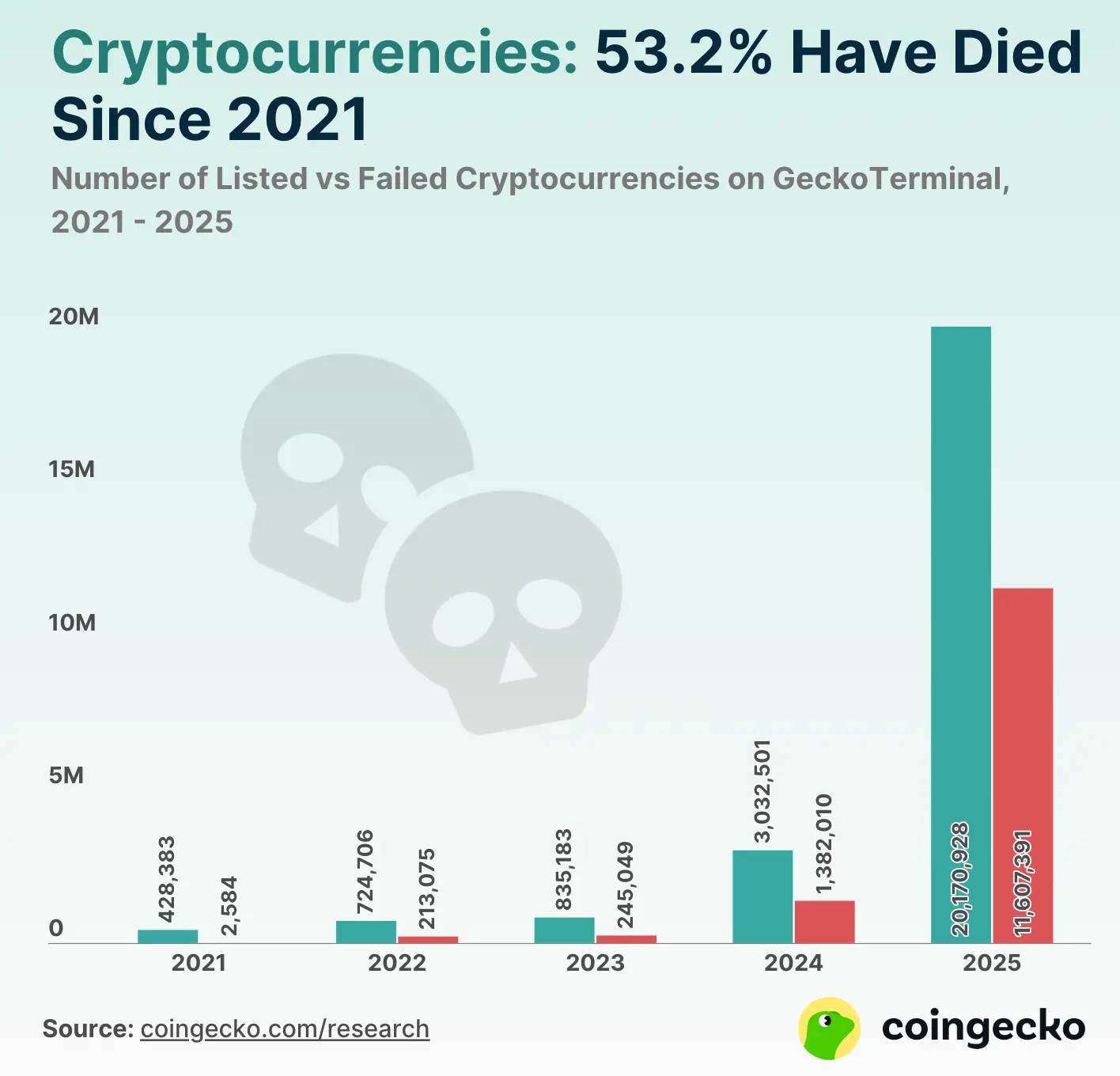
The cryptocurrency market in 2025 witnessed an extreme industry contradiction: according to GeckoTerminal statistics, although the total number of coin issuance projects exceeded 20 million, more than 57% of the projects faced termination. In this brutal elimination round, a more concealed "zombie project" phenomenon is spreading. These projects are backed by top capital and leading exchanges, frequently changing hot narratives, but are nearly stagnant in terms of actual product delivery, technological progress, and ecosystem development.
This article will deeply dissect suspected zombie-like projects such as Sleepless AI, Hooked Protocol, Saga, and Dymension, analyzing their operational characteristics. In 2026, the ability to penetrate narrative fogs and identify signs of zombification has become an essential survival lesson for investors.
Coin issuance means "wrapping up"? Project decline and zombification phenomenon
In the early stages of blockchain development, the definition of "zombie coins" was relatively simple: long-term dormant, loss of trading liquidity, disappearance of development teams, lack of community participation, etc. However, as capital markets have matured and venture capital has deeply intervened, the market has shown a more concealed absurd phenomenon in recent years.
Data shows that in 2021, the number of coin issuance projects launched on GeckoTerminal was only 428,000, but by the end of 2025, this number had skyrocketed to 20.17 million, and behind this explosive growth, as high as 53% of projects faced extinction. At the same time, behind this high turnover and elimination rate lies a large number of "zombified" projects. Although they are traded on exchanges and release social media announcements daily, there is a significant gap in actual product delivery, on-chain activities, and ecosystem construction.
Sleepless AI: Parasitic AI narrative? Research and delivery disconnection
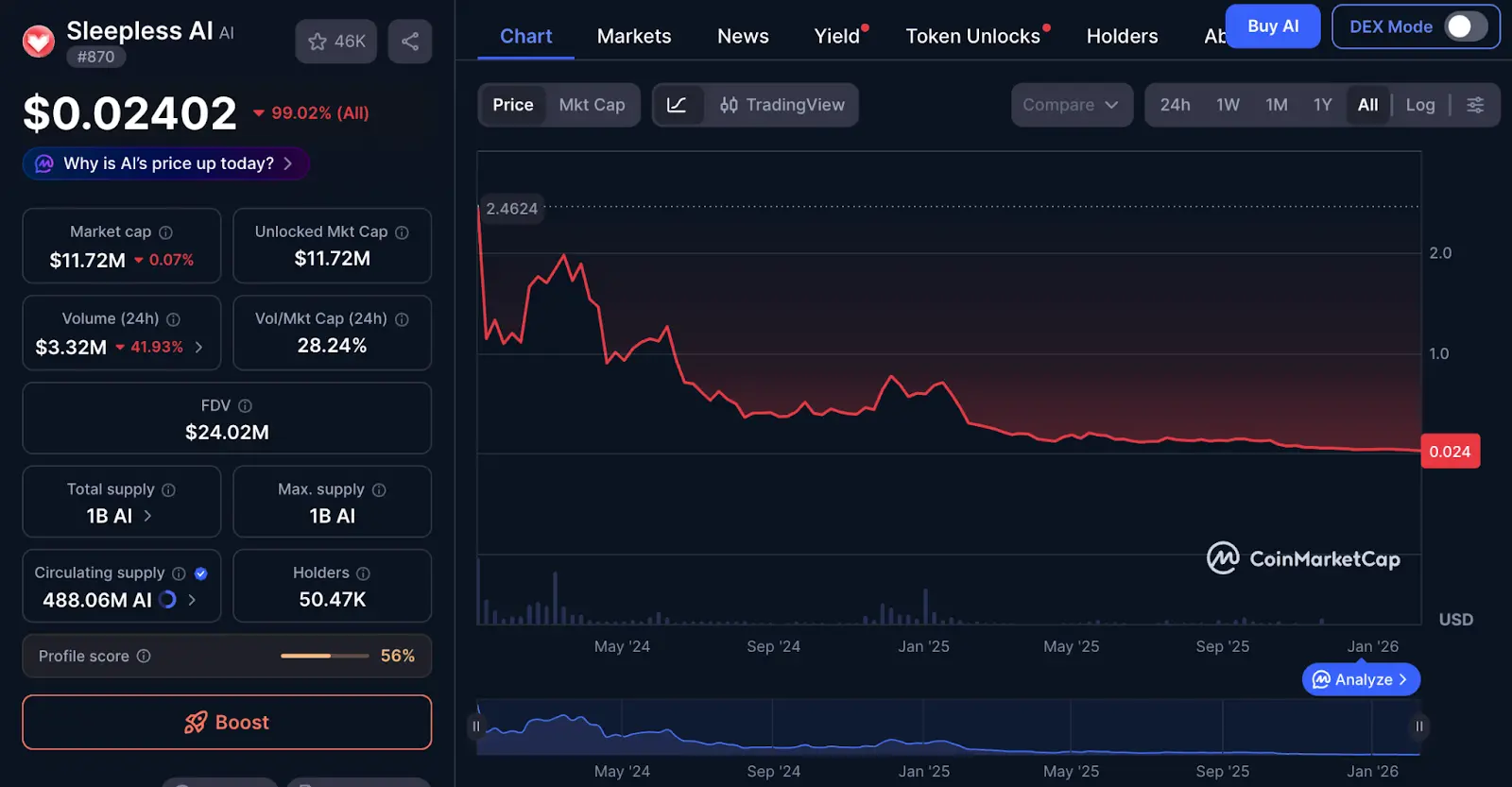
Sleepless AI was once the darling of the market, not only selected by Binance Labs as the standout of the sixth season incubation program but also debuted gracefully in Binance's Launchpool 42 with the halo of "Web3+AI virtual companion." However, entering 2026, its market performance has been contrary to its initial hype: the token price has dropped from a historical high of $2.46 to about $0.024, a decline of 99%.
1. Disconnection of technical transparency and research progress: Although the project claims to leverage AIGC and large language models (LLMs) to create deep emotional support experiences, its transparency is severely lacking at a technical level. Observations through public channels reveal that the project almost lacks traceable code update records or iterations of core algorithms. Even more concerning for investors is that the Web Dapp originally scheduled for release in Q2 2025 is still progressing ambiguously.
2. Ineffective execution of mobile strategy: In the "mobile-first" application era, Sleepless AI's product rollout appears relatively lagging. As of early 2026, its flagship product "HIM" has not been successfully launched on the iOS App Store or Google Play Store, and the official website only offers Android APK downloads. For a project aiming for mass adoption, this development efficiency greatly restricts user growth and market trust.
3. Narrative restructuring and insider doubts: Accompanying the stagnation of the product, there comes deep market questioning of its project essence. Some market participants have raisedviews suggesting that the project appears to be a "narrative restructuring" of old Web2 games, forcibly tying itself to the hype of AI through packaging AI concepts and leveraging capital relationships for investment from Binance Labs and the flow bonuses of Launchpool. Although such claims are often anonymous accusations, the combination of its weak technical delivery and token price collapse has made this phenomenon of "narrative parasitism" an important reference indicator for investors to identify suspected zombified projects in 2026.
Hooked Protocol: Ecological dilemma after incentive drying up
Hooked Protocol rose strongly in the Web3 social learning track with its Learn-to-Earn model, receiving investments from Binance Labs and Sequoia China, and was the 29th Launchpad project launched on Binance. However, as the token distribution enters its mid-to-late stages and subsidy bonuses gradually diminish, the project is facing severe tests on "real user retention" and "ecological value."
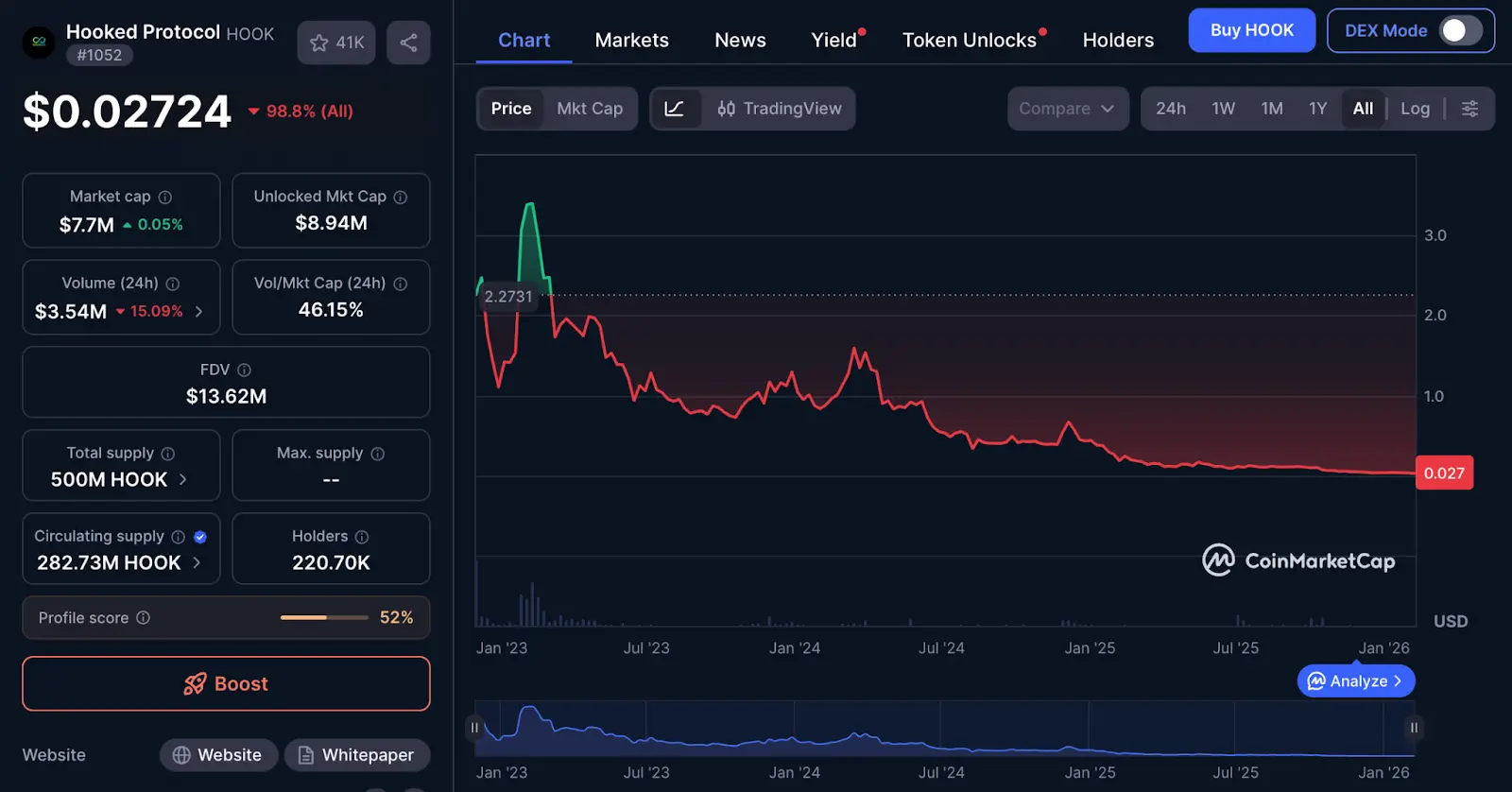
1. From Learn-to-Earn to the dilemma of incentive dependence: The initial success of Hooked Protocol relied heavily on the traffic effect of Binance Launchpad and its robust token subsidy mechanism, which could quickly translate into a large user base in the early stages. However, when the HOOK token price fell nearly 99% from its peak, a growth model relying on subsidies would lose its attractiveness. Historical experience repeatedly proves: after the TGE and when incentives disappear, the "huge user base" lacking rigid demand often shrinks rapidly.
2. The "marketization" tendency of narrative transformation: Entering 2025, Hooked attempted to transform into an "AI-driven learning ecosystem" and "educational infrastructure." Although the official statement claimed to develop courses in cooperation with 3-7 top universities and launch the Hooked Coursera Hub in August 2025 in collaboration with over 74 Web3 projects, these initiatives appear more like "brand endorsements" at the marketing level. Compared to the impressive list of collaborations, substantial breakthroughs at the technical level seem rare.
The current situation of Hooked Protocol to some extent reveals a core challenge of application-oriented projects in Web3: if the vitality of a project relies on token incentives and cannot convert into commercially resilient native demand, it will find it hard to escape the fate of significant token price declines or even zombification. The currently sluggish token price and possibly shrinking ecological activity levels are negative feedback following a subsidy-driven boom.
Saga: Dual blows of lack of market demand and security vulnerabilities
Saga represents another path to zombification: the shovel sellers cannot find the mines. With the grand vision of "one-click chain issuance", Saga successfully attracted over $1,000 in financing from top institutions like Placeholder, GSR, and Samsung Next and was also successfully launched as the 51st project on Binance Launchpool. However, this powerful automated chain issuance tool appears somewhat at a loss when faced with actual market demand.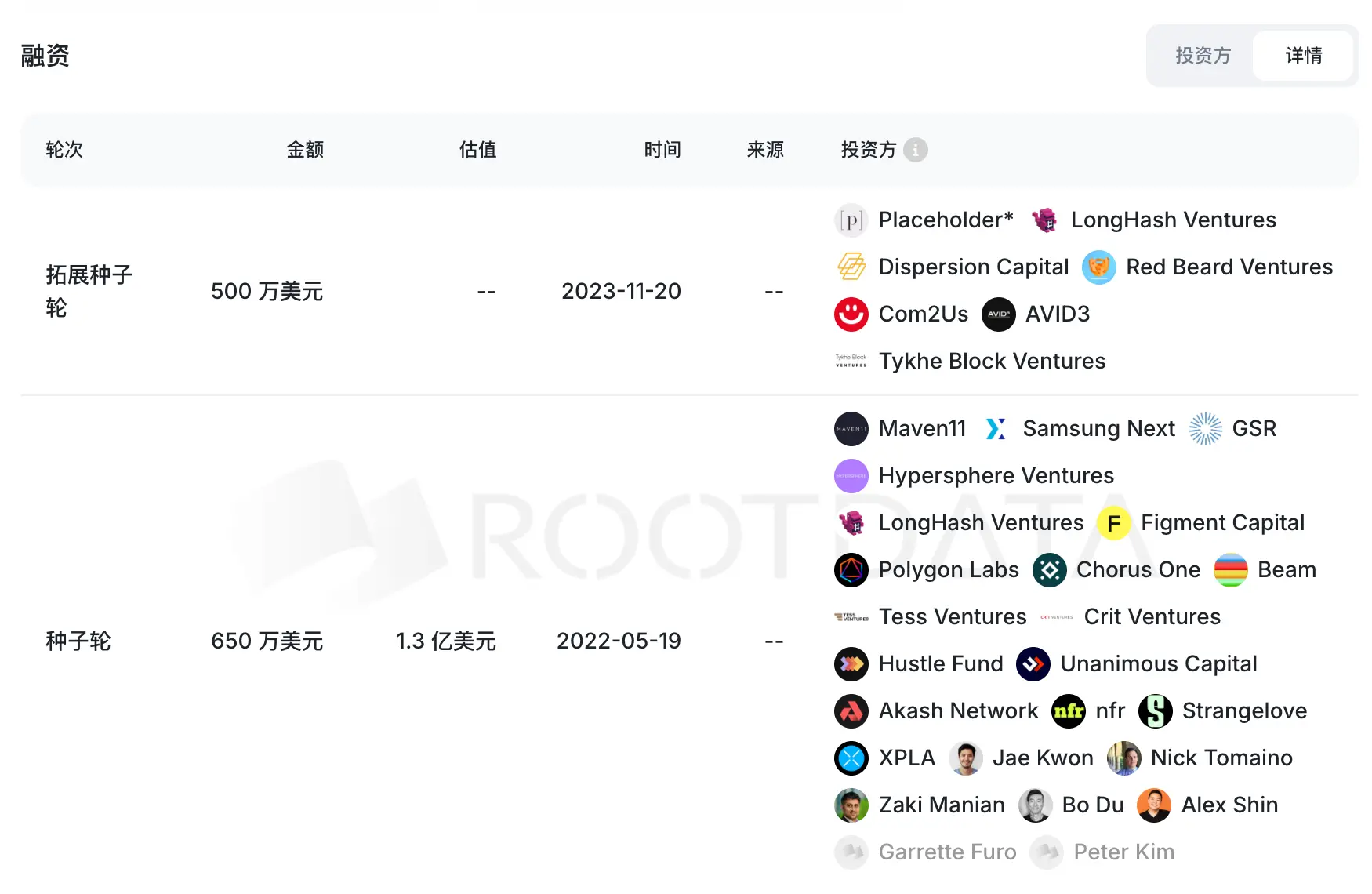
1. Frequent "change of lanes" exposing ecological anxiety: Over the past two years, Saga has demonstrated high narrative flexibility, but it has also exposed flaws in its ecological core. From initially focusing on a game-specific chain with over 350 collaborative projects to subsequently shifting towards an AI infrastructure narrative, such frequent narrative changes fundamentally reflect the growth anxiety resulting from old ecosystems that lack practical applications.
If its core technology "Chainlet" possesses genuine market demand, it should be able to drive token buybacks through continuous rentals by developers. However, the reality is that although Saga's collaboration list is lengthy, it consistently lacks blockbuster projects for support. Most partners remain stuck in early exploration stages, failing to provide substantial economic driving force for the protocol.
2. Fatal blow to security reputation: For infrastructure, technical security is its bottom line for survival. SagaEVM suffered a $7 million vulnerability attack in January this year, causing stablecoin $D to depeg to $0.75, and TVL evaporating from around $37 million to $12 million. This is undoubtedly a severe blow for a project that targets infrastructure positioning.
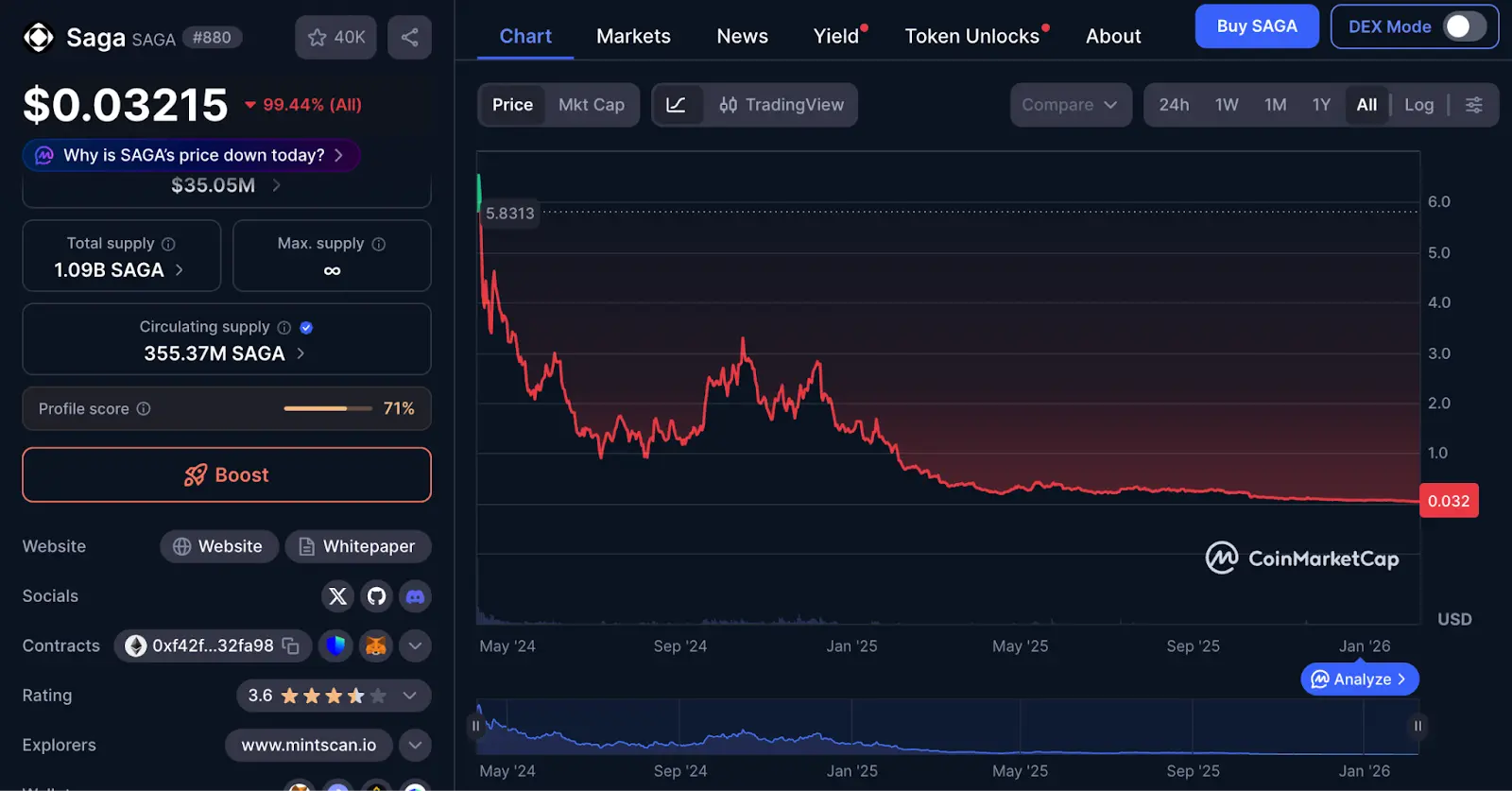
When grand narratives cannot be transformed into ecological data and technical security issues arise, the market feedback is often ruthless. Currently, the native token SAGA's price has dropped from a high of $6 in 2024 to approximately $0.032.
Dymension: Data ghost town under grand architecture
Dymension's narrative is highly similar to Saga; its proposed RollApp concept is theoretically appealing but appears more like a grand ghost town when confronted with actual data in 2026. Despite Dymension's efforts to establish a benchmark for a modular settlement layer, the true vibrancy of its ecosystem has yet to meet expectations.
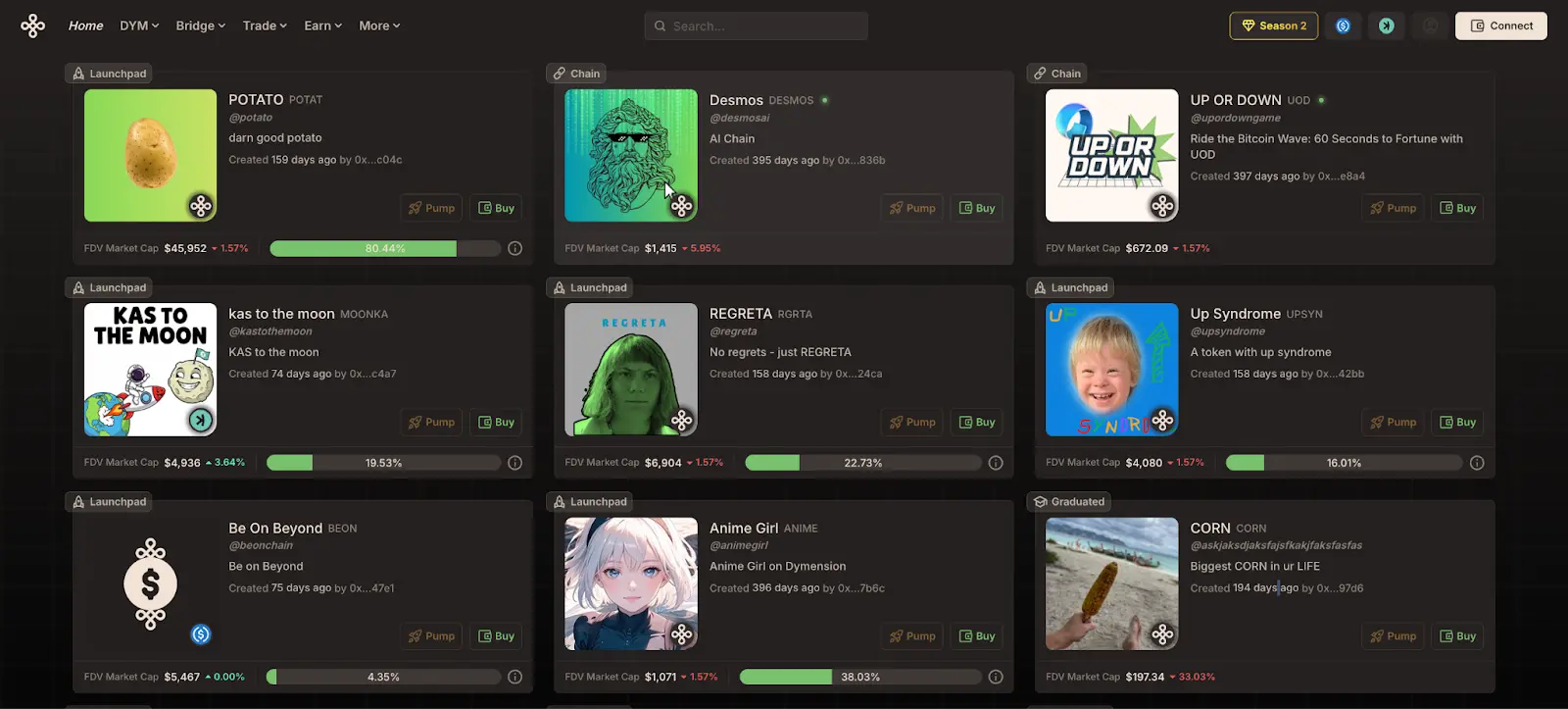
1. Activity disconnection of the RollApp network: Dymension once claimed to have deployed over 10,000 RollApps in its ecosystem; however, this data prosperity essentially stems from the lowered "coin and chain issuance thresholds." Most deployed RollApps, aside from initial token issuance, lack continued on-chain trading or substantial output, and many have already disappeared.
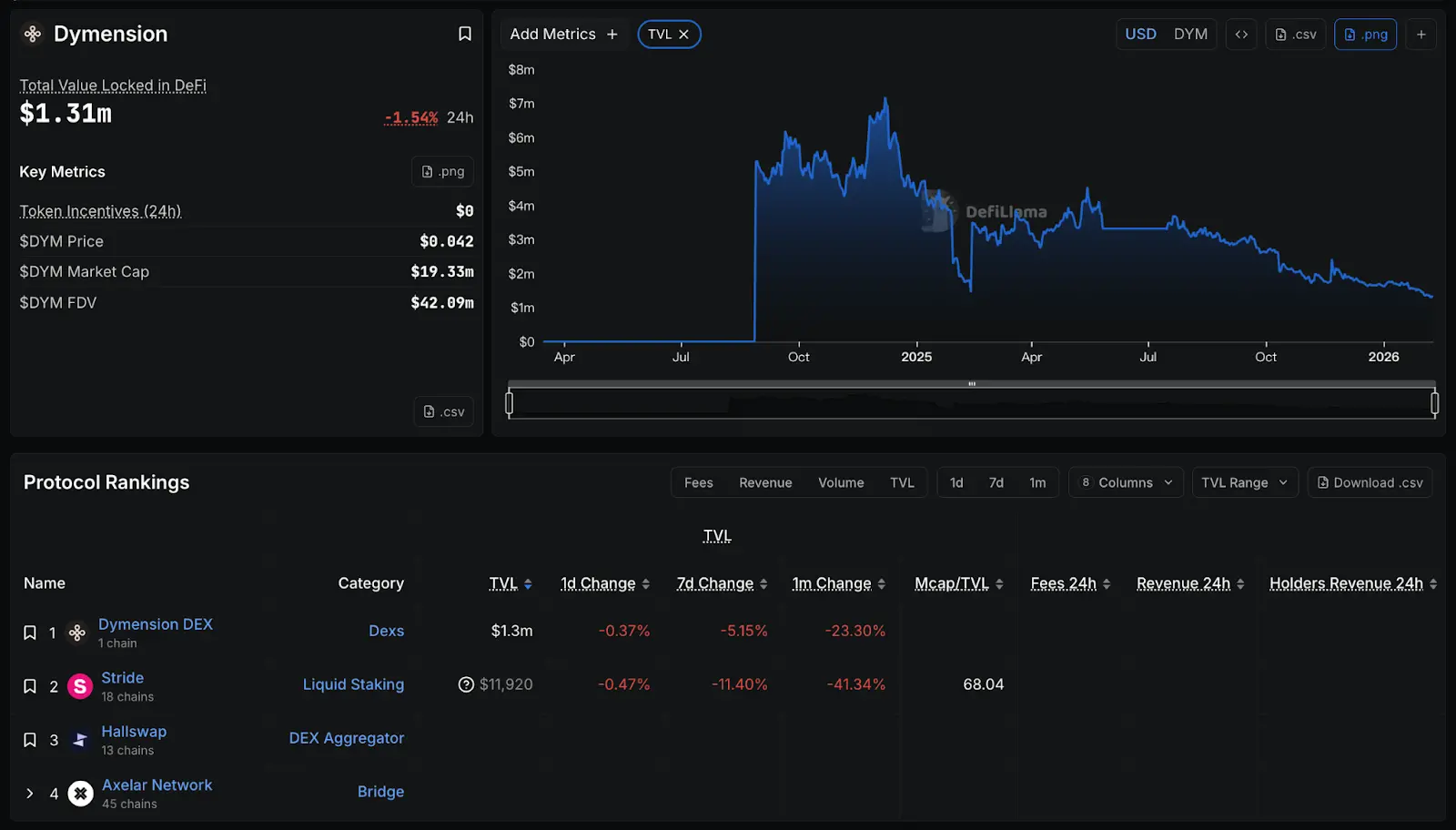
2. Economic dysfunction of infrastructure: When Launchpad and development kits fail to translate into a thriving digital economy, the infrastructure itself falls into value exhaustion. Dymension's main DEX project and overall ecosystem TVL performance are unsatisfactory, with the current overall TVL being only $1.3 million, which strongly contrasts with the initial market expectations for its "modular leader."
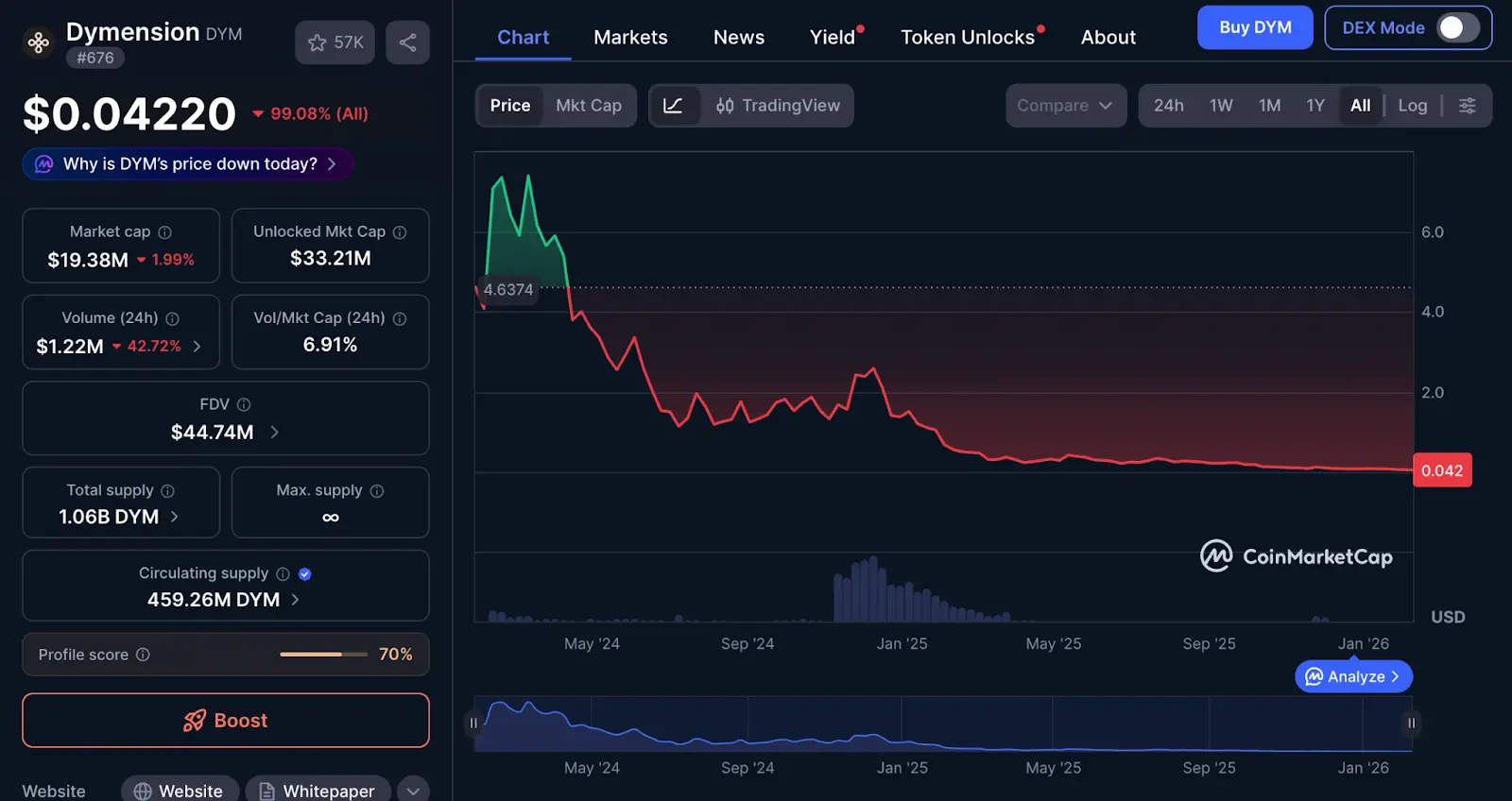
When most of the applications running on the infrastructure are zombies and the overall ecological performance declines, the price of the native token DYM is bound to be corrected by the market. Currently, the FDV is $45 million, and the token price has dropped 99% from its peak of $6, leaving only $0.042 now.
Why are "zombie" projects constantly emerging?
The reason these projects can maintain a superficial "vitality" stems from deeper structural problems in the Web3 industry.
1. The power structure of capitalizing on coin issuance: In recent years, the path for many projects to issue coins has not stemmed from substantial technological breakthroughs but rather heavily relies on "capital, interest relationships, and narrative packaging." These types of projects, with the combined efforts of VCs and internal executives, enter top exchanges through finely crafted packaging and fabricated testnet data, and once the tokens are unlocked, the teams often lose motivation for further development.
2. Vague team backgrounds: A common feature of some zombie projects is that the backgrounds of core operators and technical leaders are extremely vague. This "black-box" operational model not only allows project parties to avoid accountability when facing technical bottlenecks or security vulnerabilities, but also provides them with very low exit costs. This enables the operating team to quickly rebrand and covertly reposition themselves in another new narrative after a project becomes stagnant, while repeatedly consuming market credibility.
3. Narrative parasitism ability: Zombie projects often possess a strong ability for "narrative parasitism." Whenever the market shifts its focus, these projects, lacking substantial progress, often engage in "announcement-style transformations" to align their narratives. This not only increases investors' recognition costs, but also disperses scarce liquidity among shell companies that lack output, allowing them to ride the wave and attract speculative funds.
Conclusion: Investors should look for real value bottom lines in 2026
Facing a prosperous market intertwined with two million coin issuance projects, investors must shift their core logic. In 2026, recognizing zombified projects is no longer just an added bonus but a defensive necessity. Here are three core indicators to help readers identify:
First is the verifiability of the team and technological delivery: avoid projects that lack a clear team background, have no GitHub submission records, low roadmap fulfillment rates, and slow product distribution. Second, the value of data: distinguish between "subsidy-driven activity" and "native demand" and check if users still show retention willingness after detaching from token subsidies. Lastly, be wary of projects that change core tracks every three months; real innovation requires deep cultivation, and frequent narrative switches usually mask the failures of old businesses.
As the cryptocurrency market matures, the industry needs projects that continue to deliver value and solve market pain points, both before and after issuing coins.
免责声明:本文章仅代表作者个人观点,不代表本平台的立场和观点。本文章仅供信息分享,不构成对任何人的任何投资建议。用户与作者之间的任何争议,与本平台无关。如网页中刊载的文章或图片涉及侵权,请提供相关的权利证明和身份证明发送邮件到support@aicoin.com,本平台相关工作人员将会进行核查。


