Written by: Yangz, Techub News
In a recently sluggish market, the announcement released by LayerZero this morning became a rare highlight. Its token ZRO surged sharply from about $1.8 to a peak of $2.4, an increase of over 30%.
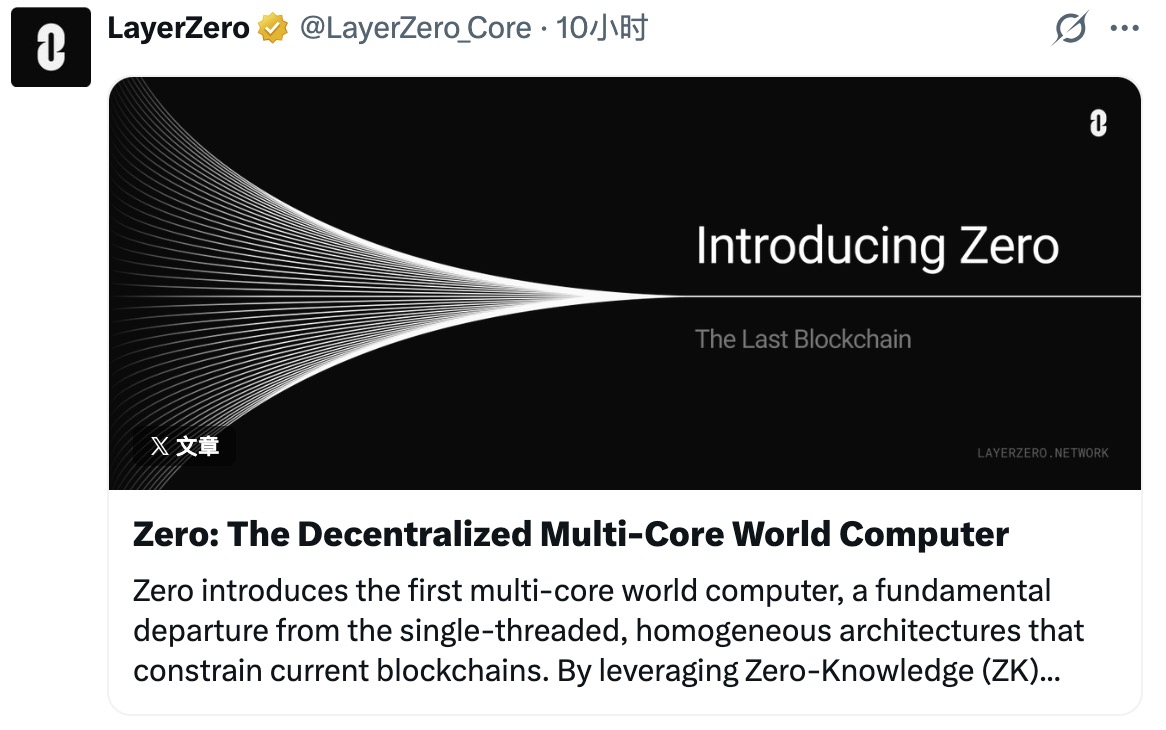
The market's keen reaction did not come out of nowhere. As early as late January, the LayerZero team had hinted to the community that a significant development would be announced on February 11. Last night, a report from AggrNews further revealed the suspense: LayerZero plans to launch its own blockchain network named "Zero." Although this news originated from a now-deleted YouTube video, the information disclosed was enough to attract market attention. Coupled with Tether's subsequent announcement of a strategic investment in LayerZero Labs, explicitly stating that they would jointly promote the construction of blockchain interoperability infrastructure, countless investors are speculating about LayerZero's "next step."
At 5:30 AM Beijing time this morning, the market speculation of recent days came to a conclusion as LayerZero published a document outlining the vision for "Zero." This document, spanning thousands of words, reveals a grand vision that surpasses market expectations: LayerZero aims to build not just a new chain, but a "multicore world computer" designed to redefine the paradigm of blockchain architecture.
So, how does LayerZero's vision differ from existing blockchain solutions? What industry problems does it attempt to solve?
Decentralized "Multicore" World Computer
In the long course of blockchain technology evolution, countless projects explore the maze of the "impossible triangle."
The evolution of Ethereum is the most representative. After initially planning to create a "world computer" through "sharding," Ethereum shifted to a Layer 2 solution centered around Rollups in 2020. However, this path was personally overturned by Vitalik five years later. Vitalik recently admitted, "The vision of Layer 2 as 'branded sharding' is no longer valid."
In contrast to Ethereum, single shard chains like Solana opt for the pursuit of extreme performance with a single execution thread. By raising hardware thresholds and optimizing parallel processing, it achieves high throughput but at the cost of highly specialized node operations and a tendency toward centralized validators.
Meanwhile, the "multichain" model represented by Cosmos and Polkadot attempts to replace "unification" with "connection." They link sovereign chains or parallel chains through standardized communication protocols (IBC) or shared security leasing markets (parallel chain slots). This creates a flexible but complex "multichain universe," but at the cost of fragmented security, disjointed user experiences, and decentralized development and liquidity.
LayerZero, over the past few years, has focused on building an efficient cross-chain communication layer as one of the key infrastructure builders in this "multichain universe." Now, with the release of the Zero concept, LayerZero's ambition is laid bare: it is no longer satisfied with merely "connecting" existing architectures but aims to propose and construct a fundamentally different new architecture. It believes that both the fragmentation of Ethereum L2, the centralization trend of Solana, and the complexity and disjointedness of multichains stem from a common underlying design limitation: requiring all network nodes to perform homogeneous redundant verification of execution.
LayerZero's answer is to return to the original intention of the "world computer," but with a completely new design formula: a single system that achieves execution and verification native separation through zero-knowledge proofs (ZK), possesses a unified security layer and state, and can run multiple heterogeneous execution environments in parallel. It attempts to simultaneously address the demands for decentralization, security, high performance, and a unified user experience in a single design.
Technical Foundations
The technical implementation of Zero revolves around one core idea: reconstructing trust through cryptography and reorganizing division of labor through architecture.
The first thing Zero aims to break is the "homogenization" fate of blockchain nodes. Zero explicitly divides network participants into two categories: block producers and block validators. Producers focus on execution and require high-performance hardware to run transactions and generate zero-knowledge proofs; validators focus on verification and only need to validate the correctness of these proofs, which can be handled by ordinary consumer-grade hardware. The revolutionary aspect of this division lies in that it abstracts complex application logic verification into a purely cryptographic problem through zero-knowledge proofs. Validators do not need to understand the specific rules of DeFi or games but only need to confirm the validity of the mathematical proof. This allows the network to maintain a low participation threshold (ensuring decentralization) while allowing the execution layer to pursue extreme performance.
Secondly, the specific carrier for this division of labor is the Atomicity Zone. Each zone is an independent execution environment that can be optimized for specific types of applications. However, unlike Cosmos's model where different chains have complete autonomy over security, all atomicity zones in Zero share a unified security layer, consensus, and global state provided by the Zero main chain.
To realize the potential of this architecture, Zero breaks through four underlying bottlenecks:
- In terms of storage, its self-developed QMDB database abandons the inefficient Merkle tree structure and is designed specifically for the continuous read and write characteristics of modern SSDs, theoretically capable of processing 3 million updates per second, 100 times faster than existing blockchain state databases.
- In computation scheduling, the FAFO system automatically analyzes data dependencies between transactions and intelligently parallel processes non-conflicting transactions without requiring manual intervention from developers. LayerZero states that this system's performance is 2500 times faster than BNB Chain, with a single node capable of processing over 1.2 million EVM transactions per second.
- In proof generation, a Jolt Pro proof system was developed on a16z's Jolt architecture, significantly enhancing the generation speed of zero-knowledge proofs. It is reported that this system proves RISC-V speeds are approximately 100 times faster than existing zkVMs.
- In networking, the creation of the SVID protocol allows validators to confirm data integrity by randomly checking very small data segments, greatly reducing network load. Theoretically, it can provide throughput of up to 10 GiB/s, over 1000 times faster than PeerDAS.
Capital Endorsement and Community Scrutiny
With its grand vision and technological advantages, Zero has attracted key support from traditional finance and crypto capital. Its advisory board features prominent individuals, including ARK Invest founder Cathie Wood, Intercontinental Exchange (ICE) Strategic Vice President Michael Blaugrund, and former head of digital assets at BNY Mellon, along with former chairman of the CFTC’s Digital Assets Committee Caroline Butler. Partners include market-making giants Citadel Securities, the DTCC, and the aforementioned ICE. Coupled with confirmed strategic investments from Tether, Zero's capital endorsement is indeed powerful.
However, in the crypto community, Zero still faces scrutiny. On one hand, some opinions question whether its technical arguments reflect "denigrating others while elevating oneself," showing marketing traits; on the other hand, opponents' responses have been sharper. Solana co-founder Anatoly Yakovenko remarked pointedly, "Well, I understand what's going on. You have done benchmarking on the testnet, that's great. But you don't even know what it feels like to be on the mainnet. Marketing tactics never change," implicitly highlighting the potential huge gap between ideal conditions on the testnet and reality.

Conclusion
The launch of Zero by LayerZero is undoubtedly a gamble of technology, capital, and ecosystem. It bets on constructing "the first truly scalable multicore world computer" through the fusion innovation of cryptography (ZK) and system architecture.
Although its grand blueprint still faces the severe test of practical implementation (LayerZero plans to officially launch Zero this fall), the proposal of Zero itself may hold significance beyond a technical solution. Given the current market's relative calm and a high probability of entering a "bear market," the introduction of Zero reflects the idea of "building in a bear market," forcing the entire industry to re-examine: what kind of "world computer" do we really need?
免责声明:本文章仅代表作者个人观点,不代表本平台的立场和观点。本文章仅供信息分享,不构成对任何人的任何投资建议。用户与作者之间的任何争议,与本平台无关。如网页中刊载的文章或图片涉及侵权,请提供相关的权利证明和身份证明发送邮件到support@aicoin.com,本平台相关工作人员将会进行核查。


