Written by: Glendon, Techub News
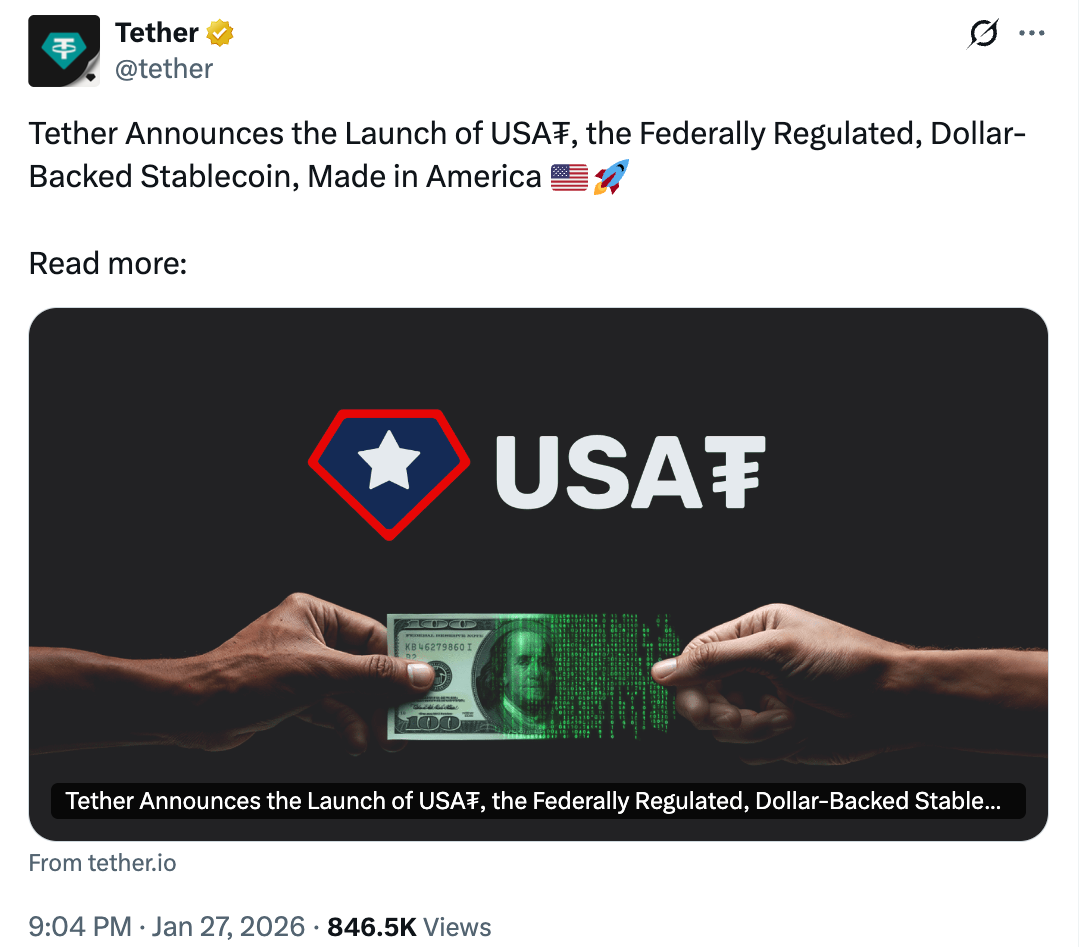
After more than four months of preparation from the initial official announcement to its official launch, Tether finally launched the USD-compliant stablecoin USAT yesterday.
USAT is issued by Anchorage Digital Bank, the first federally regulated stablecoin issuer in the United States, and developed under the federal stablecoin framework established by the stablecoin legislation "GENIUS Act." Former White House Crypto Council Executive Director Bo Hines will serve as the CEO of Tether USAT, while Cantor Fitzgerald has been designated as the reserve custodian and preferred primary dealer. Currently, the first platforms to launch USAT include Bybit, Crypto.com, Kraken, OKX, and Moonpay.
It is worth mentioning that prior to the launch of USAT, as the gold market continued to rise, Tether's gold-backed stablecoin XAUT also saw its value increase significantly. Thus, the initial form of Tether's stablecoin market "trident" has already emerged.
USDT: The "Evergreen Dominator" of the Stablecoin Market
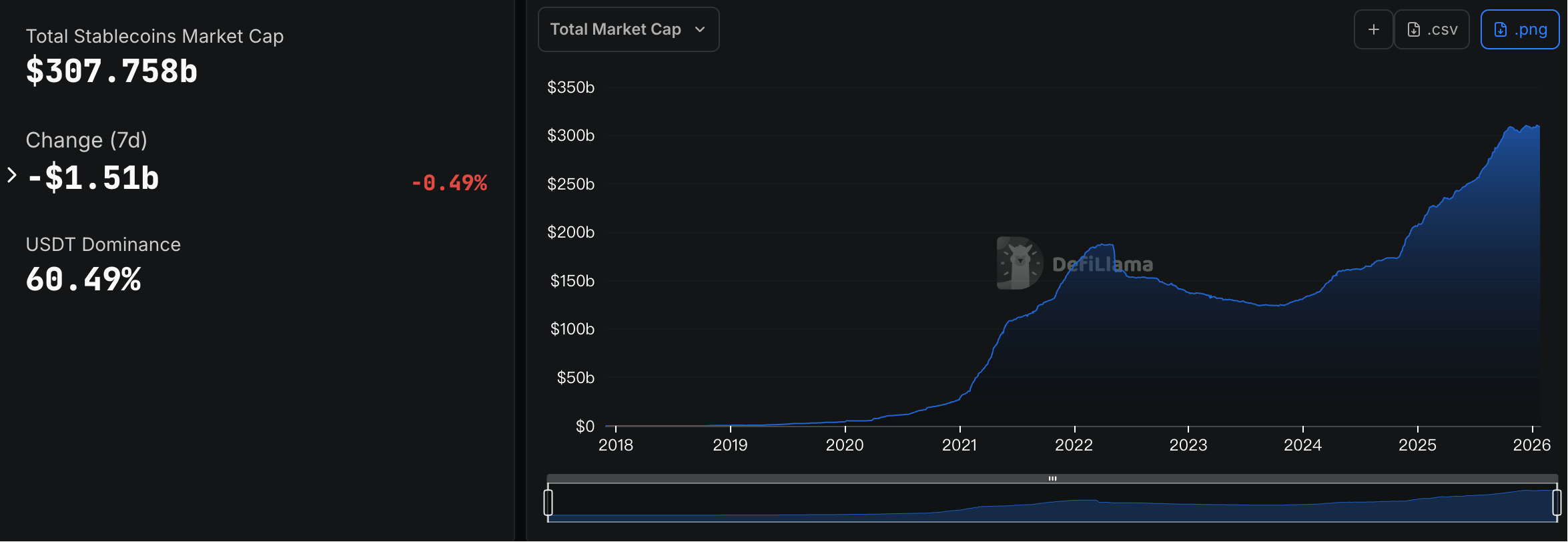
The achievements of USDT need no elaboration; as the world's first stablecoin, it has been the absolute dominator of the stablecoin market since Tether launched it in July 2014. From 2014 to 2018, USDT consistently held over 90% of the stablecoin market share. After 2018, with the rise of compliant stablecoins like USDC, USDT's market share began to gradually decline. Despite long-standing controversies regarding Tether's compliance and the opacity of its asset reserves, USDT remains firmly in the lead due to its first-mover advantage and vast ecosystem. According to DeFiLlama data, as of the time of writing, the total supply of stablecoins is approximately $30.78 billion, with USDT's supply reaching about $18.61 billion, accounting for 60.49% of the market share, an increase from 56% in early October last year, demonstrating its dominance in the market.
However, USDT is not without its challenges; its biggest dilemma remains compliance issues. In both the U.S. and European markets, USDT finds itself in a "non-compliant" predicament. Particularly in Europe, USDT has faced significant "delisting" blows. By the end of 2024, the EU's MiCA regulation will officially take effect, requiring stablecoin issuers to obtain electronic money licenses and comply with a strict set of rules, which Tether has failed to meet. Consequently, in early 2025, exchanges such as Binance, Coinbase, Crypto.com, Kraken, and OKX delisted USDT from the European market. In response, Tether CEO Paolo Ardoino stated that certain requirements of MiCA (such as keeping most reserves in European banks) could pose systemic risks, but Tether is still committed to finding a compliant path.
The U.S. market is also a "hard nut to crack" on USDT's compliance journey. Tether has not met the stringent requirements of U.S. regulators regarding reserve transparency, licensing qualifications, and funding source audits. However, with the passage of the U.S. stablecoin bill, Tether chose not to make USDT compliant but instead launched the compliant stablecoin USAT to penetrate the U.S. stablecoin market. Notably, in the official announcement, Tether also sent positive signals, indicating that it does not intend to ignore USDT's compliance challenges, emphasizing that USDT will continue to operate globally while also moving towards compliance with the requirements of the "GENIUS Act."
USAT: The "Key" to Unlocking the U.S. Market
Tether officially announced the stablecoin USAT on September 12, which is federally regulated in the U.S. and backed by the dollar, and it was officially opened to U.S. users yesterday.
USAT utilizes Tether's real-world asset tokenization platform Hadron technology, specifically designed for the U.S. market and its highly digitalized payment infrastructure, to provide institutions and platforms with digital dollars issued by nationally chartered banks. It is important to clarify that, unlike USDT, the asset reserve composition of USAT is completely transparent, with 100% of reserves in cash and short-term U.S. Treasury bills, fully compliant with all requirements of the "GENIUS Act."
At the same time, the issuer of USAT, Anchorage Digital Bank, has also built a scalable infrastructure for USAT, providing on-chain transparency, deeply integrated risk management, and bank-level compliance advantages. Tether CEO Paolo Ardoino stated that USAT offers institutional investors an additional option: a U.S.-made, dollar-backed stablecoin. For over a decade, USDT has proven that digital dollars can provide trust, transparency, and utility globally. USAT further expands and deepens the mission of digital dollars, bringing new possibilities to the market.
From Tether's perspective, the launch of USAT is highly significant. It perfectly combines the scale and mature operational model of the world's most widely used stablecoin ecosystem USDT with a framework specifically designed for the stringent U.S. institutions, making a strong and compliant push into the U.S. stablecoin market. Currently, Circle's USDC holds about 24% of the stablecoin market share, far below USDT, but USDC firmly dominates the U.S. stablecoin market. Interestingly, USAT may become USDC's first true competitor in the U.S.
Many analysts have conducted in-depth analyses of USAT's future development prospects. They believe that USAT has a clear goal of attracting institutional users, which will directly target the regulated financial institution market long occupied by Circle. Although USDC has a market capitalization of $72 billion and its growth rate last year was twice that of USDT, USAT poses a serious threat to USDC with its institutional-grade design philosophy, partnerships with traditional financial sectors, and the potential to access Tether's global network through USDT exchanges.
After all, prior to this, USDC lacked competitors in the U.S. with equivalent scale, distribution capabilities, or compliance qualifications, and the emergence of USAT may change this situation, bringing new competitive dynamics to the market.
With the official launch of USAT, Tether's next focus will undoubtedly be on promoting and marketing it. For example, last October, Paolo Ardoino revealed that Tether plans to leverage the 51 million monthly active users of the video streaming platform Rumble to significantly promote the widespread adoption of USAT in the U.S. Looking ahead to 2026, competition in the U.S. stablecoin market will become increasingly fierce, with Tether's USAT directly confronting Circle's USDC, and both sides are sure to showcase their strengths.
XAUT: Tether's "Ace" in the Gold Market
Tether's business landscape in the stablecoin field extends far beyond the currency-anchored USDT and USAT; its layout in the gold market is equally profound and strategically insightful. In January 2020, Tether launched the gold-backed stablecoin Tether Gold (XAUT), issued and operated by Tether's subsidiary TG Commodities, SA de CV (a stablecoin issuer and digital asset service provider registered under El Salvador's Digital Assets Issuance Law).
The core design of the XAUT stablecoin is a 1:1 peg to physical gold, with each XAUT backed by one ounce of pure gold, and the gold reserves stored in Switzerland, fully compliant with the London Bullion Market Association's standards for good delivery. According to key data metrics released by TG Commodities, as of the end of Q4 2025, the company's total physical gold reserves reached 520,089.350 ounces, corresponding to a circulating supply of 520,089 XAUT. Of these, approximately 409,217.64 XAUT have been sold, with 110,871.66 XAUT still available for sale.
In the past year, the global economic situation has been tumultuous, and due to ongoing macroeconomic uncertainties and escalating geopolitical tensions, spot gold has been favored by investors for its safe-haven properties, with prices continuously rising. As of today, spot gold has first broken through $5,200 per ounce, setting a new historical high. Thanks to the surge in gold, the gold-backed stablecoin market also experienced rapid expansion in 2025, with total market capitalization growing from about $1.3 billion to over $4 billion. Among them, XAUT has performed particularly well, dominating the market in both issuance and circulation, accounting for about 60% of the total supply of gold-backed stablecoins. According to Coingecko data, as of the time of writing, XAUT's market capitalization has exceeded $2.7 billion, with a current price of approximately $5,259.73, reflecting a more than 91% increase over the past year.
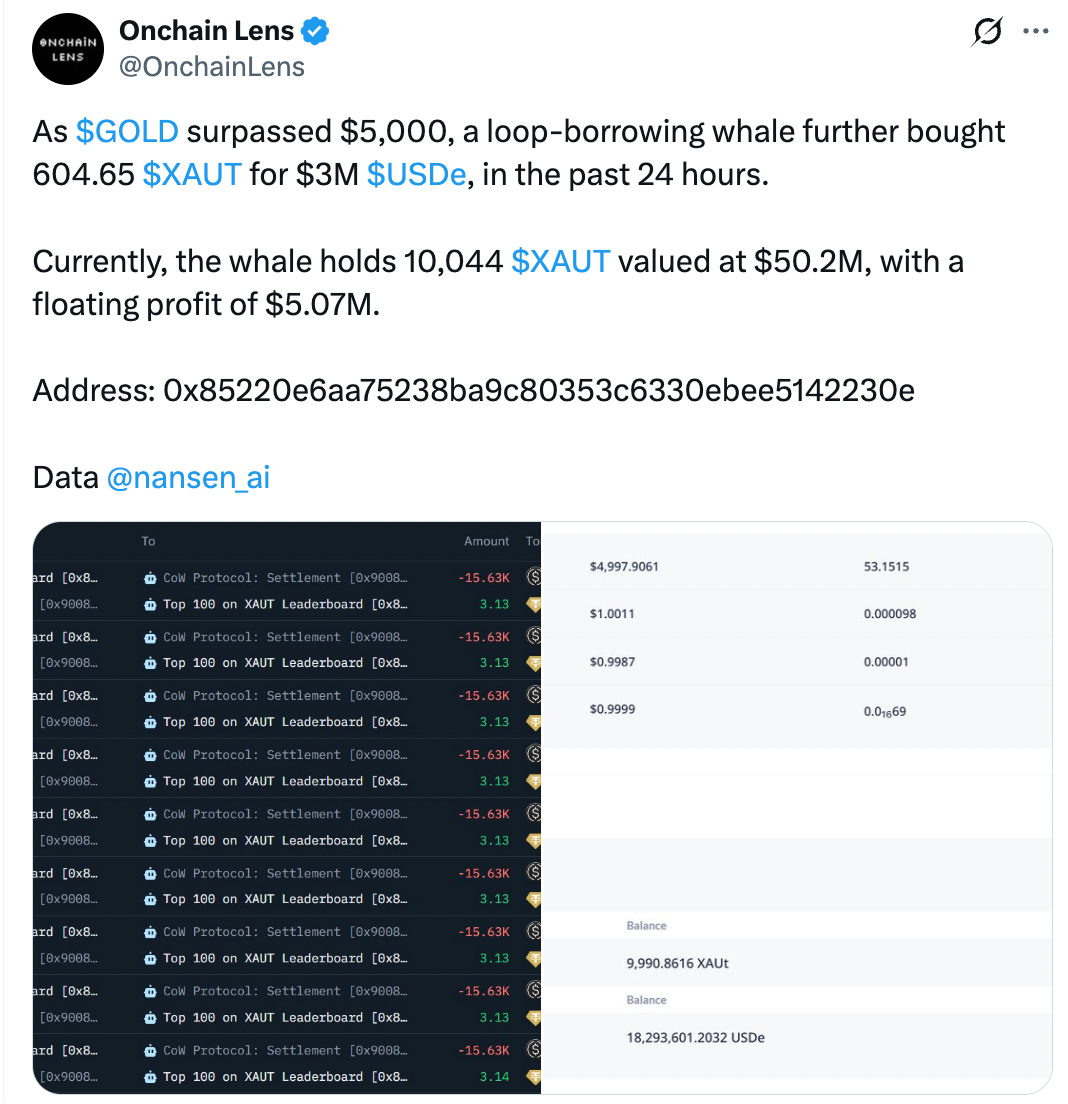
From market dynamics, in recent months, XAUT has attracted the attention of many whale investors, with frequent large-scale purchases. According to Lookonchain monitoring, a whale address (starting with 0x037) that previously lost $18.8 million in ETH is doubling down on gold: since December 13, 2024, this address has spent $36.04 million to purchase 7,536 XAUT at an average price of $4,786 each. On January 22, according to Onchain Lens monitoring, a whale address starting with 0x852 spent about $42.13 million to acquire 9,439 XAUT through circular lending at a price of $4,463 over the past 25 days; on January 24, this address purchased another 604.65 XAUT, bringing its total holdings to 10,044 XAUT. Such cases of whale accumulation are numerous, indicating a growing recognition of XAUT in the market.
In addition, many cryptocurrency exchanges have shown strong interest in XAUT. In mid-December last year, OSL launched XAUT trading pairs. OSL Group's Chief Business Officer Zhang Yinghua stated that the launch of XAUT is an important part of OSL's strategy to build a global stablecoin payment and real-world asset (RWA) ecosystem. Earlier this month, South Korea's leading exchanges Upbit and Bithumb also launched XAUT on the same day. This indicates that as gold prices rise, global cryptocurrency exchanges and whales are turning their attention to the gold stablecoin market, which has long been overlooked by the industry, and XAUT, as the "leader" in this market, has naturally become the focus of industry attention.
During this period, Tether's investment in the gold sector has exceeded expectations. According to data from the International Monetary Fund (IMF) and a report released by Jefferies at the end of 2025, Tether has successfully entered the ranks of the top 30 gold holders globally, becoming an important institutional gold reserve holder, even surpassing countries like Greece, Qatar, and Australia. In just the fourth quarter of 2025, Tether Gold Investments increased its fund exposure by approximately 27 metric tons of gold, exceeding the gold purchases of most central banks during the same period. Bloomberg noted today that Tether purchased over 70 metric tons of gold in 2025, and now holds about 140 metric tons of gold, with a total value of approximately $23 billion, making it the largest known physical gold holder outside of banks and nations.
Paolo Ardoino revealed that the company is continuously purchasing gold at a rate of 1 to 2 metric tons per week, aiming to establish a long-term, stable physical gold reserve in a former Swiss nuclear bunker. He emphasized that this move is akin to playing the role of "one of the world's largest gold central banks," predicting that geopolitical rivals will introduce dollar alternatives pegged to gold, while Tether has already positioned itself by launching XAUT. Additionally, Tether even plans to establish a gold trading platform to compete with banks like JPMorgan.
From this, we can clearly glimpse Tether's strategic blueprint, which aims to grasp both the currency system and the gold market. As Paolo Ardoino stated, in a time when confidence in the currency system is waning and facing dual challenges from institutions and individuals, the emergence of XAUT will eliminate uncertainty. It provides investors with the opportunity to hold physical gold directly while maintaining liquidity, portability, and transparency. The growth of the gold stablecoin market indicates that investors increasingly expect tokenized assets to meet the same standards as national and institutional reserves.
Although the current scale of the gold stablecoin market is relatively small, it is increasingly gaining attention and investment from the cryptocurrency industry, with surging demand. The recent success of XAUT also validates the feasibility of bringing physical assets on-chain, and with its first-mover advantage and market recognition, it is undoubtedly becoming another ace in Tether's hand.
Conclusion
It must be said that Tether's strategic layout is profound and long-lasting. Through the three stablecoin products USDT, USAT, and XAUT, Tether anchors the U.S. dollar, compliant assets, and physical gold, akin to holding a "trident," constructing a financial ecosystem that covers multiple assets and adapts to regulations. This not only meets the risk preferences of different investors but also opens up new value channels at the intersection of traditional finance and the cryptocurrency market.
In 2025, Tether delivered an impressive performance: annual profits exceeded $15 billion, and asset scale reached $187 billion, covering diversified assets such as U.S. Treasury bonds, Bitcoin, and gold. At the same time, Tether is consolidating its position as a global macroeconomic participant, with Tether Group becoming the 17th largest holder of U.S. Treasury bonds globally, surpassing sovereign nations like Germany, South Korea, and Australia. This achievement means that Tether has quietly become a "shadow central bank" in the global financial system.
Although Tether still faces significant compliance pressures, its proactive embrace of regulation through products like USAT is reshaping the entire stablecoin industry's landscape. In regions with relatively loose regulations, such as Asia and Latin America, USDT has become the preferred tool for cross-border payments and inflation hedging, and this "regulatory arbitrage" capability further solidifies Tether's market dominance.
In the future, Tether's "trident" may face more severe tests, such as how to balance regulatory compliance requirements with business expansion and how to respond to competition from USDC and emerging stablecoins. However, it is undeniable that Tether has gradually evolved from a "infrastructure provider" in the cryptocurrency field to a financial giant capable of influencing global capital flows.
免责声明:本文章仅代表作者个人观点,不代表本平台的立场和观点。本文章仅供信息分享,不构成对任何人的任何投资建议。用户与作者之间的任何争议,与本平台无关。如网页中刊载的文章或图片涉及侵权,请提供相关的权利证明和身份证明发送邮件到support@aicoin.com,本平台相关工作人员将会进行核查。


