Source: Pantera Capital
Compiled by: Gu Yu, ChainCatcher
As we enter 2026, we look forward to a more exciting year in the cryptocurrency space than the past year. But before turning the page, we want to take a moment to review the achievements of 2025.
2025 reminded us once again that the development of cryptocurrency is not always smooth sailing. Driven by historic positive factors and the clarity of U.S. regulatory policies, the market soared to historic highs, and various viewpoints evolved, with market momentum being reset periodically. Although the final closing price was below the historical peak, this year marked a necessary adjustment for the cryptocurrency industry, laying the foundation for a true leap in growth.
Summary Data
Deployment
- A total of 31 rounds of venture capital (21 new investments, 10 follow-up investments)
- 85% lead investment rate (17 out of 20 new investments were successful, excluding secondary market investments)
Portfolio
- 265 companies in the cryptocurrency ecosystem
- As of January 2026, four companies went public, with a total market capitalization of approximately $33 billion (Circle, AmberGroup, Figure, Gemini)
- Business scope expanded to 8 countries and 4 regions
Round Focus
- Series A: 56.7% of total capital.
- Series B: 29.6% of total capital.
- Seed round: 13.7% of total capital.
Industry Concentration
- Infrastructure: 33.9% of capital.
- Consumer: 17.82% of capital.
- AI + Robotics: 16.4% of capital.
- Stablecoins: 16.2% of total capital.
- Internet Capital Markets: 11.9% of capital.
- Enterprise: 3.88% of capital.
2025 was a milestone year for Pantera. We invested more funds than ever before, leading most new investments and expanding our global footprint across various industries and regions that we believe will drive the development of cryptocurrency in the next decade. At the same time, our portfolio received strong recognition in the public market, with four portfolio companies successfully going public and completing several major strategic acquisitions.
In 2025, Pantera conducted a total of 31 rounds of financing (excluding investments in digital asset vaults and liquidity strategies), including 21 new portfolio companies and 10 follow-up investments.
Pantera's venture capital portfolio has reached 265 companies. Behind these 265 companies are hundreds of founders and thousands of engineers, operators, and builders who are dedicated to solving some of the toughest problems in finance, infrastructure, and decentralization. Over the past 13 years, we have been fortunate to witness the complete journey of company development. It is this scale of experience that continually broadens our vision and deepens our belief in the builders who shape future developments.
What Makes 85% Stand Out
In 2025, Pantera not only participated but also played a leading role. In fact, among our 20 new investments (excluding secondary market investments), 17 (85%) were led by Pantera. This is not a common occurrence. In an industry where "co-leading" (sharing risk) and "following" (avoiding tough decisions) have become the norm, decisively leading is quite rare.
For us, leading means:
- Conducting critical due diligence
- Taking the first board seat
- Establishing rules that everyone must follow
- Writing checks before the round starts is a "hot" practice.
This is harder, riskier, and requires greater conviction. But it is this approach that has allowed us to build relationships with hundreds of founders over the years and to see opportunities that others may miss.
Public Market Validates the Argument
Four companies in the Pantera portfolio went public in 2025, with a total market capitalization of approximately $33 billion as of January 2026. We believe this indicates that public market investors see the long-term value of cryptocurrency infrastructure and enterprises.
IPO Wave:
-
(June 2025): Achieving global circulation of dollars through USDC
-
(September 2025): On-chain credit and structured products
-
(September 2025): Institutional-grade custody and trading
-
(March 2025): Institutional crypto financial services
Notably, these are not tokens but equity offerings aimed at traditional capital markets. Public investors recognize that stablecoins, tokenized credit, and institutional infrastructure represent the future direction of the financial system.
Strategic Validation: Robinhood Acquires Bitstamp
In June 2025, publicly traded Robinhood (NASDAQ: HOOD) completed a $200 million acquisition of Bitstamp, the longest-operating exchange in the industry (founded in 2011). We invested in Bitstamp over a decade ago in 2014.
This all-cash transaction brought:
- Over 50 global licenses in the EU, UK, US, and Asia
- 5,000 institutional clients (Robinhood's first institutional crypto business)
- $95 million in revenue over the past 12 months
- Infrastructure for lending, staking, and white-label trading services
The IPO window for cryptocurrency companies has opened, validating that infrastructure investment projects can be valued at levels comparable to traditional fintech companies. We believe that cryptocurrency infrastructure is becoming core financial infrastructure, deserving of public company valuation multiples and strategic acquisition premiums.
Investing in Cryptocurrency through DATs in the Public Market
Now let's talk about DAT. Digital Asset Trading (DAT) is one of the three major themes of 2025, alongside stablecoins and prediction markets, and Pantera has led the robust growth of this asset class and the entire industry. The overall capital inflow into the DAT market exceeded $26 billion.
Through our investment strategy, we gained exposure to a range of diversified public market tools designed to hold, appreciate, and generate returns on core digital assets. Despite facing short-term volatility and increasing skepticism as the market resets, we believe that Digital Asset Trading (DAT) is an early manifestation of a long-term structural shift: crypto assets are gradually integrating into the balance sheets, capital allocation frameworks, and institutional portfolios of public markets.
As with previous cycles, we believe that the strongest platforms, managers, and structures will emerge during the consolidation period, laying the groundwork for a more sustainable and scalable model in the coming years.
Series A Most Active
We concentrated our funding on companies transitioning from early product validation to actual scaled production, which is often the most critical period in a company's lifecycle, while maintaining selective investments in both early and late stages. This reflects our belief in the areas that can create the most value from a platform perspective.
To illustrate this more intuitively, we can look at our deployment from two angles: the number of transactions and the amount of capital deployed.
Capital deployment categorized by stage and number of transactions (31 total investments):
- Series A (48.4%)
- Seed round (25.8%)
- Series B (25.8%)
Capital deployment categorized by stage and amount of capital invested:
- Series A (56.71%)
- Series B (29.59%)
- Seed round (13.70%)
Overall, these rankings show a consistent trend. In terms of transaction count, we were most active in Series A financing, as Series A is often a key juncture where product-market fit is validated and scaling paths are clear. Capital deployment is more concentrated in Series A and B, reflecting our highest confidence in investments at these stages and indicating that large investments can significantly accelerate company growth. Seed round financing remains an important entry point for establishing early relationships and identifying market patterns, while Series A and B financing are critical stages where we can truly deploy capital and platform support.
Industry Concentration
Our investment activity in 2025 covered a wide range of crypto-native and related categories, with a clear concentration in the foundational layer of the tech stack.
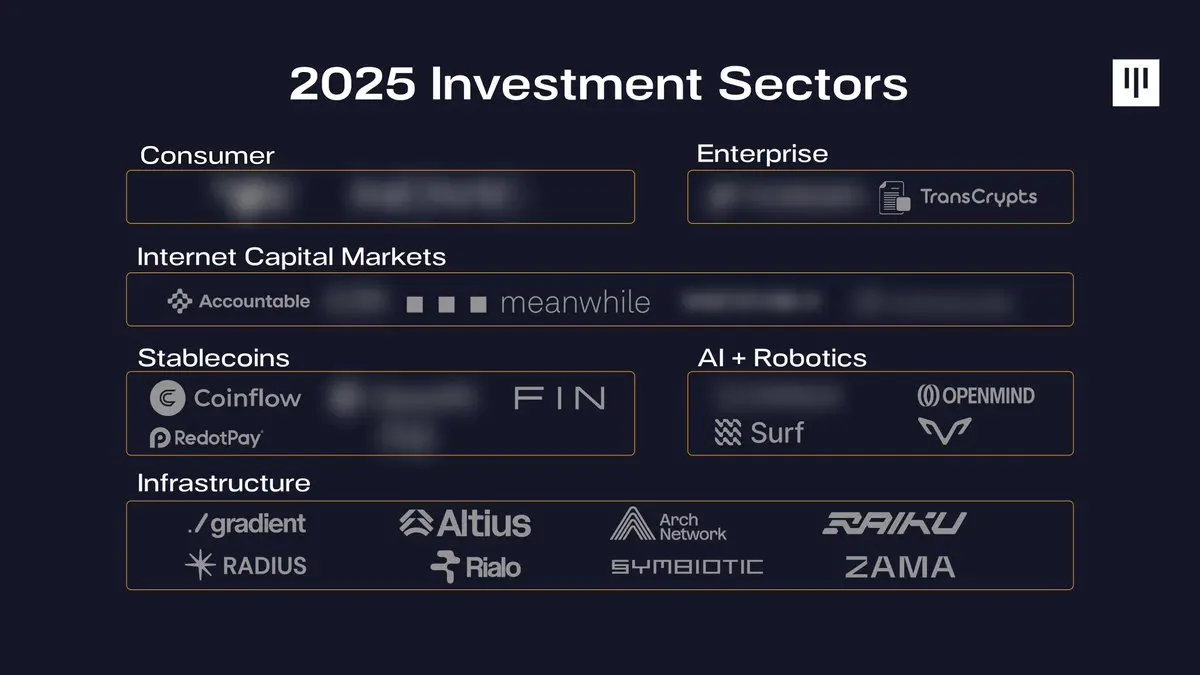
Top industries ranked by transaction count (31 total investments):
- Infrastructure (38.71%)
- Internet Capital Markets (16.3%)
- Stablecoins (12.9%)
- Consumer Products (12.9%)
- AI + Robotics (12.9%)
- Enterprise (6.45%)
Industries with the most capital invested:
- Infrastructure (33.85%)
- Consumer Products (17.82%)
- AI + Robotics (16.36%)
- Stablecoins (16.2%)
- Internet Capital Markets (11.9%)
- Enterprise (3.88%)
The infrastructure sector ranks first in both transaction count and investment capital, solidifying its position as a pillar of the portfolio and a continued focus for investment. Consumer, AI + Robotics, and stablecoin sectors have risen in investment capital rankings, primarily due to higher average individual investment amounts and more concentrated investments in differentiated, mainstream, or scalable areas.
On the other hand, Internet Capital Markets ranked second by transaction count but fell to fifth by investment amount, as this category encompasses a variety of investment opportunity types, from industry benchmark platforms to early financial prototypes. Enterprise-level investments remain the smallest category in both transaction count and investment amount, reflecting its position as a growing niche market within the portfolio.
Let’s delve deeper.
Infrastructure
This year, infrastructure remains the cornerstone of our deployment efforts. As stablecoins, on-chain foreign exchange, institutional custody, and compliance-first infrastructure evolve from "emerging" to "mission-critical," we focus on supporting teams that build the underlying architecture necessary for global cryptocurrency operations. The main trends we observe are real-time settlement, regulatory-aware design, and infrastructure that is familiar to Web2 users but operates on cryptocurrency rails.
-
– A virtual machine-agnostic parallel execution framework built for L1, rollups, and application chains, aimed at achieving high-performance execution and multi-chain atomic composability.
-
– Bitcoin-native smart contract and settlement infrastructure, allowing developers to build applications directly on BTC without the need for bridges.
-
– A decentralized ordering and block space network adopted by Rollups and L2 teams to monetize block space, improve user experience, and achieve shared ordering infrastructure.
-
– A Solana-native block space marketplace and network expansion framework used by Solana application chains and high-throughput applications to ensure inclusivity and capture MEV.
-
– A modular, fully-chain programmable network built for developers, enabling low-latency cross-chain execution, proxy workflows, and autonomous interactions.
-
– A universal shared security layer used by new and existing decentralized networks to guide sovereign security without sacrificing governance or token design.
Zama
– An open-source cryptographic infrastructure that empowers enterprises, developers, and governments to run private computations, confidential smart contracts, and privacy-preserving AI using FHE.
Stablecoins
Stablecoins continue to solidify their position as the most important real-world bridge for cryptocurrencies, with supporting data confirming this argument:
- Total stablecoin transaction volume reached $46 trillion (up 106% year-on-year)
- Adjusted transaction volume reached $9 trillion (up 87% year-on-year, excluding bot data)
- The scale of the ACH network for transferring dollars globally is approaching
We have invested in various aspects of the stablecoin technology stack, from issuance and middleware to payments and foreign exchange, supporting platforms that make digital dollars available, compliant, and globally scalable for both consumers and institutions.
-
– A unified fiat and cryptocurrency payment platform providing compliant checkout processes, embedded fraud protection, and chargeback insurance for high-risk and high-volume merchants.
-
– A payment platform enabling individuals, creators, and businesses to send and receive stablecoins, NFTs, and cryptocurrencies instantly and globally with minimal friction, designed for payments, peer-to-peer transfers, and embedded payment processes.
[Undisclosed Project] – Decentralized currency middleware for institutions, protocols, and asset issuers to connect off-chain liquidity with on-chain markets.
[Undisclosed Project] – Real-time cross-border foreign exchange settlement infrastructure for fintech companies, payment companies, and global enterprises, enabling instant transparent transfers for high-value payments.
-
– A consumer-centric stablecoin payment and card platform serving underbanked users and cryptocurrency holders looking to use stablecoins globally through Visa channels, with strong appeal in Africa and Asia.
Internet Capital Markets
The cryptocurrency-native capital markets achieved significant maturity in 2025. We support platforms dedicated to modernizing issuance, liquidity, information disclosure, and trading infrastructure, bringing institutional-grade standards to on-chain markets. These companies are working to maintain the openness and programmability of cryptocurrencies, which are structurally superior to traditional finance.
-
– A privacy-preserving financial data and reporting infrastructure for institutional investors, issuers, and exchanges to verify the returns, risks, and disclosures of crypto-native financial products.
[Undisclosed Company] – An institutionally-backed cryptocurrency exchange designed for broker-dealers, market makers, and large asset management firms to adapt to the market structure's shift towards multi-venue best execution.
-
– A crypto-native life insurance and annuity platform for Bitcoin holders seeking regulated downside risk protection and long-term BTC-denominated financial products.
[Undisclosed Company] – A decentralized exchange and liquidity protocol for traders, developers, and liquidity providers to facilitate permissionless token trading and on-chain price discovery.
[Undisclosed Company] – Token liquidity guidance and capital formation infrastructure, where token issuers and on-chain projects utilize Uniswap v4's native mechanisms to issue assets, seed deep liquidity, and capture long-term trading fees.
Enterprise Platforms
As cryptocurrency infrastructure matures, the demand for secure, compliant, and programmable systems from institutions is growing, extending beyond just asset custody. Looking ahead to 2025, we support enterprise-level platforms that serve as the backbone for crypto-native organizations, providing support for asset management, permissioned execution, and sensitive data verification in both on-chain and off-chain environments.
[Undisclosed Project] – An institutional-grade custody and trading management platform for funds, DAOs, and enterprises to securely manage assets, tokenize, and facilitate DeFi workflows.
-
– A platform for enterprises using self-sovereign identity and data verification protocols to verify income, employment, and financial data through zkTLS while protecting user ownership and privacy.
Consumer Products (Gaming, Gaming, and Prediction Markets)
Consumer-grade cryptocurrencies in 2025 will no longer be limited to novelty but will move towards products that can genuinely enhance user retention, profitability, and scalability. We focus on teams dedicated to creating native crypto consumer experiences where blockchain technology can significantly enhance user engagement, liquidity, or economic benefits, rather than merely serving as a superficial feature. Areas such as gaming, sports, and prediction markets stand out, where the combination of strong brands, differentiated user experiences, and crypto infrastructure can stimulate new consumer behaviors.
- [Undisclosed Project] – A crypto-native casino and sports betting platform providing players with a compliance-first, brand-driven, VIP-exclusive gaming experience.
- [Undisclosed Project] – A bilateral sports prediction trading platform enabling retail bettors, professional traders, and liquidity providers to trade on win/loss lines, point spreads, parlays, and props through a CLOB-style market, offering better prices and a superior mobile-first experience.
AI + Robotics
The trend in artificial intelligence has shifted from horizontal expansion to achieving specific breakthroughs in vertical domains within cryptocurrency and related systems. We see the most significant applications when AI is deeply embedded in core workflows, such as research, execution, validation, and reasoning in the physical world.
-
– An open-source AI and robotics infrastructure platform for building software and physical reasoning layers for general-purpose robots, enabling scalable, intelligent interactions with the real world through a global network of machines.
-
– A crypto-native AI research and execution platform for traders, analysts, exchanges, and KOLs to generate real-time, on-chain-supported intelligence faster than general AI tools.
-
– An AI-driven trading and research platform that has built an autonomous hedge fund enhanced by proprietary reasoning systems, designed for active traders, hedge funds, and other market participants.
[Undisclosed Company] – Formal reasoning and verification infrastructure used by blockchain foundations, enterprises, and government-related organizations to mathematically prove the correctness of code and eliminate hallucinations in mission-critical systems.
Global Portfolio
Cryptocurrency is inherently global, and our portfolio continues to reflect this reality. In 2025, we invested in founders with businesses spanning multiple continents, who have been committed from the start to building products for a global user base. At the same time, we have also seen significant changes in the location choices of new companies, largely due to the increasingly refined cryptocurrency policies and regulatory environment in the United States.
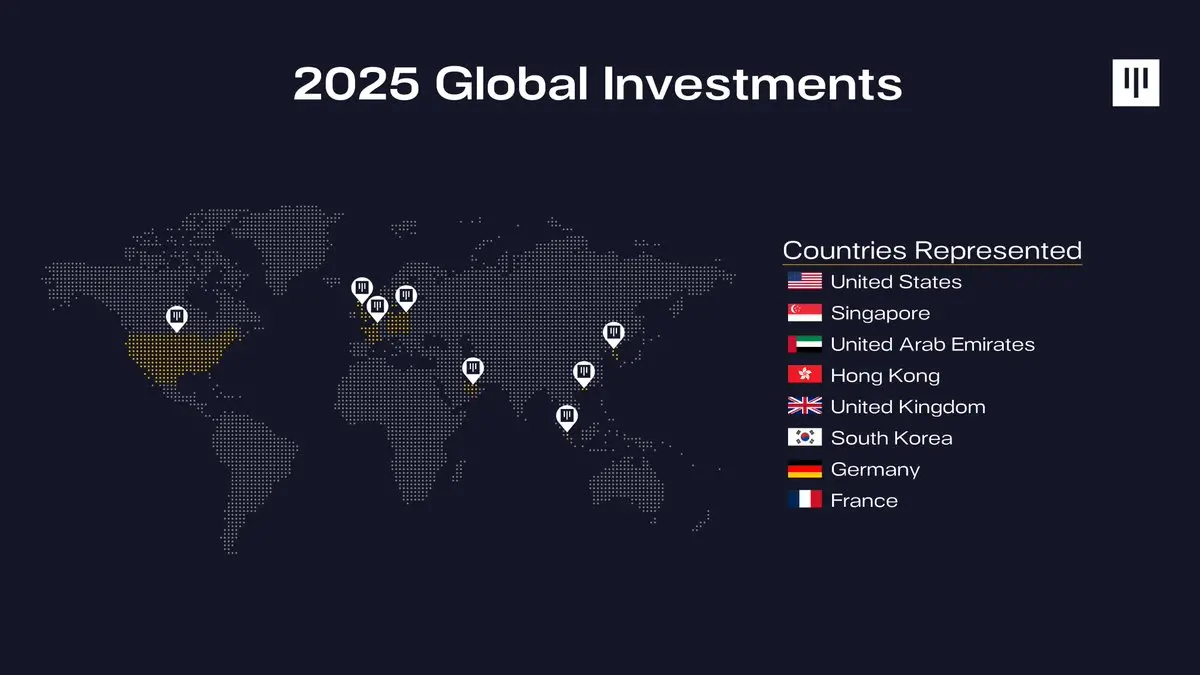
Our investments last year spanned eight countries across four regions.
- North America (64.52%)
- Asia (16.13%)
- Europe (9.68%)
- Middle East (9.68%)
Despite the fact that cryptocurrency innovation is inherently global, the United States has re-emerged in 2025 as a leading center for company formation, talent acquisition, and capital deployment. In North America, Asia, Europe, and the Middle East, we have collaborated with numerous teams to tackle various regulatory environments, payment channels, and user behaviors, often addressing these challenges simultaneously. Most of these companies adopt a distributed team model and have a global customer base, reflecting that cryptocurrency products are evolving towards international expansion from the outset.
We believe that the combination of global influence and the renewed momentum of the U.S. market will provide a decisive advantage for the strongest companies in the next phase of the ecosystem.
免责声明:本文章仅代表作者个人观点,不代表本平台的立场和观点。本文章仅供信息分享,不构成对任何人的任何投资建议。用户与作者之间的任何争议,与本平台无关。如网页中刊载的文章或图片涉及侵权,请提供相关的权利证明和身份证明发送邮件到support@aicoin.com,本平台相关工作人员将会进行核查。


