XWorld is dedicated to transforming every action in the digital world into real income.
Written by: Deep Tide TechFlow
Introduction
Have you noticed? The "watch ads to get free membership" model has been fully rolled out across major music and video platforms:
Watch a 30-second ad to receive 1 hour of VIP access for free.
In an era where internet advertising and user growth are becoming increasingly inefficient, the "watch ads to get free membership" model has staged a more clever "value distribution" among users, platforms, and advertisers:
For users: The shift from "buying membership to skip ads" to "watching ads to earn membership" represents a transition from pure consumers to "View to Earn" participants;
For platforms: Higher advertising revenue is generated; more low-paying users are reached; and closer connections are established between users and advertisers;
For advertisers: Users' ad-watching behavior shifts from passive acceptance to active choice, achieving broader and more precise user reach, as well as higher completion and conversion rates.
This more sophisticated value distribution has also gained significant market recognition. For example:
In August 2023, ByteDance launched the independent app Hongguo Short Drama, riding the wave of short sentences. With high-quality content output and traffic from Douyin, the "watch dramas for free + watch ads to earn coins/cash out" model became the core driving force behind Hongguo's explosive growth: in just over two years since its launch, monthly active users surpassed 200 million, and in March 2025, monthly advertising revenue exceeded 500 million.
Through "watching ads to get free membership," we have witnessed the enormous economic effects that more effective value distribution can leverage. However, we also deeply feel the limitations of "value redistribution" under a centralized model:
After all, the platform remains the rule-maker and value extractor, users are exploited for their attention, and advertisers are burdened with high costs, making it difficult to establish a truly win-win long-term mechanism for all parties involved.
At this point, the keen observer among you must be thinking of Web3: leveraging the power of decentralization to introduce a fairer, more transparent, and effective incentive model, becoming the core growth engine that coordinates the rights of all participants.
In fact, as early as 2023, some pioneers began to deeply integrate Web2 advertising mechanisms with Web3 incentive models in the gaming sector, achieving remarkable results over more than two years of focused development: over 10 million downloads on Google Play; more than 200 game partners; a total of 2 billion game data records created; and over 22 million dollars in revenue achieved in 2024.
This is XWorld, a platform centered on "Use to Earn," dedicated to transforming every action in the digital world into real income.
At a time when most Web3 projects are "issuing tokens first and then seeking profitability," XWorld's achievements are enough to draw attention.
In the next phase, after the business logic has been fully validated, XWorld is moving full speed ahead towards the AI Agent Economy Network, where real user participation and genuine testing feedback are needed, further ensuring that value co-creation and sharing occur better on-chain.

From Web2 Advertising to Web3 Value Reconstruction
What is the essence of XWorld?
A distribution platform that integrates Web3 incentive mechanisms, dedicated to achieving more effective connections and efficient demand matching between users and projects.
In Web2, this is a mature business model validated over hundreds of years: especially in an era of information explosion, every user's needs require more precise "recognition," and every brand needs to be better "seen."
Take luxury goods giant LVMH as an example; according to financial reports, LVMH's marketing and sales expenses exceeded 31 billion euros in 2024. At the same time, as a platform that controls a large user base, Google's financial report shows its total advertising revenue exceeded 265 billion dollars in 2024.
Before officially embarking on its Web3 exploration, XWorld had been deeply involved in the advertising distribution industry for many years, mastering core resources: users and partners.
Through years of building an app matrix, XWorld has accumulated over 100 million users globally, covering major regions such as Southeast Asia, East Asia, and South America, and has ventured into fields including news, gaming, finance, and lifestyle tools, with partnerships including giants like iQIYI, Bilibili, TikTok, and L'Oréal.
While achieving impressive results as an advertising platform company in Web2, XWorld, which is active at the forefront of the industry, gradually realized that this mature business model, which integrates users, project parties, and cash flow, is entering a "dead end":**
Under a centralized system, platform controllers hold the power of discourse and distribution, users increasingly complain about junk ads, and it becomes harder to find products that match their needs amidst a plethora of promotions. Advertisers face soaring costs but find it increasingly difficult to reach target users.
Therefore, introducing Web3 incentive mechanisms is the core idea for XWorld to lead traditional distribution out of its predicament:
Closely adhering to the core concept of "Use to Earn" to attract users, making every act of "participation" valuable and priceable;
On one hand, recording user behavior and issuing rewards based on behavioral contributions; on the other hand, obtaining more accurate user profiles to achieve more precise matching between projects and users;
Incentivizing user benefits from their perspective, while providing projects with lower-cost and more efficient advertising, attracting more users and projects to join the ecosystem, creating a continuous positive feedback loop.
Building on the mature business logic of Web2, leveraging the power of Web3, XWorld reconstructs the underlying logic of value distribution, transforming users from passive consumers into active participants and profit sharers.
In 2023, XWorld announced that while maintaining Web2 business revenue, it officially began exploring the Web3 model, aiming to integrate the Web3 incentive model into the mature Web2 business model, breaking the inherent impression of Web3 as "talking about technology without implementation," promoting large-scale adoption of Web3, and providing Web2 users with a new participation experience, creating a more sustainable ecological value cycle.
At this point, users who have not yet truly engaged with XWorld may feel:
"The narrative of 'XX to Earn' seems a bit cliché, from the initial GameFi's 'Play to Earn' to last year's explosive 'Tap to Earn' in the TON ecosystem, the industry has witnessed too many fleeting trends. How will XWorld achieve sustainability?"
Under a mature business model, real users and real income driven by genuine token utility is the answer XWorld provides.
15 million users and 22 million in revenue: A win-win for users, projects, and the platform with XWorld
In the early stages of exploring Web3, XWorld positioned itself as a Web2.5 application store and launched the application reward platform XWorld App, aiming to attract a broader range of Web2 users to participate through a seamless experience and user benefits under the Web3 incentive model, establishing a bridge for Web2 users to experience the charm of Web3.
In the XWorld App, users can quickly explore new applications/games/decentralized applications while also earning tangible rewards through interactions.
Rewards mainly come from two aspects: on one hand, users can participate in application testing or interactions to receive exclusive discounts; on the other hand, users can earn additional points when recharging or participating in tests, which can be exchanged for cash or USDT based on market rates, achieving instant rewards. Additionally, users can unlock more ecological rights by minting NFTs.
By introducing Web3 incentive mechanisms, XWorld has achieved a win-win for users, projects, and the platform:
Users: Empowering the value of "participation," rewarding experiences with projects;
Projects: Achieving more precise user matching at lower costs, leading to higher conversion and retention;
Platform: By returning more rights to value creators (users), continuously attracting new users and activating existing ones, and establishing clearer user profiles through user loyalty and behavioral data across different games and apps, achieving more efficient distribution.
Taking gaming scenarios as an example, which have a large user base, strong advertising demand, frequent asset interactions, and a high degree of alignment with the "Use to Earn" concept, the revenue-sharing ratio for games on the XWorld App is lower:
On traditional Web2 platforms, such as Google Play, game publishers must share at least 30% of their revenue, while XWorld only charges 15%–20%. This difference not only effectively reduces the costs for game projects but also creates greater space for user earnings.
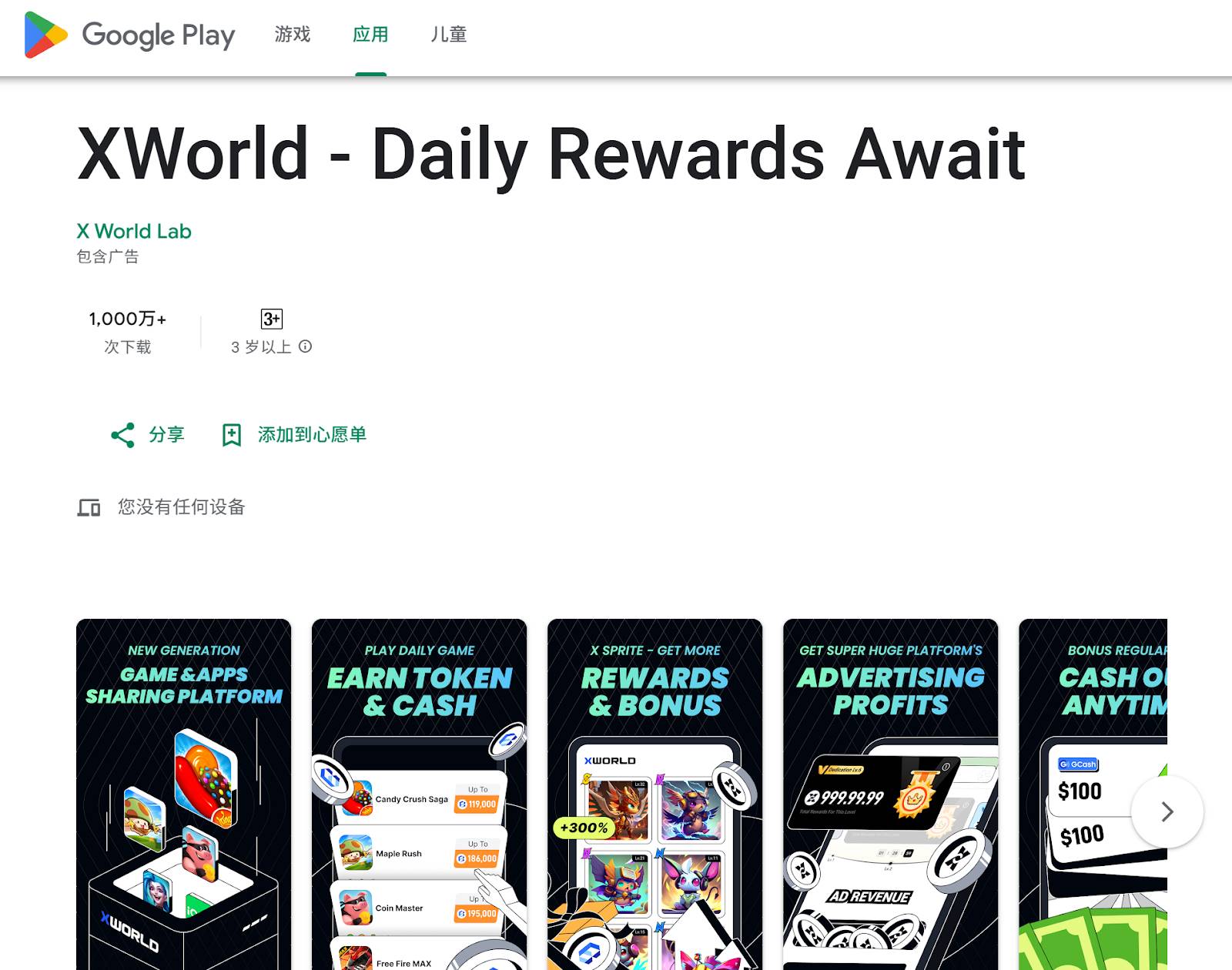
The series of achievements that XWorld App has attained in just over two years also fully demonstrates the compatibility of the Web2 business model with the Web3 incentive mechanism:
In terms of user base, according to Google Play, as of now, XWorld App has been downloaded over 10 million times. Relying on the massive user base accumulated by XWorld in traditional Web2 industries, XWorld App currently has over 15 million registered users, with daily active users exceeding 500,000, and has generated over 2 billion data records, with user scale and activity surpassing most leading Web3 projects.
Beyond its vast user base, XWorld also boasts a multi-social media matrix of user reputation driven by product experience: Searching for XWorld on TikTok reveals over 21,100 users creating content around the product, accumulating over 100 million views; on YouTube, more than 1,500 channels have published over 7,000 XWorld-related videos, with a total exposure exceeding 50 million; and on Facebook, XWorld has over 500 user-driven communities, covering more than 1 million users.
In terms of ecological cooperation, the XWorld App has established partnerships with over 200 advertisers, collaboratively building a diverse and prosperous content ecosystem.
Moreover, in terms of revenue, the XWorld App has also achieved enviable figures that many Web3 projects would covet.
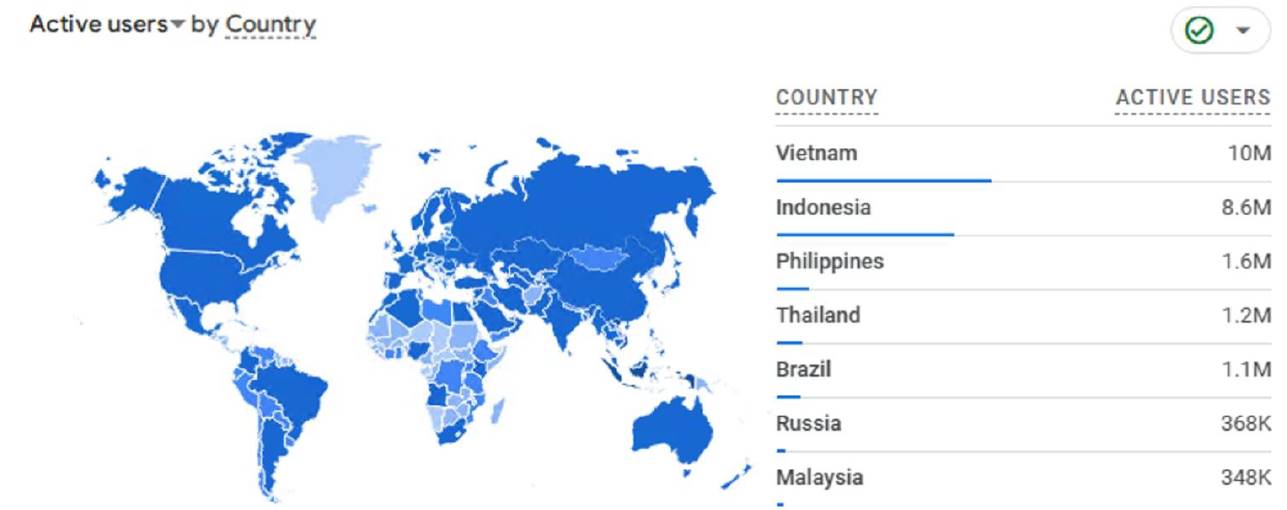
In 2024, the XWorld App's revenue exceeded 22 million dollars, and upon examining the user distribution and revenue allocation behind this 22 million dollars, we can see that XWorld has demonstrated strong social influence inemerging markets:
In developing Southeast Asian countries like Vietnam, Indonesia, and the Philippines, many ordinary users have earned rewards through the XWorld App that far exceed local income levels. You could be a university student in Vietnam or a full-time mom in Indonesia, participating in testing tasks for AI Agent and DApp projects from Silicon Valley, Singapore, and Hong Kong through the XWorld App. Just by using your phone for daily operations, you can provide real-world usage feedback to top AI teams in Europe and America while earning rewards comparable to income levels in those regions. Statistics show that many active users have earned thousands of dollars through the XWorld App.
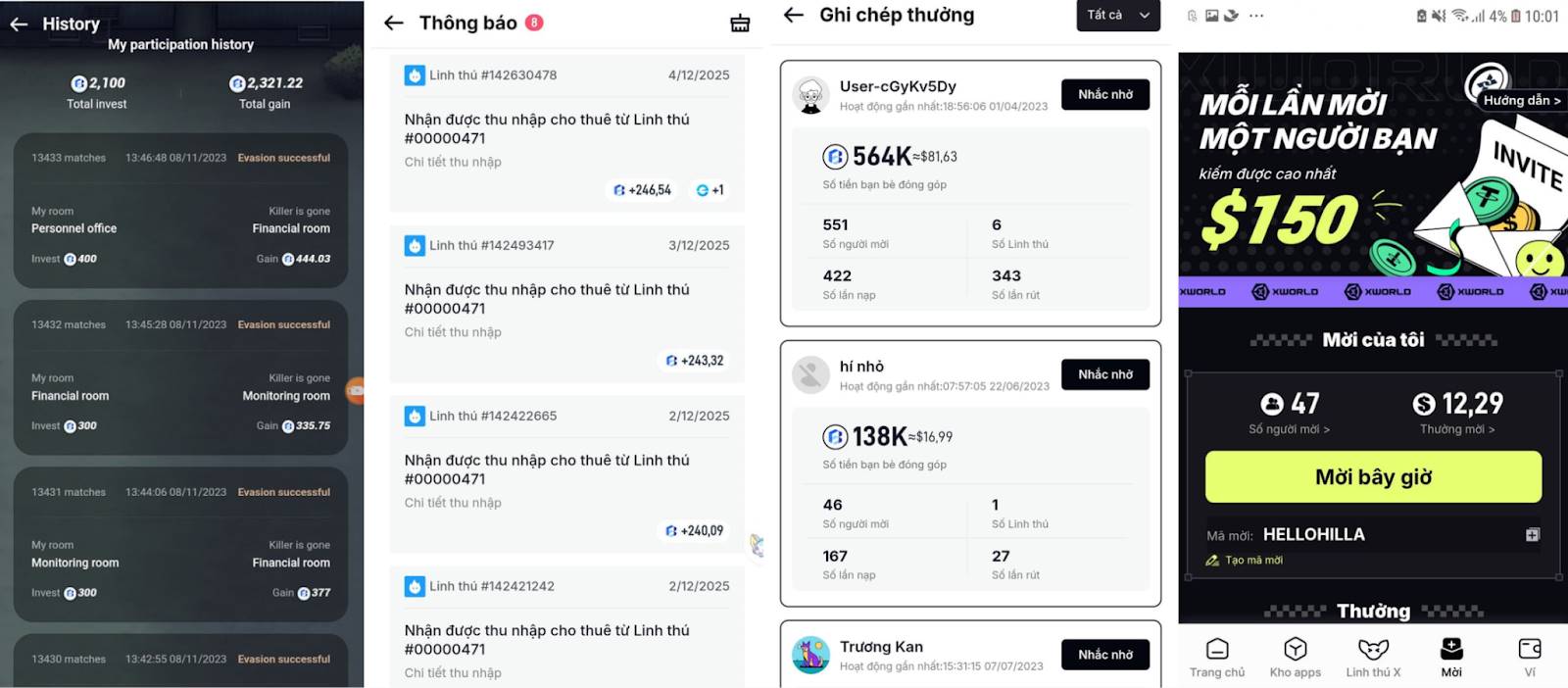
This extensive and deep user participation and value redistribution once again powerfully validate XWorld's core value proposition: it has long surpassed the traditional notion of a game and application distribution platform, evolving into an efficient global value redistribution engine, where geographical location no longer determines reward levels; the value of contributions becomes the basis for pricing.
Through Web3 incentives and on-chain transparency mechanisms, the platform channels the innovation dividends and capital advantages of developed regions precisely to billions of ordinary users worldwide, especially those in developing countries. This model not only accelerates rapid product iteration and global deployment but also substantively promotes financial equity and digital inclusion, enabling more people to become active contributors and direct beneficiaries of the global AI and digital economy.
Core Value Engine $WORLD: The Multiple Utilities and Deflationary Future of $WORLD
After understanding XWorld's market data, an unavoidable topic is XWorld's native token, $WORLD.
As a native token, $WORLD has multiple utilities within the XWorld ecosystem:
Payment tool: Developers pay service fees with $WORLD
Testing incentives: Users earn $WORLD by completing tasks
Staking rights: Enhance testing priority and gain governance rights
AI Launchpad payment layer
AI data market settlement token
Advertising and growth incentives
Membership and premium feature unlocks
Governance: Holders collectively shape the future of the ecosystem, etc.
Additionally, we know that in the current Web3 landscape, real users and protocol revenue are core indicators of a project's sustainable development.
From this perspective, one can quickly grasp the uniqueness of $WORLD. Before officially entering the market, $WORLD already possesses:
A validated business model: A global value redistribution engine built through Web3 incentives;
Significant revenue: Annual revenue exceeding 22 million dollars;
A large and active user base: 15 million registered users; 500,000 daily active users; generating over 2 billion data records.
Combined with the rich utilities of $WORLD, it is not a case of having a token first and then seeking demand; rather, it is the reverse: real demand, real scenarios, and real users gave rise to $WORLD, which endows $WORLD with a higher ceiling for value imagination.
At the same time, as more users, curators, and developers join the ecosystem, interactions within the ecosystem become increasingly active, giving XWorld, as the underlying matching platform, a stronger value capture capability.
Based on this, the destruction mechanism designed for $WORLD will also play a greater role: some tokens that have been spent will be destroyed according to the needs of ecosystem development, promoting $WORLD into a long-term deflationary model, further maintaining the value of $WORLD.
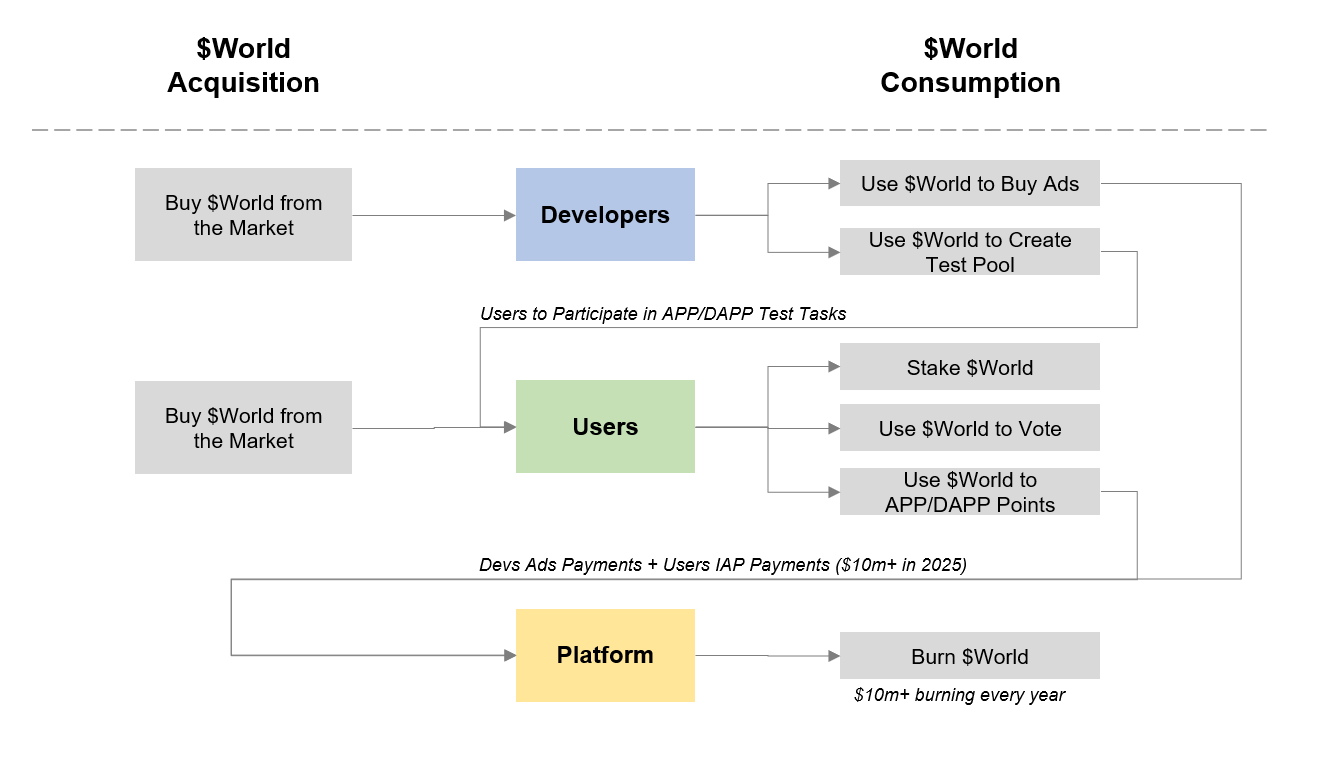
Next Stop: Evolution of the AI Agent Economic Ecosystem
The early success of XWorld not only validates the feasibility of the "Web2 business model + Web3 incentive model" path but also gives XWorld the confidence to explore Web3 comprehensively.
Theoretically, XWorld's matching logic can adapt to any distribution scenario: as long as there is a supply-demand relationship, distribution and matching exist.
In the unstoppable wave of AI, XWorld's next phase aims to quickly find product-market fit (PMF) throughout the entire process of AI application initiation, testing feedback, and optimization iteration.
As the barriers to AI continue to lower, individual developers, small teams, and startups can now create AI applications. However, AI is still in a vacuum of infrastructure deficiency in terms of testing and growth. In a field that already has enough experimenters and innovators, the greater challenge lies in how applications can quickly stand out and thrive.
AI characteristics: Require a large amount of real-world data to continuously calibrate the product's "cognition."
The current state of AI's "difficult start, costly trial and error, and long path": Unable to effectively reach users in the initial startup phase; unable to obtain enough and sufficiently real user participation experience feedback to continuously drive product optimization; often, AI products need to burn a lot of money before the path ahead becomes clear.
At this point, XWorld's efficient matching logic of "supply ⇌ demand," validated by 10 million users over the past two years, plays a significant role in matching AI applications with AI users.
So, how does XWorld specifically empower AI?
Specifically, there are three key roles within the XWorld ecosystem:
Developers can quickly build their AI applications using a series of AI development tools and kits provided by the XWorld ecosystem, gaining:
Rapidly find the first batch of seed users during the startup phase;
High-quality testing feedback from real users and curators, enabling rapid and accurate iteration optimization;
Broader calls or integrations for the product, with developers receiving rewards.
Curators are key to shifting the ecosystem from "centralized operation" to "decentralized curation":
Curators can actively discover and recommend high-potential applications for integration into the testing network. Once recommendations are validated by the community, the corresponding curators will receive additional rewards;
Curators can write reviews, share insights, and organize or guide community discussions, helping users build awareness of applications and expanding the ecosystem's reputation through contributions, earning token rewards;
Curators can also stake tokens to participate in platform governance, co-creating the future development direction of the network while receiving additional rewards.
Users participating in AI products and submitting feedback can receive:
Higher quality AI services;
Token rewards and exclusive discounts for AI applications: The system will automatically assess user reputation based on feedback quality, testing depth, and overall activity. Higher reputation levels will unlock higher reward multipliers.
By achieving efficient and precise matching between AI developers and AI users, XWorld provides a standardized infrastructure for "participation → testing → feedback → incentives → distribution → growth" for AI applications.
In the specific implementation path of empowering AI, XWorld also realizes three major closed loops in a progressive manner across three stages: AI project initiation, AI testing, and AI value creation.
The first stage's value closed loop lies in the AI application distribution network. When an AI project is initially launched, XWorld aims to help the project find its first batch of real users in the shortest time possible.
The second stage's value closed loop lies in the AI application testing network. By attracting more real users to participate in interactive testing, XWorld aims to help AI projects evolve from "some users" to systematic, high-quality "testing → feedback → iteration."
Ultimately, XWorld is committed to creating a prosperous AI application economic network: under the Web3 incentive and decentralized governance model, more and more users/curators join the ecosystem, and under the incentives of real users, real feedback, and real earnings, developers are motivated to create more AI products, release more testing tasks, and continuously promote product optimization. As the ecosystem enters a positive cycle of "more users joining, higher quality feedback, and better AI products emerging," the XWorld AI ecosystem enters a period of rapid prosperity.
Conclusion
From Web2 to Web3, from game distribution to AI application ecosystems, XWorld's every attempt lays out a clear trend of transformation in the internet value distribution system:
Reconstructing the value chain with the decentralized philosophy of Web3, allowing every participant to become a主体 of value creation.
In terms of specific implementation paths, XWorld largely avoids the trap of "doing Web3 for the sake of Web3," always grounded in real demand, carving out an independent development path:
First, run the model successfully, then use Web3 to amplify the operational momentum of the model, and finally apply it in various scenarios, allowing value to be effectively captured and reasonably priced, truly belonging to those who contribute value, embedding growth into the underlying logic of ecosystem operations.
Of course, XWorld is still in the early stages of fully embracing Web3. In the future, with the mainnet Beta launch in 2025, millions of users accessing the AI application testing network, and more features and richer ecological expansion measures being implemented, can XWorld truly become a super hub connecting users and projects, even Web2 and Web3?
On the eve of multiple roadmaps about to be realized, let us witness the next chapter of "Use to Earn."
免责声明:本文章仅代表作者个人观点,不代表本平台的立场和观点。本文章仅供信息分享,不构成对任何人的任何投资建议。用户与作者之间的任何争议,与本平台无关。如网页中刊载的文章或图片涉及侵权,请提供相关的权利证明和身份证明发送邮件到support@aicoin.com,本平台相关工作人员将会进行核查。


