On December 17th, Beijing time, Bitcoin temporarily stabilized above $87,000 after experiencing panic from a drop from the previous day's high of $94,000. The rebound was mild, but market sentiment had already fallen into the "extreme fear" range, with the crypto fear and greed index plummeting to 11 (out of 100), marking one of the most pessimistic readings of the year.
Meanwhile, the November U.S. non-farm payroll data, seen as a "macro barometer," was released, but its complex nature of "strong on the surface, weak underneath" not only failed to provide direction for the market but also deepened hesitation and divergence. A tug-of-war around the key support level of $88,000 quietly escalated amid macroeconomic fog.

Macroeconomic Perspective: Non-farm Payrolls "Strong on the Surface, Weak Underneath"
The U.S. November non-farm payroll report released last night was the first signal in a series of significant data this week, setting the tone for the market with its complex implications.
Data Performance: The report showed that 64,000 new non-farm jobs were added in November, exceeding market expectations of 45,000. However, there were significant cracks within the data: October's figures were drastically revised down to a loss of 105,000 jobs, while the unemployment rate rose to 4.6%, reaching a four-year high.
Market Interpretation: Analysts generally believe that this report exhibits the characteristic of "strong on the surface, weak underneath." The new jobs were concentrated in non-cyclical sectors like healthcare, and the rising unemployment rate indicates a mild cooling of the labor market. This provides the Federal Reserve with room to adjust policies without triggering market panic.
Policy Expectations: The data did not significantly alter market expectations for the Federal Reserve's interest rate path. According to the CME "FedWatch" tool, the market maintains a 24% probability expectation for a rate cut by the Federal Reserve in January next year. Currently, the market's focus has completely shifted to the upcoming release of the November U.S. CPI (Consumer Price Index) data this Thursday, which will be key in validating or challenging the Fed's "hawkish rate cut" stance.
Bitcoin "Stands Out," but Internal Divergence Exists
After the non-farm data was released, significant divergence appeared across major asset classes, with Bitcoin showing relatively resilient performance.
Cross-Asset Performance: Due to a cautious attitude towards the economic outlook, the U.S. stock market fell back, and international oil prices plummeted to new lows since 2021. In contrast, the cryptocurrency market showed signs of stabilization and rebound on Tuesday after a significant sell-off on Monday. Bitcoin rebounded about 3% from its overnight low, briefly returning above $87,000, standing out in a weak market.
Internal Structure Improvement: On-chain data revealed a positive signal: the selling willingness of large holders is sharply decreasing. Data shows that the number of Bitcoin flowing to centralized exchanges like Binance (whales transferring more than 1 BTC) has dropped to the lowest level since 2018. Analysts point out that this indicates a reduced intention to sell among investors holding large amounts of Bitcoin, alleviating downward pressure within the market, even though price performance remains weak.

Technical Analysis: Key Support Area Under Test
From a technical perspective, Bitcoin is currently at a critical crossroads, with short-term direction depending on the defense of several important price levels.
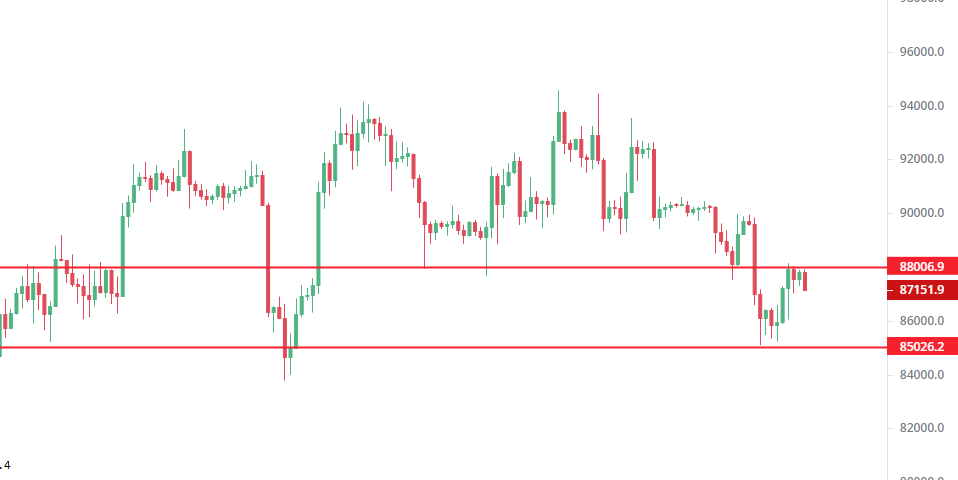
Short-term Pattern: On the daily chart, Bitcoin's price is being suppressed near the lower Bollinger Band, the MACD indicator has shown a bearish crossover, and the stochastic oscillator has entered the oversold area, indicating a short-term downward bias.
Key Support and Resistance:
Primary Support: The most important support area currently lies in the $86,000 - $85,000 range. On-chain data indicates that approximately 400,000 Bitcoins were acquired in this price range, which also encompasses the average cost line of the U.S. spot ETF, forming one of the strongest structural supports of the year.
Core Defense Line: If the above support is breached, the next significant support level will shift down to $80,600 (the late November low), followed by $74,500.
Upper Resistance: Initial resistance is located around $88,000 - $89,000. More importantly, the resistance area is at $98,155 - $102,100, which includes the 50-week moving average.
Long-term Fundamentals: Warmth in the Cold Wave
Despite short-term uncertainties, several long-term fundamental factors are building a more solid bottom for Bitcoin.
Regulatory Clarity: The U.S. has made substantial progress in cryptocurrency legislation. Following the House's passage of related bills, the Senate Banking Committee chair stated that negotiations on a bipartisan digital asset market structure bill are making "real progress." Regulatory clarity is a key prerequisite for attracting traditional institutional funds.
Institutional Inflow Continues: The adoption by global financial institutions has not stopped. Itaú Unibanco, the largest private bank in Latin America, has advised clients to allocate about 3% of their assets to Bitcoin as a long-term diversification tool. This reflects that Bitcoin is transitioning from a speculative asset to a part of modern investment portfolios.
Global Liquidity Turning Point: Although the cryptocurrency market has not fully reacted, the global monetary environment is undergoing fundamental changes. Driven by three expected rate cuts by the Federal Reserve in late 2025 and the end of quantitative tightening, the global M2 money supply has reached a historic high of nearly $130 trillion. Historically, the expansion of liquidity will ultimately benefit risk assets, including cryptocurrencies.
Trend Forecast and Outlook
Based on the above multi-dimensional analysis, the following predictions are made for Bitcoin's performance on December 17th and in the near future:
Short-term (next 24-48 hours): Consolidation, Awaiting CPI
Bitcoin is expected to maintain a consolidation pattern within the core range of $85,000 - $89,000. The market will enter a "wait-and-see mode," with trading likely to become thin as all eyes focus on the upcoming U.S. CPI data. Any inflation data that exceeds expectations could reignite "hawkish" concerns, putting pressure on prices; conversely, data below expectations could provide a window for risk assets to rebound by year-end. Analysts warn that the current rebound may only be a technical correction, and without clear macro-positive signals, the risk of prices dipping below $80,000 cannot be ruled out.
Medium-term (until the end of 2025): Options Expiration May Become a Key Node
An important technical factor that cannot be ignored is the options market. Nearly $56 billion in open interest in options is concentrated on expirations around December 26, with the largest pain point near $100,000. This may "anchor" spot prices in a specific range (median $90,000 to six figures) before expiration. After expiration, the unwinding of hedged positions may release market volatility, paving the way for a new direction.
Long-term (into 2026): Solidifying Foundations, Waiting for Opportunities
Bitcoin experienced a rollercoaster ride from its historical high (October's $126,163) to a deep correction in 2025. Looking ahead to 2026, the core driving force of the market will shift from short-term speculation to structural adoption and regulatory clarity. With the expected implementation of regulations like the "Clarity Act," improvements in the global liquidity environment, and deepening institutional allocations, Bitcoin is expected to complete its evolution from a speculative asset to a strategic reserve asset amid volatility. Once it breaks through the key resistance of $102,100, the upper target will point to $116,400 and challenge previous highs.
Conclusion
In summary, the Bitcoin market on December 17th is in a "silent period" dominated by macro data. The "strong on the surface, weak underneath" signal from the non-farm data has temporarily solidified the market's complex expectations for an economic soft landing and a shift in monetary policy, but it has not provided clear unilateral guidance. Technically, the support area of $85,000-$86,000 is crucial; maintaining it could help build a phase bottom, while breaching it may open up new downward space. Before the CPI data is released on Thursday, it is recommended that investors adopt a cautious wait-and-see approach, prioritizing capital preservation over tactical offense. Bitcoin's short-term fate is now firmly tied to the pulse of the next inflation data.
This article is exclusively contributed by "Coin Whale," please indicate the source when reprinting. There may be delays in online publication, and market conditions can change rapidly. For more real-time market updates, if you are trading contracts for Bitcoin or Ethereum and feeling lost in your investment journey, you can follow Coin Whale to communicate with teachers in real-time. Be sure to understand all related investment risks before entering the market, and take responsibility for your own risks.

Friendly Reminder: For more timely strategies and information, please scan the QR code to follow our public account. The comments and advertisements below this article are unrelated to me; please discern carefully. Thank you for your support.
免责声明:本文章仅代表作者个人观点,不代表本平台的立场和观点。本文章仅供信息分享,不构成对任何人的任何投资建议。用户与作者之间的任何争议,与本平台无关。如网页中刊载的文章或图片涉及侵权,请提供相关的权利证明和身份证明发送邮件到support@aicoin.com,本平台相关工作人员将会进行核查。