"Weekly Editor's Picks" is a "functional" column of Odaily Planet Daily. Based on the extensive coverage of real-time information each week, the Planet Daily also publishes many high-quality in-depth analysis articles, but they may be hidden among the information flow and trending news, passing you by.
Therefore, our editorial team will select some quality articles worth spending time reading and saving from the content published in the past 7 days every Saturday, providing you with new insights from the perspectives of data analysis, industry judgment, and opinion output, as you navigate the crypto world.
Now, let's read together:

Investment and Entrepreneurship
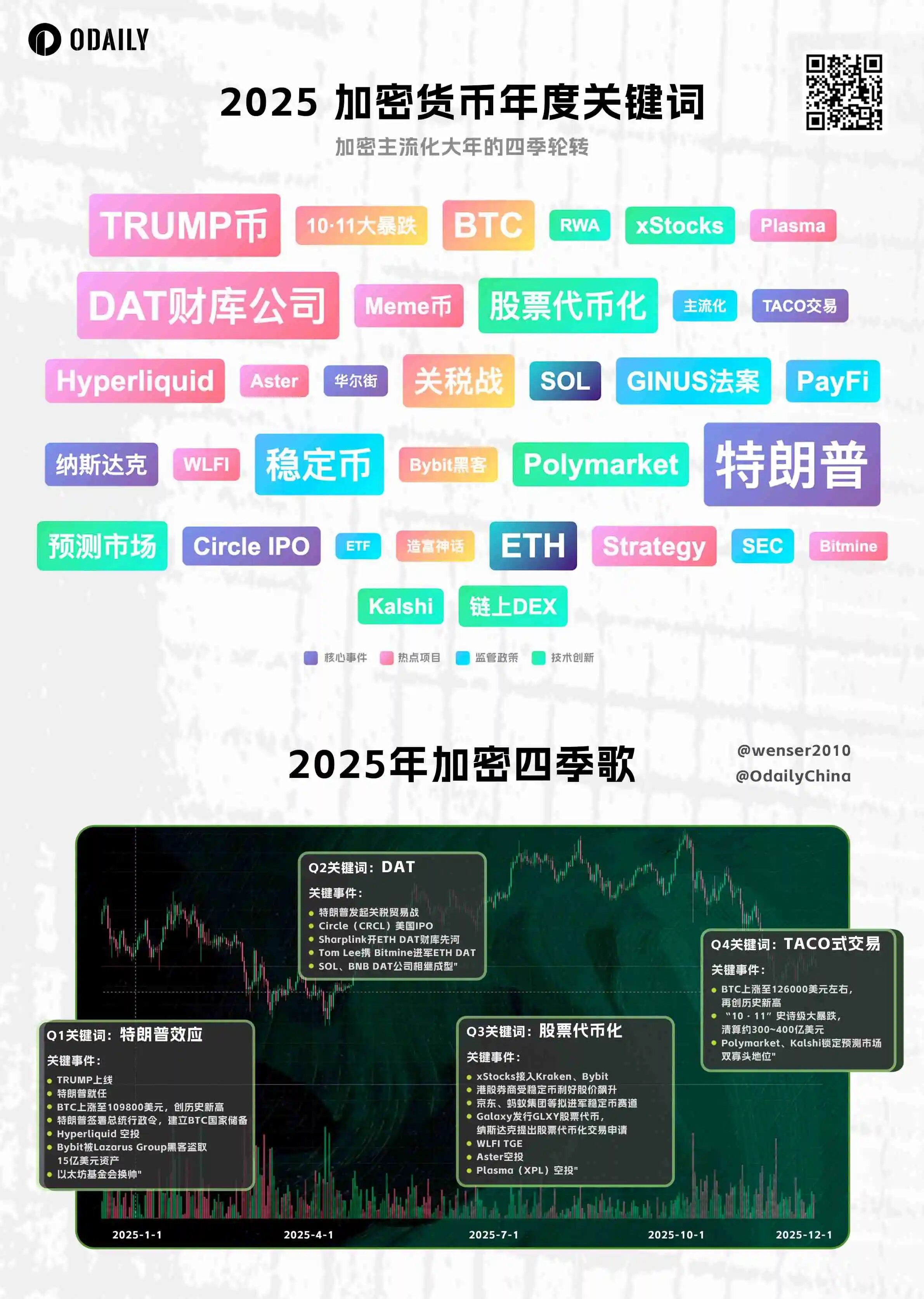
4 Key Words to Ring in the 2025 Crypto Four Seasons
BlackRock's 2026 Investment Outlook: Can the AI Bubble-Driven Global Bull Market Be Sustained?
Overweight U.S. stocks, optimistic about Japanese stocks, cautious about long-term bonds, and gold is only viewed as a tactical operation, not a long-term hedging tool.
A Brief History of the Future of Crypto: Seven Trends Reshaping the Industry Narrative in 2026
Appchain, prediction markets, Agentic Curators expanding to the next layer of DeFi, short videos becoming a new traffic entry point, blockchain driving new AI Scaling Laws, RWA, and products driven by Agents.
Market "Discount Season": What Are the Whales Hoarding?
Payment/cross-border settlement track: XRP becomes the favorite of whales; established Layer 1: hoarding ADA against the trend; DeFi blue chips: UNI and AAVE are both being bought up; Meme coins: overall pullback, with some being "cheaply topped up" by whales; AI + data track: ENA and TIA are the most favored; storage track: FIL and ICP.
Binance Real Trading Profit of $45 Million Blogger: Retail Investors, Stop Day Trading!
Pickle Cat is currently the top trader on the "Binance Contract Real Trading List," with total profits exceeding $45 million.
His article details why retail investors should not engage in high-frequency day trading when speculating on cryptocurrencies, as retail day trading has too many flaws compared to institutional day trading. "In fact, the trading strategy you believe in and execute may not necessarily lead to consistent profits and may not be suitable for you. Often, sticking to high-frequency day trading results in losing all your chips; this model may not be better than seizing the market for a big move."
Aevo Co-founder Reflects on Wasting 8 Years in the Crypto Industry
Ken Chan's attitude in the article is extremely negative; he believes the industry has lost its idealism and has turned into the largest super casino in human history, with the most participants. He also expresses deep-seated issues such as faith confusion and value collapse existing in the current industry.
Singapore surpasses the United States, Lithuania, Switzerland, and the UAE to rank first in the global cryptocurrency application index, with Vietnam and Hong Kong also in the global top ten.
The three major trends in cryptocurrency applications for 2025 include RWA, local stablecoins, and on-chain salary payments.
Policy and Stablecoins
Five Charts to Help You Understand: Where Does the Market Go After Each Policy Storm?
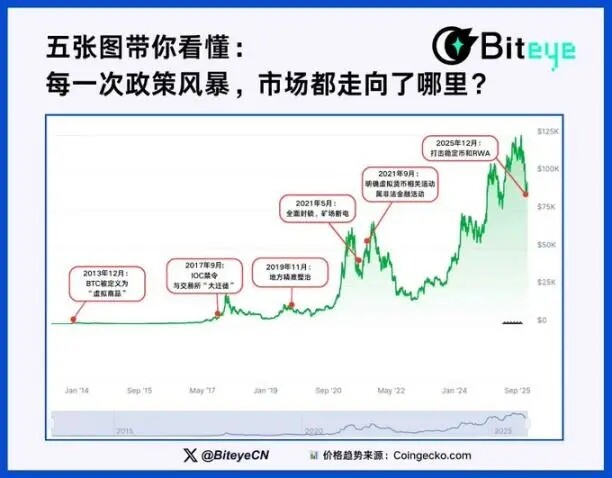
Regulatory actions are characterized by distinct "timing." Policies often drop when market enthusiasm reaches a peak or local top, aiming to cool down overheating risks. However, the long-term effects of policies are diminishing.
The binary pattern of "Eastern strict defense" and "Western dominant pricing" may become the new norm in the crypto world.
Tether Financial Analysis: Needs an Additional $4.5 Billion in Reserves to Maintain Stability
Assuming Tether's excess reserves are about $6.8 billion, its total capital adequacy ratio (TCR) will fluctuate between 10.89% and 3.87%, holding enough capital buffer to withstand 30%-50% price fluctuations of BTC, thus the USDT collateral level can basically meet the minimum regulatory requirements.
If held to a higher standard akin to large banks, Tether may need an additional approximately $4.5 billion in capital to maintain the current USDT issuance scale.
The cheaper the price, the more seriously it should be studied, rather than easily dismissed.
Current bears see short-term structural risks: excessively high distribution costs, dependence on interest rate paths, supply pressure from unlocks, and potential impacts from marginal changes in tax systems and regulations;
Bulls bet on structural dividends over a longer time frame: the migration of global settlement demand, the institutionalization process of compliant stablecoins, and the "quasi-infrastructure attributes" once networked products are formed.
Also recommended: "Securities or Commodities? A Decade-Long Tug-of-War Ends, 'Cryptocurrency Market Structure Bill' Rushes to the Senate."
Airdrop Opportunities and Interaction Guide
2025 Survival Rules for Yield Farming: Once a Land of Gold, Now Relying on These Two Cards
Looking back at 2025, the yield farming track has rapidly fallen from "wealth myths" into "winter involution." Altcoin returns are limited, and yield farming methods have diversified.
Future focus should be on new listings and stablecoin wealth management. Instead of recklessly opening high-leverage contracts on exchanges and blindly hoarding a bunch of altcoins, it is better to focus on refining "premium accounts" and steadily accumulating wealth.
Also recommended: "Zama Public Sale Too Complicated? Understand the Sealed Dutch Auction Play in One Article," "Review of Recent 7 Hot New Listing Projects," "Popular Interaction Collection | StandX Launches Mainnet Points Activity; 'Trump Game' Waitlist Application (December 12)."
Bitcoin
Decoding the financial backers of Bitcoin Core and Bitcoin developers.
Several issues exist within the Bitcoin developer ecosystem: a low number of active developers, insufficient funding amounts, concentration of funding organizations in specific jurisdictions, a gap in Asia, high concentration of maintainers (in 2024, three maintainers belonged to the same company, but this issue has improved), scarce employment opportunities (most funding is still in the form of grants), concentrated funding sources, and weak sustainability.
CeFi & DeFi
Treasury companies did not bottom-fish during this downturn; the silence behind this is not simply due to "ammunition" being exhausted at highs or falling into panic, but rather a systemic paralysis of the financing mechanism that heavily relies on premiums during downturns.
When stock prices drop too much, the "ammunition depot" (convertible notes and ATM issuance mechanisms) gets locked. Beyond issuing bonds and selling stocks, there is a more direct "ammunition depot," which is cash reserves. In total, the "nominal ammunition" (cash + ATM limits) on the books of various companies amounts to hundreds of billions of dollars, far exceeding the last bull market. However, in terms of "effective firepower," the actual bullets that can be fired have decreased.
DAT is shifting from "leverage expansion" to "interest-seeking survival."
What Did Smart Money See in Aggressively Buying AAVE at Low Levels?
Aave's revenue model is gradually entering a mature phase, GHO opens the second growth curve of vertical integration, and the buyback mechanism begins to form real and quantifiable deflationary constraints on the supply side.
a16z Predicts Decentralized Payments Will Become Mainstream, and Here Is My Judgment
Stablecoin "gateways" are undergoing revolutionary changes; RWA assets and stablecoins are merging, giving rise to on-chain lending services; the internet-as-bank model is arriving, with AI Agents, x402 protocols, and stablecoins providing more possibilities; entering an era of universal finance, investment thresholds are further lowered; the competition among stablecoins will continue, and user dividends will always exist.
Prediction Markets
How to Build a Polymarket Earning Bot from Scratch
Web3 & AI
The concept of x402 is to have the Facilitator act as the "execution agent" for on-chain transactions. It is responsible for verifying signatures, covering gas fees, submitting transactions, and handling on-chain details, while the payer only needs to submit a signature to the Facilitator, without needing to complete on-chain operations directly. For both buyers and sellers, this greatly simplifies the payment steps, as the Facilitator resolves trust and settlement issues for them.
x402 is inherently suitable for high-frequency, fragmented collaboration scenarios between machines.
However, the x402 protocol is heavily reliant on Facilitators like Coinbase. While it simplifies development, it also introduces single-point risks, and currently, the x402 protocol does not have a built-in refund mechanism.
At present, the biggest beneficiaries of AI Agents are still the developers themselves, which also brings a breakthrough in capabilities from 0 to 1 for non-technical personnel to some extent.
SocialFi
Farcaster Turns Around, "Binance Square" Takes Over Crypto Social
Farcaster co-founder Dan Romero announced that the platform is abandoning its "social-first" strategy that it has adhered to for four and a half years, shifting to a wallet-centric growth model. The pivot of the "flag bearer" of SocialFi may indicate that Farcaster lacks genuine product-market fit.
The approach of "not being obsessed with decentralization and finance, but focusing more on social aspects" and "first building social scenarios, then developing social applications" is being promoted by centralized exchanges (CEXs).
Weekly Hot Topics Recap
In the past week, the U.S. CFTC launched a digital asset collateral pilot program, allowing Bitcoin, Ethereum, and USDC to be used as margin in the derivatives market (interpretation); Binance received full regulatory authorization from Abu Dhabi Global Market and will fully migrate to the ADGM regulatory framework;
Additionally, in terms of policy and macro markets, the U.S. Bureau of Labor Statistics: will not release October PPI data, instead releasing it together with November data in January next year; Trump plans to replace personal income tax with tariff revenue; Do Kwon was sentenced to 15 years in prison by a U.S. judge; the SEC concluded a two-year investigation into Ondo Finance, paving the way for its expansion in the U.S. tokenized asset space; SEC Chair Gary Gensler stated that most types of ICOs do not fall under securities and will not be under SEC regulation; Trump announced allowing Nvidia to sell H200 chips to China, with a 25% export share; CCB responded to the transfer note "Dogecoin" being locked: triggering risk monitoring will restrict account transactions; Hong Kong launched CARF cryptocurrency tax consultation to combat tax evasion; South Korea plans to require cryptocurrency exchanges to bear "no-fault compensation obligations", with Upbit's hacking incident serving as the catalyst;
In terms of opinions and statements, Bitwise CEO stated that the crypto four-year cycle has ended, and 2026 will see a massive increase; OKX Star: 50% of global economic activity will run on blockchain in the future; a16z Crypto annual report: decentralized payment systems may see widespread application in 2026; 10X Research predicts that the market will experience "extreme information asymmetry and obvious arbitrage windows," with profits driven by a few elites, while most participants are more like "emotional bettors"; industry leaders debated the blockchain moat; Jupiter Lend and Kamino debated the definition of "risk isolation"; the Solana Foundation president called for ecological lending protocols to stop infighting and focus on expanding the market; Strategy CEO: the company will hold Bitcoin at least until 2065, maintaining a long-term accumulation strategy; Polymarket CEO: currently in loss-making operations, expanding market share is the top priority; Vitalik: a on-chain gas futures market should be established to predict and hedge future fee risks; Framework co-founder: VCs like Paradigm and a16z have all liquidated their SKY positions, and only we are still heavily invested; a16z: "inefficient governance" and "dormant tokens" are two major issues leading to BTC facing a more severe quantum threat; Jensen Huang: Bitcoin is converting "excess energy" into a portable form of currency; Ondo Finance: the platform's stock token liquidity comes from NASDAQ and NYSE, not from AMM pools, with large-scale trades approaching 0 slippage;
In terms of institutions, large companies, and leading projects, YouTube will allow U.S. creators to receive earnings through PayPal stablecoins; Western Union will launch a payment card that supports stablecoin preloading, primarily targeting high-inflation economies; Hashkey disclosed IPO details: planning to raise up to HKD 1.67 billion, set to be listed on December 17; Coinbase may launch prediction markets and tokenized stocks on December 17; Coinbase has restarted user registrations in India and will launch fiat deposit channels next year; Robinhood acquires a licensed brokerage and crypto trader in Indonesia, officially entering the Southeast Asian market; Robinhood expands its crypto product line, launching futures, staking, and tokenized stocks, and announcing its Layer-2 scaling network; Stripe and Paradigm open the Tempo blockchain to the public, adding Kalshi and UBS as partners; MetaMask launches mobile perpetual contract trading, supporting various assets including U.S. stocks, with technical support from Hyperliquid; Sei clarifies details of its collaboration with Xiaomi smartphones, with plans to launch app-specific features; the five major platforms Kalshi, Crypto.com, Robinhood, Coinbase, and Underdog jointly establish a prediction market alliance aimed at the compliant development of prediction markets; STABLE tokens are open for application; Farcaster announces a strategic transformation, shifting focus from social scenarios to wallet-driven growth;
In terms of data, a Sygnum survey found that 60% of high-net-worth investors in Asia-Pacific plan to increase their allocation to crypto assets, with an average holding ratio of 17%; Caixin reported that last year 3,032 people were prosecuted for money laundering involving cryptocurrencies, and the current task is to raise the overall awareness of virtual currency risks in society; HashKey Holdings' public offering was nearly 148 times oversubscribed; Uniswap CCA's first auction has concluded, with bids totaling $59 million;
In terms of security, He Yi's WeChat was hacked, and the meme coin Mubarakah surged briefly in the Moments; He Yi stated that he will airdrop BNB to users who suffered losses due to the WeChat hack… Well, it has been another eventful week.
Attached is the Weekly Editor's Picks series.
See you next time~
免责声明:本文章仅代表作者个人观点,不代表本平台的立场和观点。本文章仅供信息分享,不构成对任何人的任何投资建议。用户与作者之间的任何争议,与本平台无关。如网页中刊载的文章或图片涉及侵权,请提供相关的权利证明和身份证明发送邮件到support@aicoin.com,本平台相关工作人员将会进行核查。


