Abstract
Equity in unlisted companies is a trillion-dollar segment in global asset allocation, but it has long been constrained by the "high participation threshold" and "narrow exit channels," ultimately leading private equity (PE) and venture capital (VC) institutions to face severe liquidity challenges. Equity tokenization, as a key application of the real-world asset (RWA) wave, offers a new path to address this structural dilemma. This report aims to explore the current market status, core models, key bottlenecks, and future trends of equity tokenization in unlisted companies, assessing its potential to empower PE/VC exits.
Research findings:
(1) The market status presents a stark contrast between "trillion-dollar potential" and "tens of millions in reality." Although the total valuation of unicorn companies has exceeded $5 trillion, the current market value of tradable equity tokens is only in the tens of millions, indicating that the market is still in its very early stages, with targets highly concentrated in leading companies.
(2) The market has differentiated into three mainstream models: native collaborative (compliant but with few implementations, such as Securitize), synthetic mirror (pure derivatives, such as Ventuals), and SPV indirect holding (such as PreStocks, Jarsy).
(3) The SPV model, as a pioneering force that has validated market demand, demonstrates high flexibility; although the current market faces challenges in regulatory compliance, liquidity depth, and IPO endpoint connections, this also drives it towards more mature models.
This study believes that the future evolution of the market will not be a simple model replacement but rather a fusion and transformation. The core driving force of the market will be the change in attitude of unlisted companies (issuers)—as Web3 becomes increasingly mainstream, physical enterprises will begin to actively view tokenization (STO) as a new and efficient financing and market value management tool, shifting the market from one-way exploration to two-way collaboration. Meanwhile, the true blue ocean of tokenization is not the super unicorns but rather the broader long-tail of mature private enterprises seeking exit paths, whose scaled explosion will depend on the maturity of native RWA liquidity infrastructure.
Keywords: unlisted company equity, real-world assets, tokenization, PE/VC exit, SPV
01 Introduction
Equity in unlisted companies, especially in rapidly growing unicorn companies, is an important asset segment in the global economy. However, investment opportunities and significant gains in these high-value assets have long been primarily enjoyed by professional institutions such as private equity (PE) and venture capital (VC), limited to a few institutions and high-net-worth individuals, making it difficult for ordinary investors to participate. In recent years, the rise of blockchain technology has made the tokenization of equity in unlisted companies possible, allowing for the issuance of digital tokens on the blockchain to represent these equity shares, potentially changing the game rules of the traditional private market. Tokenization is seen as a bridge connecting traditional finance (TradFi) and decentralized finance (DeFi), and is an important part of the wave of real-world assets (RWA) going on-chain.
This trend is driven by enormous market potential. According to Boston Consulting Group (BCG), the on-chain RWA market could reach $16 trillion by 2030. Citigroup also pointed out that the tokenization of private markets is expected to surge 80 times this decade, approaching $4 trillion. The massive market forecasts reflect high expectations in the industry for the prospects of tokenization. On one hand, unlisted companies (such as unicorns valued at hundreds of billions) contain immense value; on the other hand, blockchain tokenization technology is expected to break the barriers of the current private market, achieving higher efficiency and broader participation.
This article will delve into the background and current status of equity tokenization in unlisted companies, analyze the pain points of traditional markets, tokenization solutions and advantages, and outline major global platform cases, technological support, regulatory policies, and challenges faced, ultimately forecasting future development trends to help readers understand the financial innovation wave being led by this popular field.
02 Unlisted Company Equity Market: A New Blue Ocean for Tokenization
Equity in unlisted companies—especially in unlisted unicorn companies—is one of the largest and most liquidity-constrained islands in global asset allocation. It is this significant contrast between scale and efficiency that makes it a new blue ocean with immense imaginative potential in the wave of asset tokenization (RWA).
2.1 Trillion-Dollar Fortress: The Value Landscape of Unlisted Company Equity
1. Asset Boundaries: What entities does unlisted company equity cover?
Unlisted company equity broadly refers to all company shares that are not traded on public securities exchanges. This is an extremely large and heterogeneous asset class, encompassing everything from early-stage startups to mature large private groups. Its holders include not only professional private equity (PE) and venture capital (VC) funds but also large founding teams, employees holding employee stock ownership plans (ESOP) or restricted stock units (RSU), and early angel investors.
As shown in the table above, among the holders of private equity, aside from strategic investors and founding teams, the vast majority of participants have a strong desire to liquidate their equity and obtain certain returns. Among them, the exit demand from private equity funds (PE) and early investors (such as angel investors and VCs) is particularly urgent. Additionally, employees holding equity incentives also have a practical motivation to realize options and "cash out" when considering leaving the company. However, under traditional pathways, aside from a few channels like company buybacks, the secondary market for private equity is not smooth, leading to a widespread structural dilemma of difficult exits and poor liquidity.
2. Scale Estimation: The Asset Volume of the Trillion-Dollar "Fortress"
First, it is important to clarify that there is currently no unified official data on the total volume of global unlisted company equity. This is mainly due to the inherent subjectivity and non-transparency of valuations in the primary market. Nevertheless, we can still estimate the scale of this market using key public data.
According to the data in the table above, we can estimate the enormous volume of this "fortress" from two dimensions:
First, from the perspective of assets under management (AUM), the total capital managed by global private equity (PE) and venture capital (VC) funds—being the main allocators of unlisted equity on the institutional side—has reached $8.9 trillion (i.e., $5.8T + $3.1T). Although this figure includes some dry powder from certain funds, it itself reflects the substantial capital that the institutional market has reserved for allocating such assets.
Second, from the perspective of asset valuation, the total market value of global "unicorn" companies (private companies valued over $1 billion) has already reached the trillion-dollar level. As shown in Table 2, the data from Hurun Research Institute indicates $5.6 trillion. Although results from different data sources vary slightly—for example, CB Insights statistics show that as of July 2025, the cumulative valuation of 1,289 unicorn companies globally exceeds $4.8 trillion—these figures all confirm this enormous scale.
Figure 1 lists the top ten unicorns globally ranked by valuation according to CB Insights, with OpenAI (valued over $500 billion), SpaceX (valued at $400 billion), and ByteDance (valued at $300 billion) at the top.
It is important to emphasize that whether it is $4.8 trillion or $5.6 trillion, this only represents the thousands of leading companies at the top of the pyramid; the vast value of tens of thousands of mature private enterprises and growth-stage companies that have not reached unicorn status has yet to be accounted for.
In summary, the actual total value of the global private equity market is a massive fortress far exceeding several trillion dollars. This astonishing scale of assets, which is high in value but low in liquidity, undoubtedly provides an imaginative application prospect for tokenization.
2.2 The "Fortress" Dilemma: The "Participation" and "Exit" Challenges of High-Value Assets
The unlisted company equity market contains enormous value worth trillions of dollars, but this potential has not been released under traditional models. Due to the lack of effective value transfer channels, this market has instead become a "fortress": its vast value is firmly bound by the structural dilemmas of "difficult exits" and "difficult participation." It is this significant friction between high value and low efficiency that constitutes the fundamental market driving force for equity tokenization in unlisted companies.
"Difficult participation" stems from the high entry barriers. Unlike the public market, investment opportunities in unlisted company equity are strictly limited to a "small circle" of "accredited investors" or institutional investors in almost all jurisdictions. Minimum investment thresholds often reach hundreds of thousands or even millions of dollars, along with stringent requirements for personal net worth, creating a high wall that excludes the vast majority of ordinary investors from this high-growth dividend. This not only solidifies inequality of opportunity but fundamentally restricts the capital supply and breadth of the market.
"Difficult exits," on the other hand, are due to the extremely scarce liquidity outlets. For holders within the "fortress"—whether early angel investors, VC/PE funds, or employee teams holding equity incentives—their exit paths are highly narrow and lengthy. Traditionally, exits heavily rely on two endpoint events: initial public offerings (IPOs) or mergers and acquisitions (M&A). However, the trend of unicorn companies delaying their public listings has made it common for investors to face lock-up periods of up to ten years, with substantial wealth remaining in a paper value state. Meanwhile, private secondary market transfers outside of IPOs represent an inefficient, high-friction narrow door: they heavily depend on offline intermediaries for matchmaking, have opaque processes, and are accompanied by cumbersome legal due diligence, high transaction costs, and lengthy settlement periods.
It is this dual dilemma of "not being able to enter" and "not being able to exit" that jointly constructs the fortress shape of the unlisted company equity market, leading to the deep locking of trillions of dollars in value. This sharp contradiction between high value and low efficiency provides the most urgent and imaginative application scenarios for tokenization technology.
2.3 Mechanism Restructuring: The Core Advantages of Tokenization Empowering Unlisted Company Equity
Faced with the fortress dilemma analyzed above, tokenization technology offers not just a simple fix but a systematic solution that fundamentally reshapes the value chain of unlisted company equity. Its core function goes far beyond passively addressing the frictions of "participation" and "exit"; it actively introduces new market mechanisms and valuation paradigms.
First, the primary advantage of tokenization lies in the establishment of continuous secondary liquidity, thereby breaking the stalemate of the fortress. This is reflected in two aspects:
• For external investors: Tokenization significantly lowers the investment threshold by finely splitting high-value equity shares, breaking the previous "participation difficulty" dilemma and opening up participation channels for a broader range of compliant investors. This is fundamentally different from the tokenization of listed stocks (such as U.S. stocks): the tokenization of stocks primarily optimizes trading convenience (such as 24/7 trading), while the tokenization of unlisted company equity fundamentally achieves the "breaking of boundaries" for asset classes under compliance—allowing compliant ordinary investors to access high-growth investment targets for the first time—enabling ordinary people to easily purchase equity in OpenAI.
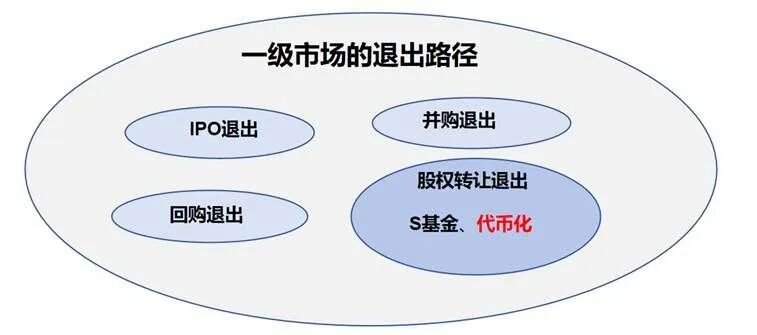
• For internal stakeholders: It is expected to open up a brand new exit path. Beyond traditional IPOs, company buybacks, mergers and acquisitions, or inefficient secondary equity transfers, stakeholders (such as employees and early investors) can transfer their equity through compliant tokenization platforms and "go on-chain," obtaining liquidity in a 24/7 on-chain market—this adds a new exit channel for traditional private equity and venture capital investors beyond IPOs and mergers, and this exit method can reach a broader base of ordinary investors.
Figure 4: Summary of Primary Market Exit Paths
 Source: Pharos Research
Secondly, tokenization brings a continuous price discovery mechanism, empowering proactive market value management. The valuation of traditional unlisted company equity relies on private financing rounds that occur every few months or even years, resulting in prices that are discrete, lagging, and opaque. The continuous secondary market trading brought about by tokenization provides unlisted company equity with high-frequency price signals that are close to those of public markets for the first time. This continuous price discovery mechanism means that its valuation is no longer a "blind box," allowing companies and primary market investors to price subsequent financing more fairly and engage in more reasonable proactive "market value management," significantly reducing the valuation gap between primary and secondary markets.
Finally, tokenization also opens up new financing channels, reconstructing the capital strategy for enterprises. Tokenization is not only a tool for the circulation of existing assets but can also become a new financing channel for incremental capital. High-growth companies (such as unicorns) can collaborate with professional Web3 project parties or tokenization platforms to bypass the lengthy cycles and high underwriting costs of traditional IPOs, directly issuing security tokens (STOs) to qualified digital investors globally. This digital listing model essentially revolutionizes the fundraising channels for enterprises, allowing them to access a larger and more diverse global capital pool. Currently, emerging platforms like Opening Bell are actively attempting to collaborate with unlisted companies to explore this cutting-edge fundraising path.
03 Market Status of Unlisted Company Equity Tokenization
3.1 Market Size and Overview of Target Assets
Currently, there is some difficulty in accurately measuring the overall market size for unlisted company equity tokenization. On one hand, some platforms (such as Robinhood) have not disclosed the complete market value data of their tokenized equity; on the other hand, synthetic contract products like Ventuals only exist as "open interest" and do not have a so-called "equity token market value." Therefore, this section primarily provides a macro estimate of the current market size by reviewing the market values of key products available in the public market (such as CoinGecko).
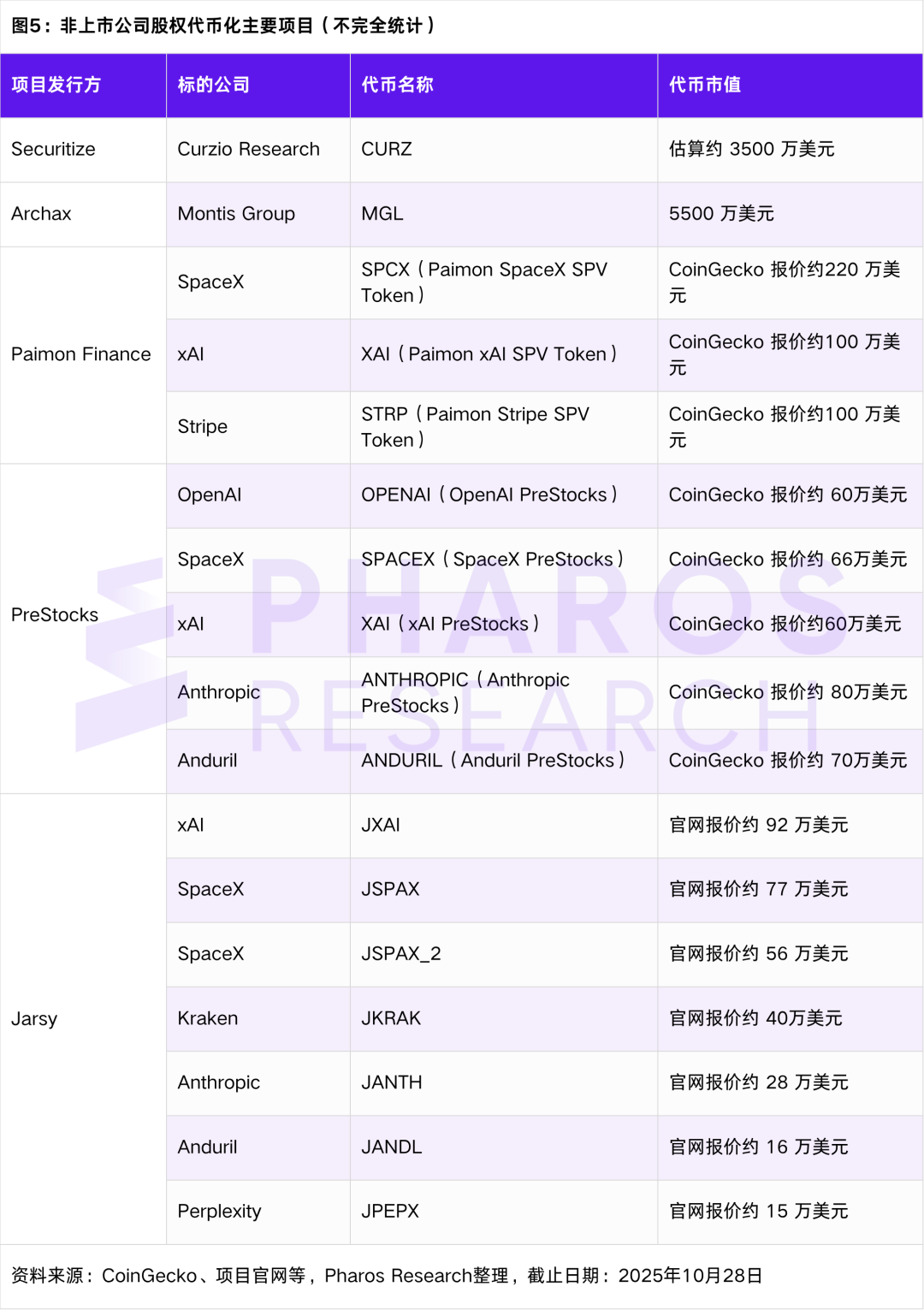
① The CURZ token trades on the tZERO (ATS platform), which has not publicly disclosed its total market value; the data in the table is estimated using "latest available price × total shares outstanding." Additionally, this product is not freely tradable in the traditional sense on DEX or CEX but circulates within an Alternative Trading System (ATS).
② The MGL token issued by Archax is part of the UK Financial Conduct Authority (FCA) digital securities sandbox project launched in July 2023. This asset is issued by Montis Group on the Hedera chain, with Archax providing custody; it is a tokenized equity but has not yet entered public circulation.
③ Some tokens issued by Jarsy include already listed stocks (such as NVIDIA and Tesla), but their total value locked (TVL) is generally low. Additionally, some tokens with market values below $100,000 are not included in the statistics.
Based on the incomplete statistics in the table above, the unlisted company equity tokenization market is still in its very early stages, with an estimated total market value of around $100 million to $200 million. Excluding Securitize and Archax, the total market size is expected to be in the tens of millions of dollars, representing a particularly niche market. The reason for excluding Securitize's CURZ and Archax's MGL is that the former trades in the alternative trading system (ATS) tZERO, while the latter belongs to a UK regulatory sandbox product, and neither currently possesses liquidity in the traditional crypto-native sense.
From a market structure perspective, shares are highly concentrated in compliant issued leading projects. The combined total of CURZ issued by Securitize and MGL issued by Archax accounts for over 60% of the total market volume.
In terms of underlying assets (excluding the special projects of Securitize and Archax), the current market's tokenized targets show a high degree of homogeneity, concentrated in top U.S. high-tech unicorn companies, especially in the AI sector. Companies like OpenAI, SpaceX, and xAI have become the most sought-after assets. This primarily reflects the tendency of project parties in the early stages of market cultivation to prioritize well-known companies that can attract investor interest. In contrast, although some project parties have indicated they are in talks with equity holders of Chinese-backed unicorns (such as ByteDance and Xiaohongshu), no actual landing projects have emerged yet.
3.2 Three Mainstream Models of Unlisted Company Equity Tokenization
Currently, the market has evolved three distinctly different implementation models in exploring the path of unlisted company equity tokenization. These models differ fundamentally in terms of compliance basis, asset attributes, and investor rights, with the third model—SPV indirect holding—being the mainstream model at present.
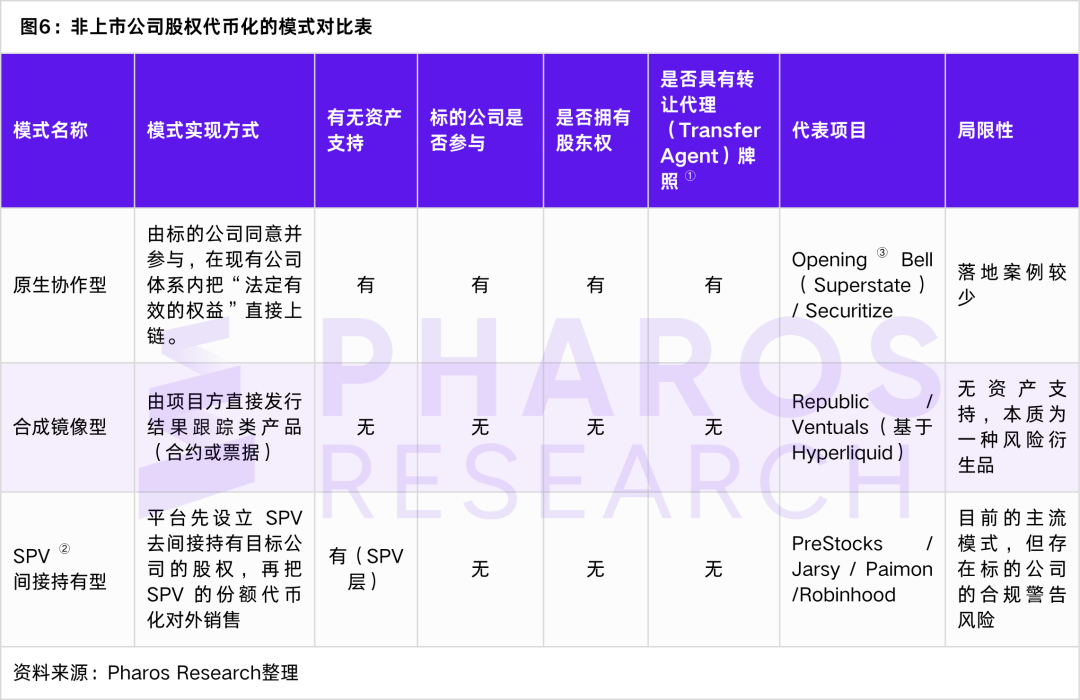
① A Transfer Agent license refers to a registration completed with the SEC for transfer agency, which has the authority to maintain, manage, and change the shareholder register. This is the compliant starting point for tokenizing equity in the U.S. The full set of compliance for securities issuance and operation by the SEC also requires a Broker-Dealer license and an Alternative Trading System license.
② SPV (Special Purpose Vehicle) is a common financial term referring to a "ring-fenced" company established for a specific transaction (or asset holding) to isolate risk; in simple terms, it is a "shell company."
③ Although Opening Bell adopts a method of collaborating with target companies to tokenize company equity, its current landing cases are all for listed companies, and its cooperation with unlisted companies remains at the promotional level without actual implementation.
1. Native Collaborative Model
This model is directly authorized and deeply involved by the target company (i.e., the unlisted company entity), registering and issuing "legally effective equity" directly on the blockchain. In this model, the on-chain token is the equity itself, and its legal effect is entirely equivalent to that of the offline shareholder register (specific rights are executed according to the company's articles of association and the laws of the relevant jurisdiction).
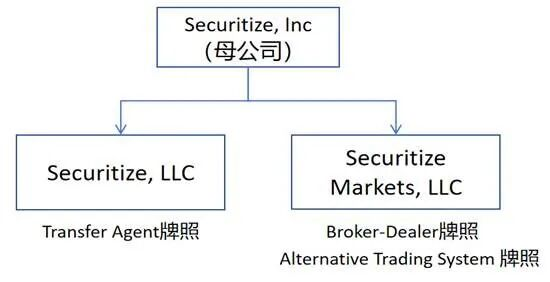
Therefore, token holders are registered as "registered shareholders" of the target company and typically enjoy full voting rights, dividend rights, and rights to information. The issuing platform must hold key financial licenses, such as a SEC-approved "Securities Transfer Agent" license, to legally manage and change the shareholder register. Representatives of this path include Opening Bell (which advocates for the "on-chaining" of statutory company stock) and Securitize (whose model is more applied to the compliant tokenization of fund shares and possesses a full set of licenses including Transfer Agent, Broker-Dealer, and Alternative Trading System).
However, there are currently limited landing cases for this model. Securitize has only a handful of landing cases, while Opening Bell's current landing cases are all for listed companies, and its cooperation with unlisted companies remains at the promotional level.
2. Synthetic Mirror Model
This model is typically issued unilaterally by third-party project parties without the permission of the target company. What is issued is not equity but synthetic derivatives (Synthetic Derivatives) that simulate the economic benefits of the target equity, such as "Contingent Value Notes" or on-chain perpetual contracts.
The tokens purchased by investors do not correspond to real shares, and holders will not be registered as shareholders, thus naturally lacking voting rights and dividend rights. The gains or losses for investors depend entirely on the contractual settlement with the issuer. Therefore, this model carries significant counterparty risk, price tracking errors, and severe regulatory uncertainty. Representatives of this path include Republic (with its mirror note-type tokens) and Ventuals (based on Hyperliquid's company valuation perpetual contracts).
3. SPV Indirect Holding Model
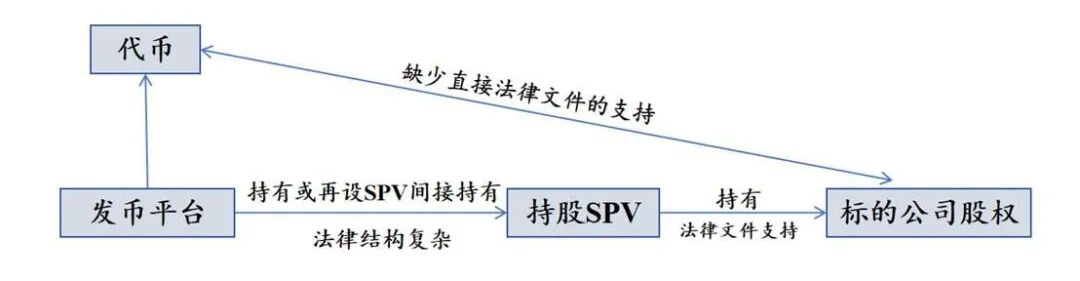
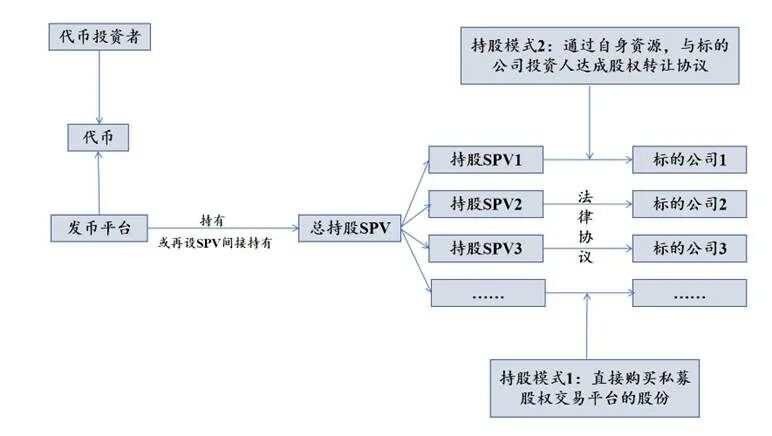
This model is the mainstream method of unlisted company equity tokenization at present and is a common workaround structure. The tokenization platform first establishes a "Special Purpose Vehicle" (SPV), which acquires and holds the real equity of the target company through the traditional private secondary market. The platform then tokenizes and sells the "equity shares" or "beneficial certificates" of the SPV (rather than the equity of the target company itself).
Figure 7: SPV Indirect Holding Issuer Structure Diagram
Source: Pharos Research
Under this structure, investors hold contractual economic rights to the SPV rather than the registered shareholder rights of the target company, and therefore typically do not enjoy voting rights in the operating company. This model essentially issues tokens based on the SPV's shareholding, supported by legal documents between the SPV and the target company's equity, but the tokenization of SPV shares attempts to bypass the direct permission of the target company.
This model carries risks of operational opacity and compliance warnings from the target company. Issuing platforms (project parties) often seek "regulatory arbitrage" by establishing complex offshore SPV structures. Their transparency is often one-sided: investors can usually only see proof of the SPV's "asset side," meaning that the SPV indeed holds the equity of the target company (through asset proof and custody documents); however, there is often a lack of transparency regarding the SPV's "liability side," which includes the operational status, financial health, and specific details of the token issuance by the project party, resembling a "black box." At the same time (as will be discussed in detail later), such operations have received legal warnings from some target companies (such as OpenAI). Representatives of this path include PreStocks, Jarsy, Paimon Finance, and Robinhood.
3.3 Implementation and Compliance Paths for Unlisted Company Equity Tokenization
The three models analyzed above (Native Collaborative, Synthetic Mirror, SPV Indirect Holding) differ in legal frameworks, investor rights, and risk exposure. This section will delve into their specific implementation methods and compliance paths.
1. Synthetic Mirror Model: Simulating Equity with Derivatives
The essence of synthetic mirror tokens is financial derivatives. Their value is not anchored to real equity but tracks the valuation performance of the target company through mechanisms similar to "Contracts for Difference" (CFDs). The implementation path typically involves "indexing" the valuation and dividing it into tradable contract units, which are then matched through on-chain protocols.
For example, Republic's Mirror Token is legally classified as a Contingent Payment Note, and its nature is that of a debt instrument—specifically, a debt note issued by the platform that is anchored to the valuation of unicorns. Ventuals is more direct, offering perpetual contracts based on Hyperliquid, which are purely contractual derivatives.
In terms of compliance, such tokens do not grant holders shareholder rights, leading to differentiated paths. Projects like Ventuals adopt a purely Web3 "regulatory evasion" approach, relying on the Hyperliquid protocol, which explicitly does not target U.S. investors. In contrast, Republic demonstrates a different compliance approach: its platform has a broad main business, a high level of compliance, and holds a Broker-Dealer license, with its Mirror Token (debt note) being issued as a security under U.S. securities law, clearly indicating whether specific products are open to U.S. investors.
2. Native Collaborative Model: Achieving True Equity on the Blockchain through Compliance
In the native collaborative field, market explorers are mainly concentrated in Securitize and Opening Bell. Opening Bell is a sub-project launched by Superstate, advocating for "issuer-coordinated true equity on-chain." Currently, its landing cases (such as Galaxy Digital and Exodus) involve target companies actively tokenizing their equity using the Opening Bell platform.
However, it must be noted that all of Opening Bell's current landing cases involve listed companies, not the unlisted companies that are the core focus of this article. Its cooperation with unlisted companies is currently limited to promotional levels, with no actual projects having landed. Therefore, under the native collaborative model, Securitize's path is currently a more valuable reference case for analyzing unlisted company equity tokenization.
• Securitize was established in 2017 and focuses on infrastructure services for RWA tokenization. The core of its business model is to transform traditional financial assets such as company equity and fund shares into compliant digital securities that can be issued, managed, and traded on the blockchain, providing a full-service process from primary market issuance to secondary market trading.
• To achieve this business closed loop, Securitize holds three key licenses—Transfer Agent (TA), Broker-Dealer (B-D), and Alternative Trading System (ATS)—under the regulatory framework of the U.S. SEC and FINRA, forming a complete compliance qualification.
Figure 8: Securitize's Compliance License Structure Diagram
Source: Securitize Official Website
Securitize's practice provides two directions for unlisted companies: one is the tokenized IPO path represented by Exodus; the other is the long-term circulation path in the private market represented by Curzio Research.
Path One: From ATS to NYSE—Exodus's Tokenized IPO Method: The collaboration between U.S. crypto wallet company Exodus and Securitize serves as a benchmark case demonstrating the complete lifecycle of unlisted equity tokenization. As of November 1, 2025, the project's token market value reached $230 million, accounting for over 30% of the entire stock token market share. Its successful journey to a public exchange clearly illustrates the evolution of liquidity paths for tokenized equity at different stages of development.
(1) Project Journey: The collaboration between U.S. crypto wallet company Exodus and Securitize serves as a benchmark case demonstrating the complete lifecycle of unlisted company equity tokenization. As of October 2025, the project's token market value reached $230 million, making it an important part of the tokenized stock market. Its successful journey to a public exchange clearly illustrates the evolution of liquidity paths for tokenized equity at different stages of development.
• Exodus's tokenization began in 2021 when the company, as an unlisted entity, collaborated with Securitize to mint its Class A common stock as "equity tokens" on the Algorand chain using its DS protocol. Throughout this process, Securitize served as its core Transfer Agent (TA), responsible for the creation, maintenance, and destruction of all tokens.
• Subsequently, the project underwent a series of key developmental milestones: from initially supporting peer-to-peer transfers only between whitelisted wallets to launching on Securitize Markets and tZERO (both ATS platforms) for compliant trading; ultimately, in December 2024, Exodus successfully listed on the New York Stock Exchange (NYSE American) under the ticker symbol "EXOD," officially making its tokenized equity a publicly traded security. After the listing, to expand asset reach, Exodus announced in 2025 a partnership with Superstate's Opening Bell platform to further extend its stock tokens to the Solana and Ethereum networks, while Securitize's core position as Transfer Agent remained unchanged.
(2) Liquidity Realization Mechanisms for Exodus Products at Different Stages: Depending on the different stages of the asset, the liquidity realization mechanisms for Exodus stock tokens can be primarily divided into the following three:
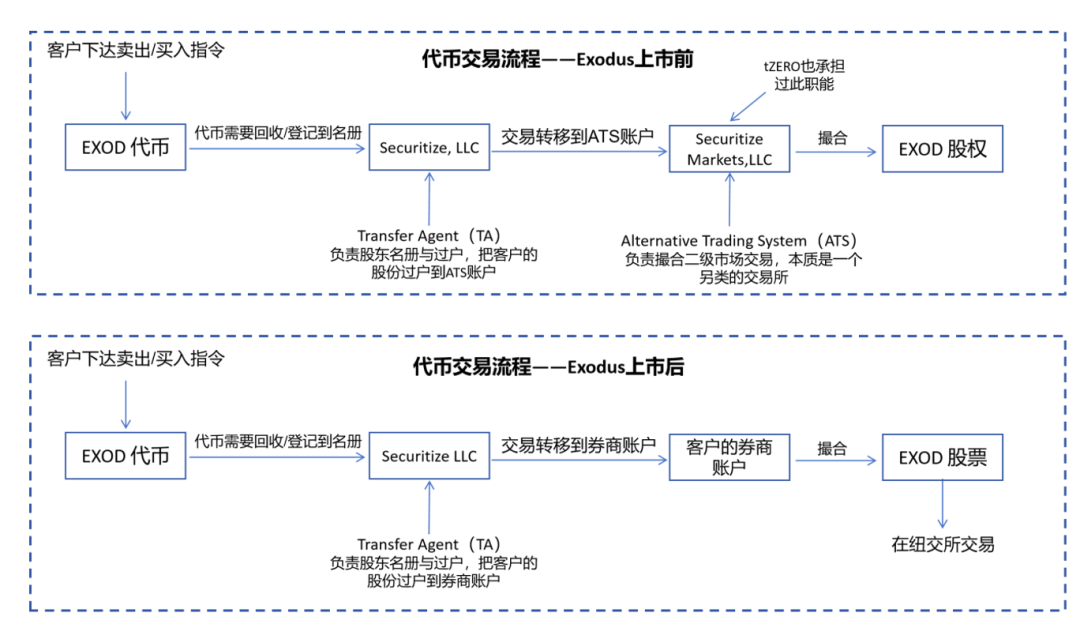
• Pre-Listing (2021-2024): Circulation through ATS platforms: Before going public, the main liquidity channel for the token was licensed Alternative Trading Systems (ATS). The standard process was as follows: investors first needed to deposit their tokens with the Transfer Agent (Securitize) to update the shareholder register, after which the agent would transfer the corresponding holding records to the ATS broker (such as tZERO Markets or Securitize Markets). Finally, investors would submit trade instructions through the corresponding ATS platform, with the system completing the matching and settlement.
• Post-Listing (December 2024-Present): Conversion to Public Market Stock: After successfully listing on the NYSE American, the token gained access to the public market. The standard process was as follows: investors would hand over their tokens to the Transfer Agent Securitize, which would assist in converting the tokens into traditional registered shares (i.e., street name holdings) in their personal brokerage accounts. Once the conversion was complete, investors could trade the stock on the public market under the ticker symbol "EXOD" through their brokers.
Figure 9: Token Trading Process for Exodus Before and After Listing
Source: Paramita Venture
• Basic Path: Compliant Over-the-Counter (OTC) Transfers: As a consistently existing underlying trading method, tokenized EXOD stock also supports compliant over-the-counter (OTC) or peer-to-peer (P2P) transfers. The core premise of this path is that both parties' wallet addresses must be verified through the whitelist of the Transfer Agent Securitize. The transaction price and payment consideration are negotiated offline by both parties and then executed on-chain for token transfer. It is noteworthy that during the transition period from the project delisting from ATS to officially landing on the NYSE, this compliant OTC path was the only liquidity realization method at that time.
Path Two: Long-Term Circulation in the Private Market—Curzio Research's ATS Norm: Although Exodus's listing path outlines the most ideal blueprint, for the vast majority of unlisted companies, conducting private circulation within ATS platforms may not be a transitional phase toward an IPO but rather its long-term final form. The case of U.S. investment research company Curzio Research profoundly reflects this common reality.
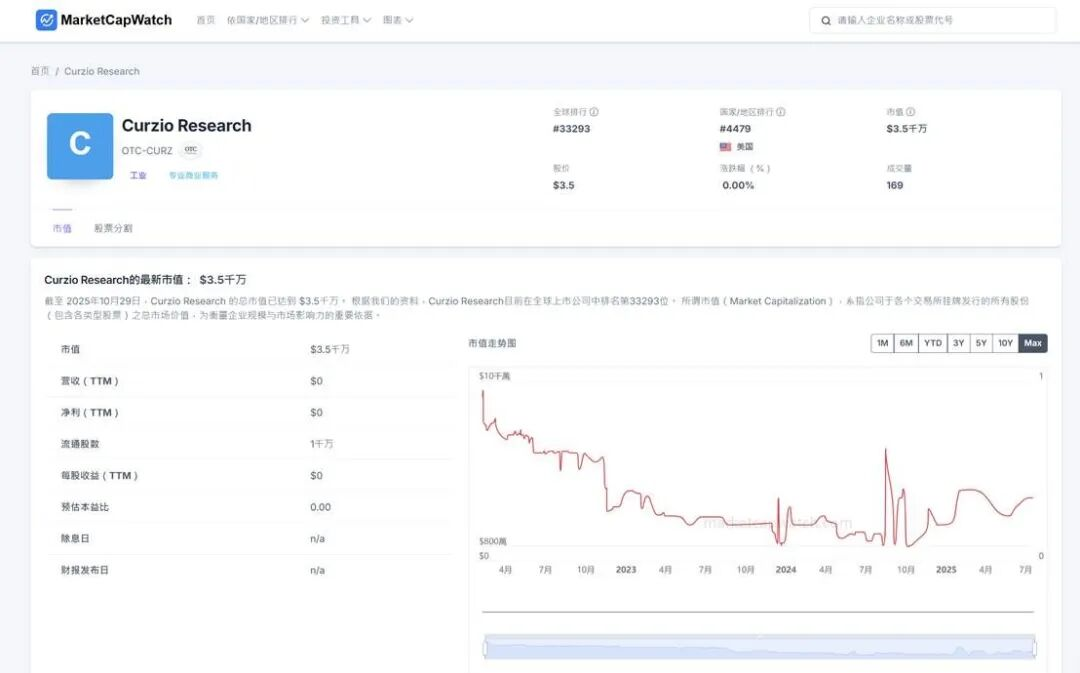
• The company tokenized its equity into CURZ tokens through Securitize and continues to trade on the tZERO ATS platform for qualified investors. The core value of this model lies in providing a compliant, continuous, yet limited liquidity secondary market for a large number of private enterprises that cannot or do not intend to go public, addressing the critical exit challenges for early shareholders.
• Its market value trend (as shown in Figure 6) also confirms the characteristics of private circulation on the ATS platform: after its issuance in 2022, the CURZ token market value experienced a long-term decline, bottoming out in early 2024. Subsequently, its market value entered a high volatility range, exhibiting typical characteristics of a "thin market" with scarce liquidity and low price discovery efficiency, contrasting sharply with the high liquidity of public markets like the NYSE.
Figure 10: Curzio Research Token Market Value Trend Chart (Trading on ATS Platform)
Source: MarketCapWatch
3. SPV Indirect Holding: The Mainstream "Regulatory Arbitrage" Path
SPV indirect holding is currently the most mainstream practice model in the field of unlisted company equity tokenization. Its core structure involves the issuing platform establishing a (typically offshore) Special Purpose Vehicle (SPV), which holds the equity of the target company through the private secondary market, and the platform then tokenizes the SPV's beneficial certificates.
In terms of asset acquisition, the SPV primarily obtains the target equity through two paths:
• One is to leverage the issuer's core resources in the traditional PE/VC field to directly acquire shares from private equity funds or venture capital funds that hold the target company's equity. In this structure, the holding SPV typically acts as a new LP (limited partner) in the fund, holding indirectly.
• The second is to purchase through private equity secondary market platforms (such as EquityZen, Forge Global, Hiive). Although this path is more standardized, it may also incur additional legal structure costs and compliance risks.
Figure 11: SPV Indirect Holding Token Issuance Structure Diagram
Source: Pharos Research
The key to this model lies in circumventing the transfer restrictions in the target company's shareholder agreement. Since the shares acquired by the SPV are usually small, and the transaction (as in the first path) may be viewed as an internal LP share transfer within the investor's fund, it often does not require reporting to the target company. This provides the platform with temporary legal operational space to bypass the target company's permission.
However, the operation of this model often has a lack of transparency. The issuing platform utilizes complex offshore SPVs, which can only provide one-sided transparency: investors can only verify the SPV's asset holdings (the target equity), while the project party's financial health and operational details remain in a "black box." This lack of transparency is also specifically reflected in its issuance model, with common market operations divided into two categories:
• "Buy First, Issue Later" Model: This refers to the project party (and its subordinate SPV) using its own funds to first purchase the target company's equity, and then tokenizing the equity shares held by the SPV to sell to the public to recoup funds. This model is relatively robust, as the assets have been secured in advance.
• "Issue First, Buy Later" Model: This refers to the project party first issuing tokens to raise funds, then committing to use the raised funds to purchase the target company's equity. This model carries higher risks, as the project party may face insufficient fundraising, price fluctuations of the target assets, or even the inability to acquire the assets, creating significant uncertainty for investors.
Of course, this operational lack of transparency is relative. Compared to "synthetic mirror" derivatives that have no asset backing, the SPV model at least provides tangible equity asset backing, thus offering relatively higher asset stability.
However, what truly raises concerns about this model is not its internal operational risks, but the external legal and compliance challenges faced by its "regulatory arbitrage" structure. Due to the project party's unauthorized tokenization actions being publicly opposed by some target companies (such as OpenAI), SPV holdings under this "regulatory arbitrage" model often face dual restrictions from compliance regulation (from the government) and corporate legal affairs (from the target company). This will be discussed in detail in the following sections.
免责声明:本文章仅代表作者个人观点,不代表本平台的立场和观点。本文章仅供信息分享,不构成对任何人的任何投资建议。用户与作者之间的任何争议,与本平台无关。如网页中刊载的文章或图片涉及侵权,请提供相关的权利证明和身份证明发送邮件到support@aicoin.com,本平台相关工作人员将会进行核查。


