Author: Claude, Deep Tide TechFlow
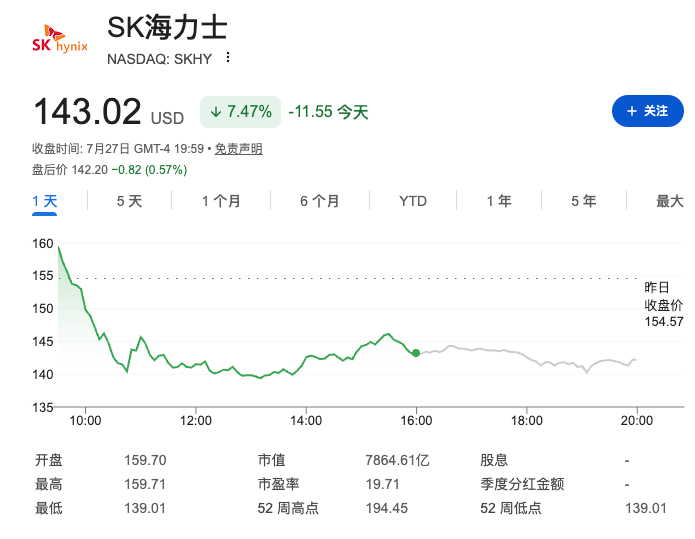
Deep Tide Guide: SK Hynix's US stock ADR fell to a low of $139.01 during intraday trading on July 27, closing at $143.02, below the issuance price of $149, just 17 days after going public on July 10, marking the largest foreign IPO in history. During the same period, the xyz:SKHX perpetual stock on Hyperliquid fell 8.47% to $1086.5 in 24 hours, briefly dropping to around $1007 just before and after the Seoul opening, with a 24-hour trading volume of $906 million. The previous day, Yangtze Memory Technologies surged 466% on its debut on the sci-tech innovation board.
Priced on July 9, listed on July 10, and breaking the issue price on July 27. SK Hynix’s $26.5 billion financing went from "the largest foreign company IPO in history" to falling below the issue price in just 17 days.
According to Bloomberg’s report on July 27, SK Hynix’s ADR fell by as much as 10% during the day, hitting a low of $139.01, and closing at $143.02, 4% lower than the issue price of $149. This marked the first time the stock closed below its issue price since listing, associating it with Musk's SpaceX as it became the first name among this year’s largest newly listed stocks in the US to break its issuance price.
The reaction on the chain is earlier and more intense.
17 Days after Listing, the Largest Foreign IPO of $26.5 Billion Falls Below the Issue Price
On July 9, SK Hynix issued 177.9 million ADRs at a price of $149 each, raising approximately $26.5 billion, surpassing Alibaba's 2014 US listing, setting a historic record for foreign companies' IPOs in the US. Each ADR corresponds to one-tenth of the ordinary shares listed in Seoul.
On its first trading day, July 10, it opened at $170, closing at $168.01, a rise of 12.76%, and with a total market value of approximately $1.22 trillion based on the closing price.
Afterward, it was a complete rollercoaster. On July 13, the Seoul stock price plunged more than 15% in a single day, the largest daily drop in nearly twenty years, with the KOSPI falling 9% and triggering a 20-minute circuit breaker; on July 14, the ADR surged to a peak of $193.92; on July 20, it fell back to $151.16; on July 27, it directly broke below the issue price.
On the same day, the Philadelphia Semiconductor Index closed at its lowest since May 19. Nvidia fell about 5% that day, and other new stocks such as Innio also fell below their issue prices.
For those who entered the secondary market on July 10, going from $168.01 to $143.02 represents a 15% paper loss; for those who picked it up at $193.92, the drop has reached 26%.
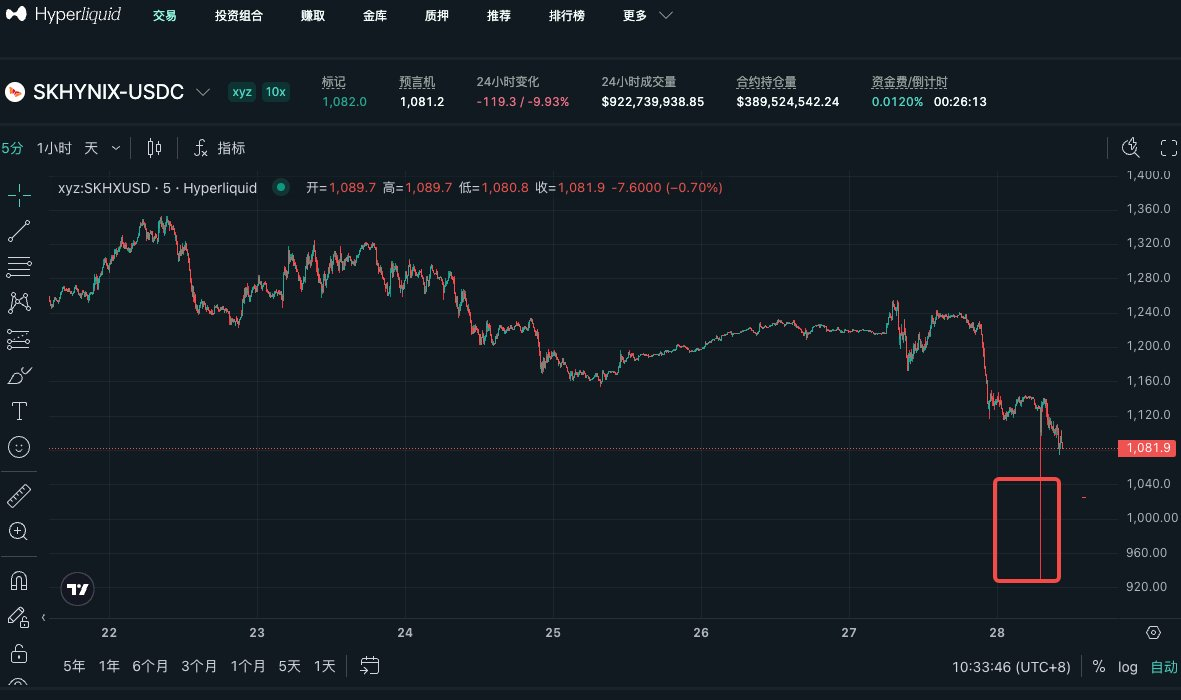
Hyperliquid Perpetuals Dive Simultaneously, Briefly Hitting Around $1007
There is a perpetual contract tracking SK Hynix on Hyperliquid, code xyz:SKHX (displayed as SKHYNIX-USDC on the front end), deployed by Trade.xyz through the HIP-3 framework, settled in USDC, with a maximum leverage of 10 times.
As of July 28, 10:09 (UTC+8), the contract marked price is $1086.5, with an oracle price of $1084.3, down $100.6 in 24 hours, a drop of 8.47%, with a 24-hour trading volume of $906 million and open contracts worth $380 million, with a funding rate of 0.0062%. Third-party data platform OAK Research showed readings of $1086.1, down 8.51%, trading volume of $914 million, open contracts of $388 million, and an open contract cap of $1 billion, with both sets of data aligning closely.
From the K line, on July 28 in the UTC+8 morning, there was an extremely long lower shadow reaching a low of about $1007, quickly pulling back to around $1080. This timing was close to the Seoul stock market opening.
The reason for the spike needs confirmation from chain transaction records, but the structural risks are clear: the forced liquidation of such contracts is calculated based on the marked price, and with 10 times leverage compounded by limited order book depth, the marked price can be briefly breached without waiting for traders to react. Positions made long will have vanished even if prices recover a few minutes later.
Yangtze Memory Technologies Surges 466% on Debut, Facing Selling Pressure from AI Financing and Chinese Rivals
On July 27, domestic DRAM leader Yangtze Memory Technologies (688825.SH) debuted on the sci-tech innovation board. With an issue price of 8.66 yuan, it opened at 49.50 yuan, a rise of 471.59%, hitting a maximum intraday price of 55.03 yuan, and closing at 49.00 yuan, a rise of 465.82%, with a total market value of 3.28 trillion yuan, surpassing Industrial and Commercial Bank of China to top the A-share market cap. Throughout the day, the trading volume was 141.1 billion yuan, with a turnover rate over 66%, both setting A-share individual stock records. Nomura Securities initially covered it with a buy rating and a target price of 116 yuan, corresponding to a market value of approximately 7.76 trillion yuan.
Yangtze holds about 7.7% of the global DRAM market share, up from about 3% a year ago.
According to a report by Reuters on July 28, Korean chip stocks plummeted that day, with Samsung Electronics and SK Hynix falling 9.5% and 11.1% during intraday trading, and the KOSPI dropping about 8% at Greenwich Mean Time 01:20. The two reasons provided were rising market concerns over financing risks behind AI infrastructure spending and intensified competition from China.
The bullish logic of the storage cycle remains unchanged. SK Hynix CEO Kuok-ru said earlier to Reuters that the storage industry is expected to face the most severe supply shortage by 2027. However, the supply side now has a competitor with a market value of 3.28 trillion yuan that is also raising 57.9 billion yuan for continued capacity expansion, which will inherently change the market’s valuation multiples for cyclical peaks.
On-chain Perpetuals Track Seoul Stock Prices, Not Nasdaq ADRs
According to Trade.xyz’s design, xyz:SKHX tracks the dollar-converted price of SK Hynix's ordinary share listed in Seoul (000660.KS), not the Nasdaq ADR's quotation. OAK Research’s page displays the related asset as 000660.KS, quoted at $1103.95, down 10.64%.
This creates a price disparity that needs attention. The current price of the on-chain contract at $1086.5 corresponds to one share of ordinary stock; one ADR equals one-tenth of a share, closing at $143.02 on July 27, translating to about $1430 per share. The difference is over twenty percentage points. Part of this is due to the time lag, as Seoul dropped another 10% on July 28 before the ADR opened; the remaining part is the pricing difference between the two markets, which cannot be fully explained with a single source at the time of publication.
This pricing mechanism by Trade.xyz is not a new concept. The perpetual CXMT for Yangtze Memory Technologies, launched on July 14, used the same framework, with the on-chain price briefly soaring to $8.64 before listing, corresponding to an implied market value far exceeding the approximately $85.5 billion calculated based on the issue price of 8.66 yuan. After Yangtze listed on July 27, the contract switched to being based on the actual A-share price using an external oracle. Such switches are inherently high-frequency points for price fluctuations and liquidations.
The conclusion is operational: the on-chain stock perpetuals provide a 24-hour exposure for those without US stock accounts, at the cost of bearing the triple risks of underlying volatility, cross-market price disparities, and oracle switches.
Those who go long on Hynix using this are watching the Seoul market, betting on the Korean storage cycle, while the liquidation price is determined by that spike on-chain.
免责声明:本文章仅代表作者个人观点,不代表本平台的立场和观点。本文章仅供信息分享,不构成对任何人的任何投资建议。用户与作者之间的任何争议,与本平台无关。如网页中刊载的文章或图片涉及侵权,请提供相关的权利证明和身份证明发送邮件到support@aicoin.com,本平台相关工作人员将会进行核查。


