Original author: Zhao Ying
Original source: Wall Street News
On July 6, the well-known semiconductor research institution SemiAnalysis released six tweets on platform X, revealing that Nvidia's Kyber NVL144 rack has been delayed by more than 12 months due to PCB midboard manufacturing issues. The Asian AI hardware supply chain responded with a significant drop.
Nvidia later responded that "the roadmap has not changed", but did not disclose specific progress details.
The controversy continues. On July 7, SemiAnalysis published another paid long article targeting Nvidia. But this time it no longer played the role of a "bearish" player.
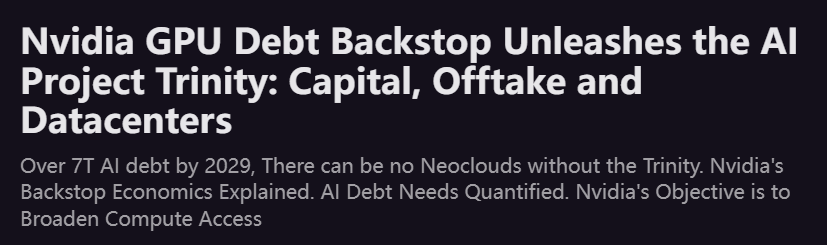
SemiAnalysis predicts: By 2029, the global AI debt financing scale will exceed 7 trillion dollars. What does 7 trillion dollars mean? It will become the second largest asset-backed debt market in the world, only after the U.S. mortgage market (approximately 13 trillion dollars).
What role does Nvidia play in this? SemiAnalysis disclosed Nvidia's strategic layout—"Backstop Plan." Nvidia is using its AA/Aa2 investment-grade credit rating to provide minimum income guarantees for AI computing power lessors, thereby leveraging bank loans. In other words, Nvidia acts as the ultimate lender and insurer for the entire AI ecosystem, putting a significant amount of sales on the books while taking on parts of the risk associated with insufficient downstream demand. SemiAnalysis compares Nvidia to a "central bank in the AI field."
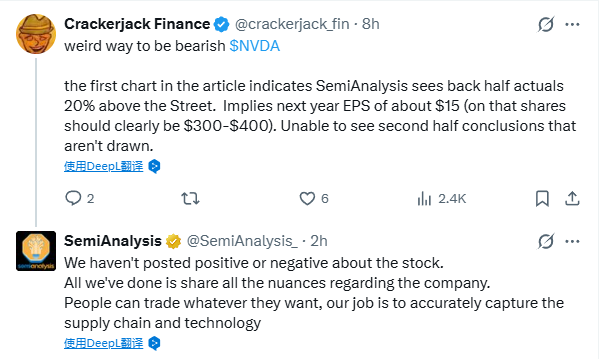
Regarding the discussion on platform X about whether SemiAnalysis is "bearish on Nvidia," the institution stated:
It has not published any positive or negative views on Nvidia's stock, but is only accurately capturing supply chain and technical details, allowing the market to trade on its own.
AI Debt Snowball: Surpassing 7 Trillion by 2029, Approaching the U.S. Mortgage Market
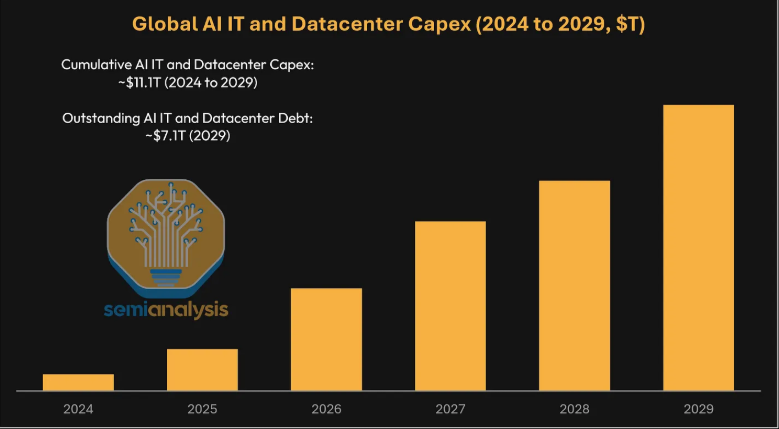
SemiAnalysis believes that infrastructure construction for AI is forming a credit market worth trillions of dollars. By 2029, AI-related outstanding debt may reach approximately 7.1 trillion dollars, surpassing other asset-backed debt markets in the U.S. aside from the mortgage financing market.
This portion of the debt mainly comes from two types of capital expenditures. One type is AI IT capital expenditures, including GPUs, networks, storage, and accompanying CPUs; the other type is AI data center capital expenditures, including the infrastructure required to support these GPUs, such as server rooms, power, and cooling.
In the past, cloud giants like Google, Amazon, Meta, Microsoft, and Oracle primarily relied on their cash flow to build AI clusters. However, in the past year, Oracle, Meta, and even Google have started to use more debt. As project scales continue to expand, the market constraint is no longer just whether they can obtain GPUs or simply find server rooms, but whether they can borrow money that is cheap enough and long-term enough.
SemiAnalysis concludes that the financing method for AI capital expenditures is changing. The balance sheets of cloud giants are not unlimited, and if all AI clusters rely on a few investment-grade cloud vendors' endorsements, new projects will eventually encounter credit bottlenecks.
The "Trinity" Predicament: Capital, Clients, and Data Centers Are All Indispensable
SemiAnalysis breaks down AI project financing into a "Trinity" of capital, underwriting contracts, and data centers.
First is capital. Lenders typically need to see long-term take-or-pay contracts from investment-grade cloud vendors, or similar credit guarantees, before they are willing to lend. In other words, what lenders truly value is not NeoCloud's own credit, but the credit of the client behind it.
Second is underwriting. NeoCloud must often prove it can pay the GPU deposit and secure the equipment to obtain clients. But, to obtain equity funding, it also needs to prove it has clients and loans. This makes projects prone to getting stuck in a cycle in the early stages.
Third is data centers. NeoCloud either convinces data center operators to lease capacity with client contracts and financing or builds its own data center. The latter carries greater funding pressure and longer cycles.
This model locks the market into a "5-year, cloud giant-backed" template. The problem is, many VC-backed AI startups and inference service providers need short-cycle, large-scale computing power rather than 5-year long-term contracts. Inference service providers, in particular, are unwilling to bear long-term price and demand risks; in many cases, they would rather forgo computing power than sign leases longer than one year.
Nvidia as the "AI Central Bank": Using AA Credit to Leverage the Entire Market
Nvidia proposed the "Backstop Plan," addressing this financing gap.
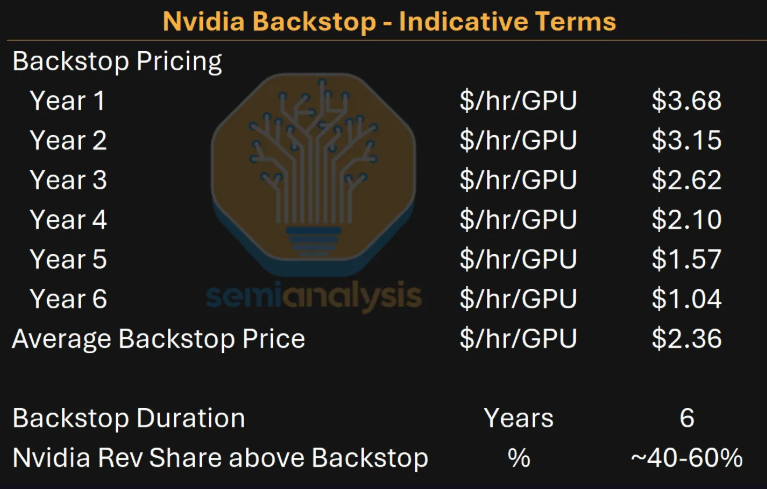
According to SemiAnalysis, Nvidia provides income guarantees for GPU rental revenues to NeoCloud. If third-party client demand is insufficient, Nvidia promises to purchase computing power at preset prices; if NeoCloud rents out computing power at higher prices, Nvidia shares part of the excess revenue.
Such arrangements typically last for 6 years, with minimum income guarantees provided based on a pre-agreed price curve for the underlying GPU capacity. NeoCloud can still rent computing power to any client and can offer more flexible lease terms. The Nvidia backstop is only triggered when market demand is insufficient and cannot rent at market prices.
This is the source of the "AI Central Bank" metaphor. Nvidia is not really issuing currency; rather, it is playing a role akin to that of a final buyer and credit guarantor in the AI computing power credit system. Lenders can assess project worst-case scenarios based on Nvidia's AA/Aa2 level credit, making them more willing to lend.
For Nvidia, this helps to expand the GPU buyer base. If the market can only rely on a few super-large cloud providers to sign 5-year underwriting contracts, GPU demand will soon collide with financing constraints; moreover, these cloud providers are using self-researched chips to hedge against Nvidia systems. By supporting NeoCloud and more enterprise clients, Nvidia is effectively opening new financing channels for GPU demand.
Dissecting the "Backstop Plan": How Much Nvidia Earns, How Much NeoCloud Earns
SemiAnalysis emphasizes that NeoCloud does not use Nvidia's credit for free. Under the backstop structure, NeoCloud has to sacrifice a portion of its upside income to exchange for project financing feasibility.
In a sample price curve, the average backstop price over 6 years is 2.36 dollars per GPU per hour. Assuming the first-year 1-year lease price for GB300 is 6.75 dollars per hour, and the first-year backstop price is 3.68 dollars per hour, the difference between the client price and the backstop price is 3.07 dollars. If Nvidia takes 40% of the amount exceeding the backstop price, Nvidia receives 1.23 dollars, and NeoCloud receives 1.84 dollars, resulting in NeoCloud's real income in the first year being 5.52 dollars per hour, lower than the 6.75 dollars without backstop.
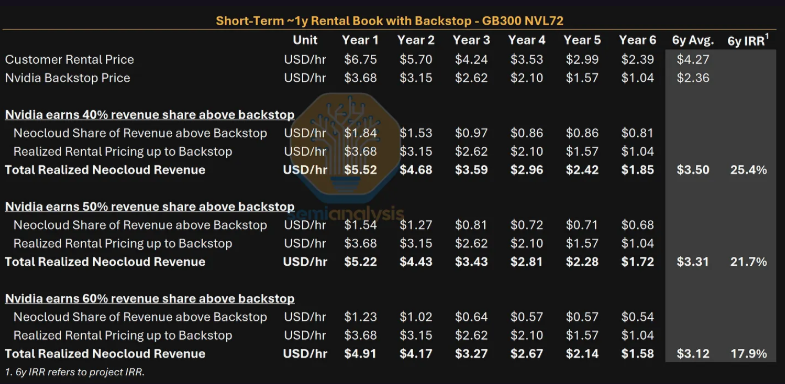
Over six years, in this scenario, Nvidia's average take will be about 18%. NeoCloud's project IRR would also decrease. In a scenario where there is Nvidia backstop and primarily 1-year short-term leases, the project IRR is 25.4%; if there is no backstop but financing and leasing proceed smoothly, the IRR can reach 40.7%.
The key lies in the worst-case scenario. If demand is insufficient, NeoCloud can only rent computing power to Nvidia, and the project return may approach zero, or even slightly negative. Lenders do not require that the project makes money in the worst case; they only require that it can still repay debts. Therefore, whether the debt can be established increasingly depends on whether Nvidia's backstop is reliable.
This is also the core focus for investors: Nvidia's arrangements help to promote GPU sales and NeoCloud's expansion in the short term, but if computing power demand falls short of expectations, the income gap will be borne by Nvidia. The debt may not be directly recorded on Nvidia's books, but the safety cushion of the financing model is increasingly concentrating on Nvidia's credit.
GPU Financing Pricing, Essentially Viewing Who Is Endorsing
SemiAnalysis states that currently, the pricing in the GPU financing market primarily looks at who signed long-term underwriting contracts, rather than NeoCloud's own credit.
CoreWeave serves as a reference. Its 5-year unsecured bond yields are around 10%; however, the fixed-rate cost of an 8.5 billion dollar delayed draw term loan backed by Meta is about 5.9%, only 90 basis points higher than the approximately 5.0% yield on Meta's 5-year bonds. This 90 basis points roughly reflects the market's pricing of CoreWeave's execution risk.
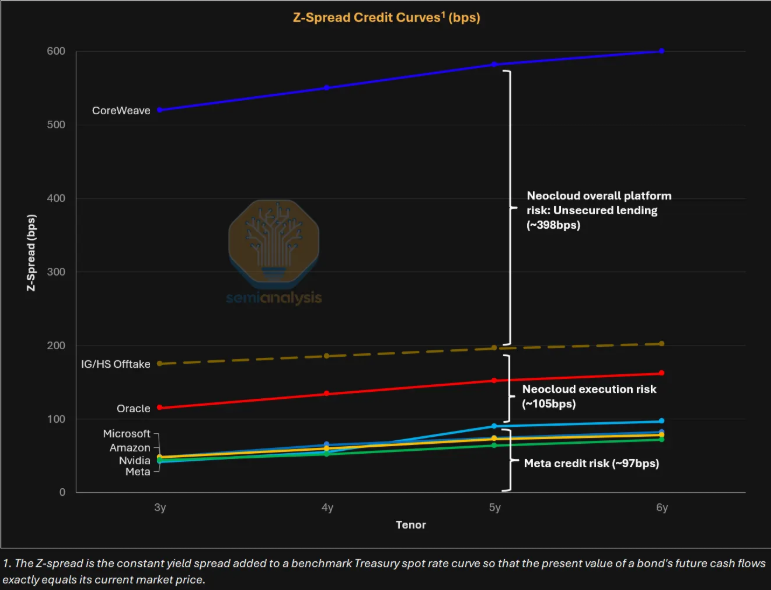
If NeoCloud breaks away from long-term cloud vendor underwriting, financing costs will rise significantly. For top-tier NeoClouds, unsecured financing may require paying approximately 10% interest rates, which is about 4 percentage points higher than backed financing. With a loan-to-value ratio of 70% to 80%, financing costs would rise from 5.62% to 10%, causing pre-tax profit margins to drop from 14.8% to 5.4%.
Nvidia's backstop would position pricing between the two: higher than the total yield of about 5.9% from current cloud vendor-backed deals, but lower than CoreWeave’s unsecured bonds with about 10% yield. Banks primarily focus on the debt service coverage ratio (DSCR). For projects with Nvidia backstop, loan amounts are typically calculated based on the worst-case scenario where the backstop is triggered; in the initial years, the DSCR must reach at least 1.3 times, which corresponds to a loan-to-value ratio of generally 70% to 80%.
Public Projects Amplifying in Asia-Pacific, Backstop Model Begins Implementation
Currently, publicly disclosed Nvidia backstop projects are concentrated in the Asia-Pacific region.
The first is SharonAI's 72MW AI plant in Australia. This project was announced in June 2026, with plans to expand to a maximum of 40 thousand GB300 under a 6-year backstop. The total backstop value disclosed by SharonAI is 4.88 billion dollars, which translates to an average floor price of about 2.33 dollars per GPU per hour over six years.
Another is Firmus's 360MW AI cluster in Batam, Indonesia, which may be located in DayOne's facilities in Kabil Industrial Tech Park. This project was announced on June 29, 2026, indicating that Nvidia's backstop is entering a larger scale.
Firmus expects the project's six-year customer revenue to be 25 billion to 30 billion dollars, targeting clients including AI-native companies, enterprise clients, and inference service providers, while offering different lease terms. However, before deploying GPUs, Firmus still needs to confirm the data center provider or continue building internally.
SemiAnalysis also points out that Nvidia is not the only GPU manufacturer using backstop arrangements. AMD has already offered similar arrangements to AWS, OCI, DigitalOcean, Vultr, Tensorwave, and Crusoe last year: customers purchase more AMD GPUs, and if NeoCloud cannot fully sell the capacity, AMD is willing to rent back a portion through a long-term contract for internal software development.
SemiAnalysis Denies Bearishness, But Market is More Sensitive to Its Signals
At the time of the article's release, SemiAnalysis itself was also embroiled in controversy.
On the morning of July 6, SemiAnalysis published a series of tweets on platform X, stating that Nvidia's Kyber NVL144 rack architecture is experiencing significant delays, postponed for more than 12 months until 2028. This news sparked attention in pre-market trading and resulted in declines in several AI hardware supply chain stocks in Japan, South Korea, and Taiwan. Nvidia subsequently responded that its product roadmap had not changed, denying that core progress was affected.
This makes SemiAnalysis's follow-up articles more easily interpreted by the market as being either bearish or bullish on Nvidia. In response, SemiAnalysis stated on X that it has not published any positive or negative views on Nvidia's stock, only sharing company supply chain and technical details.
Crackerjack Finance countered the "bearish" interpretation, stating that SemiAnalysis's charts indicate that actual data for the second half of the year is 20% higher than market expectations, leading to a projected earnings per share of about 15 dollars next year, with stock prices expected to be between 300 and 400 dollars. THE Grand Poobah commented that "the three-party circular financing seems inadequate", pointing to market concerns about the complexity in financing structures.
The issue is that AI-related assets have undergone several years of increase, with valuations and expectations at high levels. Any signals of supply chain risk or changes in financing structures will be quickly amplified. SemiAnalysis's clarification may indicate that it did not directly give stock viewpoints, but after the Kyber NVL144 incident, the market influence and credibility controversy of its supply chain disclosures will continue to coexist.
For investors, the real significance of this "long article" is that the competition in AI is no longer just "who has GPUs," but "who can simultaneously piece together GPUs, debt, client contracts, and data centers." Nvidia's backstop mechanism may continue to amplify GPU demand, but it may also concentrate more of the end-of-cycle pressure of AI debt onto Nvidia's credit itself.
免责声明:本文章仅代表作者个人观点,不代表本平台的立场和观点。本文章仅供信息分享,不构成对任何人的任何投资建议。用户与作者之间的任何争议,与本平台无关。如网页中刊载的文章或图片涉及侵权,请提供相关的权利证明和身份证明发送邮件到support@aicoin.com,本平台相关工作人员将会进行核查。


