Author: momo, ChainCatcher
Recent geopolitical conflicts have spurred the prices of commodities like crude oil, also driving the prosperity of TradFi trading on CEX.
In fact, since the second half of last year, cryptocurrencies have been in a bear market, while traditional capital markets such as precious metals and U.S. stocks have experienced an upward trend. TradFi has gradually become a "covert war" among CEXs.
In this competition, Gate, which has been responsive to user asset demands, has arguably reaped a substantial part of the benefits. From the data, as of March 19, Gate's single-day trading volume for TradFi contracts has surpassed $20 billion.
Compared to many exchanges that only began to catch up after hotspots erupted, Gate had already made systematic arrangements since last year. Therefore, when a big market appeared, it could more rapidly absorb traffic and convert it into real trading.
For Gate and the entire crypto CEX industry, TradFi is not just a temporary hot narrative, but may become a key pathway to break the shackles of the crypto cycle, pushing exchanges from being "single crypto asset trading platforms" to "super financial apps" aimed at a broader user base.
This time, we will take Gate as a sample to see how CEX has tapped into the TradFi benefits and how it can gradually influence future trading patterns.
1. Why is TradFi so important to CEX?
If we look back at Gate's actions in the TradFi and RWA direction, we will find that it did not just follow suit after the market rose.
As early as 2023, when RWA was still in the conceptual stage, Gate had already begun to systematically analyze this sector through research reports, such as how government bonds and private equity assets could be tokenized, as well as the integration pathways of RWA with DeFi, essentially doing preliminary cognition and direction validation.
By 2024, it began to enter the stage of ecological groundwork, continuously launching RWA-related projects while gradually guiding user attention to these types of assets through partnerships and specialized operations.
In 2025, Gate directly completed a critical step by materializing its products. In early 2025, it successively launched metal perpetual contracts, index contracts, and even pioneered the index perpetual contract category, followed by launching U.S. stocks and commodities, truly turning RWA and TradFi into tradable and participable assets.
This early groundwork allowed Gate to rapidly meet trading demands when the crude oil and commodity markets finally started to soar, instead of scrambling to catch up at the last moment.
Why does Gate have such a "sense"? Essentially, it is not just Gate's judgment, but a reality that the entire CEX industry has faced in the past two years: growth has started to stall.
According to a CryptoQuant report, the total spot trading volume of cryptocurrencies in 2025 is expected to grow by 9% year-on-year, far lower than the explosive increase of 154% in 2024; the total volume of perpetual futures trading is expected to grow by 29%, with momentum clearly slowing since the second half of last year.
In this context, CEX needs to find new sources of growth, and TradFi and RWA happen to provide a practical direction.
On one hand, the infrastructure is gradually maturing. Whether it is the previous bull market's "U.S. debt tokenization" wave or the recent TradFi trading rush of precious metals and commodities, it demonstrates that it is not merely self-indulgence on the supply side, but that real market demand has emerged on a larger scale, and the infrastructure can meet user needs.
On the other hand, user demand itself is changing. What CEX possesses is actually a cohort of highly active young trading users worldwide. For example, Gate has already surpassed 50 million registered users.
These users have been educated to develop trading habits and are no longer satisfied with singular crypto assets. Instead, they begin to hope to complete a diversified allocation and trading of crypto assets, gold, crude oil, U.S. stocks, and other assets on the same platform.
From the recent rise in crude oil and other assets due to geopolitical conflicts, a signal can already be observed: part of the trading flow that originally belonged to traditional financial markets is being taken over by CEX.
This further validates that the core value of CEX is not just "trade matching," but its ability to shape the trading habits of a generation of new users, and TradFi is the key step to amplify and extend this capability to broader asset categories.
2. How did Gate capture this wave of TradFi benefits?
From the current activity levels in Gate's TradFi sector, it is evident they have achieved some phased success. Overall, its core lies in gradually establishing a competitive barrier through three dimensions: products + efficiency + compliance.
1. Product side: "Full path + high flexibility" layout
From the layout of TradFi products among the three leading exchanges, it can be seen that Gate's TradFi asset richness and product flexibility are particularly prominent.
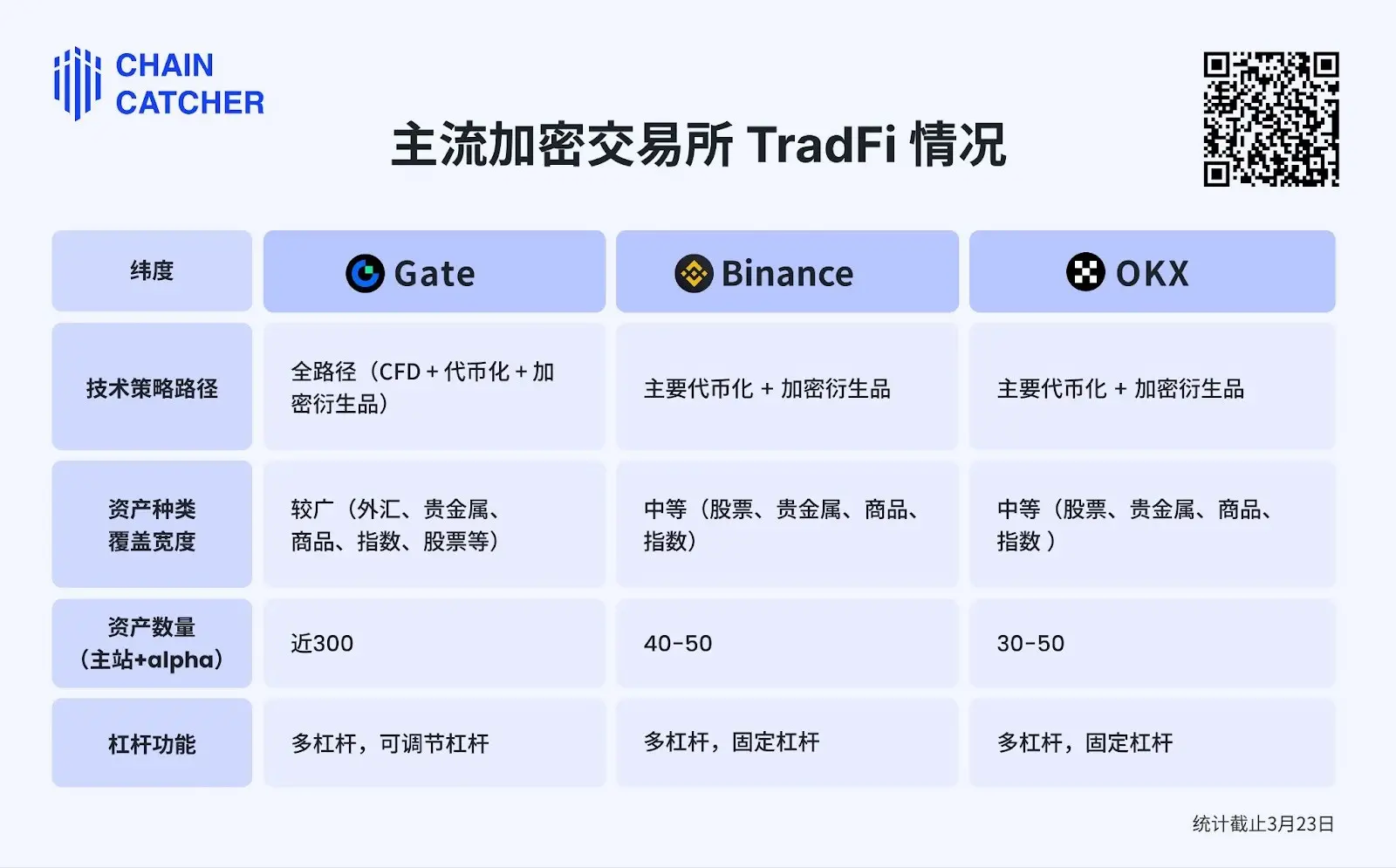
First, regarding asset richness, Gate's TradFi covers asset categories including forex, precious metals, commodities, indices, and stocks, effectively bringing all mainstream TradFi assets aboard, offering extensive coverage.
In terms of asset quantity, Gate covers a wide range. Currently, it covers nearly 300 types of TradFi assets. For precious metals, Gate covers over 10 metal contracts including gold, silver, platinum, palladium, aluminum, and copper, making it one of the platforms with the most varieties in the industry. Additionally, it supports over 110 stock assets, placing it among the leaders in major exchanges regarding offerings.
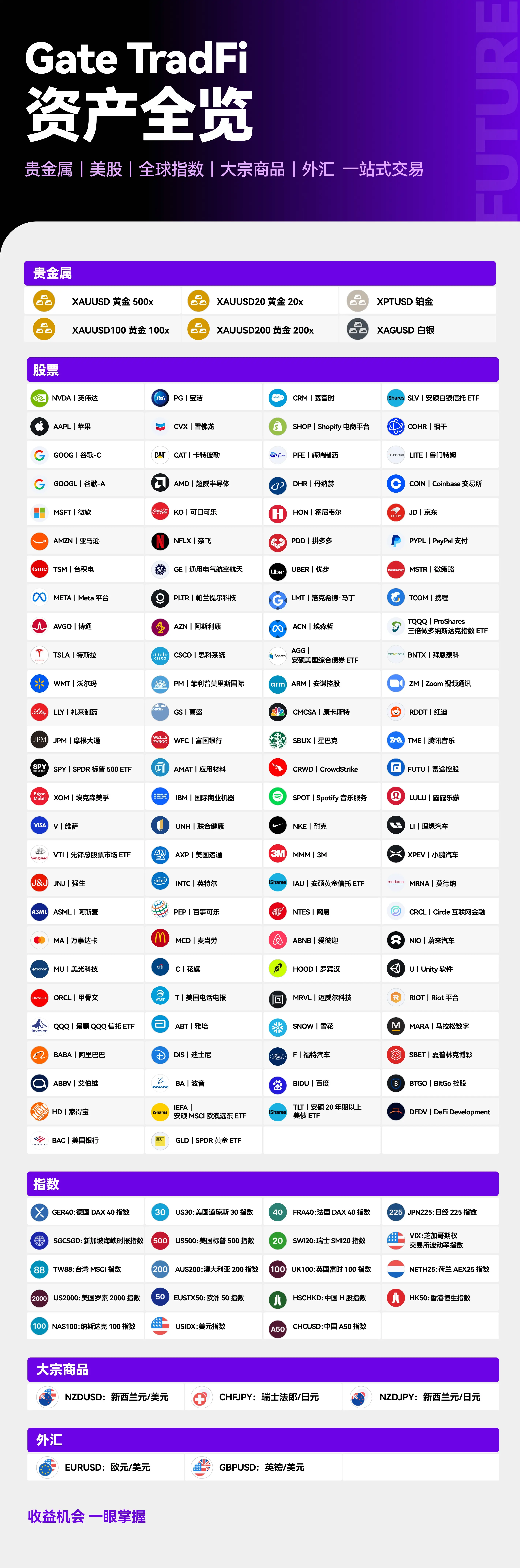
Maintaining asset richness is backed by Gate's choice of a heavier strategic path: concurrently advancing CFD (Contracts for Difference) + tokenized assets + perpetual contracts.
Currently, the CEX TradFi offerings mainly consist of these three technological pathways, with most exchanges opting for one or two.
Gate's full path coverage essentially addresses different levels of user demand rather than only serving a specific type of trader. For instance, both in gold or U.S. stocks, users can use CFDs for high-leverage short-term trading, use tokenized assets for a more spot-like allocation, and use CFDs for derivative hedging or trend trading.
In the long term, this is expected to allow Gate to build the infrastructure necessary to absorb larger volumes under the TradFi trend.
Even more noteworthy is that within TradFi, Gate aims to develop "flexibility" into a true product capability, rather than a simple parameter adjustment.
Recently, while leading exchanges have adopted fixed leverage, Gate TradFi has exclusively launched a "four-tier sliding leverage mechanism," which preset multiple leverage ranges targeting the volatility characteristics and liquidity structures of different assets. For example, in core assets like gold, NASDAQ, and crude oil, users can freely switch between 20x, 100x, 200x, and even 500x, instead of being restricted to a single fixed multiple.
This is not merely an adjustment of leverage parameters but a refined feedback tailored to user needs.
Firstly, this is differentiated allocation by asset class. The volatility and liquidity structures of different assets vary, for instance, the volatility rhythm of gold and silver is distinctly different from that of crude oil and stock indices. Therefore, the platform does not adopt a "one-size-fits-all" leverage standard but sets corresponding leverage ranges for metals, stock indices, foreign exchange, and commodities.
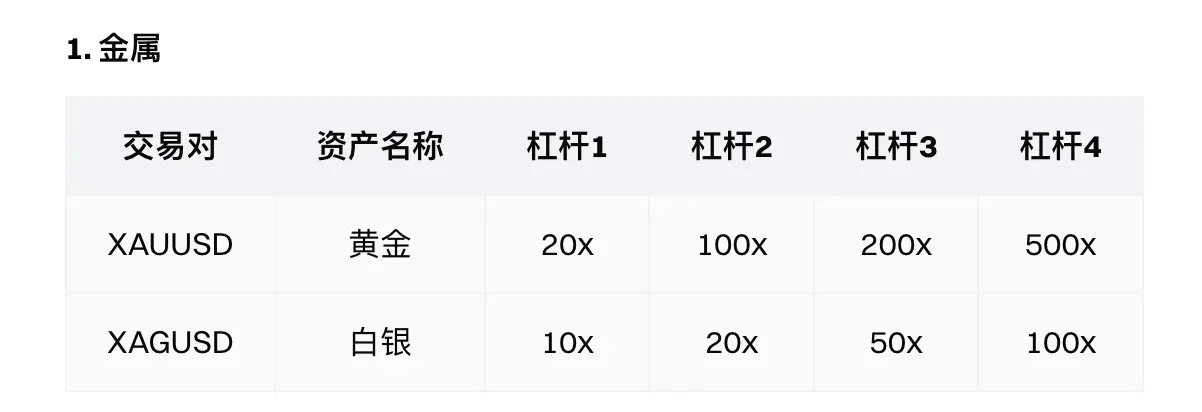
Secondly, there is a clear multi-tier design. Each type of asset corresponds to four leverage levels, ranging from relatively stable low multiples to highly elastic high leverage tiers, creating a tiered structure. Users no longer have to choose between “low leverage or high leverage” but can make leverage selections based on their risk preferences at the time of placing orders.
Deeper analysis shows that this design is actually serving different strategy needs. Lower leverage is more suitable for trial positions, hedging, or medium-to-long-term allocations, while high leverage is more appropriate for trend amplification or short-term speculation. By integrating these leverage tiers, it essentially places both "conservative" and "aggressive" trading styles into a single trading system.
Lastly, there is the expanded coverage. This mechanism targets not just a single asset but extends to cover gold, foreign exchange, stock indices, and commodities, meaning that trading across different markets can be executed within the same logical framework for leverage management and strategy execution.
In summary, this "four-tier sliding leverage" more resembles adding a "strategy tool layer" within a multi-asset trading system, allowing users to manage risks and positions more finely within the same account.
This is actually a very typical product optimization "starting from user pain points." In the current market, many traders have clearly felt an issue: that is, the cost of trial and error is increasingly high. Recently, trading highly volatile assets like crude oil means that if one only has fixed high leverage, even a small misstep could lead to liquidation, leaving almost no margin for error.
Gate TradFi's flexible leverage mechanism effectively hands back "risk control" to users. While it may seem like a small functional change, it actually poses a comprehensive test for the platform's system stability, real-time risk management capabilities, and underlying liquidity depth. Because once leverage becomes dynamic, margin calculations, liquidation logic, and order execution will become more complex, and if foundational capabilities are lacking, risks can easily spill over during extreme market conditions.
2. Unified accounts and sufficient liquidity
If the product layer solves the question of “can I trade,” then Gate enhances user experience at this level, pushing TradFi from "available" to more efficient and user-friendly.
This aspect is particularly evident in actual use, primarily due to the integration of account systems. On some platforms, crypto assets and TradFi trading are often separated, requiring funds to be transferred back and forth between different accounts. However, Gate employs a unified account model using USDT as margin, enabling users to switch between crypto and TradFi within the same account. On the surface, it may just save a few steps, but during volatile times, this "one less transfer" translates to higher responsiveness and lower operational costs.
Moreover, the data on both the web and app is interconnected, with positions, funds, and risk management status synchronizing in real time, offering a more complete experience rather than a patchwork of multiple modules.
Another clear aspect is the execution efficiency.
I primarily experienced mainstream assets like gold and crude oil. Previously, on various platforms, two issues would often arise: either the spread (the difference between buying and selling prices) would rapidly widen at critical moments before the trades could be entered, causing significant increases in trading costs; or, after finally placing an order, slippage would occur at critical levels, resulting in actual transaction prices deviating from expectations.
However, after using Gate recently, the overall feeling is relatively stable, with quick price updates, no obvious anomalies in spreads, and good control of slippage.
More importantly, orders are successfully executed. This may sound basic, but those who have experienced trading know all too well that many times, the issue is not your judgment but the lack of depth, where orders cannot be executed or profits are reduced.
This point is also indirectly verified by the data; for instance, Gate's XTI contract and XAUT contract previously ranked first and third globally in terms of trading volume, indicating that liquidity indeed has substantial support.
Another aspect I found to be quite friendly for large funds is that it has increased the maximum order quantity; stock orders can go up to 100 lots, and others like commodities and indices can also go up to 10 lots, meaning users want to take on larger positions without having to break them into smaller parts.
Other detailed mechanisms can also be perceived as Gate's effort to lower users' capital or usage costs. For example, TradFi trading volume is also counted towards VIP status, allowing users engaging in gold, forex, etc., to gradually upgrade their fees. Moreover, regarding APIs, for those doing quantitative trading or automatic strategies, it can be directly integrated without having to tamper with intermediate layers, saving considerable operational time and costs.
3. Transparency leading, building long-term advantages
If the earlier aspects concerning products and efficiency address the question of “short-term growth,” then in the realm of TradFi, the true limiting factor is compliance and transparency, quite simply because only when rules are clear and information is transparent, will institutions and high-net-worth individuals feel confident placing large amounts of capital.
In this regard, Gate's recent investments have been quite evident. According to the second issue of the crypto exchange transparency rankings released by RootData (for stocks), Gate has already ranked first in the relevant dimensions.
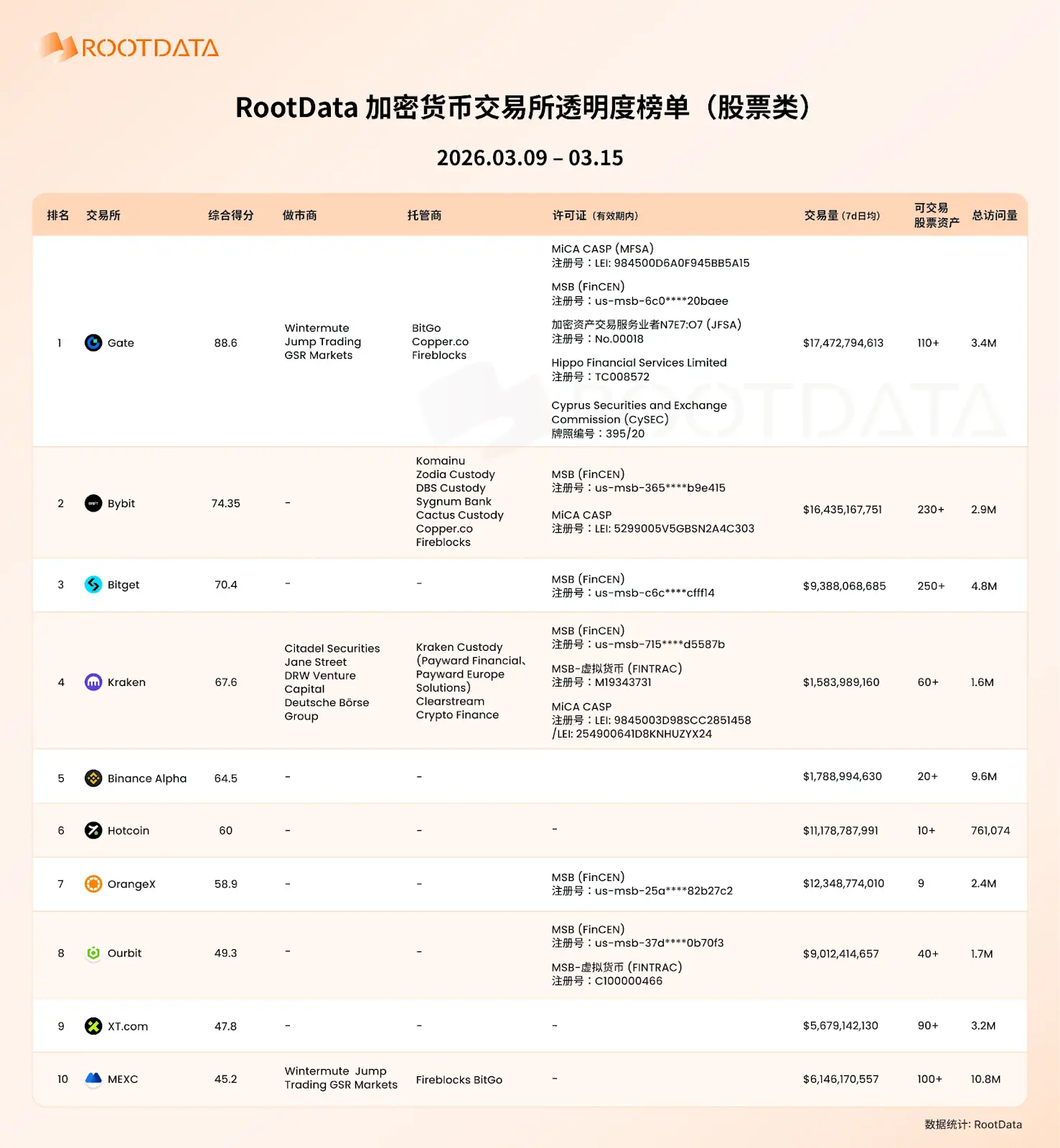
The core of such ranking is not merely flow or trading volume, but also includes market maker structures, asset transparency, and the integrity of platform operation data. In other words, it addresses a deeper issue: making the trading of TradFi assets on-chain become "trustworthy."
3. Gate Card: bridging the "last mile" for the "super APP"
It is noteworthy that beyond TradFi trading, Gate has recently made a crucial enhancement in payment by launching the newly upgraded Gate Card.
If we briefly outline the timeline: from launching crypto debit cards in 2023, to pilot projects in regional markets in 2025, followed by a complete version upgrade in 2026, Gate Card has evolved from a "payment tool" to a core component connecting trading and consumption.
This version's focus is quite clear: higher cash back (up to 5%), more flexible tiered systems (dual-track upgrades), and higher payment limits (up to $500,000 per day), fundamentally enhancing attractiveness in high-frequency use scenarios.
However, the more critical aspect is not these parameters but its positioning within the entire system:
It extends "trading" into "consumption" in a real sense. Earnings from crypto or TradFi trading on Gate can be directly spent globally through the Card, without needing to transfer or switch platforms.
This means a complete loop starts to form: earning from trading, real-time consumption, and tier upgrades leading back to the trading system.
Why is this step taken now? If the preceding TradFi layout addresses the “how to make money” question, then Gate Card essentially tackles the “how to spend money” question.
Once the platform possesses multi-asset trading capabilities, payment capabilities become a crucial element that determines whether users stay long-term.
From a broader perspective, this step is very important; Gate is gradually bridging three aspects: transitioning from crypto asset trading to TradFi asset expansion and then to real-world consumption.
Perhaps moving from a "trading platform" to a "fund circulation platform," and ultimately towards a "super financial lifestyle app," is the key path for CEX to truly break free from cycles and seek long-term growth.
免责声明:本文章仅代表作者个人观点,不代表本平台的立场和观点。本文章仅供信息分享,不构成对任何人的任何投资建议。用户与作者之间的任何争议,与本平台无关。如网页中刊载的文章或图片涉及侵权,请提供相关的权利证明和身份证明发送邮件到support@aicoin.com,本平台相关工作人员将会进行核查。


