Author:Wintermute
Translation: ShenChao TechFlow
ShenChao Guide: This article is written by Wintermute OTC traders, deeply analyzing the fundamental reasons for the outflow of retail funds from the current cryptocurrency market. Historically, cryptocurrency bull markets have often been driven by retail speculation, but the latest data indicates that retail investors are flooding into U.S. stocks at a record pace, causing the cryptocurrency market to shift from "rising and falling together" to a "seesaw" effect. As volatility in the cryptocurrency market declines, entry and exit thresholds decrease, and AI gives retail investors an analytical advantage in U.S. stocks, cryptocurrencies are no longer the first choice for retail speculation. Understanding this logic of capital rotation will help us readjust our multi-asset investment framework.
The full text is as follows:
The activity level of retail investors has always driven the cryptocurrency market. Through speculation, reflexive buying on dips, and flexible capital rotation between various tokens, retail investors have defined every major cycle in cryptocurrency history. However, the latest data suggests that the relationship between retail investors and the cryptocurrency market is changing.
For some time, we have been warning that the U.S. stock market is attracting the attention of retail investors, sacrificing the liquidity of altcoins. The latest data from JP Morgan's strategy department, combined with our exclusive capital flow data, further indicates that U.S. stocks and cryptocurrencies are becoming substitutable risk assets.
Correlation Reversal
By overlaying Wintermute's exclusive data on retail capital flows in cryptocurrency with JP Morgan's retail capital inflow data in U.S. stocks, we gain a new perspective on examining the relationship between retail activity in U.S. stocks and the cryptocurrency market.
Historically, both have typically resonated in sync. Until the end of 2024, rising risk appetite often meant buying on both sides, as to some extent, they both served as outlets for excess capital (referencing M2 data) and risk appetite. However, since the end of 2024, this correlation has broken down. Today, we see the most severe divergence in recent history: retail investors are flooding into U.S. stocks at a record pace while choosing to hold cash in the cryptocurrency market.
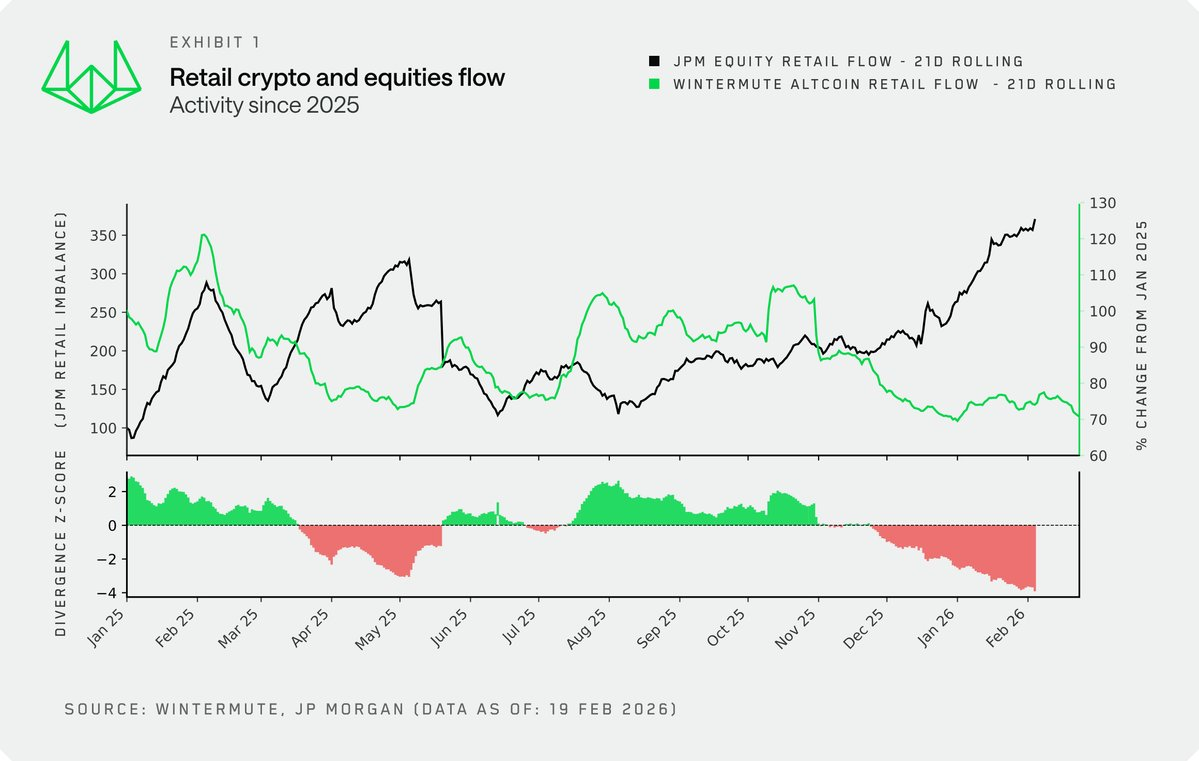
Looking at an extended period, we use the total market capitalization of altcoins as a long-term alternative indicator of retail activity in cryptocurrency. It highly aligns with our retail capital flow data and has a more objective and longer historical record. From 2022 to the end of 2024, the trends of cryptocurrencies and U.S. stocks have generally been consistent, with retail investors viewing both as part of a high-risk investment portfolio. However, the decoupling at the end of 2024 is particularly striking, and retail trading behavior has also become more driven by short-term factors, frequent fluctuations, and a lack of structure.
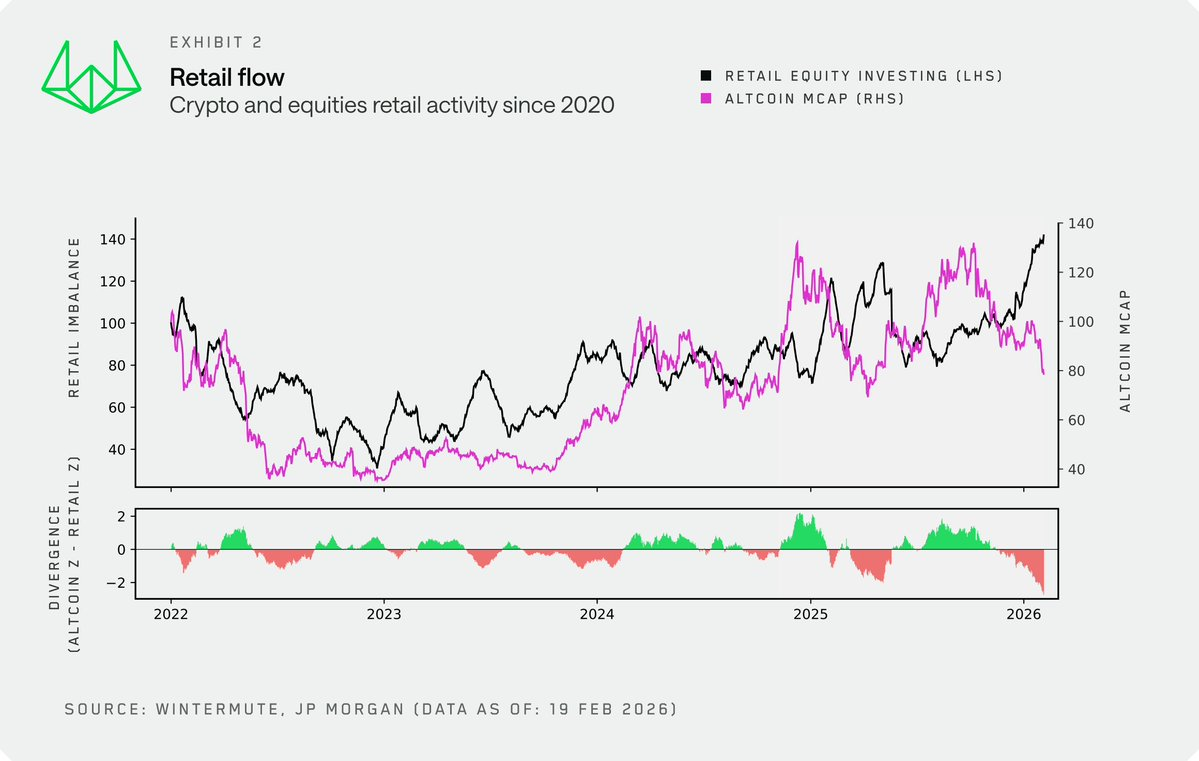
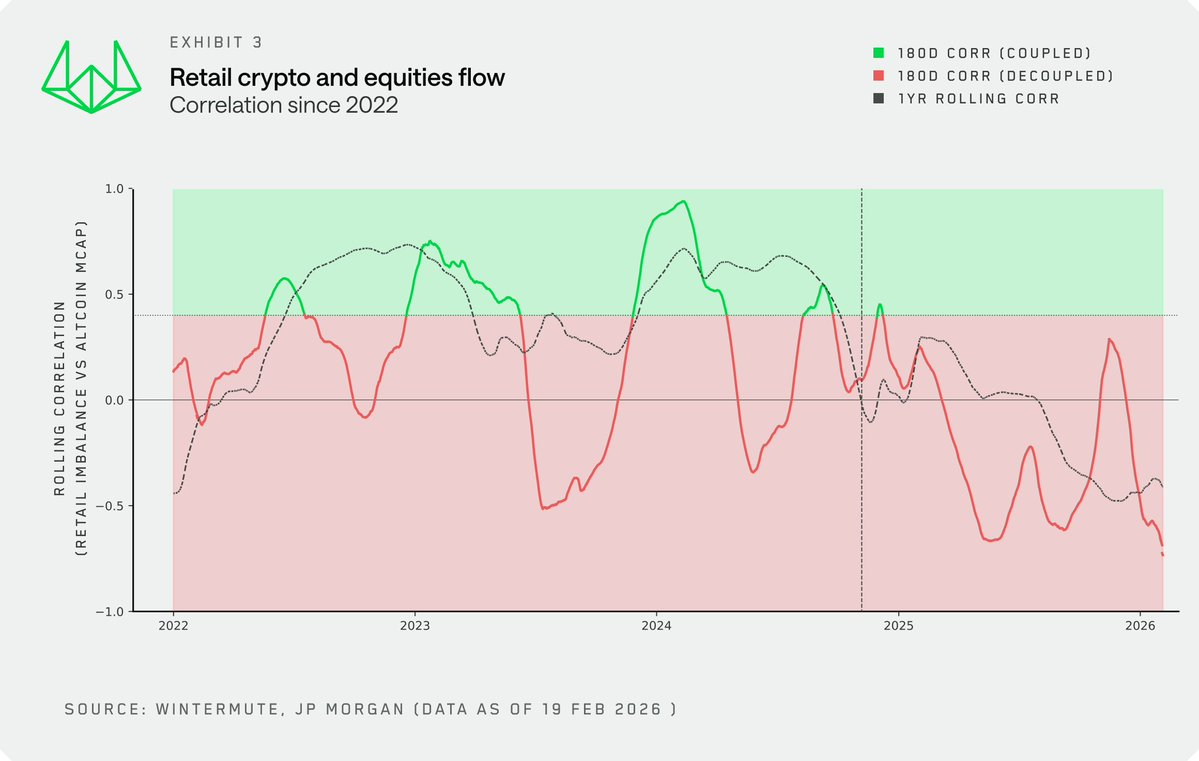
The rolling correlation between retail activity and the market capitalization of altcoins confirms this shift. The previously volatile yet overall positively correlated relationship has now turned negative. Retail investors are now allocating funds between the two through a "choose one" strategy instead of buying both simultaneously.
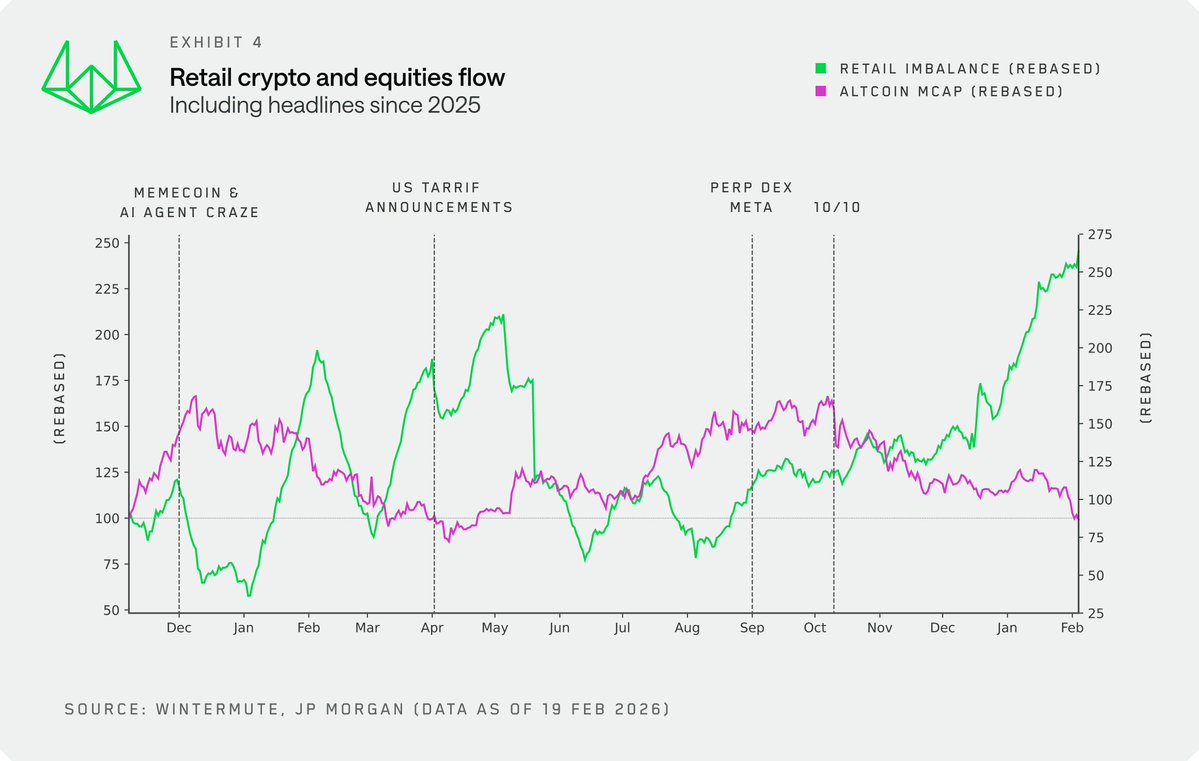
Focusing on 2025, combined with key catalytic events, this dynamic change will become clearer. A few points stand out:
- When the activity level in the U.S. stock market stagnates, Memecoins and AI agents shine, with retail investors shifting their speculative demand to these areas.
- Whether during the announcement of tariff policies in April 2025 or in recent times, retail investors continue to aggressively buy U.S. stocks on dips.
- After October 10, funds have almost completely shifted to U.S. stocks, and this trend continues to this day.
Causation
One thing must be made clear: we do not believe that the retail volume in the cryptocurrency market is large enough to withdraw funds from U.S. stocks. On the contrary, it is the rising enthusiasm of retail investors in the U.S. stock market that is draining liquidity from the cryptocurrency market.
New data also confirms this. The activity level of retail investors in U.S. stocks has become a new variable, and cryptocurrency investors should closely monitor this indicator to find opportunities when retail funds might provide sustained buying power for the cryptocurrency market.
Volatility Itself Is a Product
While there are many reasons, one core reason retail investors are so active in the cryptocurrency market and attracted to it is the asset's volatility characteristics. Volatility itself is a product. This was the core driving force that brought retail investors into the cryptocurrency sphere initially.
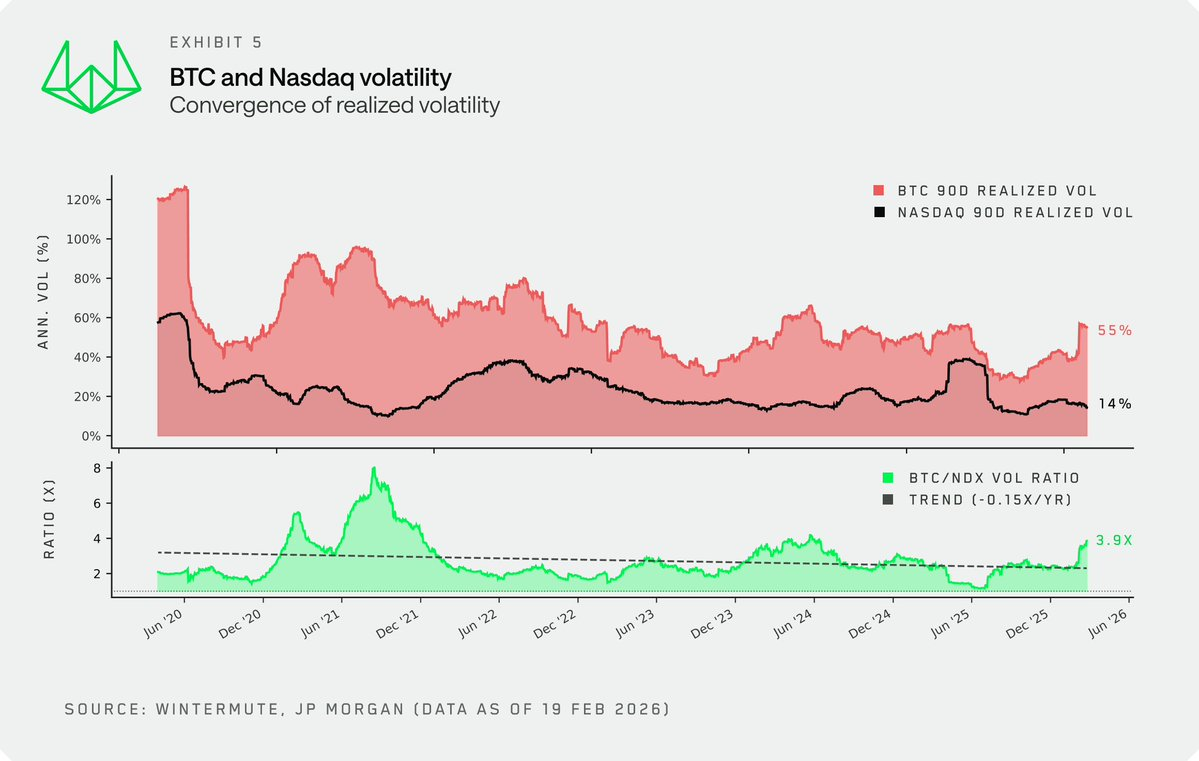
However, despite the fact that the volatility of the cryptocurrency market still far exceeds that of U.S. stocks, its realized volatility has been undergoing structural compression, and this trend is difficult to reverse. The volatility ratio of BTC to the Nasdaq 100 (NDX) has been declining, compressing to below two times in the first half of 2025.
Thoughts on some key driving factors:
- Market Maturity. An increasing number of mature investors, combined with the emergence of new liquidity tools like ETFs and DAT, have suppressed the typical reflexive volatility surges that characterized earlier cycles.
- Market Size. The current total market capitalization of the cryptocurrency market is $2.3 trillion; even with a 40% pullback from its all-time high (ATH), the amount of capital required to drive the market up now is far larger than five years ago.
As volatility compresses, the core selling point for cryptocurrencies to attract retail investors wanes. The explosive rises and falls that defined the bull market cycles of 2021 to 2022 and attracted an entire generation of retail investors are now gone forever. For retail investors seeking volatility, U.S. stocks are becoming increasingly attractive.
Technical Driving Factors
Apart from the structural changes in the cryptocurrency market itself, technical driving factors are also accelerating this capital rotation, which has not been sufficiently discussed in the market.
- Investment Channels Opening Up. The integration of financial technology and traditional brokerage platforms with cryptocurrency trading (or cryptocurrency-native platforms integrating U.S. stock trading) has indeed lowered the entry threshold, but its more profound impact is manifested in "capital withdrawal." In previous cycles, complex deposit and withdrawal processes meant that once funds entered the cryptocurrency market, they were locked in, driving organic rotation between different tokens. However, today, the same smooth deposit and withdrawal channels mean that funds can shuttle freely between cryptocurrency and U.S. stocks without obstruction.
- Cognitive Edge. Retail investors seem increasingly attracted to U.S. stocks, partly because they have gained a new edge through AI. Large language models (LLMs) significantly enhance retail investors' analytical capabilities, giving them the illusion of being able to compete fairly with institutions.
However, in the cryptocurrency market, this feeling does not exist. While one can analyze cryptocurrency projects based on data, there is a lack of a consensus valuation framework and token value capture mechanism in the cryptocurrency space, while the investable assets continue to expand indefinitely, making it hard for retail investors to find that sense of "having the advantage" here.
Conclusion
Retail investors were once the most reliable reflexive demand source in the cryptocurrency market, but now, their risk appetite is increasingly being satisfied elsewhere. U.S. stocks offer highly competitive volatility, providing retail investors with an increasingly enhanced analytical edge, and through the same app on their phones, funds can seamlessly switch between the cryptocurrency market and U.S. stocks. While cryptocurrencies still hold a place in retail investment portfolios, they are now just one of many speculative tools, no longer the primary vehicle for speculation.
This shift should also reshape investors' perspective on observing the market. Some tried-and-true indicators have become ineffective. For cryptocurrency investors to succeed, merely seeking leading indicators of risk appetite and combining them with cryptocurrency-native frameworks is no longer sufficient. Investors need to increasingly view cryptocurrencies through the lens of a multi-asset investment portfolio, just as it has already become standard practice in U.S. stocks and fixed income markets.
免责声明:本文章仅代表作者个人观点,不代表本平台的立场和观点。本文章仅供信息分享,不构成对任何人的任何投资建议。用户与作者之间的任何争议,与本平台无关。如网页中刊载的文章或图片涉及侵权,请提供相关的权利证明和身份证明发送邮件到support@aicoin.com,本平台相关工作人员将会进行核查。


