"This year, no client's demand can be completely satisfied."
South Korean chip giant SK Hynix stated that the company's overall inventory of DRAM and NAND is currently only about 4 weeks, at historically low levels. From cloud providers like Google and Microsoft to AI companies like OpenAI, and to consumer electronics manufacturers, all customers are unable to obtain sufficient supply.
Price increases are inevitable. Starting from the third quarter of 2025, SK Hynix will raise HBM3E prices by 15%-20%, with DDR5 16Gb chip prices increasing by as much as 102% in a single month. From November, all categories of DRAM will see price hikes, with NAND contract prices being adjusted simultaneously. In January 2026, there will be further significant price increases of 20%-60%.
Moreover, the rise in stock prices is also inevitable. Since the beginning of 2025, SK Hynix's stock price has surged nearly sixfold, while another South Korean chip giant, Samsung Electronics, has seen its stock price nearly quadruple.
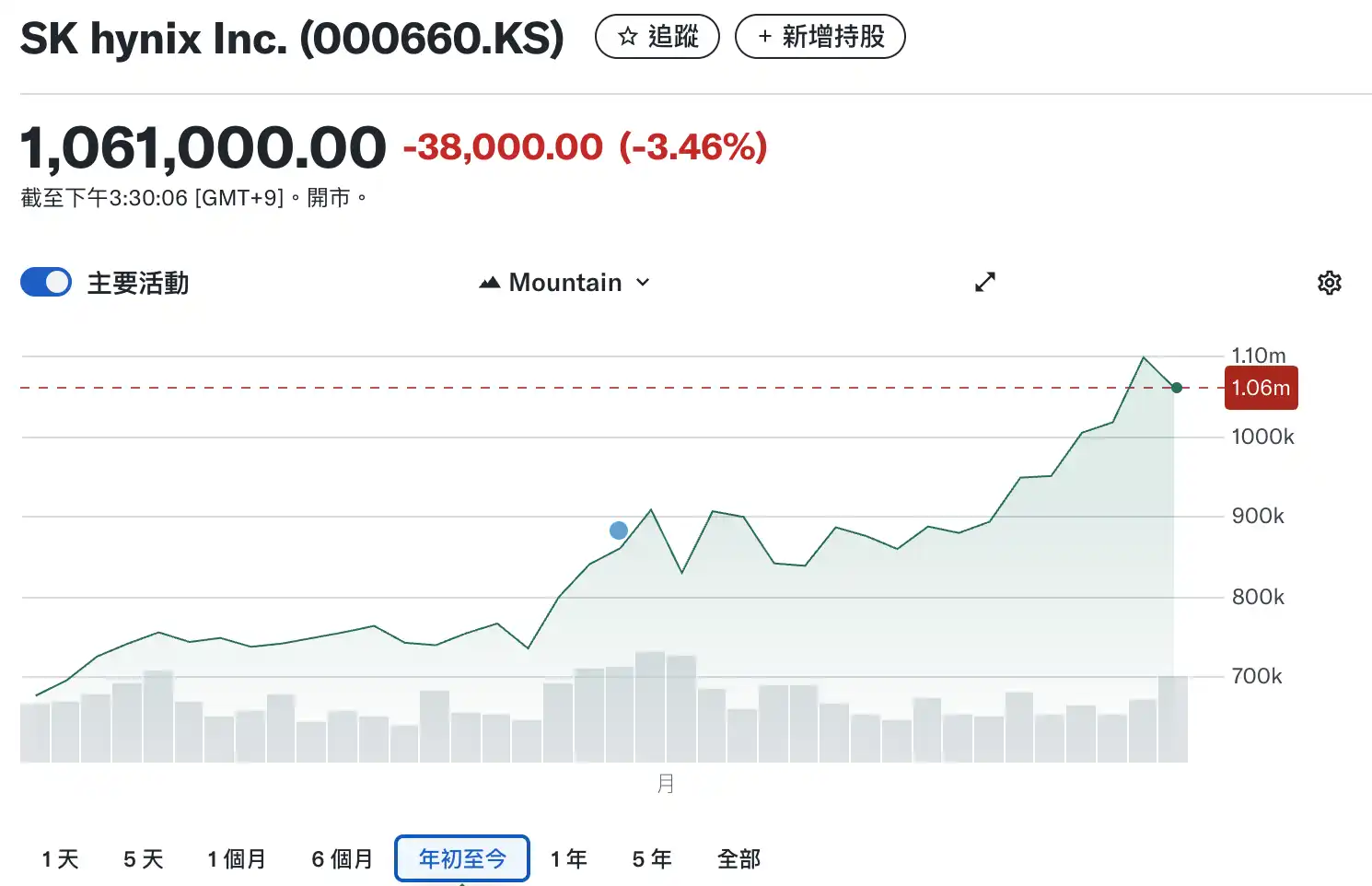
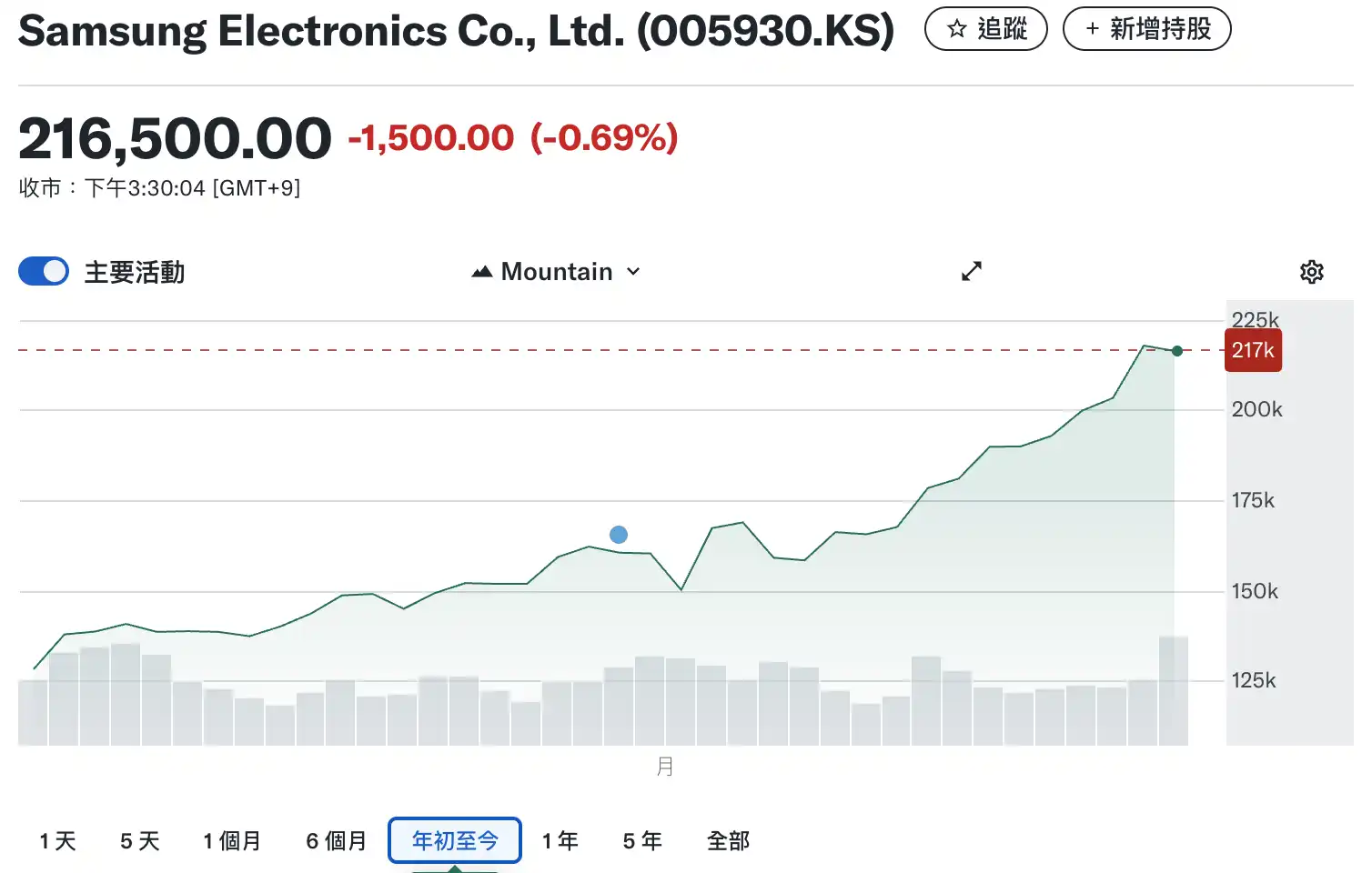
Consequently, the Korean stock market's KOSPI index has risen above the 6000-point mark for the first time, with the total market capitalization of the Korean stock market exceeding 3.76 trillion USD, increasing by approximately 2.23 trillion USD since the beginning of 2025, surpassing the German and French stock markets to become historically one of the top ten globally, rising to ninth place worldwide. Since 2026, the index's cumulative increase is nearly 45%, making it one of the best-performing major stock markets in the world.
This small sliver of land in Korea, long neglected by overseas funds due to its low valuation, has now become the focus of the global capital market, also diverting the attention of young people who were originally crazy about cryptocurrency.
Repricing Samsung and SK Hynix
In the era of consumer electronics, the industry paradigm represented by Apple Inc. has dominated for two decades.
As Apple's largest foundry, Foxconn employs over 1.4 million workers in China, situated at the bottom of the "smile curve." Design, brand, and sales occupy both ends of the curve, with profits rising sharply. The distribution of profits thus presents a stable structure: downstream (whole machines/platforms) profits while upstream drinks soup. After all, there are numerous upstream suppliers with strong substitutability; the right to define products is in the hands of brand manufacturers; demand is concentrated in the terminals; and switching costs are low.
Many Chinese manufacturers take pride in being "Apple accessory manufacturers," but from an investment perspective, there is a consensus that one can buy Apple, but not Foxconn.
However, when four conditions emerge simultaneously—highly concentrated technology, slow expansion speed, strong downstream dependence, and no short-term alternative paths—upstream suppliers become "system bottlenecks." Upstream suppliers instead gain pricing power.
This is exactly what is happening in the current AI industry and the HBM (high bandwidth memory) track.
For over a decade, the semiconductor industry has defaulted on one premise: the computing power bottleneck is within the computing chips themselves. But large model training has shattered this understanding. As the parameter scale expands from billions to trillions, GPUs have discovered a more pragmatic problem: no matter how fast the calculations, data must be fed in. HBM determines whether the GPU can operate at full capacity; whether cluster efficiency can be maximized; and whether the unit computing cost can decrease. It has become the "circulatory system" of AI chips.
The more advanced the GPU, the deeper the reliance on storage. Taking Nvidia as an example, from A100 to H100, and then H200 and subsequent routes, each generation of GPU is bound to an HBM capacity and bandwidth that rises stepwise. Computing power doubles, and HBM usage almost doubles simultaneously. The cost of HBM increasingly occupies a higher proportion of the overall card BOM.
Globally, there are very few players capable of large-scale production: Samsung Electronics, SK Hynix, and relatively smaller Micron Technology. Apple needs Samsung, and Nvidia needs Hynix.
When demand grows exponentially while supply cannot be swiftly released, price elasticity will be magnified infinitely. In the traditional PC era, CPU/GPU took the lion's share of profits, while storage was cyclical and had weak bargaining power. However, in the AI server era, HBM has become an irreplaceable component. When a component holds irreplaceability and supply is restricted, it means having absolute pricing power, almost inevitably leading to excess profits.
Repricing Samsung and SK Hynix has become the main line of most financial markets, including Korea. This main line's allure even surpasses that of cryptocurrency.
Korean Retail Investors Dive into Semiconductors
If you open a Korean young person's chat window late at night in 2023 and 2024, Bitcoin will absolutely be a frequently occurring topic. For a long time, Korea has been one of the world's most retail-driven cryptocurrency markets, playing an essential role.
And 2026 marks the fourth year since the LUNA crash, the previous figure Do Kwon, who attracted significant attention from the financial sector in Korea, has been sentenced to 15 years in prison. This year of the Fire Horse, characterized as a strong fire year, sees the AI industry still in explosive growth, and geographically, Korea is evidently too fiery.
When the editor recently opened Naver's investment forum, most discussions were about "Samsung Electronics" and "SK Hynix." Samsung and SK Hynix.
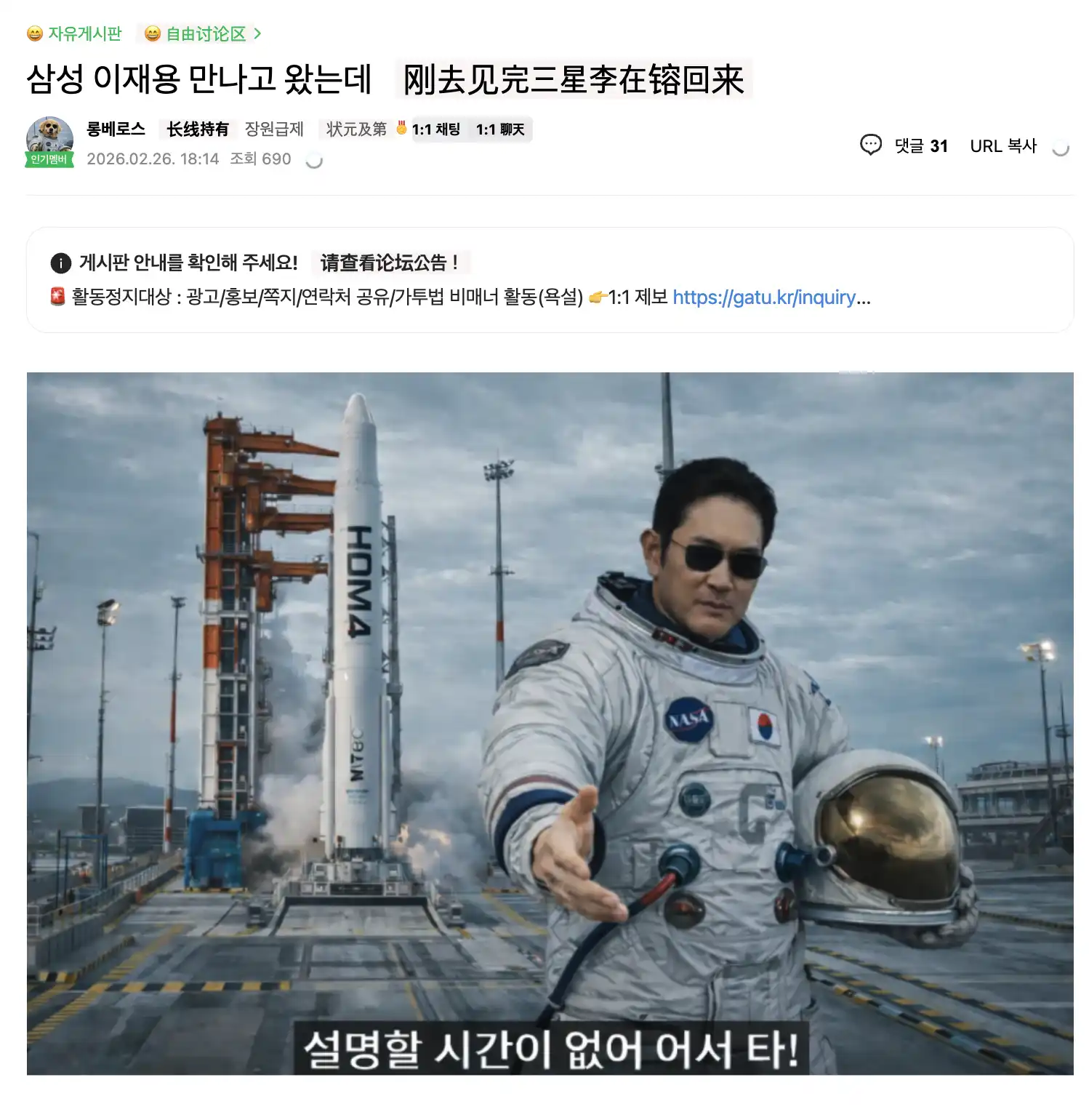
Previously enthusiastic about highly volatile altcoins, Korean investors are now reallocating funds into domestic and foreign stocks, especially those related to artificial intelligence and robotics.
According to Bloomberg statistics, the trading volume of domestic cryptocurrency exchanges in Korea dropped by approximately 65% year-on-year in January. In stark contrast, the trading volume of KOSPI, which is the core benchmark of the Korean stock market, surged by 221% during the same period. The margin balance of securities firms has surpassed 30 trillion KRW (approximately 20.8 billion USD).
The speculative nature of Korean youth has not changed, but they have shifted their battlefield.
This trend had become apparent as early as the end of 2025.
In 2025, Upbit’s trading volume fell by 80% compared to the same period in 2024, and the activity of the Bitcoin-KRW trading pair was far less than in previous years; in contrast, the Korean stock market was booming, with the KOSPI index rising more than 70% within the year and consistently reaching new historical highs. On Kakao Talk and Naver forums, retail investors who used to discuss altcoins every day are now talking about "AI semiconductor concept stocks."
This migration has also resonated subtly with the political climate. Current President Lee Jae-myung publicly proposed a target of "KOSPI 5000" during his campaign. It is rumored that he experienced significant losses in the stock market during his youth, and his experience of being "cut as chives" has become the driving force behind his push for financial reform.
Moreover, Lee Jae-myung is very clear on one thing: whether the stock market can rise to 5000 ultimately depends on whether corporate profits can increase substantially. Since the Korean stock market's weight is highly concentrated in technology and semiconductor leaders, he is focusing on these sectors.
After taking office, he quickly sent strong signals of favor towards the capital markets: establishing the "KOSPI 5000 Special Committee"; promoting revisions to commercial laws; strengthening equalization rules for shareholder rights; and enhancing board accountability. On the eighth day of his presidency, he made a special visit to the Korea Exchange. There was only one goal: to keep Korean residents' money in the stock market for the long term.
As for how far the Korean stock market can rise, some analysts believe that besides the influence of the AI sector, the political arena will also hope that the upward trend continues leading up to the local elections in June this year.
This atmosphere has deeply influenced the remaining liquidity in the cryptocurrency realm.
On February 11, 2026, Lighter Exchange launched the world's first on-chain perpetual contracts for Korean stocks, including Samsung Electronics, SK Hynix, Hyundai Motor, and the KOSPI index, with leverage of up to 10 times. A few days later, Trade XYZ went live with Samsung and Hynix, also offering 10x leverage.
This is also a highly symbolic scene, as trading platforms that once hosted altcoin frenzies are now beginning to host Korean stocks.
After all, in this era where AI is reshaping the world, semiconductors are more attractive than altcoins.
免责声明:本文章仅代表作者个人观点,不代表本平台的立场和观点。本文章仅供信息分享,不构成对任何人的任何投资建议。用户与作者之间的任何争议,与本平台无关。如网页中刊载的文章或图片涉及侵权,请提供相关的权利证明和身份证明发送邮件到support@aicoin.com,本平台相关工作人员将会进行核查。


