The BOT Chain team announced today that its mainnet will officially launch in the first quarter of 2026. Unlike the never-ending stream of "Ethereum killers" or "Solana challengers" over the past decade, BOT Chain has chosen a previously unverified technological path—modular algorithm networks. Its goal is not to create a "faster and cheaper" chain, but to fundamentally restructure the production relations of public chains: to increase development efficiency by 90%, eliminate the need for hard forks in iterations, and return value capture to the real growth of the network.
As this news is released, Web3 is standing on the threshold of mass application explosion, while the computational tsunami brought by AI is posing unprecedented challenges to underlying infrastructure. The narrative surrounding public chains over the past decade—faster TPS, lower Gas, more compatible EVM—seems pale and outdated in the face of this tsunami.
The emergence of BOT Chain may just be that variable.
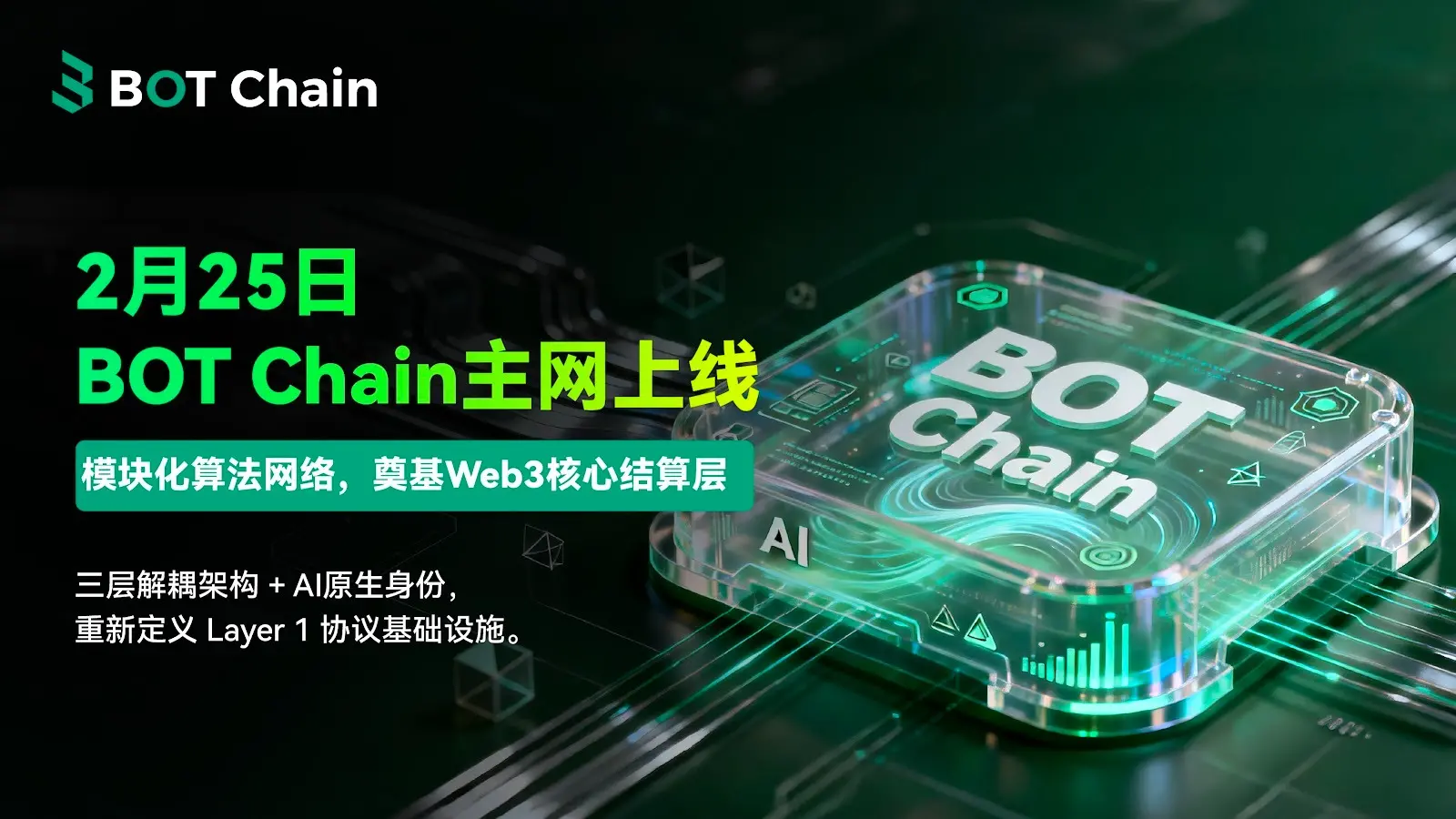
From Fee Market to Protocol Infrastructure: Changes in Layer 1 Competition Logic
Over the past decade, the economic model of mainstream Layer 1 public chains has primarily centered around transaction fees.
Smart contract platforms represented by Ethereum have formed a fee market through a Gas mechanism. With limited block capacity, users bid for transaction priority through fees, and network income is highly correlated with on-chain activity. This model has been repeatedly validated during the DeFi and NFT cycles.
However, as application complexity increases, its structural problems gradually emerge:
Network value is more reflected in the execution and settlement layer
Protocol development still requires a lot of underlying engineering work
There is a lack of deeper structural synergy between public chains and applications
The focus of industry competition has begun to shift from "performance parameters" to "architectural capabilities".
Against this backdrop, BOT Chain proposes a three-layer decoupled architecture:
Structural Core Layer is responsible for consensus and state management
Verifiable Execution Layer optimizes computational scheduling mechanisms
Modular Protocol Layer abstracts common protocol capabilities into standardized components
Its core idea is not merely to pursue throughput but to reduce the complexity of protocol construction and improve development efficiency.
If early public chains emphasized transaction processing capacity, the competition in the new stage is shifting towards protocol generation and architectural reuse capabilities.
The narrative of Layer 1 is moving from fee markets to protocol infrastructures.
Technological Differentiation: AI Agent On-Chain Identity + PoS/DePIN Dual Mining
In terms of technological innovation, BOT Chain has established unique differentiation advantages in two directions:
Firstly, native support for AI Agents. Through the self-developed AIDID identity protocol, AI agents are no longer "tools" off-chain but truly become "residents" on-chain—possessing independent accounts, credit weights, and value settlement capabilities, able to autonomously pay Gas fees, participate in governance voting, and automatically allocate profits. When millions of AI Agents autonomously interact on-chain, Web3 will evolve from a "people-to-people network" to a symbiotic network of "people and machines, machines and machines".
Secondly, dual mining with PoS and DePIN. Verification nodes can simultaneously participate in staking and hardware contribution (GPU/CPU/storage) to receive dual rewards. This design deeply binds network consensus security with real computational power—nodes are both network guardians and computational power providers, returning security incentives to the real economy.
It is noteworthy that BOT Chain has reached a deep strategic partnership with the NIX Foundation in Sweden. As a leading technology investment institution in Europe, its global layout in the decentralized computing field will achieve underlying integration with BOT Chain. This means that in the future, the global distributed computing resources' rights confirmation, scheduling, and value settlement will all be supported by BOT Chain—making it a "core settlement layer" connecting the global supply and demand of computing power.
AI needs computing power, computing power needs incentives, and incentives require on-chain identity. BOT Chain builds a real infrastructure for the next era of Web3 with its three major differentiations.
Institutional Endorsement: $15 Million Strategic Financing is in Place
The early investor lineup of BOT Chain has come to light. The project has confirmed receiving a total of $15 million in strategic investments from three institutions:
NIX Foundation: A national-level technology fund in Sweden, investing tens of millions of dollars, bringing deep resource links from European academia and industry to BOT Chain, as well as strategic布局 in the next generation of decentralized computing.
Alpha Capital: A top crypto fund in the Middle East, managing assets over $100 million, with a portfolio that includes KuCoin, Coinbase Global, Bybit, and more.
Gemhead Capital: A community-driven VC, with over 80% of past investments landing on leading exchanges like Binance, Bybit, Gate.io, etc.
In terms of security, BOT Chain has completed audits by CertiK and established a long-term vulnerability disclosure and reward mechanism, continuously advancing security testing and risk assessment through the HackenProof platform.
Roadmap: Mainnet Launch in Q1 2026, Clear Ecological Goals
According to the roadmap, the development of BOT Chain is divided into three stages:
Short term (2026-2027): Mainnet launch, deployment of 21 super nodes + 72 light verification nodes, release of the first batch of DeFi/NFT/AI Agent modules, with an ecological protocol target of over 10,000 by the end of 2026, aiming for 500,000 daily active users, and listing on mainstream exchanges.
Medium term (2028-2030): Achieving dynamic TPS expansion to 500,000, full deployment of zero-knowledge proofs, transitioning DAO from semi-autonomous to fully autonomous, with ecological protocol targets of 30,000, over 4 million daily active users, and an annual trading volume target of over $800 billion.
Long term (2031 and beyond): Evolving into a global Web3 operating system, supporting over 1 billion users, becoming the underlying protocol layer connecting the real world and the digital world.
Industry Observation: Modular Public Chains Welcome New Variables, Web3's "Android Moment" is Approaching
Over the past five years, the growth logic of public chain ecosystems has been singular: waiting for a blockbuster. Everyone has been betting on the next Axie, the next Uniswap, as if innovation can only rely on the overnight rise of genius projects.
BOT Chain provides another possibility.
Its core logic is not "waiting," but "empowering." When DeFi, NFT, and AI Agents are encapsulated as standardized modules, and protocol development is shortened from months to hours, a completely new landscape is unfolding: the future of Web3 will no longer be the playground of a few elites, but a collaborative creation by millions of "protocol engineers." Just like the Android system enabled hundreds of millions of developers to participate in mobile internet innovation.
When the threshold is lowered to a sufficiently low level, innovation transforms from a "scarce resource" into a "people's movement." When millions of developers and AI agents interact autonomously on-chain, and global computing power flows freely through the DePIN network, Web3 will迎来真正的“大爆炸”时刻。
The modular public chain track welcomes a new variable. But the true meaning of this variable is not another technically superior public chain, but that Web3 has finally迎来了它的“安卓时刻”——the power of innovation no longer belongs to a few, but to everyone.
About BOT Chain
BOT Chain is a public chain designed for large-scale applications in Web3.
It adopts a modular three-layer architecture: the structural core layer is responsible for consensus security, the verifiable execution layer carries the self-developed VPC parallel engine, and the modular protocol layer encapsulates core functions such as DeFi, NFT, and AI Agents into standardized components, allowing developers to avoid writing smart contracts from scratch.
BOT Chain aims to become a truly usable infrastructure for Web3—enabling low-cost innovations for developers, allowing AI agents to operate autonomously, and returning value capture to the true growth of the network. The project has received $15 million in strategic investment from NIX Foundation, Alpha Capital, and Gemhead Capital, completed security audits by CertiK, and the mainnet will launch in the first quarter of 2026.
免责声明:本文章仅代表作者个人观点,不代表本平台的立场和观点。本文章仅供信息分享,不构成对任何人的任何投资建议。用户与作者之间的任何争议,与本平台无关。如网页中刊载的文章或图片涉及侵权,请提供相关的权利证明和身份证明发送邮件到support@aicoin.com,本平台相关工作人员将会进行核查。


