Written by: Long Yue, Wall Street Watch
The "war for talent" in Silicon Valley's AI sector escalates, as Mark Zuckerberg and Sam Altman personally engage in the battle. The founder of the popular AI agent OpenClaw ultimately aligns with OpenAI, aiming to overcome the final barrier from "fun" to "useful" in AI.
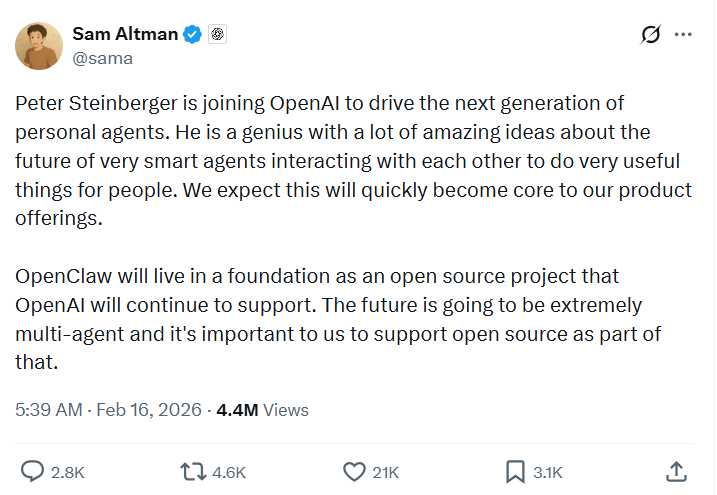
OpenAI CEO Sam Altman confirmed on social media platform X on Sunday that Peter Steinberger, the creator of the open-source AI agent OpenClaw, will join the company.
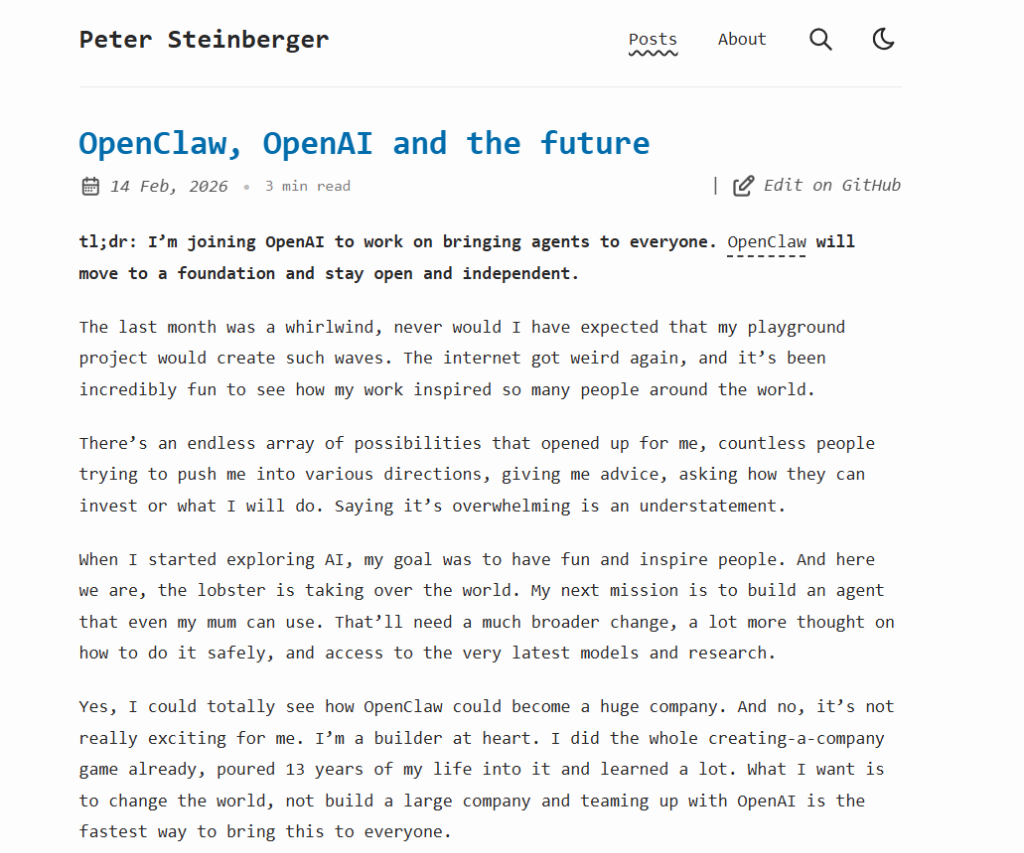
Regarding the project ownership that has garnered market attention, both parties have provided reassurance: OpenClaw will not be privatized but will transition into an independent foundation to continue open sourcing, with OpenAI pledging support.
Altman: Steinberger is a genius
Altman praised Steinberger's joining with high acclaim and directly revealed OpenAI's upcoming product strategic direction.
"Peter Steinberger's joining OpenAI is aimed at advancing the development of next-generation personal agents." Altman wrote, "We expect this to soon become the core of our product offerings."
This marks a shift in OpenAI's strategic focus from single, large model capabilities to more complex agent interactions. Altman further explained the underlying logic:
"He (Steinberger) is a genius, with many amazing ideas about how highly intelligent agents can interact in the future to do very useful things for humanity."
He emphasized: "The future will be an extremely multi-agent world, and being part of it, supporting open source is important to us."
From "Geek Toy" to "Mass Consumer Product": Even Mom can use it
Steinberger's core mission after joining OpenAI is very clear and straightforward: to solve AI usability.
OpenClaw previously gained immense popularity on GitHub for its ability to autonomously control phones, clean emails, and book flights, but its operational threshold remains high. Steinberger stated in a release:
"My next mission is to build an agent that even my mom can use. This requires broader transformation, more thought on how to safely achieve this goal, and access to the latest models and research."
This statement hits the biggest pain point in the current AI market. While large models are powerful, they lack an interactive layer that allows ordinary consumers to engage with "zero threshold."
OpenAI's move aims to bridge this gap, pushing AI Agents from the developer community to billions of ordinary users, which directly relates to the ceiling of AI commercialization.
Altman's "Compute Conspiracy" vs Zuckerberg's "Geek Spirit"
This is more than just a hiring; it is a microcosm of a giant game. Meta and OpenAI launched completely different strategies to compete for Steinberger.
It is reported that Meta leveraged a "CEO direct hire" approach. Zuckerberg not only personally tested the product but even spoke with Steinberger over the phone to discuss code details, attempting to win him over with "technical resonance." Steinberger once remarked: "Zuckerberg understands me."
However, in the end, OpenAI won this round with its absolute "hard power." Altman directly showcased the top computational potential brought by the collaboration with Cerebras and the deep support for the Codex model. In current AI research and development, computational power equals truth.
Steinberger admitted: "Ultimately, I felt that OpenAI is the best place to continue advancing my vision and expanding its influence."
This sends a signal to investors: in the competition for top AI talent, mere high salaries or CEO care are no longer decisive factors; the one who can offer the most advanced model access and computational resources holds the pricing power.
"Lethal Trifecta" and the Theory of APP Vanishing
As the capabilities of agents leap exponentially, the reconstruction of safety and business models has become the B-side of market attention.
OpenClaw previously "went crazy" due to excessive permissions, sending hundreds of spam messages to users. Cybersecurity experts refer to this combination of "accessing private data + external communication capabilities + encountering untrustworthy content" as the "Lethal Trifecta."
After Steinberger's entrance, how to grant AI autonomy while keeping it in check will be the primary technical challenge facing OpenAI.
The more profound impact is on the software ecosystem. Steinberger predicts that "80% of apps will disappear in the future," transitioning to exist in API form, with agents taking over all interactions.
If this prophecy comes true, existing traffic distribution logic and app advertising models will be completely overturned. For investors, the focus should not only remain on model vendors but also on those companies constructing "agent-friendly" API interfaces.
免责声明:本文章仅代表作者个人观点,不代表本平台的立场和观点。本文章仅供信息分享,不构成对任何人的任何投资建议。用户与作者之间的任何争议,与本平台无关。如网页中刊载的文章或图片涉及侵权,请提供相关的权利证明和身份证明发送邮件到support@aicoin.com,本平台相关工作人员将会进行核查。


