Written by: Eric, Foresight News
On the evening of February 13, Beijing time, Tomasz Stańczak, the co-executive director of the Ethereum Foundation, announced that he will step down at the end of February, with Bastian Aue temporarily assuming his duties, while another co-executive director Hsiao-Wei Wang will remain in position.
In a farewell letter published on the Ethereum Foundation's website, Tomasz Stańczak stated that during his less than one year in office, objectives such as accelerating decision-making, communicating with younger generations, injecting new vitality into the builder community, conducting more open communications on social media and podcasts, collaborating more openly with institutions, supporting founders, formulating financial policies, strengthening local centers and community building, introducing compensation policies, clarifying the hierarchical relationship between L1 and L2, and enhancing both internal and external transparency of budgets and organizational structures have been achieved or are continually improving.
Besides reflecting on the past year's work and praising the Ethereum Foundation, Tomasz made a poignant remark: "Some changes can only wait for 'surprises' to happen. As time passes, my ability to execute independently at the Ethereum Foundation will gradually decline, and if I stay in the organization by 2026, it will increasingly feel like I'm just holding the baton for the next person." The Ethereum Foundation is currently a healthy organization capable of balancing long-term goals and the need for change.
This seemingly emotional expression triggered the community to suspect that there might be deeper reasons behind Tomasz's departure.
Tasked in a Time of Crisis
The influence of Tomasz Stańczak within the Ethereum ecosystem is evident, but his appointment to manage the Ethereum Foundation felt more like being called upon during an emergency.
A year ago, after Bitcoin broke the 100,000 USD mark, it began a period of correction, while Ethereum's price showed a downward trend, even falling below the low point from August 2024 in February. Next door, Solana was thriving due to meme culture, while the Ethereum ecosystem was quiet, and token prices were underwhelming. The long-accumulated grievances within the community erupted, with voices claiming that the era of Ethereum has come to an end echoing loud and clear.
Many placed the blame squarely on the Ethereum Foundation, arguing that the organization was busy with internal power struggles, completely disconnected from the market and frontline builders. Teams wanting support from the Ethereum Foundation had to develop a "politically correct" project, such as those favored by Vitalik or those with advanced technology. However, most of these projects proved to be all talk and no action, as they quickly faded from market memory after being hyped for a few days with no tangible applications.
During that time, "insiders" on X frequently pointed out all the faults of the Ethereum Foundation. At this moment, for Ethereum's upper management, it was time to make changes, even if just to silence the voices of discontent.
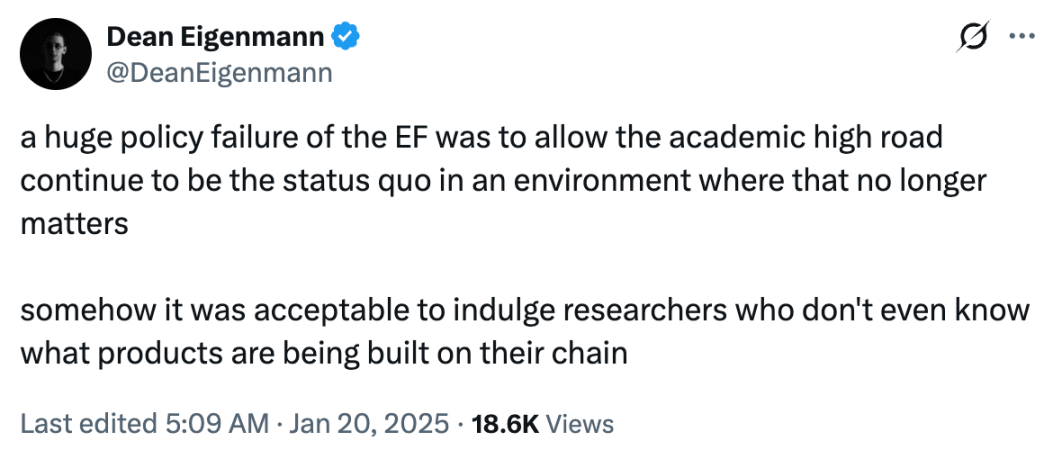
On the night of March 1, 2025, the Ethereum Foundation announced the appointment of Hsiao-Wei Wang and Tomasz Stanczak as co-executive directors starting March 17, while the then-executive director Aya Miyaguchi would still remain on the board but step back from front-line duties. Hsiao-Wei had been a core researcher at the Ethereum Foundation for seven years and was a key contributor to the Ethereum Beacon Chain. Tomasz Stańczak led a team that developed the execution client Nethermind.
In the following year, although there may not have been drastic changes visible to most, many significant improvements were genuinely occurring, summarizing into two main points: internal efficiency enhancement and external communication strengthening.
Internally, the two greatly optimized the internal processes of the Ethereum Foundation, speeding up decision-making significantly. Previously, the Ethereum Foundation faced criticism for slow responses and bureaucratic practices; the new officials quickly pushed the foundation out of its comfort zone, such as becoming more proactive in addressing community feedback and reducing internal delays. To achieve this, the foundation also laid off 19 employees and streamlined its structure.
The most significant change felt by everyone was the rapid decrease in transaction costs on Ethereum, which even fell below that of some L2s. Although a decline in on-chain activity contributed to this, alterations to basic parameters that previously needed repeated discussion—such as blob expansion and gas limit increases—were swiftly executed within the year.
Externally, the foundation increased its public communications, with Tomasz beginning to participate frequently in podcasts, community AMAs, and social media interactions. Vitalik specifically mentioned that he brought a "fresh new energy," making the Ethereum Foundation more responsive to the outside world. In addition to communicating with the community, Tomasz also strengthened his dialogue with developers, government entities, and institutions, promoting Ethereum's entry into practical fields while supporting Web3 projects. It’s believed that everyone can notice Ethereum seemingly revisiting the "privacy" narrative, which is prepared for practical application scenarios in real life.
Did He Still Lose to "Power Struggles"?
Leaving hastily after less than a year in office, along with seemingly loaded statements in his farewell letter, has sparked multiple speculations regarding the true reason for Tomasz Stanczak's departure.
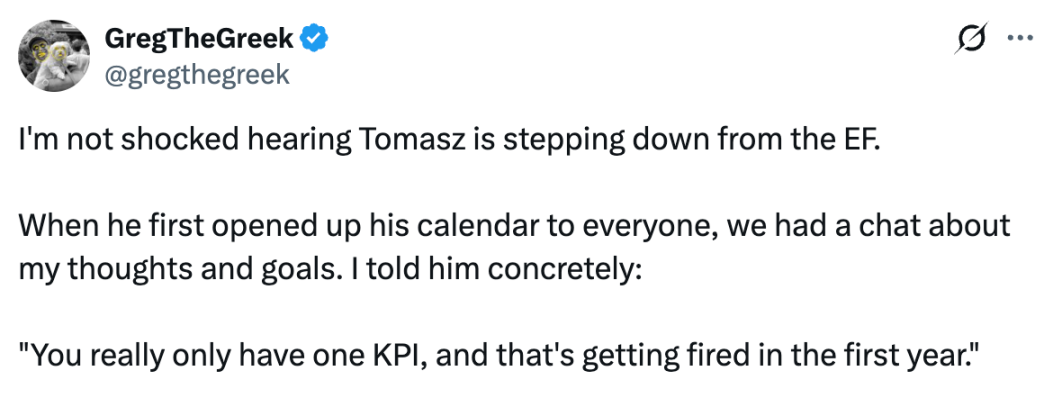
A core contributor to Ethereum's consensus layer, a user known as GregTheGreek on X, made a post claiming that a year ago, during a conversation with Tomasz, he said: "You actually have only one KPI, which is to get fired in the first year." GregTheGreek made this judgment for two reasons: first, the power struggles within Ethereum remained intense, with Aya, the chairperson of the Ethereum Foundation, retaining significant influence; the reforms pushed by Tomasz did not uproot this "source", hence he faced exclusion from the original interest groups.
The second reason is that Tomasz has a deep background in Nethermind, Flashbots, and venture capital, with clear conflicts of interest. Although Tomasz disclosed this in advance, such conflicts surely stirred dissatisfaction among many.
Even with this prediction, GregTheGreek could not confirm the real reason; he wished to believe that Tomasz preferred being on the front lines of technology and industry rather than issuing commands from the office, yet he still felt that leaving within a year likely meant he was pushed out. In response to comments from other users on X, he mentioned, "You can change an organization within a year, but you cannot change its culture in such a short time."
The community's speculations about the reason for Tomasz's departure stem from the notion that "less than a year is too short," evoking a sense of a trial period being concluded unsatisfactorily. However, given that Tomasz himself insists he prefers to personally engage in projects, and Ethereum co-founders Vitalik and Joseph Lubin have not revealed much more information, we cannot hastily assume that everything is related to power struggles. But from Tomasz's own words, there is an implicit sense of reluctance.
This year, we witnessed changes in Ethereum and saw Vitalik dare to negate his previous misjudgment of L2. However, if Ethereum truly desires a complete overhaul, perhaps it could consider bringing in an experienced professional manager from outside the ecosystem—someone without conflicts of interest and who would not be influenced by the intricate ties within the ecosystem, a truly independent manager.
免责声明:本文章仅代表作者个人观点,不代表本平台的立场和观点。本文章仅供信息分享,不构成对任何人的任何投资建议。用户与作者之间的任何争议,与本平台无关。如网页中刊载的文章或图片涉及侵权,请提供相关的权利证明和身份证明发送邮件到support@aicoin.com,本平台相关工作人员将会进行核查。