Intelligent agents need identity, limits, and settlement rights: Pantera outlines the four-layer stack of AI x blockchain.
Written by: Paul Veradittakit
Translated by: AididiaoJP, Foresight News
The products that truly need to be built are not flashy: wallets with limits, stablecoin settlements that machines can independently execute, verifiable credentials presented by intelligent agents, computational power that you can truly own, and proof that can be provided without flipping through ledgers.
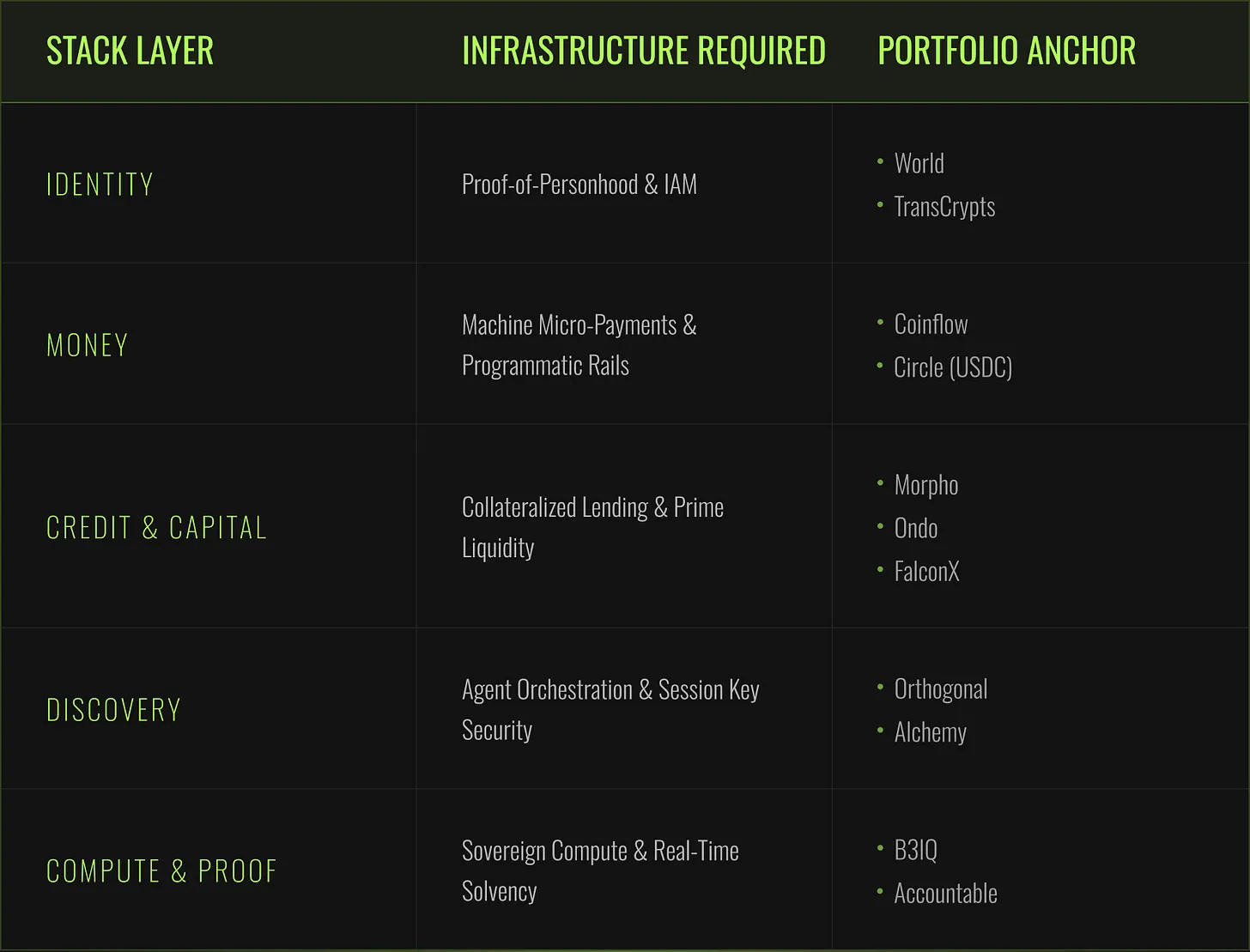
Pantera already has a number of portfolio companies laid out in this convergence zone: money and machine settlements (Circle, Coinflow, OpenFX); credit, capital, and transactions (Morpho, Ondo); identity, credentials, and control (World, TransCrypts, Alchemy); sovereignty of computational power and real-time proof (B3IQ, Orthogonal, Accountable).
Founders and investors often ask: What is really happening at the intersection of AI and blockchain?
What we are now faced with and need to build is an 80 billion customer base, each with several intelligent agents, plus clusters in enterprises addressing coding, finances, procurement, and sales. This amounts to hundreds of billions of new decision-making and transaction endpoints. For intelligent agents to become customers, they must simultaneously possess identity and memory, have budgetary authority, the capability to select and execute settlements, and be accountable to their owners. Gartner predicts that by 2030, the impact of agents on procurement will reach $30 trillion. Visa, Mastercard, and Coinbase's x402 have already begun issuing credentials and turning sub-tier payments into tangible realities. Cloudflare has stated that robot requests account for more than half of HTTP traffic.
80 Billion Customers
8 billion people, each running a team of personal and enterprise AI intelligent agents, covering coding, finance, procurement, sales, and logistics. This equals a sudden increase of billions of independent decision-making and transaction endpoints.
For an AI model to become an economic subject, three things must be in place simultaneously:
- Identity and memory: Cryptographic credentials anchored to the owner.
- Budget authority: Programmable limits, flow rate restrictions, session keys.
- Autonomous settlement: Capability to discover, compare, and pay for services on chain.
The key question posed by Franklin to builders is: Who do these agents belong to? The individuals and companies they represent, or the platforms they operate on?
If centralized cloud vendors hold the identity, memory, and learning loop of the agents, switching suppliers means firing the entire digital workforce and starting over with memory-less newcomers. Blockchain provides the underlying layer of ownership: portable identity, bounded authorization, and a settlement mechanism that model vendors cannot alter.
What AI x Blockchain Looks Like Today
Money and settlement between machines
AI intelligent agents do not fill out KYC forms, do not wait three days for ACH transfers, and do not manage monthly credit card subscriptions. What they seek is frictionless, sub-tier, round-the-clock payment pathways.
Coinflow: Seamlessly connecting card and bank payments to stablecoins in over 170 countries, allowing users to avoid interacting with the underlying chain. OpenFX: Stablecoin settlement has processed on an annualized scale of billions of dollars, explicitly built around software clients rather than human end-users. Circle (USDC): Launched during the last bear market, has now grown into the default accounting unit for machine-to-machine micropayments and enterprise agent settlements.
Credit, Capital, and Transactions
When intelligent agents need to borrow or deploy funds based on configuration instructions, a programmable liquidity layer is required.
Morpho: Already embedded in Coinbase, Robinhood, Société Générale, and Apollo, serving as a credit backend. It is becoming the default lending infrastructure that intelligent agents check during programmatic borrowing. Ondo Finance: Transforms tokenized US Treasuries and stocks into interest-earning, collateralizable assets. Nathan Allman left Goldman Sachs to focus on institutional asset tokenization, which is now directly connected to intelligent agent budgeting issues. FalconX (acquired via bloXroute): Combines high-speed prime brokerage and execution stacks to service never-closing markets — this is also the only operating hours recognized by AI intelligent agents.
Identity, Credentials, and Control
Synthetic content is ubiquitous, proving "this is human intent" and "this intelligent agent is authorized" has become critical.
World: Turns "humans" into a foundational primitive, using cryptographic proofs to ensure a unique human stands on the chain, combating robot networks and witch attacks. TransCrypts: Places employment, educational, and legal credentials onto user-controlled pathways, allowing intelligent agents to verify claims of authority without handing over sensitive original documents. Alchemy: Provides the core development platform supporting intelligent agent wallets and session key models. Developers no longer give the main private key to intelligent agents but instead issue finely grained limits on counterparties, with expiration times and the ability to revoke instantly.
Sovereignty of Computational Power and Real-Time Proof
B3IQ: Offers sovereignty as a service via a "rent-to-own" computational power network. For institutions to maintain true autonomy, model weights and execution paths cannot be locked into a single vendor environment. Orthogonal: Serves as the orchestration and discovery layer for intelligent agent services, being one of the leading platforms for on-demand activation and native billing on decentralized networks. Accountable: Allows financial institutions and autonomous funds to demonstrate solvency in real-time via cryptography, without making their private assets and liabilities public.
What Type of Founders We Value in Defining Tracks
Focusing solely on sovereignty is not enough to constitute a selling point. Winning products provide what closed platforms cannot via decentralized infrastructure: lower transaction costs, stronger privacy guarantees, faster customization, or more stable execution.
When conducting due diligence on teams at the convergence, we focus on four things:
- Deep Expertise: You are living in this problem, not just reading about it. For example, Ed Felten left Princeton and the White House to build Offchain Labs / Arbitrum.
- Strong Drive: You see the market structure clearly enough that major institutions lay down on your track. For example, Paul Frambot founded Morpho in his early twenties, turning it into the default credit engine for DeFi.
- Unfair Networks: Distribution and collaboration enable you to deliver products even during a downturn. For example, Jeremy Allaire tied Circle and Coinbase together, establishing USDC as a global settlement standard.
- Obsession: Even when the spotlight shifts elsewhere, you hold a belief that you can weather the cycles. For example, Nikil Viswanathan and Joe Lau turned Alchemy into the default development platform for Web3.
If you're currently at Goldman Sachs, Citadel, Stripe, Block, or a cutting-edge AI lab: what once seemed like mere "adjacency to digital assets" is now the job description for building an 80 billion customer economy.
免责声明:本文章仅代表作者个人观点,不代表本平台的立场和观点。本文章仅供信息分享,不构成对任何人的任何投资建议。用户与作者之间的任何争议,与本平台无关。如网页中刊载的文章或图片涉及侵权,请提供相关的权利证明和身份证明发送邮件到support@aicoin.com,本平台相关工作人员将会进行核查。


