Author: Nancy, PANews
The on-chain gold rush of Robinhood Chain is intensifying, with stock memes becoming a new popular play, attracting increasing attention from market funds and traders.
At the same time, a "short squeeze experiment" combining low-priced stocks and memes is unfolding on Robinhood Chain. However, this experiment, which seems to be against Wall Street shorts, currently resembles a float squeeze happening in a very small market on the chain.
From "Coin Holder" to "Shareholder," Long.xyz Sparks Stock Meme Frenzy
Who would have thought that players trading memes could instantly transform from "coin holders" to on-chain "shareholders" with a single transaction?
Stock memes are becoming a hot trend on Robinhood Chain, satisfying the speculative needs of crypto players while allowing funds to gain indirect exposure to US stocks. Unlike previous meme coin trading, these tokens no longer use ETH, SOL, BNB, or stablecoins as pools, but directly select tokenized US stocks like NVDA, TSLA, GME, AAPL, SPCX as the pricing unit and trading pairs.
When players buy a stock meme, the funds in the transaction path usually need to first convert into the corresponding stock token before completing the meme trade. Each meme transaction indirectly drives on-chain demand for stock tokens, trading turnover, and liquidity pool locking.
For Robinhood Chain, stock memes have opened a more crypto-native traffic entrance for tokenized stocks. Originally relatively "traditional" RWA assets have gained higher trading frequency and stronger liquidity after being integrated into the meme trading scene. This gameplay unexpectedly became a lever to activate stock token trading and broaden the application scenarios of RWA assets, serving as a significant driver for the rising trading heat of Robinhood Chain. (Related reading: What Growth Flywheel has Robinhood Chain Seen Nearly Two Months after Launching?)
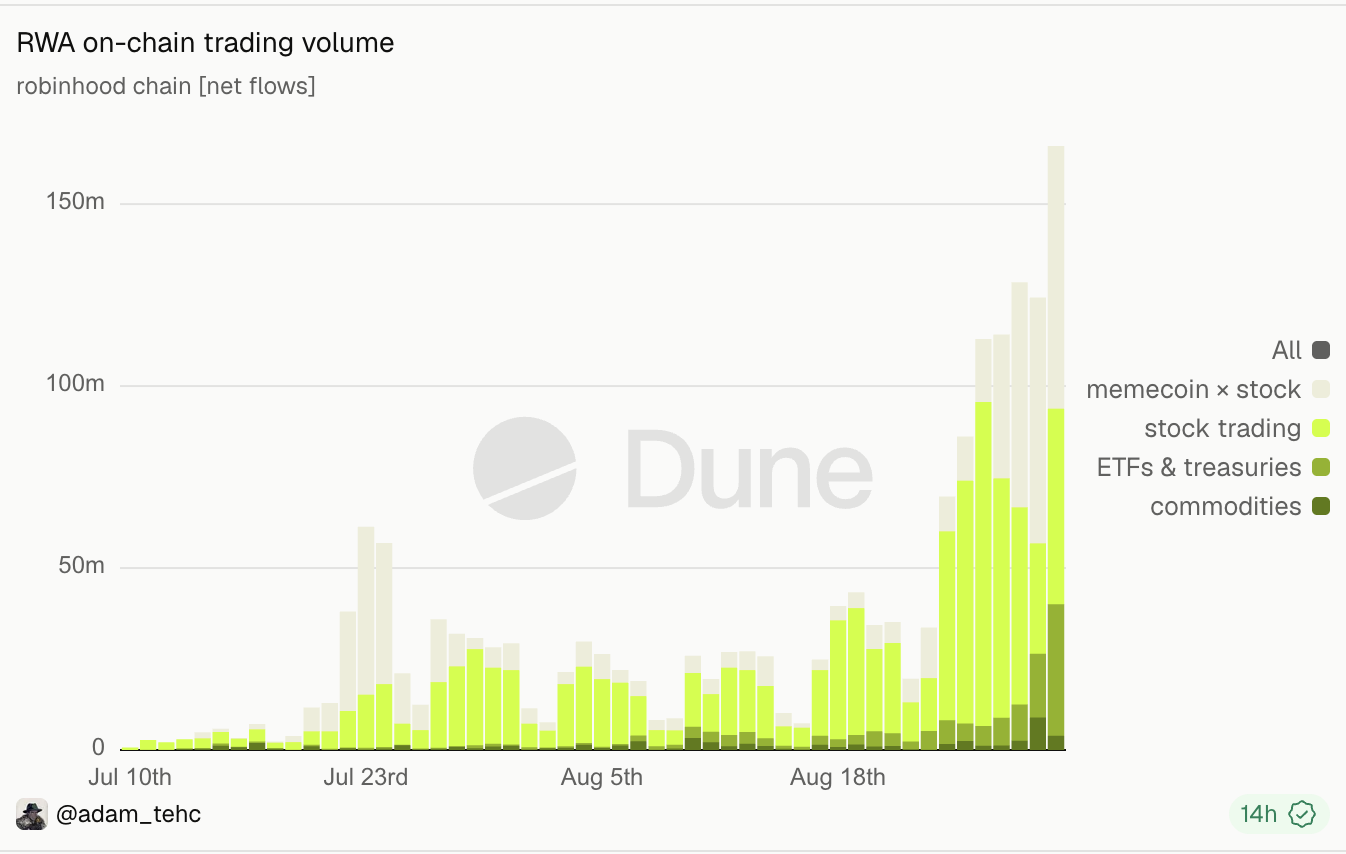
According to Dune data, at the early stage of Robinhood Chain's mainnet launch, stock meme trading pairs became active first, contributing a major share of RWA trading volume. As the scale of RWA trading rapidly expands, on-chain stock trading gradually becomes the core liquidity source of the ecosystem, driving overall trading volume to continue rising. Recently, stock meme trading has heated up again, returning to the top of the RWA trading types, jointly becoming an important force in pushing Robinhood Chain's trading volume to new highs.
Since the launch of Robinhood Chain's mainnet, multiple launchpads such as Long.xyz, Bankr, and Pons V2 have entered the scene to support issuing meme coins with tokenized US stocks as the base pool.
Currently, Long.xyz has become the largest traffic entrance for stock memes on Robinhood Chain. Dune data shows that on September 1, long.xyz's daily trading volume exceeded $22.2 million, with a market share of 72.1%, nearly 2.6 times that of all other launchpads combined.
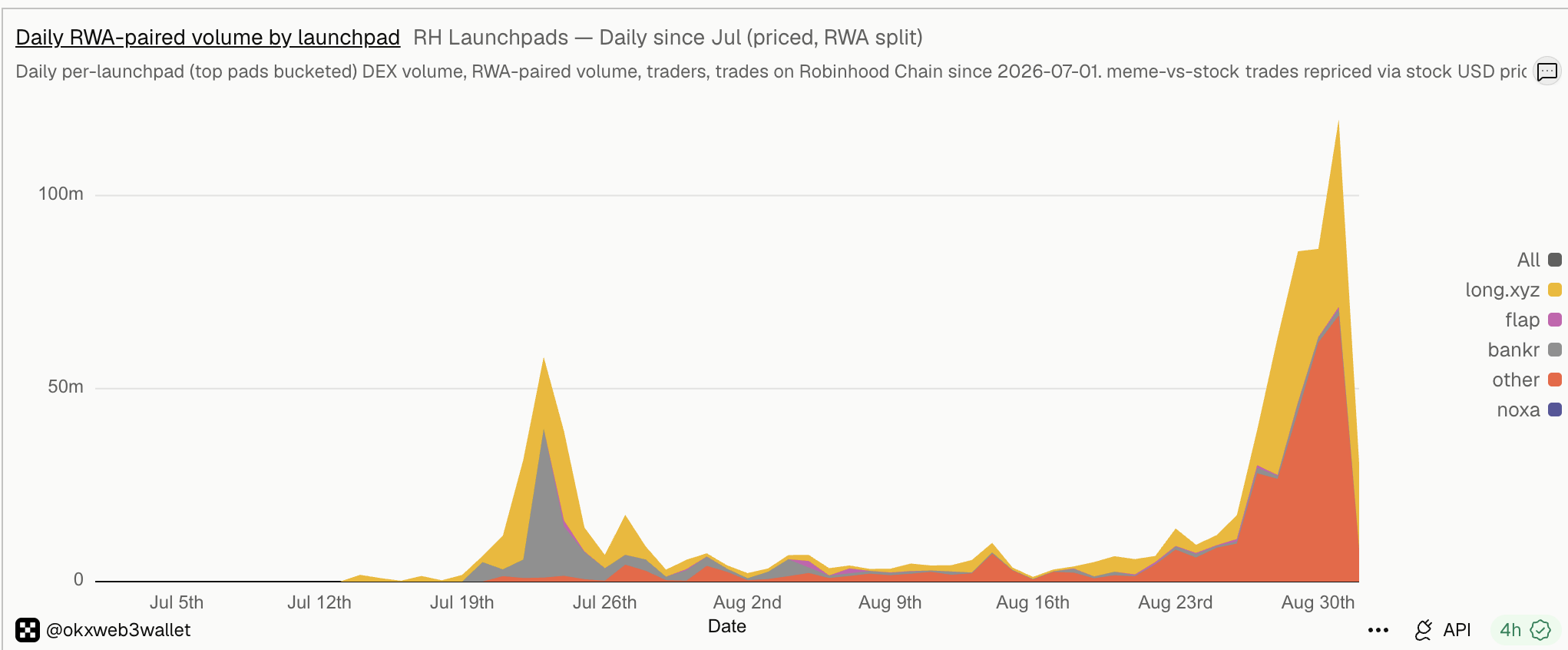
Since mid-July this year, Long.xyz has begun supporting users to issue meme coins backed by liquidity from tokenized stocks. Recently, tokens paired with NVDA such as $AI and $microduck, as well as $MARTIANS and $SPACEHOOD paired with SPCX, and $MOO paired with Micron stock have been hotly speculated by the market. Especially the AI tokens, whose market capitalization recently broke $190 million, also brought further market exposure to Long.xyz.
Moreover, Long.xyz has recently announced the launch of LongX Expansion, packaging the NVDA 3x leveraged position on Lighter as ERC20 tokens, supporting minting, redeeming, DEX pool trading, and liquidity pairing, with related trading fees flowing back to AI tokens, allowing leveraged stock positions to be directly packaged into on-chain tradable, combinable meme assets. Currently, this feature is still in a controllable testing phase.
However, how much real demand stock memes can eventually settle for the RWA ecosystem remains to be seen. But at least for now, memes are becoming a new path for tokenized stocks to leverage crypto liquidity and open on-chain application scenarios.
Trading meme coins can also "squeeze" Wall Street?
Interestingly, stock memes are currently playing out an "experiment" against Wall Street shorts. It all starts with the meme coin BONER on Long.xyz.
The main trading pool for BONER is BONER/HIMS, where HIMS is a tokenized stock on Robinhood Chain, corresponding to the NASDAQ-listed company Hims & Hers Health. This is an internet healthcare company with business covering areas such as men's health.
When users buy BONER, the transaction is completed along the path "USDG→HIMS→BONER". In other words, every BONER purchase generates demand for HIMS, with some HIMS locked into the liquidity pool, reducing the number of HIMS available for free trading in the market.
At the time, the HIMS on the chain was itself a very small market. Last Friday, the total issuance of HIMS tokens on Robinhood Chain was about 15,000, with over 80% locked in the BONER/HIMS main pool. Compared to the circulating share capital of Hims & Hers actual stock, this part of the on-chain float can be almost ignored, but for a market with very thin liquidity, it can cause huge price impacts.
Due to the NYSE being closed for the weekend, authorized participants could not buy the underlying stock and mint new HIMS tokens as they would during normal trading hours. Thus, the market experienced a "closed market squeeze," with meme buy orders still continuing, but the new supply of HIMS tokens temporarily frozen, leading to fewer and fewer HIMS available for free trading. This caused the on-chain price of HIMS to spike to about $132, while the underlying stock closed at around $29 on Friday. As the price of HIMS was pushed up, the dollar value of BONER was also simultaneously increased. GMGN data showed that the market capitalization of the BONER token once approached $90 million. However, as the underlying stock market reopened, the premium on HIMS had basically disappeared.
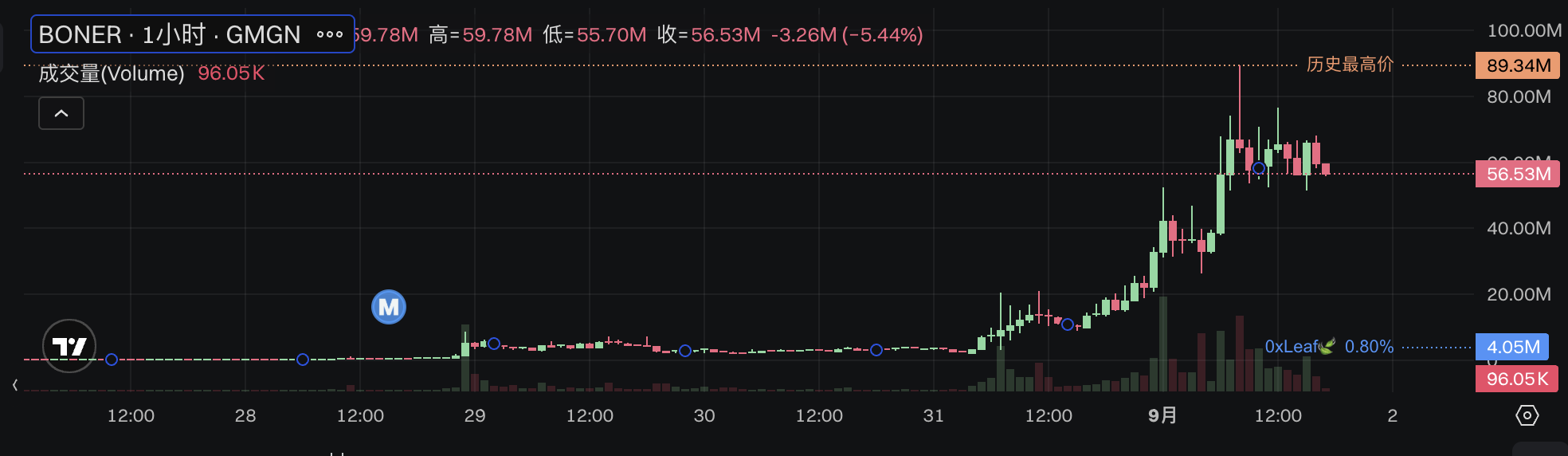
As of September 1, the total issuance of on-chain HIMS had approached 72,000, with over 52% locked in the BONER/HIMS main pool. Based on the underlying stock's price of about $29, the nominal market value of this batch of tokens corresponding to on-chain HIMS is about $2.088 million. Within just a few days, the on-chain supply of HIMS has increased several times. However, even so, compared to the more than 200 million shares of actual circulating stock of Hims, the on-chain market remains an extremely small shadow market.
Therefore, the BONER/HIMS experiment resembles more of a "float squeeze" that takes place on the chain. Meme demand continuously absorbs tokenized stocks, and tokenized stocks are locked in liquidity pools; when the traditional stock market is closed, and new tokens cannot be minted in a timely manner, the extremely limited tradable float on the chain will be quickly squeezed by funds, resulting in price fluctuations that far exceed those of the underlying stocks.
Similarly, the crypto community plans to initiate a "meme short squeeze experiment," intending to tokenize low-priced NASDAQ stocks and pair them with meme coins for trading.
On September 1, crypto KOL Rune stated that he had spent about $1.8 million over the past three weeks buying shares of a NASDAQ-listed company through two brokers in batches, reaching a stake of 37.4%. This company currently has a market capitalization of about $4.8 million, with a stock price of about $0.12 and a short-selling ratio of up to 92.3%, while carrying about $6.2 million in debt and an ARR of only about $380,000.
His plan is to tokenize this part of the equity and deploy it to Robinhood Chain, further establishing a trading pair between the tokenized stock and a meme coin. His idea is that the on-chain trading demand generated by the meme coin community will be transmitted to the underlying NASDAQ stock through the trading mechanism of the tokenized stock. For a company with a market cap of only about $4.8 million and an extremely high short position, even if a $500,000 level buy order forms on-chain, it could significantly affect the liquidity of the underlying stocks; if the buy order further expands to $2 million, it could theoretically magnify price fluctuations significantly and increase the pressure on shorts to cover.
If this mechanism works, the combination of low-priced stocks and stock memes may be imitated by more projects on Robinhood Chain.
However, it is necessary to emphasize that this is still a long way from truly "squeezing Wall Street". The current BONER/HIMS case resembles more of a "float squeeze" driven by meme demand in an extremely small, low liquidity on-chain stock market, essentially exploring a new on-chain liquidity lever. In the future, only when this demand continues to expand and is sufficient to allow market makers and authorized participants to repeatedly and on a large scale buy real stocks, will on-chain funds be able to further transmit to the underlying stock market and truly apply pressure on the shorts.
免责声明:本文章仅代表作者个人观点,不代表本平台的立场和观点。本文章仅供信息分享,不构成对任何人的任何投资建议。用户与作者之间的任何争议,与本平台无关。如网页中刊载的文章或图片涉及侵权,请提供相关的权利证明和身份证明发送邮件到support@aicoin.com,本平台相关工作人员将会进行核查。


