Original Author: Dong Jing
Original Source: Wall Street Insight
The global bond market is experiencing the most intense sell-off in nearly twenty years. The Bloomberg Global Government Bond Index yield has risen for four consecutive trading days, reaching 3.72%, the highest level since mid-2008—this is not a localized fluctuation in a single market but a systemic repricing affecting the United States, Japan, Australia, and even the entire G10.
On Tuesday (September 1), the yield on the US 10-year Treasury bond briefly rose to 4.78%, the highest since January 2025; the yield on Japan's 10-year government bond reached 3% for the first time in 30 years, and Australia’s equivalent bond yield also rose to the highest level since 2011. The UK 10-year government bond yield climbed to its highest level since June 2008, up 7 basis points to 5.223%.
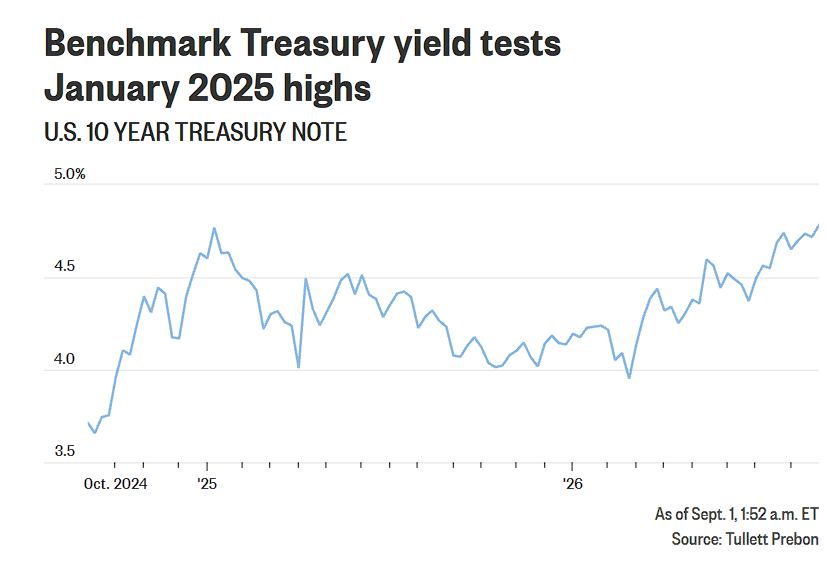
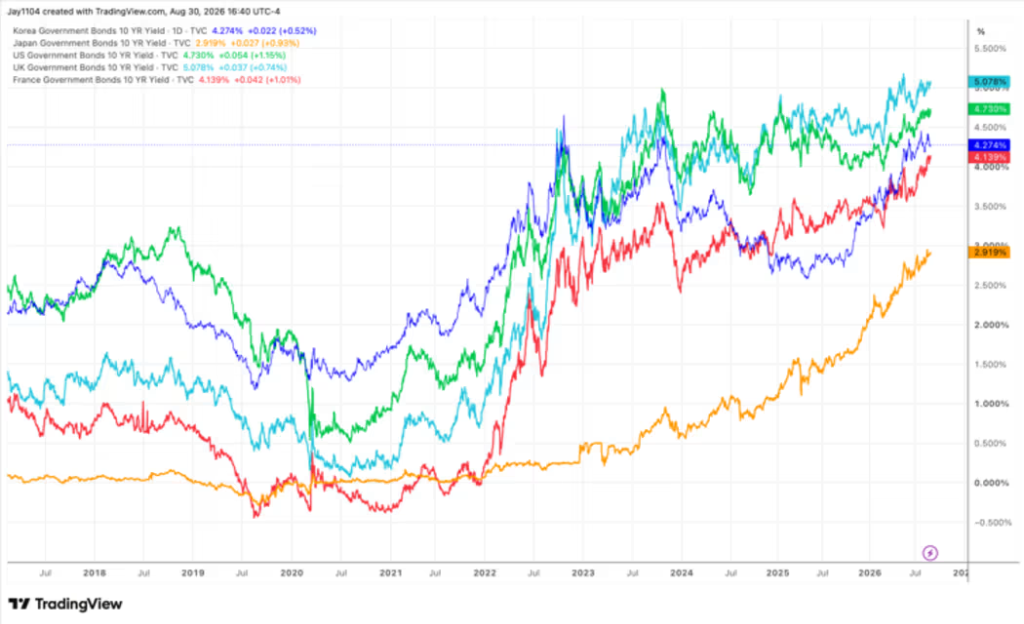
The logic driving this sell-off is intricately linked: Federal Reserve Chairman Kevin Warsh reiterated the anti-inflation stance at the Jackson Hole annual meeting, while escalating US-Iran conflicts pushed Brent crude oil back above $90 per barrel. Coupled with the US national debt exceeding $40 trillion and a continuous expansion of the fiscal deficit, the market is completely reassessing the pricing for "maintaining high rates for a longer time."
However, the more critical issue is: the era of cheap funding that has underpinned global asset pricing for over a decade may have ended. Analysts believe that a 5% yield on US Treasuries may not be the endpoint, but rather the starting point of a new normal.
Trigger: Warsh's Strong Stance Combined with Oil Price Shock
The direct trigger for this round of sell-off was a simultaneous outburst of two forces.
In his speech last Friday at Jackson Hole, Warsh reaffirmed the commitment to thoroughly suppress inflation—this is the fifth consecutive year that the Fed has failed to control inflation within target levels. Following the speech, the probability of a Fed rate hike in September surged from 34% to 65% in the interest rate swap market.
At the same time, the escalation of US-Iran conflicts raised concerns that energy transport through the Strait of Hormuz would face ongoing disruptions, with Brent crude prices increasing by 1.2% to about $91.55 per barrel. Rising oil prices have directly bolstered inflation expectations and further depressed bond prices.
According to Bloomberg, several current and former US and Iranian officials have indicated that the Middle Eastern conflict is expected to persist for months. This means that the upward pressure on energy prices is unlikely to dissipate in the short term, and the uncertainty regarding inflation trajectories will continue to haunt the bond market.
The combination of these two forces has markedly intensified pressure on the bond market. Barclays and Société Générale both updated their interest rate forecasts after Warsh's speech, incorporating previously unanticipated rate hikes in September and December into their baseline scenarios.
The Core Logic of US Treasuries: Uncontrolled Deficits and Reassessment of Real Rates
The upward movement of US Treasury yields is driven by deeper structural factors beyond geopolitical issues.
The US national debt surpassed $40 trillion in August, leading to an increasing supply pressure in the Treasury market. Meanwhile, major tech companies are launching long-term corporate bond issuances on a large scale to finance artificial intelligence infrastructure, and about $200 billion in high-quality corporate bonds are expected to flood the market in September, competing for the same batch of funds as Treasuries.
According to MarketWatch, the growth rate of nominal GDP in the US has accelerated to about 6.6% year-on-year, but the real growth rate is only 2.1%, with the difference mainly reflecting inflation—the GDP deflator index has risen 4.4% year-on-year. Historically, yields on 10-year Treasuries have typically been higher than the GDP deflator index, but the current spread between the two is at a historical low, suggesting that yields still have room to rise.
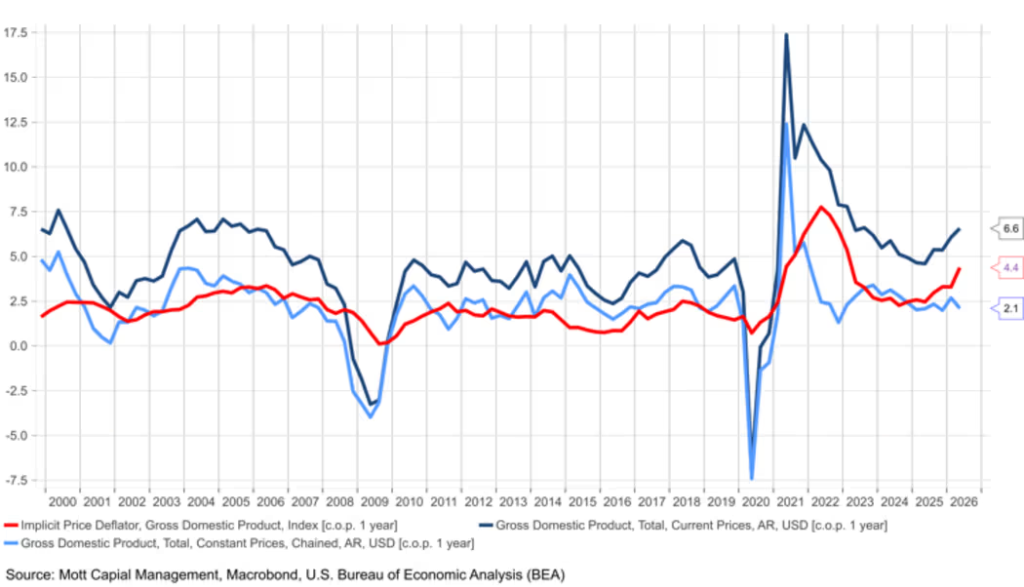
Notably, this round of rising yields is primarily realized through real rates (actual yields) rather than inflation expectations. This indicates that the bond market is not simply pricing for inflation but is demanding higher real returns—this is a fundamental reassessment of the long-term equilibrium rate level for the US economy.
According to MarketWatch, the growth rate of nominal GDP is also faster than that of money supply, with an increasing velocity of money, historically closely related to rising long-term rates.
Reportedly, Treasury Secretary Bunch stated on Monday that he and Warsh share a position on issues regarding the approximately $31.5 trillion Treasury market. The Treasury had previously announced in mid-August an expansion of repurchase operations for 10 to 30-year Treasuries; however, analysts believe that the authorities’ current objective may only be to stabilize yields rather than actively lower them.
Global Central Bank Tightening Resonates, The Era of Cheap Funding is Coming to an End
The other core logic behind this bond market sell-off is the end of the era of cheap funding globally.
For a long time, the low yields on US Treasuries partially relied on the continuous inflow of cheap foreign capital from low-interest-rate economies like Japan and Europe. However, as major global central banks tighten monetary policies in succession, this logic is breaking down.
As foreign yields rise, the relative attractiveness of US Treasuries to foreign investors diminishes, especially when accounting for currency hedging costs, further intensifying the upward pressure on US Treasuries. Bloomberg strategist Mark Cranfield points out:
"G10 fixed-income traders are increasingly closely monitoring Japanese government bonds, and Australian bonds are now more frequently priced alongside Japanese bonds rather than US bonds. The current backdrop is extremely unfavorable: sticky inflation combined with massive fiscal deficits in the US, Japan, the UK, and France."
Japan's transition is particularly critical. The Bank of Japan will end the world's last negative interest rate policy in 2024, after which yields on Japanese government bonds have quickly climbed. The yield on 10-year Japanese bonds was only about 1.5% a year ago and has now reached 3%, doubling in increase.
The share of international investors in the monthly spot trading of Japanese government bonds has risen from 12% in 2009 to about two-thirds, showing that Japanese bonds are becoming an important option for global asset allocation, which means that part of the funds previously flowing into US Treasuries is returning.
Meanwhile, the fiscal pressures cannot be overlooked. The administration of Japanese Prime Minister Sanae Takaichi has introduced an unprecedented fiscal spending plan, but the financing plan for a reduction in food consumption tax has not yet been clarified, raising further concerns about fiscal sustainability and pushing up Japanese bond yields. In the initial budget application for the next fiscal year, the Ministry of Finance has recorded a record debt repayment cost reaching 36.6 trillion yen (approximately $230 billion).
Rate Hike Expectations Rise Globally Across the US, Japan, Europe, and Australia
As the global bond market faces a large sell-off, the wave of global rate repricing continues to spread, with market bets on the tightening of monetary policy by various major central banks significantly increasing.
After the Jackson Hole global central bank annual meeting, according to Bloomberg data, the probability of a Fed rate hike in September has surged from 34% before Warsh's speech to 65%.
Moreover, the interest rate swap market indicates that a rate hike at the European Central Bank meeting on September 10 has been fully priced in, the probability of a rate hike by the Reserve Bank of New Zealand this week is at 98%, and the probability of a rate hike by the Bank of Japan on September 18 is 92%, with October's rate hike fully priced in as well.
Wall Street Insight article states that, according to Japan's national broadcaster NHK, US Treasury Secretary Bunch met separately with Japanese Finance Minister Satsuki Katayama and Bank of Japan Governor Kazuo Ueda during the G20 finance ministers' meeting on Monday. Bunch clearly told both parties that Japan should consider raising interest rates next.
Subsequently, Bunch stated in an interview with CNBC: "I have information that the market does not know, and I believe the Japanese government and the Bank of Japan will take action to strengthen the yen." This is the clearest signal yet from Washington regarding Japan's monetary policy.
Pepperstone Group strategist Dilin Wu pointed out, "The policy paths of major global central banks will be revealed within the same month, creating a highly concentrated pricing window for rates and the foreign exchange market."
Global Resonance: A Chain Reaction from Australia to Europe
This sell-off has evolved into a synchronized global event rather than an isolated incident in a single market.
On Tuesday, the yield on Australia's 10-year government bonds rose to the highest level since 2011, following stronger-than-expected inflation data, leading traders to increase bets on a fourth rate hike by the Reserve Bank of Australia this year, with the probability rising to 54%.
TD Securities senior rates strategist for the Asia-Pacific region Prashant Newnaha stated:
"The bond market has not collapsed, but it is issuing a very clear memo: the stickier inflation is, the higher and longer policy rates need to be. Fiscal deterioration and higher term premiums will continue to be the focus of the market."
From a seasonal perspective, the pressure may persist. According to Bloomberg data, the past ten years have shown that September and October are the two worst months for global bond index performance, with average monthly declines exceeding 1%.
Stock Market Under Pressure, Overall Borrowing Costs Rising
The ongoing rise in yields is transmitting through multiple channels to the real economy and financial markets.
For the stock market, Dakota Wealth Management senior portfolio manager Robert Pavlik stated:
The 10-year US Treasury yield of 4.75% is a threshold that is making investors "truly start to pay attention," as the market begins to worry about yields hitting 5% and triggering a stock market correction.
Chris Galipeau, chief market strategist at Franklin Templeton Institute, stated that the stock market can currently withstand the current interest rate levels, but if the 10-year yield surpasses 5%, the market "may face some trouble."
For ordinary households, the 10-year Treasury yield serves as the pricing benchmark for 30-year mortgage rates, and rising yields directly increase home buying costs.
Drew Matus, chief market strategist at MetLife Investment Management, pointed out that a rise in yields breaking through the "comfortable range" of 3.5% to 4.5% will force households to increase savings, putting downward pressure on consumption.
The 30-year US Treasury yield currently stands at 5.27%, having closed above 5% for 55 trading days since January, the most since 2006. In mid-August, the 30-year yield briefly touched 5.34%, the highest since 2007.
Garrett Melson, portfolio strategist at Natixis Investment Managers, cautioned that if yields rise further, it will exacerbate the multiple headwinds facing the stock market, especially against the backdrop of recent soft economic data. He said:
"Attractive real yields combined with a hint of slowing growth are enough to change the market narrative and reignite demand for bonds."
The non-farm payroll report for August, to be released this Friday, will become the next key observation window.
免责声明:本文章仅代表作者个人观点,不代表本平台的立场和观点。本文章仅供信息分享,不构成对任何人的任何投资建议。用户与作者之间的任何争议,与本平台无关。如网页中刊载的文章或图片涉及侵权,请提供相关的权利证明和身份证明发送邮件到support@aicoin.com,本平台相关工作人员将会进行核查。


