Last week, there was an interesting divergence in the U.S. stock market.
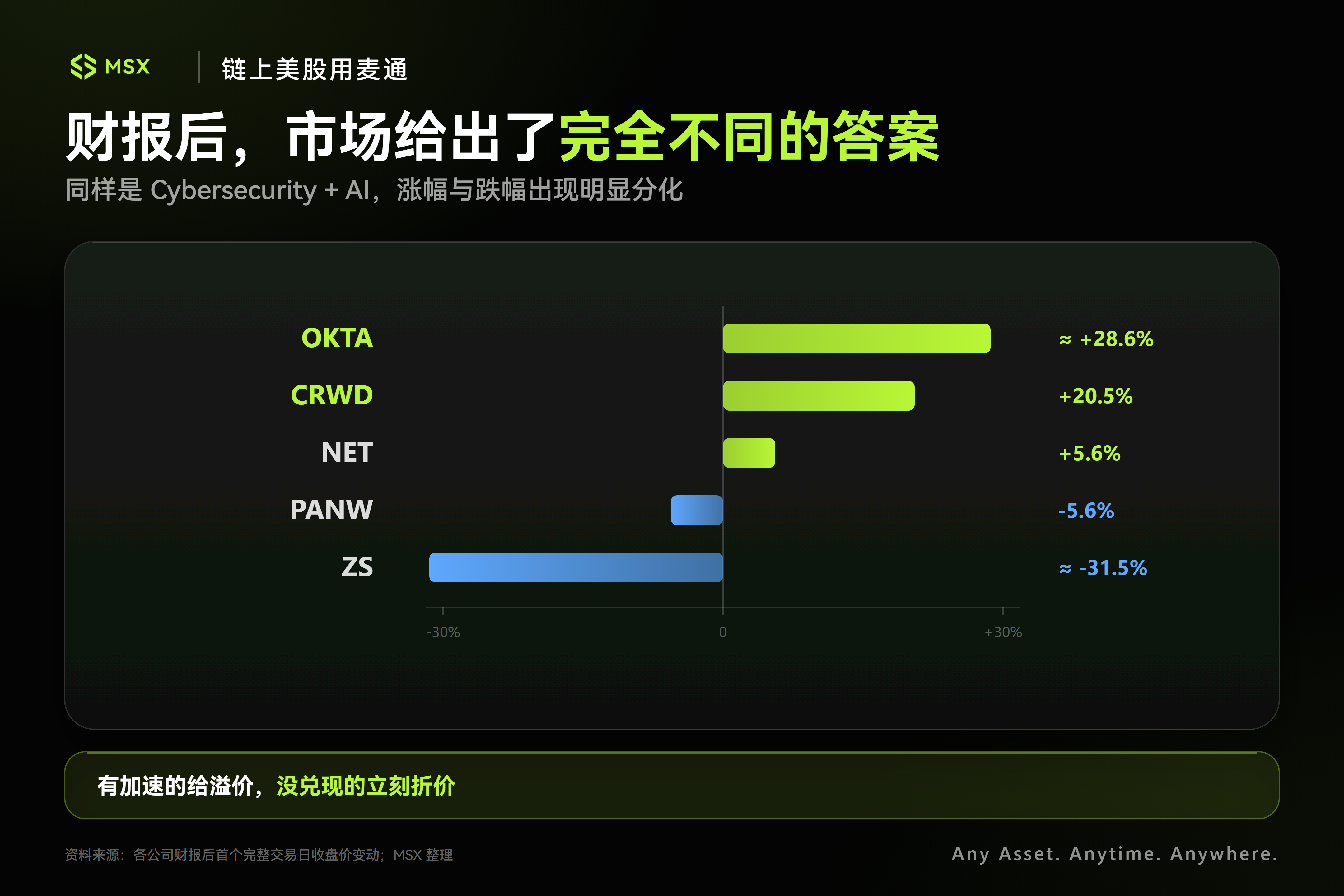
NVIDIA surged after its earnings report, continuing to prove that the demand for AI infrastructure is far from over; meanwhile, CrowdStrike (CRWD) rose 20.5% in a single day, and Okta (OKTA) was close to 29%, with the cybersecurity sector also experiencing a noticeable valuation recovery.
On the other hand, Zscaler (ZS) saw its stock plummet over 30% after its last quarter report, and SentinelOne (S)'s performance after its latest report was also disappointing.
They are all cybersecurity companies and all talk about AI, reflecting a very clear change behind the scenes:
As funds begin to explore new sources of AI revenue by shifting down from computational power, the market is no longer willing to pay for all "AI + cybersecurity" stories uniformly, but instead starts to screen—who has truly captured the new demand brought by AI?
1. Computational Power is Burning Money, Software Should Start Making Money
One of the biggest controversies in the software industry over the past six months is whether AI agents will ultimately shake the SaaS business model.
Because traditional SaaS relies heavily on headcount.
For example, if a company has 100 employees, it may mean 100 accounts for Salesforce, ServiceNow, or other enterprise software.
But if more and more work is completed by agents in the future, the number of employees may decrease, or one employee could manage dozens of agents, then some software that charges based on Human Seat could indeed face an unprecedented issue:
The usage of software is increasing, but the number of paying heads may not increase accordingly.
This has also been one of the core logics behind the market's trading of the so-called "SaaS apocalypse" this year.
However, the special aspect of cybersecurity is that while AI reduces some Human Seats, it also creates more non-human entities that need to be managed and protected.
For example, in the past, a company's security perimeter mainly revolved around employees, computers, and applications, but today this list has rapidly expanded: beyond employees, there are machine identities, beyond applications, there are APIs, and further on there are increasing numbers of AI agents.
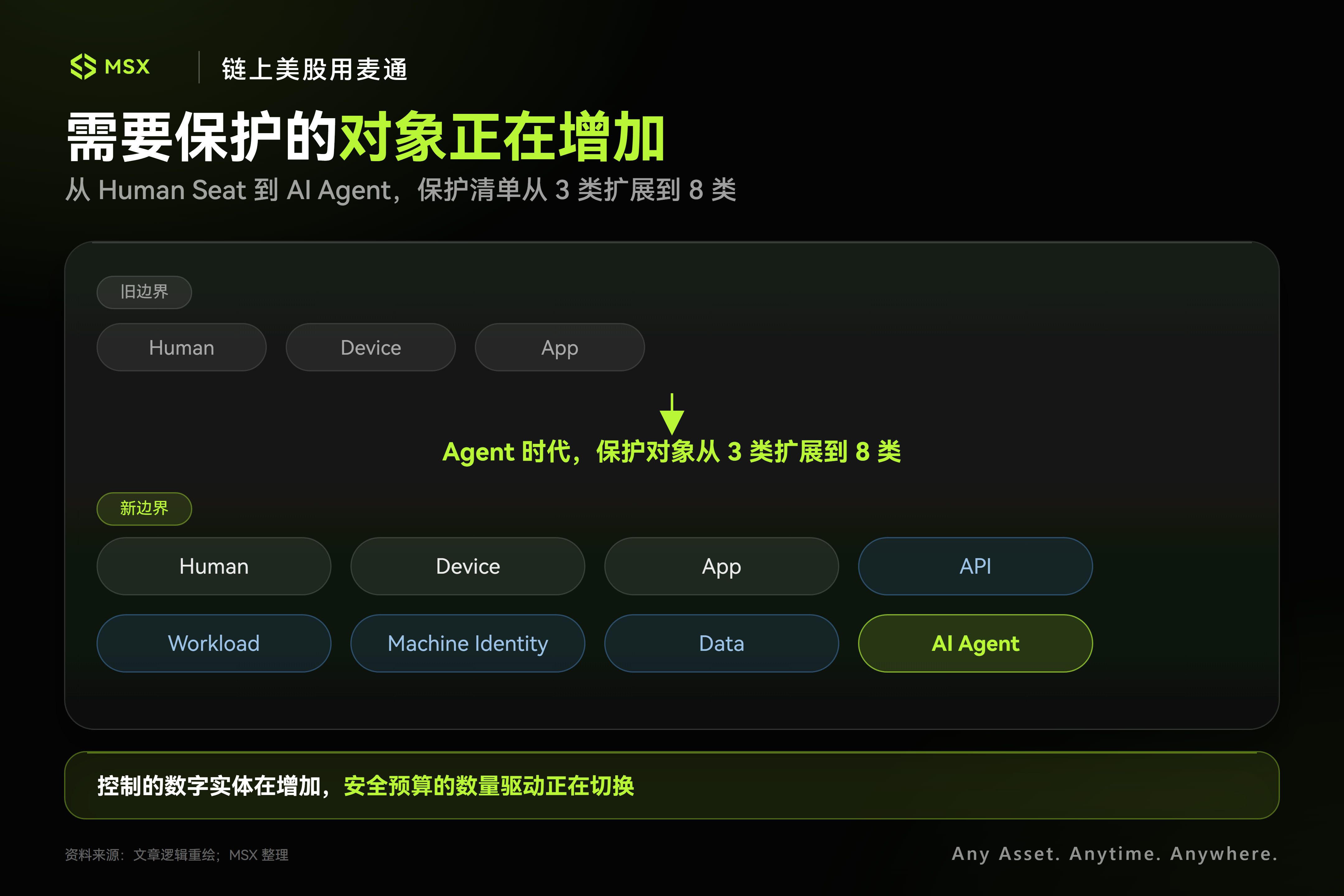
This means that an agent may not need a traditional employee account, yet still require access to the enterprise system; it may not be sitting in front of a computer, yet needs to access databases, invoke APIs, and connect to cloud services.
Thus, what is truly important about AI for cybersecurity is that the digital entities that need protection are increasing.
This is exactly the opposite of what many traditional SaaS companies face.
AI may lead enterprises to need fewer people, but it is unlikely to lead to a reduction in the number of identities, devices, interfaces, data, and machines that need protection, and it may very well be the opposite.
Because of this, as the market begins to search for the next corporate budget outside of AI infrastructure, cybersecurity naturally becomes a direction worth observing.
2. Talking about AI Security, Some Soar While Others Plummet?
However, even though they are all talking about AI security, the market has begun to show significant divergence.
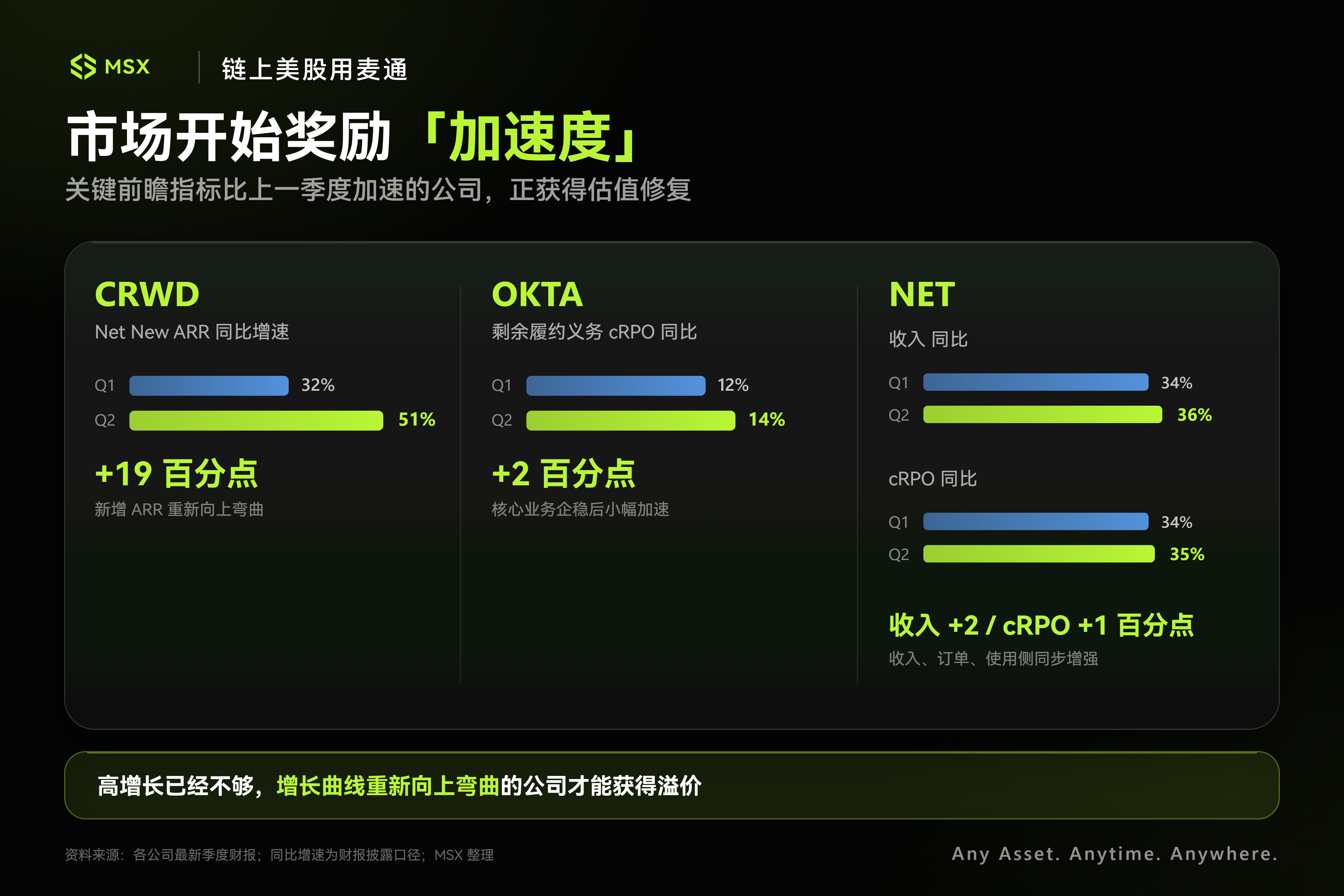
First, looking at Cloudflare (NET), as a representative company, its latest Q2 2026 revenue reached $696.1 million, a year-on-year increase of 36%, higher than the 34% in Q1; cRPO increased by 35% year-on-year, further improving from the previous quarter's 34%.
The changes in CrowdStrike are even more apparent, with Net New ARR for Q1 FY27 at $256 million, a year-on-year increase of 32%; by Q2, Net New ARR had reached approximately $333 million, with the growth accelerating to 51% year-on-year.
Okta's revenue growth still stands at only 11%, but cRPO improved from 12% in Q1 to 14% in Q2, while RPO's year-on-year growth rate reached 17%.
Ultimately, for subscription-based and platform software companies, revenue largely stems from the fulfillment of past orders, yet the current market is focusing on more indicators that can tell investors "what will happen in the next few quarters."
CRWD is the most typical example, with the company's latest quarter revenue at $1.47 billion, a year-on-year increase of 26%; the ending ARR reached $5.84 billion, a year-on-year increase of 25%, which appears "unremarkable," but the Net New ARR of $333 million, with a year-on-year increase of 51%, greatly stimulated the market.
This remarkably accelerated new order curve also represents the most important pricing logic of this round of cybersecurity action: high growth itself is no longer rare; what is rare is the re-acceleration of growth.
Looking in reverse makes the contrast even clearer.
Zscaler's last quarter Q3 FY26 revenue grew by 25% year-on-year, with ARR growth also at 25%, and while the numbers themselves do not indicate a poor report, the stock price nevertheless dropped over 30% because funds began to doubt whether its FY27 growth rate could continue to rise.
Similarly, SentinelOne's latest quarter shows a comparable situation.
In Q2 FY27, revenue reached $292 million, a year-on-year increase of 21%; ARR reached $1.218 billion, a year-on-year increase of 22%, and the company raised its annual revenue expectations, yet in after-hours trading following the earnings report, the stock price still dropped over 5% because the profit guidance and future expectations did not exceed the elevated thresholds set by the market.
3. More Agents, Bigger Business for Cybersecurity Companies?
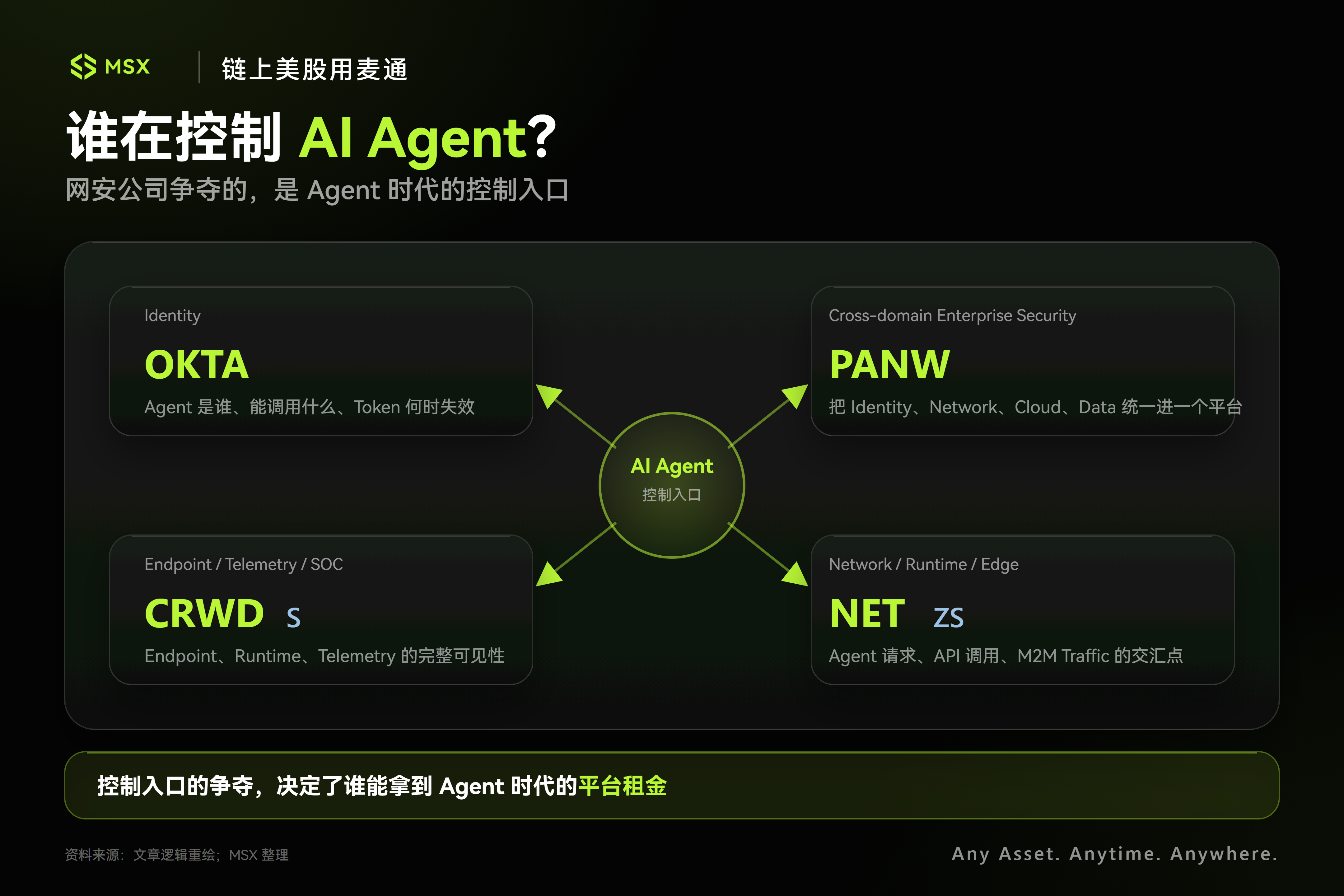
What's even more interesting is that if we continue to look down this logic, we will find that even though they all belong to the cybersecurity industry, the AI dividends that CRWD, NET, and OKTA enjoy are actually different.
1. CRWD: Enterprise Security is Becoming Like a Whole System
CrowdStrike's most traditional advantage comes from Endpoint, which is endpoint security.
Yet today it is far from just a set of antivirus software installed on computers; its business spans various segments including Endpoint, Cloud Security, Identity, Security Operations, Observability, Data Protection, and Threat Intelligence.
This is particularly important in the age of agents.
Because an agent completing a task often does not only stay within one system. It may first obtain an identity, access APIs after authentication, then enter Cloud Workload, read databases, and finally write results back to another enterprise system.
Thus, the boundaries among Endpoint, Identity, Cloud, and Runtime are becoming increasingly blurred; whoever has more complete telemetry has a chance to become the unified control platform for enterprise security operations.
This acceleration of Net New ARR also preliminarily proves that enterprises are willing to pay for larger security platforms.
2. NET: The More Active Agents, the More Internet Traffic
Cloudflare is the most unique among these companies.
Because it is actually difficult to simply define it as a traditional cybersecurity company; in addition to Security and Zero Trust, it also has global networks, a Workers development platform, and edge computing capabilities.
As such, AI's impact on Cloudflare does not just occur within the "security budget," but may also directly increase usage on the Cloudflare network.
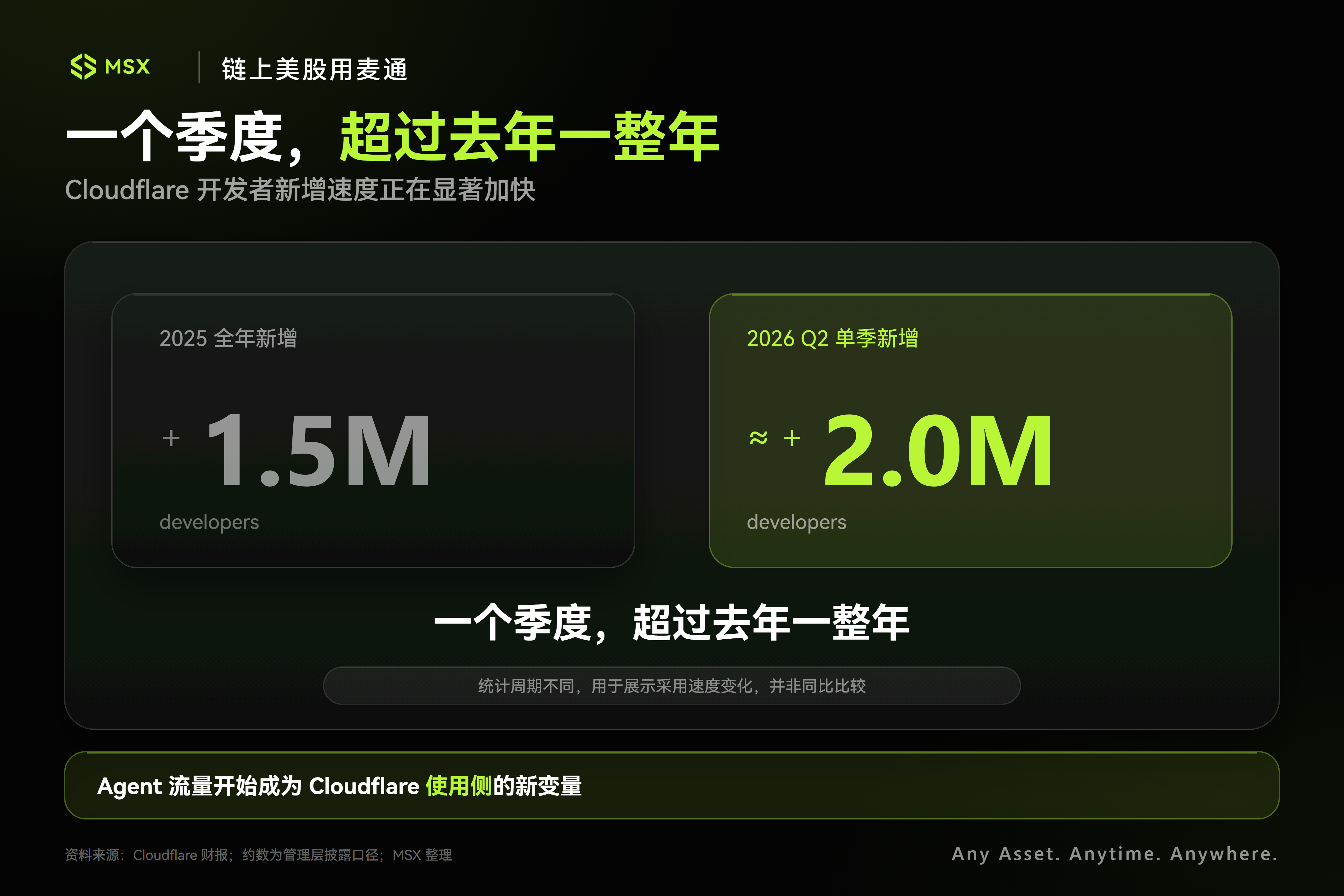
As of Q2, over 7.4 million developers were on the Cloudflare platform, with nearly 2 million added in just one quarter, exceeding the approximately 1.5 million added in the entire year of 2025.
Management also revealed an interesting phenomenon: for the first time in Q2, over half of the Cloudflare network traffic was not generated directly by humans.
Requests from AI agents continue to rise, and regardless of how many people agents ultimately replace, they require internet connectivity, need to invoke models, access APIs, read databases, execute code, and exchange information with other agents.
Cloudflare happens to stand at the intersection of these variables.
Thus, NET's more accurate positioning is akin to betting that in the future, there will be increasingly more traffic not initiated by humans on the internet.
3. OKTA: In the Future, There May Be More "Authorized" Entities in the Company Beyond Employees
Okta's situation requires a more cautious perspective.
In the latest Q2 FY27, the company reported revenue of $805 million, a year-on-year increase of 11%; RPO reached $4.858 billion, a year-on-year increase of 17%; cRPO reached $258.5 million, a year-on-year increase of 14%.
Compared to Q1's 12%, cRPO has indeed improved.
However, from the disclosures by management, the current improvement primarily stems from large customers, core Workforce / Customer Identity, and new products in Identity Governance.
Meanwhile, the greater significance of Agent Identity is that it opens up a market that did not previously exist for Okta—previously, Okta managed employees and customers, but in the future, enterprises must also manage agents.
Currently, Okta has already begun to roll out capabilities around AI agents including discovery, registration, access control, and lifecycle management.
While it cannot yet be said how much revenue Agent Identity has brought to Okta today, it certainly adds quantity-based imagination space to a market that is already quite mature in identity.
In the past, a company may have only tens of thousands of employees, but in the future, it may very well operate hundreds of thousands or even more machine identities and agents simultaneously.
If this trend indeed occurs, the market boundaries for identity will also change accordingly, and OKTA will undoubtedly face re-evaluation.
Conclusion
Where will the money spent on AI ultimately turn into revenue?
Cybersecurity may be one of the first industries to provide an answer.
The reason is not complicated: AI can replace a portion of humans, but it will not reduce the digital activities within enterprises, and may even lead to more than before.
This means that the challenges posed by AI to some software companies may precisely become the incremental market for another group of software companies.
However, the latest earnings reports have begun to distinguish between the two types of companies; just having AI stories is no longer sufficient, what really matters is whether orders, revenue, and growth have genuinely accelerated, and this weighting is becoming significantly larger.
The second round of AI may have just begun.
免责声明:本文章仅代表作者个人观点,不代表本平台的立场和观点。本文章仅供信息分享,不构成对任何人的任何投资建议。用户与作者之间的任何争议,与本平台无关。如网页中刊载的文章或图片涉及侵权,请提供相关的权利证明和身份证明发送邮件到support@aicoin.com,本平台相关工作人员将会进行核查。


