Recently, the cryptocurrency asset market has shown a phase of warming. Bitcoin has fluctuated around 80,000 dollars, and Ethereum once stabilized at 2,500 dollars. Major digital currencies like BTC, ETH, and SOL have once again become the focus of market attention.
The recovery in this round of market is driven by multiple factors, including changes in liquidity expectations, inflows of institutional funds, demand for spot ETFs, and the closing of short positions. However, beyond the price rebound, it is more noteworthy that the way users manage global assets is changing: digital currencies are no longer just a single asset in independent accounts, but are gradually connecting with needs such as cross-border remittances, currency exchanges, stocks, foreign exchange, wealth management, and global payments. What users truly need is no longer just a remittance tool or a single trading entry, but a one-stop asset allocation platform that can accommodate funds flow, asset allocation, and payment consumption.
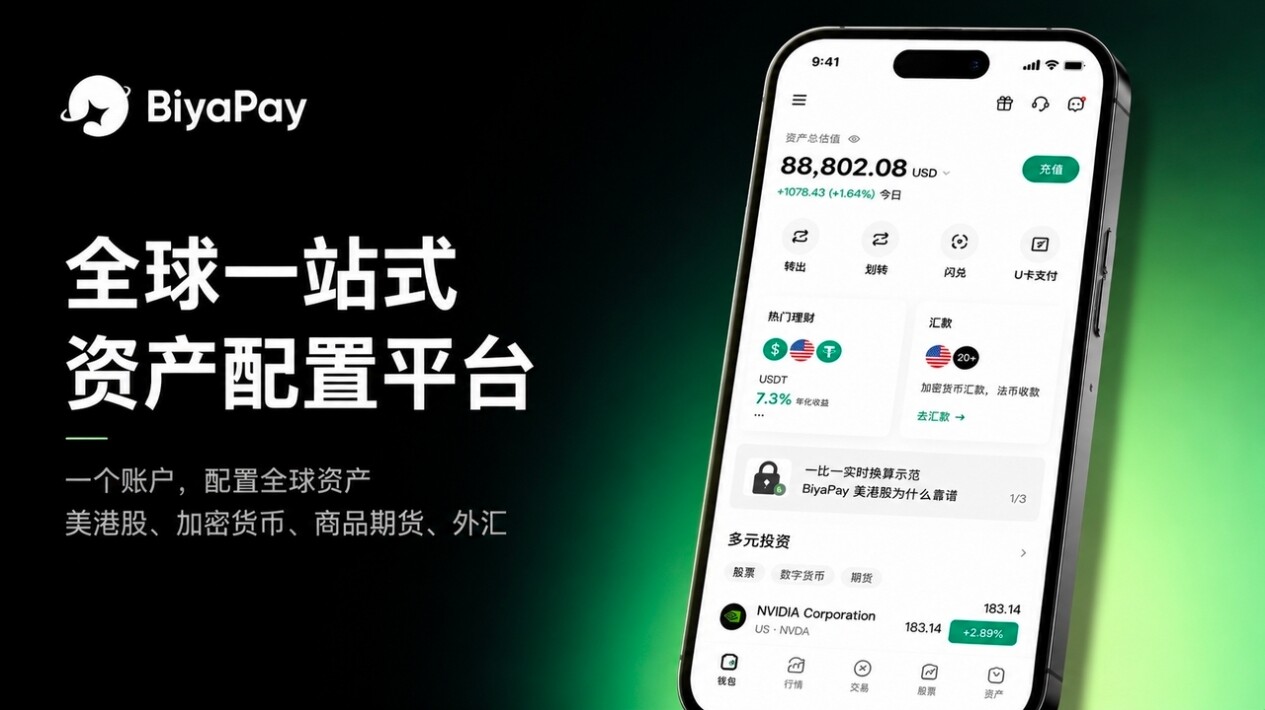
Cross-border remittance and payment is the starting point of BiyaPay's market entry. As user demands continue to extend, its services have gradually covered scenarios such as US and Hong Kong stocks, cryptocurrencies, foreign exchange, commodity futures, and wealth management. Pay resolves the first step of fund flow, while BiyaPay is addressing the next question: after the funds arrive, how to achieve more efficient fund management within a single account.
Starting from cross-border remittance, connecting global funding scenarios with USDT
In cross-border financial services, remittance and payment are basic yet longstanding pain points.
For international students, tuition, rent, and living expenses need to flow between different countries and accounts; for overseas workers, salary payment, family remittances, and multi-currency exchanges are high-frequency needs; for freelancers and cross-border practitioners, receiving payments from abroad, account transfers, and fund settlements are directly related to daily operational efficiency.
The pain points of traditional cross-border remittances are not unfamiliar. Cross-border remittance often involves multiple issues: opaque fees, unstable arrival periods, uncontrollable intermediary bank fees, unclear exchange rate discrepancies, complex requirements for receiving accounts, and a lack of smooth connection in the subsequent use of funds.
BiyaPay initially chose cross-border remittance as a starting point, and the underlying product logic is not complicated: first solve the most basic and high-frequency fund flow problems for users.
BiyaPay's cross-border remittance business emphasizes the integration of fund flow chains. Users can use USDT as the fund entry point, completing operations such as digital asset exchange, fiat currency exchange, and cross-border remittance within the platform, and using the funds for overseas accounts, investment accounts, or other payment scenarios according to actual needs.
The significance of starting from cross-border payments is not only to bring BiyaPay the first batch of users, but also to establish a set of basic trust capabilities for the platform around identity verification, account security, risk control, customer service, and fund flow. These capabilities later became an important foundation for the platform to expand other financial services.
As the number of users and usage scenarios increases, BiyaPay has also gradually discovered that once a remittance is completed, the user’s needs do not end there.
International students receiving living expenses may need to exchange them for local currency to use for online consumption; overseas workers receiving salaries may want to transfer part of the funds back to a family account and use another part for savings or investments; users holding USDT and other digital assets may need to complete currency exchanges, cross-border remittances, or further participate in the US and Hong Kong stock markets.
In these scenarios, payment is just the first step in the fund flow chain. After the remittance is completed, funds still need to enter different accounts, assets, and consumption scenarios. The issues users face also shift from "how to complete a cross-border remittance" to "how to manage cross-border funds within a single account."
This becomes the realistic foundation for BiyaPay's extension from a payment tool to broader financial services.
From a product logic perspective, BiyaPay does not treat cross-border remittance as an isolated function, but places it within the fund chain of global asset allocation. Cross-border remittance addresses the problem of funds flowing across regions, USDT exchanges and fiat remittances solve the entry of funds into different currencies and account systems, while subsequent products like US and Hong Kong stocks, digital assets, wealth management, and foreign exchange further accommodate the management and usage needs after funds arrive.
From Crypto to US and Hong Kong stocks, BiyaPay expands multi-asset service scenarios
The product boundaries of cross-border financial platforms are often determined by the next destination of user funds.
Once a fund completes its cross-border flow, users typically have several directions: exchange it for dollars, Hong Kong dollars, and other currencies, enter stock or other financial markets; retain it as USDT and participate in Crypto-related services; or transfer it into wealth management products for managing idle funds.
Many users already hold USDT, but their needs do not stop at Crypto trading; they seek to connect funds to broader global asset markets such as US and Hong Kong stocks.
Under traditional paths, users wanting to participate in US and Hong Kong stocks often need to prepare offshore accounts or brokerage accounts, completing multiple steps such as currency exchange, funding, and fund transfers. For users already holding USDT, they first need to convert digital assets into the corresponding fiat currency before entering the stock account through other channels. The entire process involves multiple platforms and accounts, leading to longer fund paths, as well as potential time and operational costs.
BiyaPay’s product expansion is unfolding along this fund path. In the US and Hong Kong stock scenarios, BiyaPay attempts to connect cross-border funds with traditional securities markets. Users do not merely view stock market trends, but instead participate in real stock markets through related brokers and clearing services. Unlike stock tokenization, real stocks correspond to asset rights in traditional securities markets, and relevant orders, clearing, and dividend arrangements are executed according to corresponding market and service rules.
BiyaPay lowers the basic costs for users to participate in the market through mechanisms such as zero-commission trading in US stocks, further connecting users with actual stock-related services in US and Hong Kong markets, realizing "using USDT to buy real US and Hong Kong stocks."
Cryptocurrency services further expand BiyaPay’s asset coverage. As Bitcoin, Ethereum, and other digital assets gradually become part of global users' asset allocation, users' concerns extend beyond market fluctuations to include asset conversions, fund transfers, fee transparency, and account security. BiyaPay provides access to over 200 mainstream digital assets for viewing, trading, and managing, connecting them to cross-border funding scenarios.
Foreign exchange and commodity futures correspond to another category of globalization needs. Exchange rate fluctuations can impact the actual costs of studying abroad, traveling, cross-border commerce, and overseas investments, while commodity prices are closely related to inflation, energy markets, and global economic cycles. The platform covers foreign exchange and commodity futures not just to add two product categories, but also to enable users to observe and manage assets in a more complete market dimension.
Wealth management services meet the management needs for USDT funds that temporarily have no clear purposes. Some users retain a certain proportion of idle funds after completing remittances, currency exchanges, or asset adjustments. The annualized return for demand deposits can reach up to 10.22%, providing more options between liquidity and yield needs.
US and Hong Kong stocks, cryptocurrencies, foreign exchange, wealth management, and commodity futures may seem like different product categories, but they correspond to the same user path: once funds enter the account, they need to continuously flow among exchanges, allocations, and management.
From cross-border payments, USDT fund entry, to US and Hong Kong stocks, foreign exchange, Crypto, and wealth management services, BiyaPay's product expansion is not a simple stacking of functions, but instead unfolds gradually around the user’s fund flow path.
Streamlining the entire fund flow chain, BiyaPay moves towards one-stop asset management
Global financial services are moving from single-point tools to account-based platforms.
"Future financial services will not be limited to one market, one currency, or one asset category," said BiyaPay’s CEO. "What users need is an account that can connect global stocks, digital assets, and foreign exchange markets, allowing funds to flow more freely between different assets, currencies, and scenarios."
BiyaPay is trying to play such an entrance role. From cross-border remittance to US and Hong Kong stocks, from cryptocurrencies to foreign exchange and commodity futures, and then to wealth management and global payments, the platform's product matrix gradually covers four major aspects: "fund flow, asset allocation, fund management, and global consumption."
BiyaPay hopes to seize this round of traditional finance and digital finance's technological fusion cycle, building the first entrance for global asset integration through the combination of Web2 and Web3 capabilities. On the Web2 level, BiyaPay connects mature financial and consumption scenarios such as US and Hong Kong stocks, foreign exchange, commodity futures, and U-card payments; on the Web3 level, the platform provides users with more flexible funding paths through USDT and other stablecoins, digital asset trading, and on-chain fund flow capabilities.
One account connects diverse scenarios, as BiyaPay transitions from being a tool to a one-stop asset allocation platform. When these scenarios are placed within the same account system, what BiyaPay provides is no longer an isolated function, but a relatively complete global fund usage path. It aims to break down barriers between assets and allow value to flow more freely.
Diverse allocation also poses higher requirements for the platform. The more products there are, the more the platform needs to clearly explain the providers of different services, cost structures, market risks, and applicable regions; the richer the asset categories, the more account security, identity verification, risk management, and customer support need to be simultaneously improved.
For global users, multilingual services have also become an important part of the global platform. For cross-border users, localization is not just about translating page text into another language but includes whether product rules can be accurately understood, whether fees can be clearly displayed, whether risk warnings conform to local contexts, and whether users can receive effective support when encountering issues.
From remittance tools to multi-asset financial services, BiyaPay is redefining its service boundaries. Pay is the starting point, but in a time when global user demands continue to change, it is clearly not the endpoint.
As traditional finance and digital finance further merge, BiyaPay also hopes to become an important entrance connecting the two, helping more global users enter a new phase of financial services characterized by multi-assets and cross-markets. BiyaPay's next step is to create a global one-stop asset allocation platform for users.
免责声明:本文章仅代表作者个人观点,不代表本平台的立场和观点。本文章仅供信息分享,不构成对任何人的任何投资建议。用户与作者之间的任何争议,与本平台无关。如网页中刊载的文章或图片涉及侵权,请提供相关的权利证明和身份证明发送邮件到support@aicoin.com,本平台相关工作人员将会进行核查。


