
This article is co-produced by PANews and BIT US Stocks. BIT US Stocks offers 10,000+ US mainboard stocks and ETFs, supports the inflow and outflow of stablecoins as well as traditional USD wire transfers, and provides complete shareholder rights and dividend voting rights.
BTC stuck before key moving average, noticeable divergence in September's rise and fall
On the last trading day of August, Bitcoin was not pierced by macro headwinds. The situation between the US and Iran escalated oil prices and lowered stock index futures. hawkish remarks from Waller raised expectations for a rate hike in September, yet BTC remained close to $78,000 during Asian hours, up over 24% from the closing price of approximately $62,900 at the end of July.
The market's current focus remains on the 50-week moving average, which is around $81,000. Historically, Bitcoin successfully stood above this line in 2015, 2019, and 2023, after which bear markets were essentially declared over; however, rebounds in 2015, 2018, and 2022 also encountered strong resistance in this range before retreating again. Therefore, this time, being above $80,000 is not just an ordinary resistance but a dividing line of contention between bulls and bears.
Traders have a concentrated view on the short-term range: $76,800 to $77,000 is seen as a critical support level. If this level holds, Bitcoin may have the chance to push towards $79,000 to $80,000; if it breaks below, the price could retreat to around $75,500 or even $74,300. The resistance above is concentrated at $78,400, $79,400 to $80,800, with a real opening needing a strong hold above $82,000 to $83,000.
The market has also begun to repeatedly discuss "after the soaring in August, will September necessarily decline?" Crypto Xlarge reminds us that historically Bitcoin has never posted a green September immediately following a green August; this doesn't mean September will definitely decline, but when prices reach key historical ranges, seasonal pressures cannot be ignored. Benjamin Cowen, founder of Into The Cryptoverse, pointed out through historical data comparisons that in the bear markets of 2018 and 2022, Bitcoin rebounded about 40% from summer lows and encountered resistance at the 50-week moving average, subsequently further declining in the fourth quarter. He emphasized that considering we are in a midterm election year, not in a halving year, markets typically do not reach true bottoms until after the elections in early November, advising investors to remain cautious.
Wealthmanager also pointed out that the weekly RSI is still in the weak zone akin to the pre-breakdown of 2022, suggesting that if history repeats, a retracement before the true bottom appears would not be surprising. Chain Mind believes there is currently a bearish divergence, and only a breakthrough above $83,000 would clearly change the structure to a bullish one.
However, bulls have not retreated; Doctor Profit believes that Bitcoin has entered a "soft bull market," with $71,000 as strong support and $78,500 as major resistance, seeing potential towards $82,000 following a breakthrough. Aylo is also on the side of the bulls, believing the four-year cycle cannot be rigidly applied; unless there is a catastrophic decline in the US stock market, a macro crisis occurs, or Bitcoin itself faces a significant black swan event, the current scenario resembles a post-bottom oscillation more.
BIT Asset Management head Daniel YU believes that Bitcoin is facing the dual challenges of seasonal weakness and technical resistance, and a dense supply wall exists in the $81,000 to $86,000 range. During the window period of the September CPI data release and the Federal Reserve’s interest rate meeting, market volatility may intensify.
Today's highlights:
EigenCloud (EIGEN) unlocks about 36.82 million tokens, valued at approximately $7.2 million
Upbit 24-hour trading volume ranking: XRP, SKR, TT, BTC, ZKC
Bitcoin spot ETF saw a net inflow of $924 million last week
Ethereum spot ETF saw a net inflow of $824 million last week
SOL spot ETF saw a net inflow of $154 million last week
XRP spot ETF saw a net inflow of $110 million last week
HYPE spot ETF saw a net inflow of $56.8551 million last week
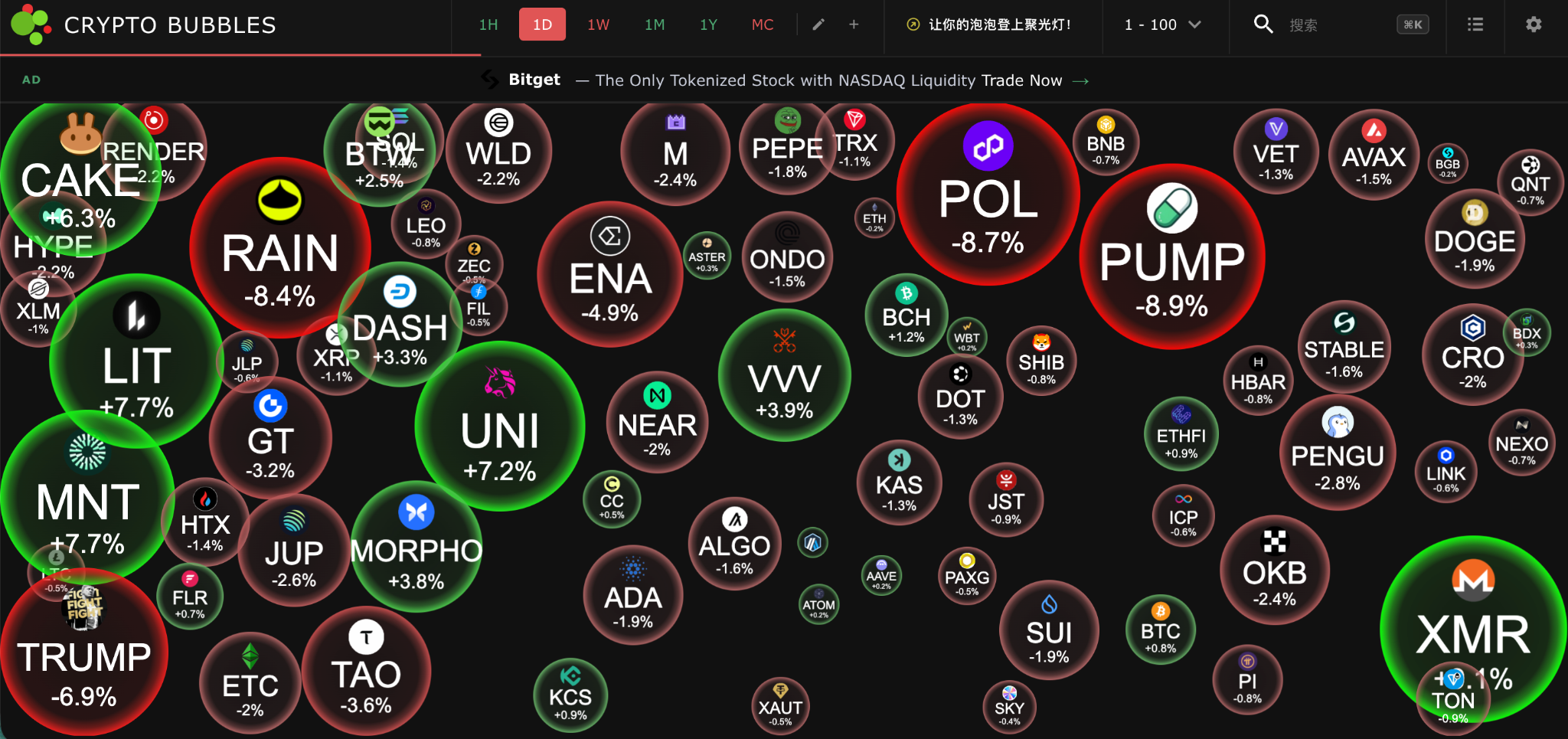
The largest gainers among the top 100 cryptocurrencies today: XMR up 11.1%, MNT up 7.7%, LIT up 7.7%, UNI up 7.2%, CAKE up 6.3%.
Stock indices remain cautious, chips and crypto stocks attempt recovery

US stock night trading sentiment remains cautious, with Dow futures down 0.12%, Nasdaq 100 futures down 0.03%, and S&P 500 futures down 0.13%.
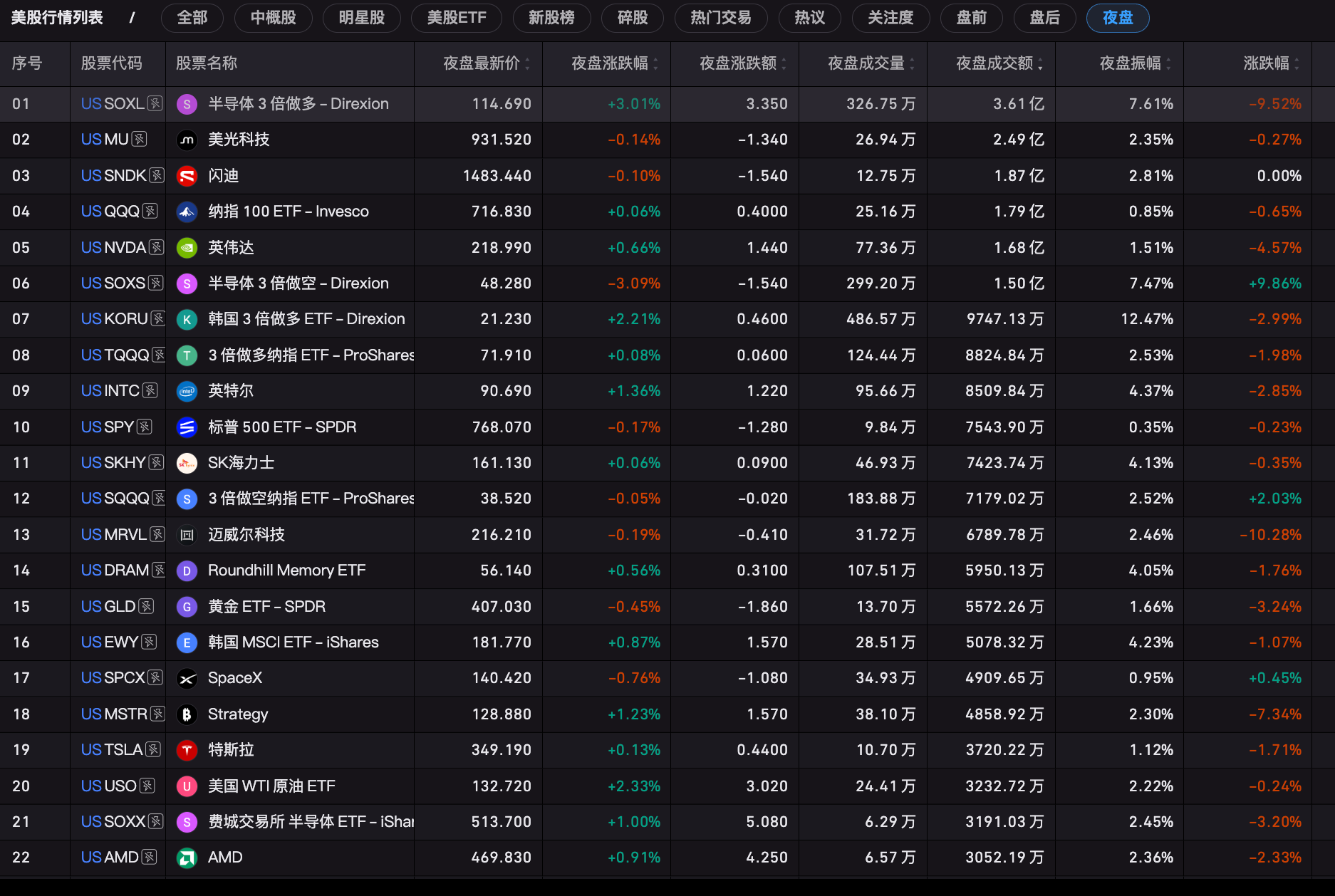
BIT night trading data shows that semiconductors are starting to recover, with 3x long semiconductor up 3.01%, Nvidia up 0.66%, AMD up 0.91%, Intel up 1.36%, and Philadelphia Semiconductor ETF up 1.00%. After a sharp drop the previous trading day, some funds began to buy chips at lower prices.
Crypto-related night trading also saw a slight rebound, with Strategy up 1.23%. However, this is more of a technical recovery after a sharp drop; whether it can sustain depends on whether BTC can reestablish itself at $79,000 to $80,000.
Waller disrupts AI frenzy, cloud and software take over from hardware
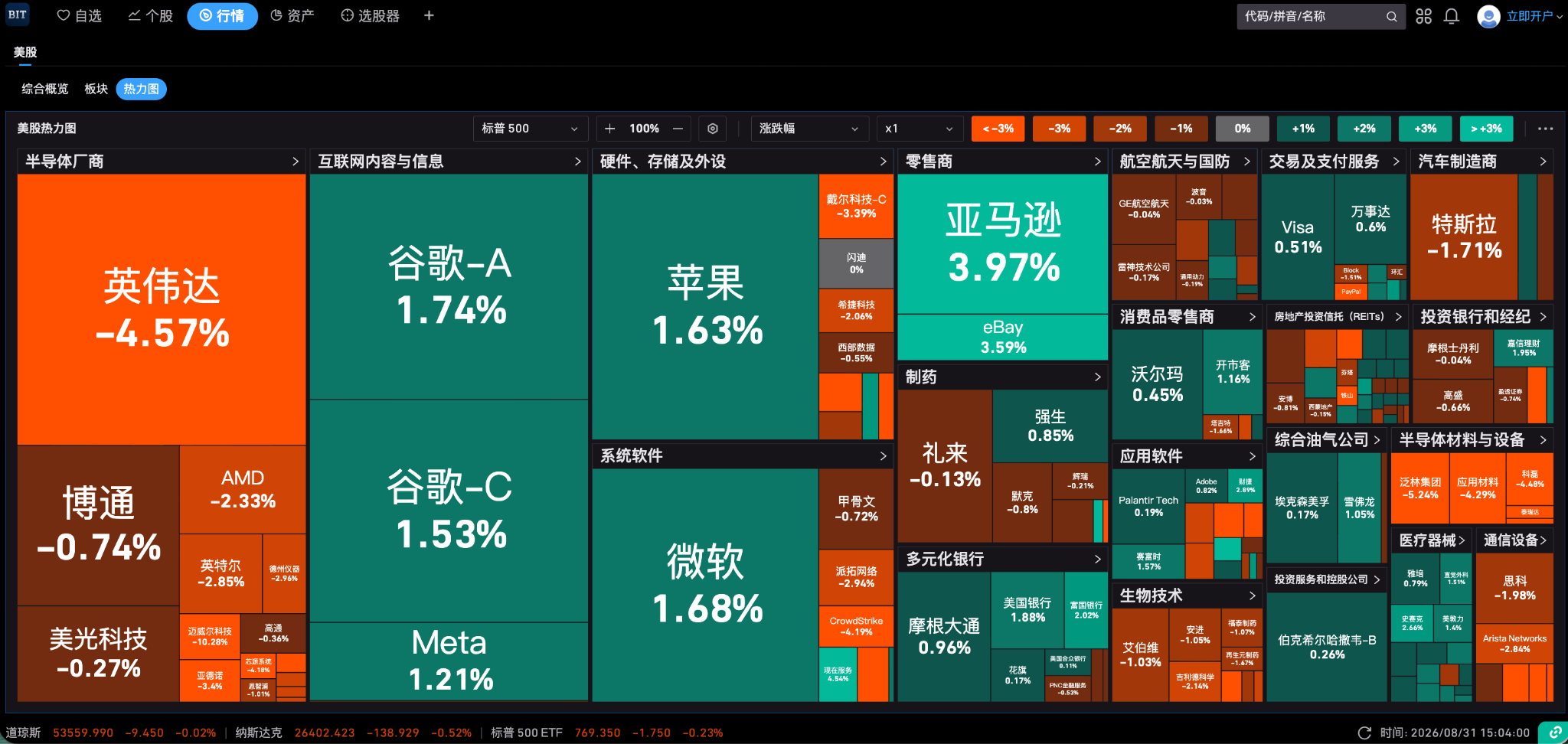
Last Friday, the three major US indices collectively weakened, with the Dow down 0.02%, the S&P 500 down 0.25%, and the Nasdaq down 0.52%. The market was initially trading positively after Nvidia's earnings report, but Waller's remarks rekindled concerns about interest rate hikes.
China International Capital Corporation (CICC) believes Waller's remarks are not simply about announcing a September rate hike but about rebuilding the Federal Reserve's credibility against inflation; if subsequent employment and inflation data don't deteriorate significantly, a rate hike in September is a realistic possibility. Morgan Stanley warns that Waller is more focused on balance sheet issues, suggesting that the Fed may initiate a reduction of more than $1.5 trillion next year, using a "more reduction, less rate hikes" approach to suppress inflation.
Chip stocks have become severely affected, with Nvidia down about 4.57%, AMD down about 2.3%, ARM down over 6%, Applied Materials down over 4%, and Marvell plunging over 10% due to disappointing margin guidance.
On the contrary, cloud services and software are rallying, with Barclays noting that a significant portion of AI model company revenue will translate into cloud computing expenditures, flowing to Amazon AWS, Microsoft Azure, and Google Cloud. As a result, the market has come to recognize that the more AI becomes commercialized, the more cloud providers resemble "rent collecters." Amazon rose nearly 4%, while Microsoft, Google, Meta, and Apple also showed strength. Software company Elastic surged over 19% following its earnings, Workday rose nearly 6%, and ServiceNow increased by over 4%.
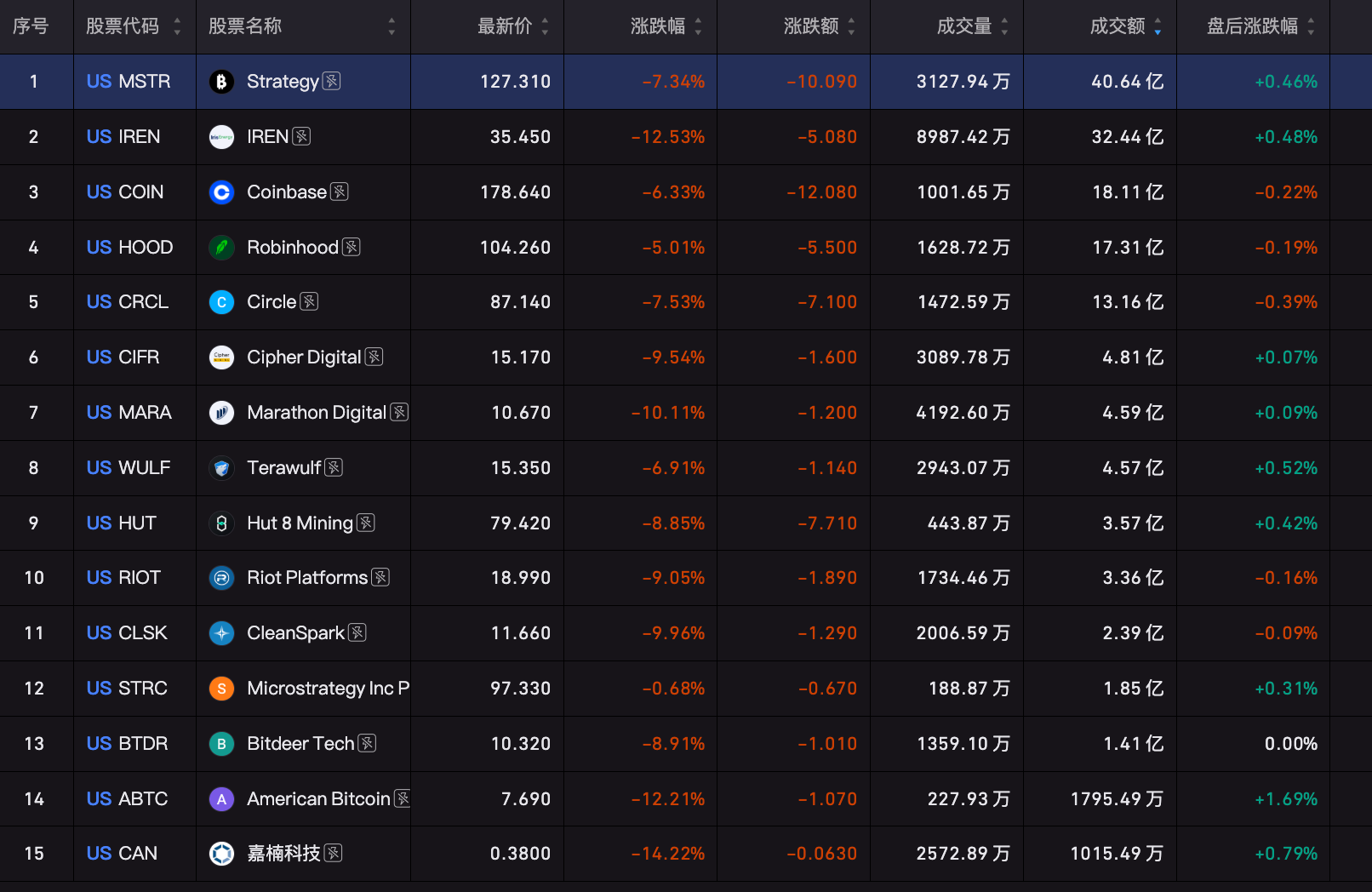
Cryptocurrency stocks collectively fell, with data from BIT US Stocks showing that Strategy dropped 7.34%, Coinbase fell 6.33%, Robinhood decreased 5.01%, Circle down 7.53%, and Strategy preferred shares STRC down 0.68%.
Mining companies generally faced larger declines than BTC, as they are affected not only by coin prices but also by electricity costs, capital expenditures, and market valuation compression. Canaan Creative fell 14.22%, American Bitcoin decreased 12.21%, IREN dropped 12.53%, Marathon Digital fell 10.11%, CleanSpark down 9.96%, Cipher Digital down 9.54%, Riot Platforms down 9.05%, Bitdeer down 8.91%, Hut 8 down 8.85%, and Terawulf dropped 6.91%.
Japan and South Korea's chip stocks first decline then recover, A-shares and Hong Kong stocks supported by AI applications and dividend assets
The Asia-Pacific market was hit in the morning by rising global bond yields, US tech sell-offs, and rate hike expectations. The South Korean KOSPI index once dropped over 3%, but closed up 0.46% at the end of trading, accumulating about 3.4% growth for the month.
Roy Lim, a stock sales trader at Samsung Securities, noted that South Korean pension funds significantly bought KOSPI stocks in the last 20 minutes of trading, with a scale of around 120 billion won, mainly concentrated on tech stocks, marking a key turning point for the South Korean market from decline to rise.
On the individual stock level, SK Hynix once dropped over 4% in the early session, with Samsung Electronics also under pressure following suit. Regulatory tightening on single-stock leveraged ETFs continued to affect the trading structure: from July 31 to August 28, retail investors net sold 16 single-stock leveraged/inverse ETFs linked to Samsung Electronics and SK Hynix totaling 1.773 trillion won, and the average daily trading volume for related products in August dropped to about 8%, with the retreat of leveraged capital causing increased volatility in chip leaders.
The Japanese market faced dual pressures, with the Nikkei 225 index closing down 0.14%, declining nearly 2% earlier due to the global tech stock sell-offs and rising bond yields. The USD/JPY rate broke above 160 again, and the 10-year Japanese government bond yield reached a multi-decade high, leading to rapid reduction in holdings of overvalued tech stocks.
Japanese semiconductors were severely impacted, with Advantest falling over 7% in the early session, and Tokyo Electron, Renesas Electronics, and others following suit. The market is concerned about the excessive gains in the AI chip supply chain, which need to be digested in the short term regarding valuations.
As the yen broke below 160, discussions around whether Japan will intervene in the exchange rate resurfaced. US Treasury Secretary Yellen stated that the current yen movements are "under control," unlike the previous disordered market conditions; he also mentioned that Bank of Japan Governor Ueda will "do the right thing," keeping market attention on whether the BOJ will follow with interest rate hikes.
The A-share market performed relatively strongly, with the three major indices starting lower but climbing back. The Shanghai Composite Index closed up 0.86%, the Shenzhen Component Index rose 0.44%, the ChiNext Index grew 0.42%, and the Sci-Tech 50 increased by 1.34%. China's manufacturing PMI for August rose from 49.2 to 49.8; although still below the neutral line of 50, this marginal improvement boosted market sentiment.
The main focus of A-shares is on AI applications, liquid cooling servers, short dramas, and computing power hardware. The short drama and film sector surged, with Shanghai Film, Zhongguang Tianze, Bona Film, and Huanrui Century hitting the daily limit; the domestic first fully AI-produced long drama "Post Journey to the West" aired on Hunan TV and Mango TV, igniting expectations for the commercialization of AI content. Guotai Junan Securities points out that the entrance of AI content into mainstream long content broadcasting systems is significant, but subsequent reputation and the ability to replicate models remain core observation variables.
Liquid cooling servers continue to explode in demand, with Inspur Information, Jinfu Technology, Jindi Co., and Xinpeng Co. hitting the daily limit. CCTV Finance reports that as the Wanka Intelligent Computing Center accelerates deployment, the AI chip power consumption exceeds 1000W, with traditional air cooling struggling to meet the requirements; liquid cooling is transitioning from an “optional” to a “mandatory” choice, with related production line orders projected to extend to the end of 2026 or even 2027.
Hong Kong stocks, however, showed significant divergence, with AI large model stocks becoming the absolute focus, as MINIMAX surged over 17%, announcing its H3 Max 768P, 480P's integration into open platforms and MiniMax Design, with a 5 seconds complete audio-video generation time cut to under 3 seconds, the generation speed now faster than playback speed. Huatai Securities believes that the commercialization of AI models is expected to accelerate in the next 4 to 6 months, with MiniMax’s product launch rhythm in the second half driving revenue growth.
Zhizhi surged nearly 10%, with its first interim report post-listing expected today, officially entering the MSCI China Index. The market focuses on its ARR, API call volume, token processing capacity, and domestic computing power support capabilities.
Yuewen Group surged over 6%, with the scheduling of "Post Journey to the West" boosting expectations for short dramas and AI comic dramas' commercialization; the company previously announced that its revenue from short dramas and AI comic dramas exceeded 430 million yuan in the first half, growing 2.3 times year-on-year.
The Chinese banks listed in Hong Kong rose against the trend, with Bank of China up over 5% hitting a historic high, Postal Savings Bank rising over 7% post-earnings, and Minsheng Bank, Bank of Communications, and China Construction Bank seeing widespread increases. The interim reports from the major state-owned banks showed comprehensive positive revenue growth and net interest margin stabilization signals, alongside optimized real estate lending policies, making the banking sector a safe haven for defensive funds in Hong Kong stocks.
Upcoming attention needed:
August 31 (Monday)
9:20 33 Chinese stocks including Zhizhi officially included in the MSCI index effective: Index adjustments will bring passive fund allocations and short-term portfolio rebalancing. Zhizhi, as a high-profile component stock added to the emerging markets, may drive volatility in AI, semiconductors, pharmaceuticals, and new materials.
G20 Finance Ministers and Central Bank Governors meeting held until September 1: The meeting focuses on global inflation, exchange rate fluctuations, debt risks, financial stability, and sanctions against Iran. US Treasury Secretary Yellen may promote cooperation from other countries on secondary sanctions against Iran, and related wording will affect oil, the US dollar, US Treasuries, and emerging market currencies; if the meeting emits signals of exchange rate coordination, the yen, the USD/JPY, and long-term US Treasuries may also show fluctuations.
Zhizhi, Hezhizhi Intelligent, Minglue Technology, and Horizon Robotics to announce performance: Hong Kong stocks of AI and intelligent driving chains enter a concentrated testing period. Zhizhi’s first interim report post-listing will focus on testing ARR, API call volume, token pricing, and commercialization capabilities; Horizon relates to intelligent chip shipments, advanced driver assistance schemes' penetration, and the valuation of the automotive AI chain.
September 1 (Tuesday)
Tim Cook officially steps down as CEO of Apple, John Ternus to succeed: Apple enters a new round of management handover window. After stepping down, Cook will serve as executive chairman, with current Senior VP of Hardware Engineering John Ternus taking over as CEO. The market is watching whether Apple will accelerate hardware innovation and AI terminal layouts under the new management team, especially in products like foldable iPhones, edge AI, new Siri, and smart displays.
Wave of price increases for electronic components and materials concentrated in effect: Qualcomm adjusting prices on some products, ZTE adjusting RF product prices, SunMicro increasing MLCC prices, Mitsubishi tools adjusting prices, Nanya Plastics CCL and semi-cured sheets increasing by 20%-25%. This wave of price increases reflects rising pressures from upstream raw materials, production capacity, and supply chain costs. Qualcomm and ZTE’s price hikes will impact communication chips and RF front-end chains; SunMicro's MLCC price increases will benefit passive components sector; Mitsubishi tools' price adjustments reflect rising industrial consumables costs; Nanya Plastics' CCL pricing increases may be transmitted to PCB and AI server board chains. If downstream can smoothly accept price hikes, related companies' profit expectations may improve; if transmission is unsuccessful, it might compress the gross margins of terminal hardware manufacturers.
G20 Ministers of Technology meeting held until September 2: Tech giants like Musk, Jensen Huang, and Altman will attend, focusing on global AI governance, digital economy regulations, and the AI light regulatory "Carolina Principles" pushed by the US. If the regulatory tone is lenient, it will benefit AI platforms, model companies, cloud computing, chips, and computing power chains; if regulation tightens, AI applications and large model companies' valuations may be compressed.
Japanese 10-year and 30-year government bond auctions (September 1, September 3): Japan will issue 10-year and 30-year government bonds. Currently, with the yen dropping below 160 and long-end US Treasury rates high, market attention is on whether domestic bond demand will siphon off overseas funds. If auction demand is weak, Japanese bond yields may rise, affecting US Treasuries and global growth stock valuations; if demand is robust, it will help alleviate pressures on global long-term rates.
NIO's US stock pre-earnings report: The market closely watches second-quarter deliveries, overall vehicle gross margins, narrowing losses, contributions from Leto and Firefly, as well as third-quarter delivery guidance. If vehicle gross margins maintain around 17%-18% and strong delivery outlook is given, sentiments in the Chinese electric vehicle sector might recover; if margins are eroded by multi-brand expansions, NIO and the new forces chain may face pressure.
Baido's dual primary listing in Hong Kong and the US takes effect: The dual primary listing enhances liquidity and financing flexibility in both markets and continues to serve as a benchmark for Chinese concept stocks returning to Hong Kong. The Hong Kong tech sector may benefit from index allocations, southbound capital, and international capital rebalancing.
Shein and Mech-Mind robots officially land in Hong Kong stock market: Shein's performance on the first day will influence valuations in the Hong Kong consumption technology and cross-border e-commerce sectors; Mech-Mind robots will impact sentiments in the robotics and machine vision sectors.
September 2 (Wednesday)
Dell, Credo Technology, MongoDB, Palo Alto Networks' earnings report: Dell will verify AI server order visibility and margin quality; Credo will validate demand for active cables in AI data centers; MongoDB will observe enterprise database cloud migrations; Palo Alto will verify cybersecurity expenditure under AI-driven security threats. Strong orders and guidance may lead to optimism in AI infrastructure, network devices, data cloud, and cybersecurity sectors.
SEMICON Taiwan International Semiconductor Exhibition held until September 4: The meeting focuses on advanced packaging, HBM, semiconductor equipment, and materials. If the industry chain releases signals of expansion or technical breakthroughs, it will benefit advanced packaging, storage, equipment, materials, and TSMC's supply chain.
免责声明:本文章仅代表作者个人观点,不代表本平台的立场和观点。本文章仅供信息分享,不构成对任何人的任何投资建议。用户与作者之间的任何争议,与本平台无关。如网页中刊载的文章或图片涉及侵权,请提供相关的权利证明和身份证明发送邮件到support@aicoin.com,本平台相关工作人员将会进行核查。


