Eight asset management and digital asset institutions gathered together to explore a new paradigm of dual mainline configuration
(Hong Kong, August 27, 2026) The "AI·CRYPTO Global Asset Allocation" themed forum, hosted by Zhi Rui Securities (Hong Kong) Limited (hereinafter referred to as "Zhi Rui Securities"), was held this afternoon at the Renaissance Harbour View Hotel in Hong Kong, coinciding with the Bitcoin Asia 2026 event. The forum focused on macroeconomic cycle assessments driven by AI and digital assets' dual mainlines, attracting nearly 200 investors on-site, with enthusiastic responses during the interactive session.
The forum brought together industry leaders from institutions such as China Asset Management (Hong Kong), E Fund (Hong Kong), Animoca Brands, VDX, BE Trust, Metalpha, BigQuant, and Beishui Financial Holdings, covering topics including the development path of digital asset ETFs, the institutionalization process of Bitcoin, and the capital transmission of the AI computing power cycle, addressing investors' concerns about configuration directions at the intersection of the two main lines.

Caption: The "AI·CRYPTO Global Asset Allocation" forum attracted nearly 200 investors to participate.
Macroeconomic Assessment: Can the AI Bull Market Continue? Continuous Breakthrough Applications Needed
Jerry Ou, fund manager at Zhi Rui Securities, delivered a keynote speech titled "Global Asset Allocation Outlook under the Dual Narratives of AI and Bitcoin," analyzing the impact of the two mainlines on global capital flows from a macroeconomic cycle perspective.
He pointed out that AI has been the absolute driving force behind the US stock bull market over the past three years, while current CAPEX has reached a point where CSP free cash flow is negative. Continuing high-intensity CAPEX can only rely on massive debt, which requires AI applications to form a $1 trillion ARR by 2030 (versus just over $100 billion in 2026) to repay the debts. Currently, global AI to C commercialization has not yet succeeded, and this year's ARR surge has almost entirely relied on Anthropic successfully running AI to B, mainly as programming AI replaces programmers, leading to a significant contraction in the number of programming jobs in the US, especially for recent graduates. However, why is the total non-farm employment number not showing a significant decline? This is mainly because new jobs created by AI data center construction are mostly located in Republican-controlled states and key swing states. Moving forward, the hot application direction of AI to B mainly lies in high-paying white-collar positions in finance, law, and consulting. Achieving a $1 trillion ARR ultimately requires AI combined with robotics to run successfully, aimed at significantly reducing labor costs and bringing manufacturing back to the US. Currently, valuations of AI stocks, especially semiconductors, are at historical peaks, but whether they retreat or even turn bearish critically depends on whether these breakthrough AI applications can continue to follow up, as the bursting of the 2000s tech bubble was a result of the unexpected stacking of three negative factors.
Regarding Bitcoin, he believes that according to the four-year halving pattern, it is currently in a bear market cycle stage, and the price at the bottom of a bear market is usually determined by mining costs.
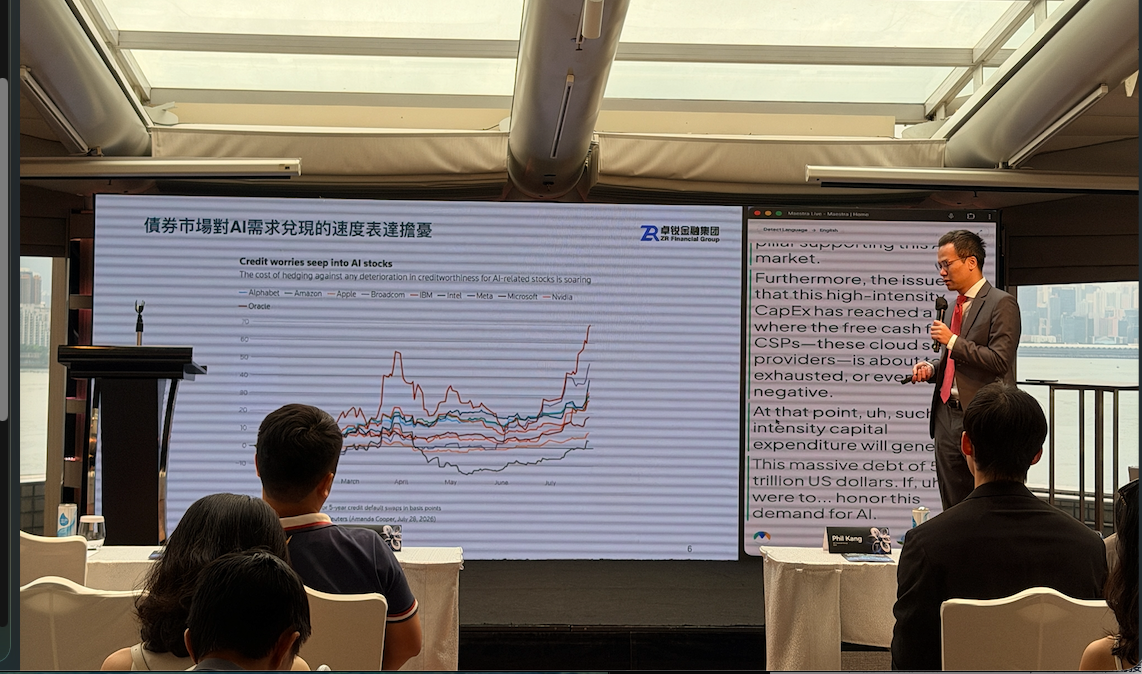
Caption: Jerry Ou, fund manager at Zhi Rui Securities, delivers a keynote speech on asset allocation outlook under the dual narratives of AI and Bitcoin.
Configuration Perspective: Low Correlation Between Bitcoin and Major Assets, Configuration Value Under Spotlight
William Kung, Portfolio Director at China Asset Management (Hong Kong), shared insights on "New Opportunities for Bitcoin". He pointed out from an asset allocation perspective that Bitcoin has had very low correlation with major asset classes over the past decade—correlation coefficients of 0.17 and 0.19 with the S&P 500 and Nasdaq 100, respectively, and nearly zero with gold and bonds, showcasing unique risk-return characteristics. Taking the past five years' backtesting as an example, including Bitcoin in a traditional 60/40 portfolio resulted in better performance for those with a higher allocation ratio.
Regarding market space, he mentioned that digital assets currently account for less than 0.4% of the total global wealth, with Bitcoin's market capitalization roughly equivalent to 3.5% of gold. The movements of institutional funds are also changing in sync: according to the 13F filings as of mid-August 2026, Morgan Stanley and JPMorgan's Bitcoin-related exposures increased by approximately 3.7% and 12.2% quarter-on-quarter, respectively, with even more significant increases in Ethereum-related exposure. He also pointed out that after the fourth halving, the cash production cost of the most efficient miners is around $60,000, which can serve as a reference for observing support levels.
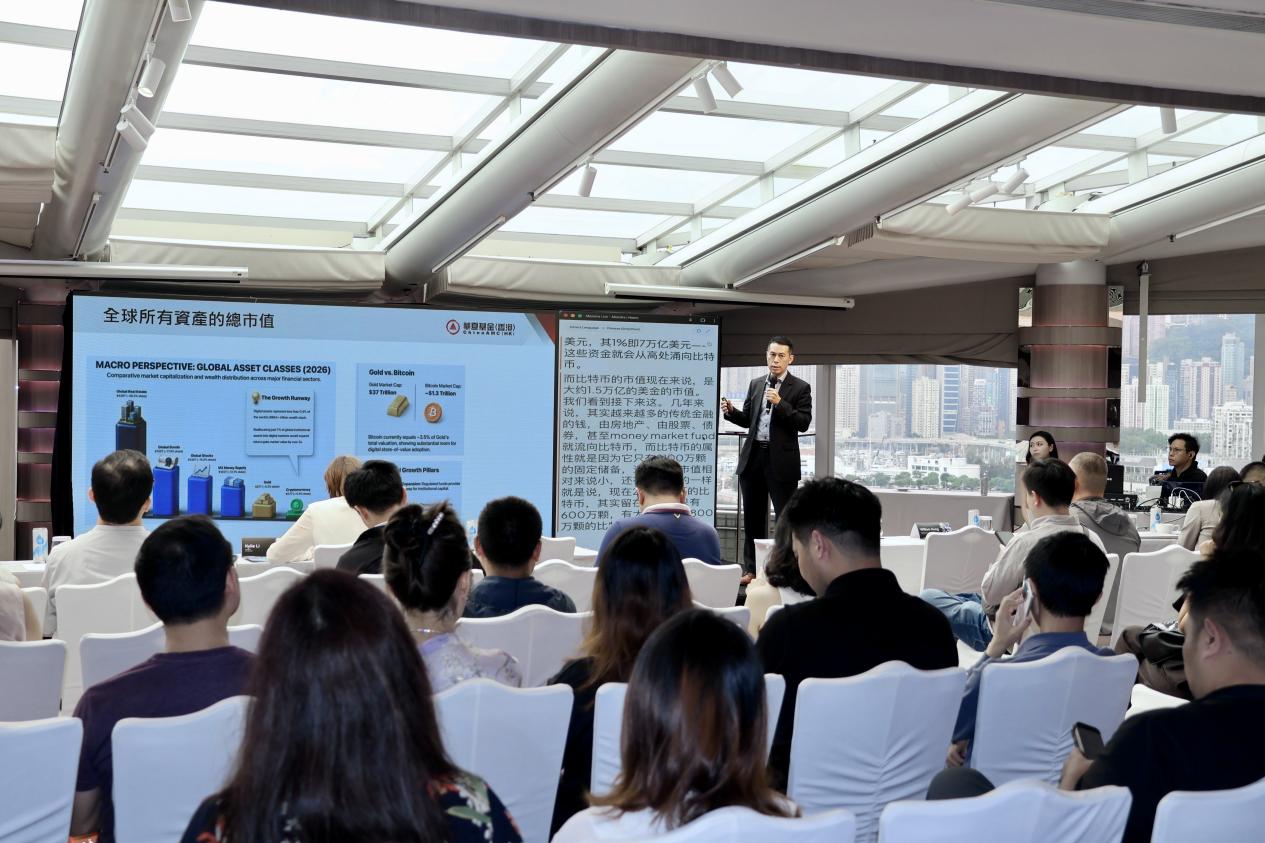
Caption: William Kung, Portfolio Director at China Asset Management (Hong Kong), shares the allocation value of Bitcoin and prospects for the second half of the year.
Roundtable One | The Institutionalization Process of Bitcoin
The first roundtable was hosted by Bobby, co-founder of Techub News, with participants including Paolo, Chief Strategy Officer of VDX, David Ching, Director of Investment & Strategic Partnerships at Animoca Brands, and Yaney, Investment Director at BE Trust. The discussion focused on ETFs, liquidity, and the new market cycle. The three guests agreed that this round of growth is not a cycle reversal but a phase of repair driven by liquidity expectations, net ETF inflows, and short-covering. More importantly, changes in trading structure warrant attention. Yaney from BE Trust described that the market is at a critical stage of "early holders exchanging their coins for Wall Street institutions," with the four-year cycle effect weakening, and volatility gradually converging towards more mature major asset classes. Paolo, Chief Strategy Officer of VDX, also observed that the correlation between Bitcoin and Nasdaq tech assets continues to rise, becoming a high-beta asset in the eyes of institutions.

Caption: Roundtable One "The Institutionalization Process of Bitcoin: ETFs, Liquidity, and the New Market Cycle" discussion scene.
Industry Penetration: Decreasing Costs Push Up Computing Power Demand
Sapphire Wang, Digital Marketing Director at E Fund Hong Kong, approached from the perspective of industry penetration and demand, sharing the new investment landscape in the AI era. She quoted Stanford University's 2026 AI Index report stating that the AI adoption rate among global enterprises has exceeded 88%, and the penetration speed is significantly faster than the early days of internet proliferation. Regarding computing power demand trends, she explained with Jevons' Paradox: a decrease in model inference costs does not reduce total consumption but, rather, expands application scenarios, pushing up the demand for tokens and computing power further.
She also mentioned the high degree of complementarity in the AI industry chain between China and the US— the US leads in model layers and computing power chips, but has relatively insufficient electricity supply, and the expansion of data centers is constrained by power availability; China controls hardware production capacity such as optical modules and PCBs and has energy advantages, but advanced processes rely on imports. A single market cannot form a closed loop; the two are mutually necessary conditions.
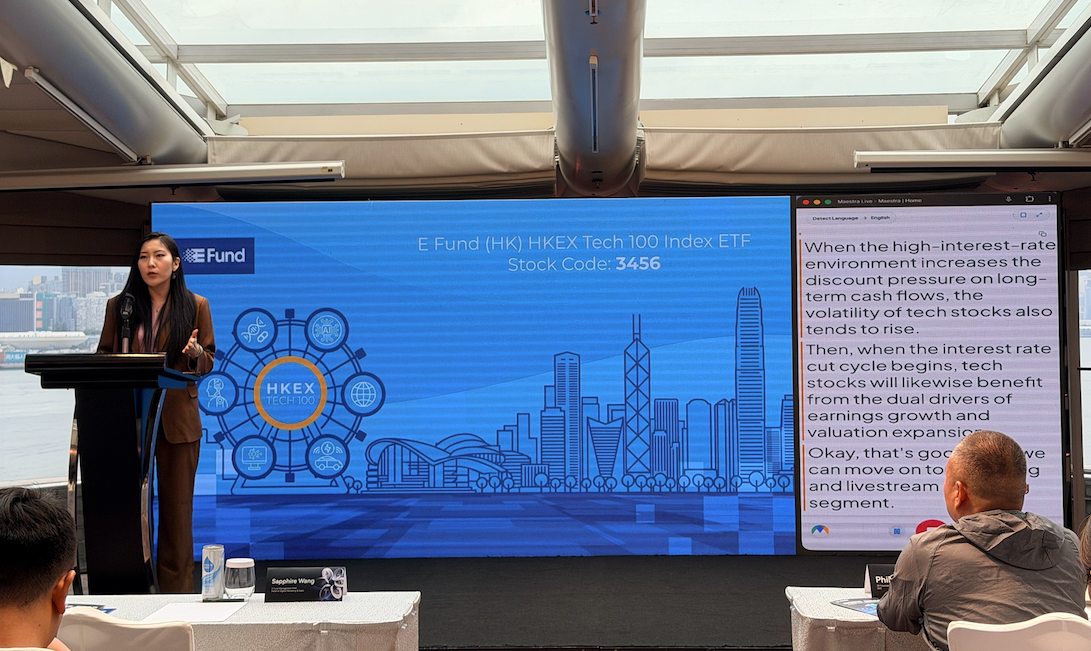
Caption: Sapphire Wang, Digital Marketing Director at E Fund Hong Kong, delivers a keynote speech on the new investment landscape in the AI era.
Roundtable Two | New Cycle of Computing Power: From Chips to Cloud, How Capital Expenditure Translates into Investment Opportunities
The second roundtable was hosted by Miranda, Vice President of Market at Zhi Rui Securities, with Liang Ju, CEO of BigQuant, Kylie Li, co-founder of Beishui Financial Holdings, and Max, head of the Metalpha ecosystem, participating in the discussion. The topic revolved around changes in the distribution of investment opportunities after AI capital expenditures extend along the industry chain downstream. The three guests believe that the recent pullback in AI assets is a cleanup of crowded trades at high levels, rather than an indication of a peak in the industry cycle— the industry is still growing rapidly, just that commercialized realization has not kept pace with speculative expectations, and secondary market valuations have significantly overshot. Max, head of the Metalpha ecosystem, compared the current AI industry to the early blockchain sector: "Enormous infrastructure investment and extremely high capital enthusiasm, but truly profitable applications that can run the closed loop are still scarce." The location of opportunities is also shifting—from stacking computing power to cost reduction and implementation; areas such as custom chips, optical communications, liquid cooling, power infrastructure, and the vertical application layer are seen as the main battlefield in the next stage.
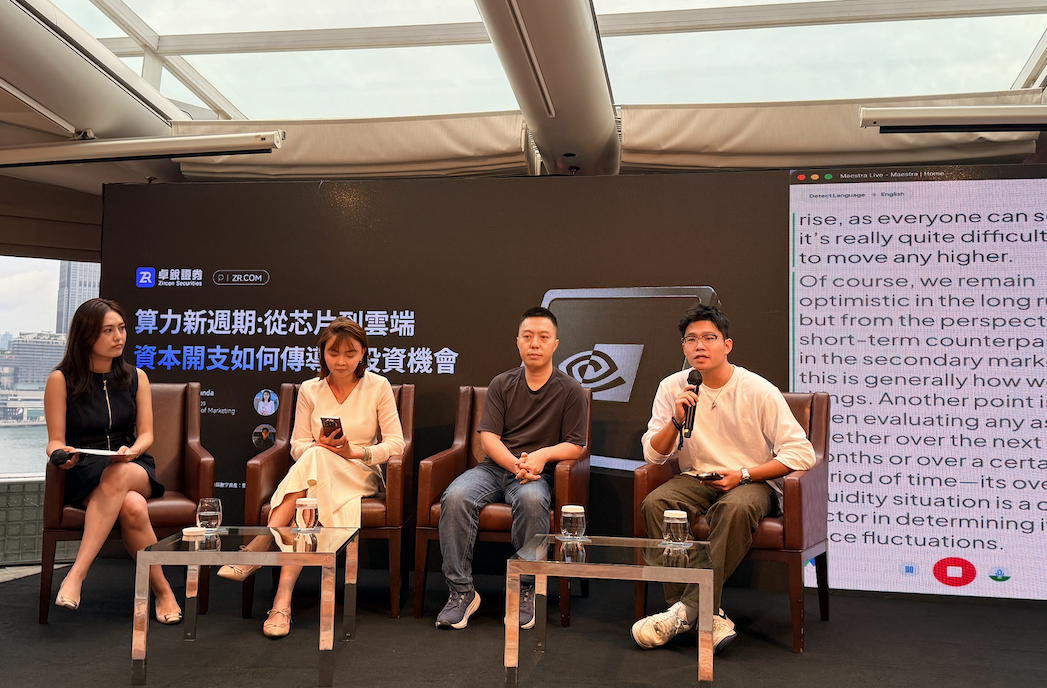
Caption: Roundtable Two "New Cycle of Computing Power: From Chips to Cloud, How Capital Expenditure Translates into Investment Opportunities" discussion scene.
Cross-Industry Dialogue Continues After the Meeting
The forum concluded with a free exchange session, where representatives of participating institutions continued in-depth discussions on their respective concerns. Public funds, digital asset investment platforms, and quantitative technology companies have previously focused on different key points, but as digital asset compliance advances and the AI industry cycle evolves, the core issues they face are increasingly similar: in an environment where market variables increase and cycles shorten, how to establish clear and replicable allocation methods.
From traditional securities to virtual assets, from Hong Kong to Singapore and Australia, Zhi Rui Securities is advancing along the same path—bringing different types of assets back to the same allocation table. Currently, Zhi Rui Securities holds licenses from the Hong Kong Securities and Futures Commission for categories 1, 2, 4, 5, and 9, with category 1 license approved to offer virtual asset deposit, trading, and withdrawal full-process services to professional investors and retail clients; their independently developed one-stop platform ZR allows investors to complete allocations of stocks, ETFs, and virtual assets with a single account.
"To become a trusted global fintech platform"—this is the vision of Zhi Rui Securities and the initial intention for hosting this themed forum. The company stated that it will continue to hold more offline exchange activities around global asset allocation topics in the future, working with investors to seize market opportunities under the dual mainlines.
Risk Warning: The views expressed by the guests are solely personal opinions and do not constitute any offers, solicitations, recommendations, or guarantees regarding any securities, financial products, or instruments.
免责声明:本文章仅代表作者个人观点,不代表本平台的立场和观点。本文章仅供信息分享,不构成对任何人的任何投资建议。用户与作者之间的任何争议,与本平台无关。如网页中刊载的文章或图片涉及侵权,请提供相关的权利证明和身份证明发送邮件到support@aicoin.com,本平台相关工作人员将会进行核查。


