Before the triggering of the two major signals mentioned above, he believes that the market will continue its "grinding higher" pattern without leadership from any sector.
Written by: Dong Jing, Wall Street Insights
Michael Hartnett, Chief Investment Officer of Bank of America, warned that despite the current market sentiment being at an extremely bullish stage, contrarian investors are preparing for a sudden shift in market sentiment, ready to switch their portfolios to "risk-off" mode.
In the latest Flow Show report, Hartnett stated that the core of this potential shift lies in two upcoming key signals: a potential compromise in the U.S.-Iran conflict and the upcoming U.S. midterm elections. Any abrupt cooling of geopolitical tensions or unexpected changes in political power could quickly break the fragile consensus currently supporting the leadership-less rise of risk assets.
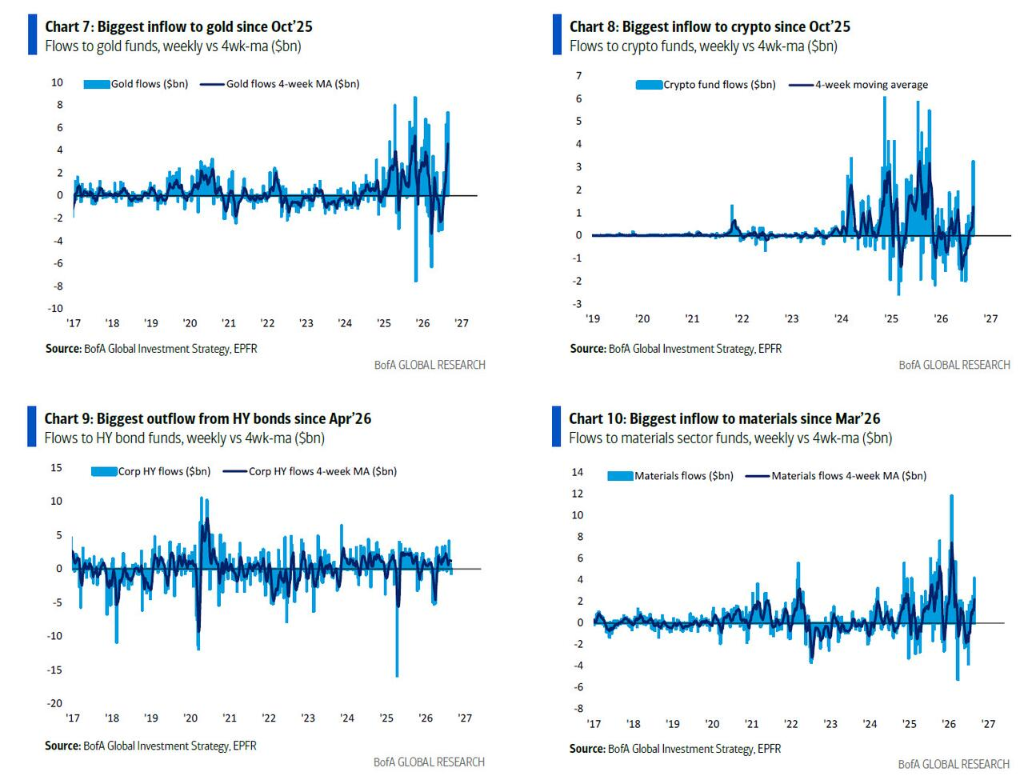
The report points out that market funds have already begun to hedge against the risk of fiat currency depreciation, and safe-haven assets are experiencing massive inflows. Recent data shows that gold and cryptocurrencies together attracted over ten billion dollars in a single week, while the U.S. stock market faced significant outflows, highlighting the underlying currents of money against the backdrop of apparent prosperity and investors' defensive psychology.
Meanwhile, the bond market is vying for dominance in global asset pricing. Hartnett believes that whether policymakers can successfully suppress long-term Treasury yields is not only related to the financing environment for artificial intelligence capital expenditures but is also a critical factor determining whether the current stock market's risk appetite can be sustained.
Two Major Reversal Signals: The Contrarian Investors' Waiting List
Hartnett explicitly listed two "reversal risk" opportunities that contrarian investors are waiting for:
First, easing of the U.S.-Iran situation and a final drop in oil prices. If the U.S.-Iran conflict sees substantial easing, oil prices could face a final round of downward pressure, at which point the market’s optimistic sentiment towards EPS expectations may peak, providing an entry window for shorting risk assets.
Second, the results of the U.S. midterm elections. Hartnett clearly pointed out that if the Republican Party loses Senate seats or the governorship in Texas, it would have a negative impact on the market. The logic is:
Voters are indicating through their ballots that affordability and controlling inflation rank higher in political priority than tax cuts, deregulation, or pushing up stock prices, which could fundamentally shake the policy foundation of the current market consensus.
Before the triggering of the above two signals, Hartnett believes the market will continue its "grinding higher" pattern without any leading sector, while contrarian investors remain highly vigilant and ready to switch to risk-off mode.
Fund Flows and Sentiment Indicators: Safe-Haven Assets Encountering Rush to Buy
In recent market fluctuations, fund flows show strong "anti-depreciation" characteristics.
According to a Bank of America report, funds are flowing out of traditional risk assets en masse, instead pouring into alternative safe-haven assets.
Specifically, gold recorded an influx of 7.3 billion dollars, while cryptocurrencies saw an influx of 3.2 billion dollars, both marking the largest scale since October 1998.
In stark contrast, the U.S. stock market faced outflows of 4.4 billion dollars, marking the first time in five weeks; high-yield bonds also recorded an outflow of 700 million dollars. Despite inflows into technology and materials sectors, the overall fund sentiment has shown defensive tendencies.
Additionally, the Bank of America Bull & Bear Indicator rose further to 9.7 last week, nearing an all-time high.
Hartnett believes that this extremely bullish indicator is primarily driven by the enhanced breadth of global stock indices and hedge funds increasing their long positions in gold and their short positions in VIX. Although the S&P 500 index has seen slight increases since triggering a "sell signal" on May 26, the extreme positioning has sown the seeds of potential correction.
Bond Market Pricing Power: Yields Become the Core Point of Market Games
Michael Hartnett stated in the report that it is currently "bond trading information, stock trading ideas." In the artificial intelligence investment boom, AI bonds are seen as leading indicators.
The report indicates that only when the 30-year Treasury yield falls below 5% will the underperformance of AI spenders (MAGS) and AI builders (SOX) relative to AI adopters end, but this goal currently seems difficult to achieve in the short term.
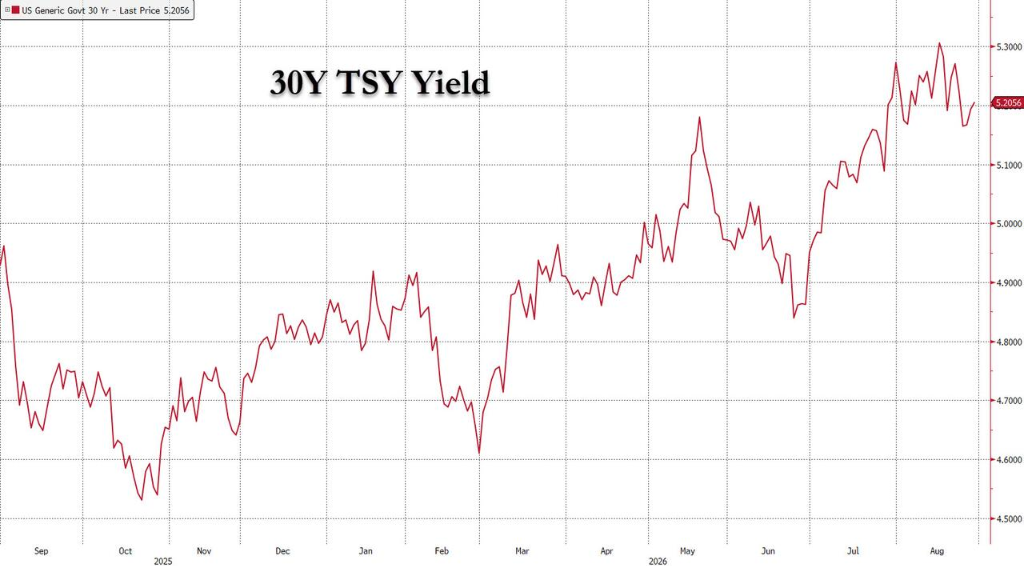
Hartnett believes that the new Fed Chair Waller’s speech at Jackson Hole attempted to balance inflation and the yield curve. Although the 2-year and 30-year yield curve flattened significantly after the speech, and the dollar rebounded, broader risk appetite did not rise as expected, with Treasury yields even breaching the critical intervention level of 4.7%.
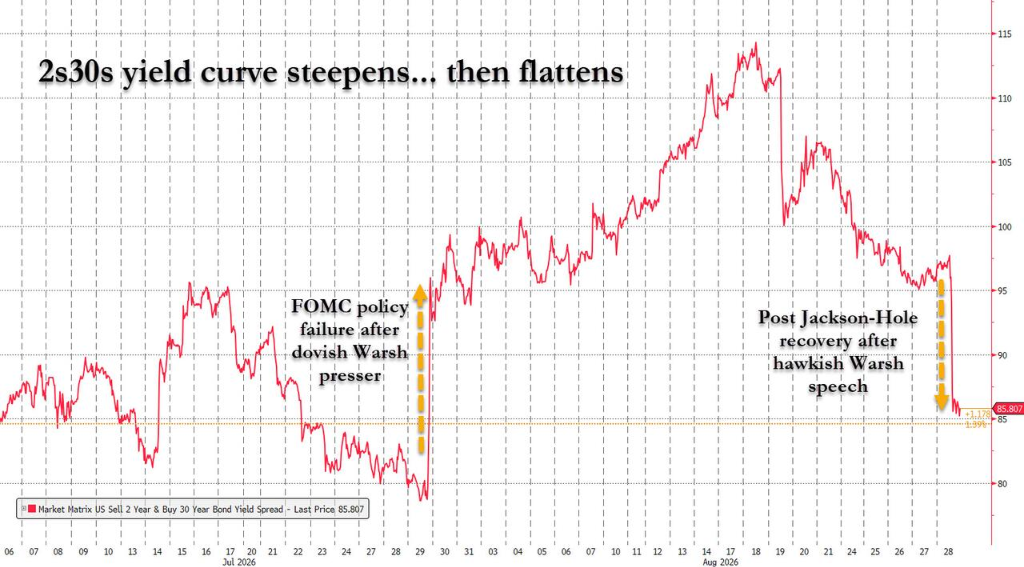
Michael Hartnett believes that the combination of Bessen and Waller's policies must stop U.S. Treasury yields from rising further; otherwise, long-duration trading will face enormous pressure.
Policies and Positioning: The Central Bank's Shift and the Collision of the "No-Landing" Consensus
From the market positioning standpoint, investors are currently immersed in a perfect consensus of "no macro landing, the Fed not raising interest rates, AI capital spending not cutting back, and no Democratic sweep." Asset allocation shows characteristics of going long on stocks, going long on investment-grade bonds, and shorting government bonds and the dollar.
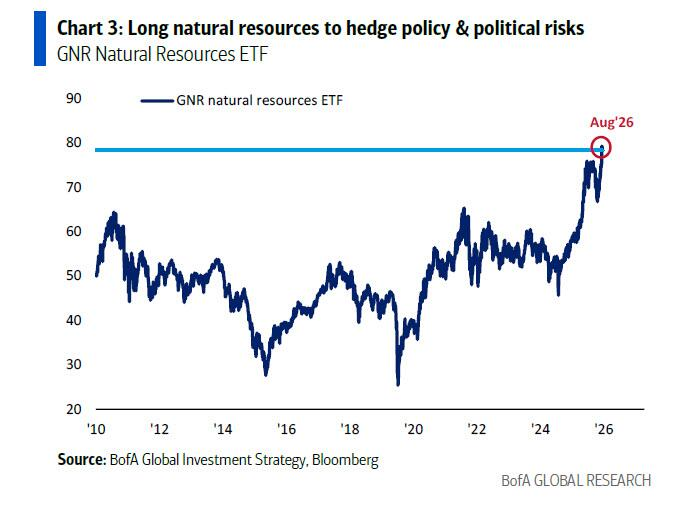
However, to hedge against the risk of this highly consistent consensus, Michael Hartnett insists on going long on gold and global natural resources as commodities.
On the policy level, global central banks are quietly changing course. The report notes that in the past three months, global central banks have raised rates 13 times, exceeding the 12 rate cuts, and Bank of America expects a scenario of 17 rate increases to 4 cuts by the end of the year.
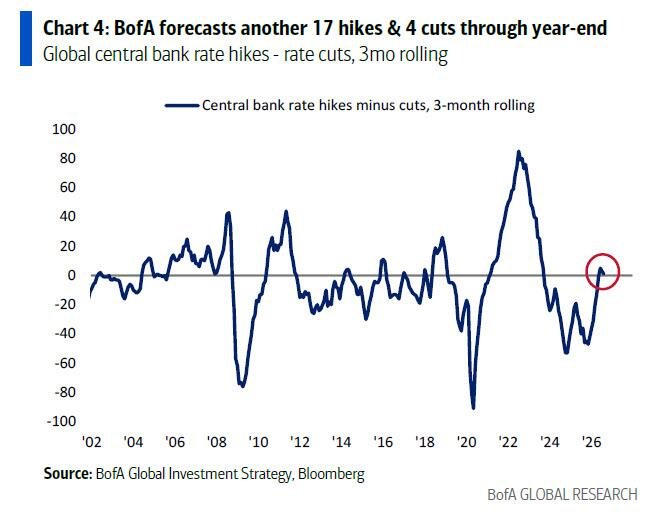
Hartnett believes that the rate hikes by central banks help align with the U.S. Treasury’s bond and foreign exchange interventions to suppress long-term yields — which is crucial for financing the AI capital expenditure boom, as well as preventing consumers from increasing precautionary savings due to fears of 40 trillion dollars in debt. Notably, the U.S. Treasury's buyback program will end on November 4, just one day after the U.S. midterm elections.
On the political level, Trump's economic approval rating (35%) and inflation approval rating (28%) have declined again.
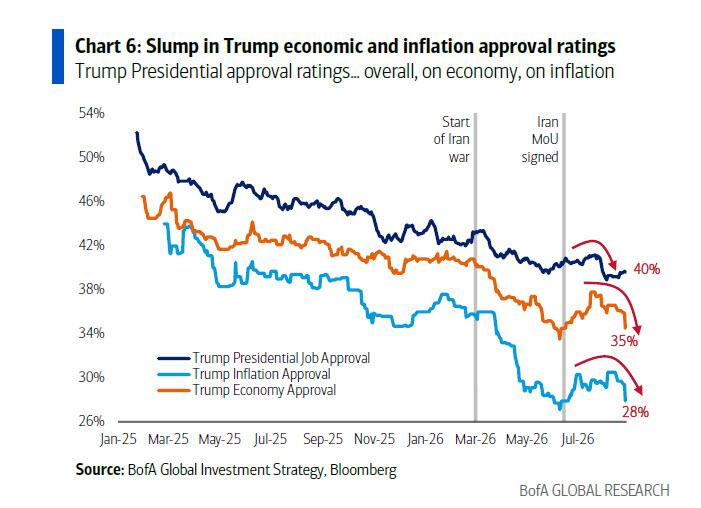
Hartnett pointed out that quickly resolving the U.S.-Iran conflict is the easiest path to boost support ratings, which is also the core logic behind contrarian investors' close attention to the situation in Iran.
免责声明:本文章仅代表作者个人观点,不代表本平台的立场和观点。本文章仅供信息分享,不构成对任何人的任何投资建议。用户与作者之间的任何争议,与本平台无关。如网页中刊载的文章或图片涉及侵权,请提供相关的权利证明和身份证明发送邮件到support@aicoin.com,本平台相关工作人员将会进行核查。


