

Car labels devalue, the collective transformation anxiety of China's automotive industry chain.
Article by丨Zhao Yu
Edited by丨Gong Fangyi Huang Junjie
Last year, China's new energy vehicle industry produced over 16 million cars, helping over a hundred million people travel daily. In terms of vehicle sales alone, it generated 2 trillion yuan in revenue within a year, providing millions of jobs across upstream and downstream sectors.
The "embodied intelligence" industry currently produces about more than 10,000 robots annually, still seeking its significance. Yet, even after a halved stock price, Yushun Technology’s market value still exceeds the combined total of Ideal, Li Auto, and Seres—these three companies’ revenues are 200 times that of Yushun.
The same group of people can gain more capital returns simply by removing the word "automobile." Five embodied intelligence companies, founded by executives and technical leaders who left Ideal, have not yet generated much revenue, but their total valuation is nearing half that of Seres.
The entire new energy vehicle industry, from car brands to automotive chain companies, no longer enthusiastically talks about electrification and intelligence. Intelligent driving manufacturers have shifted to discussing "physical AI," and new car companies prefer to refer to themselves as artificial intelligence enterprises. An executive from a company making lightweight automotive parts even told us they plan to voluntarily abandon 10%-20% of their automotive business revenue—some projects require massive R&D investment, and the more product models, the higher the maintenance costs, making it ultimately difficult to make a profit.
After analyzing nearly 8,000 financial statements, research notes, inquiry responses, and close to 230,000 interactive platform Q&A from 296 listed automotive chain companies, we discovered that this automotive industry's escape from cars began earlier than expected.
Geely stated in its 2019 annual report that its goal is to transform into a global technology group; in 2022, Great Wall Motors rebranded as a "global intelligent technology company." In 2024, automotive chain companies accelerated shedding automotive tags, with 40 companies mentioning "robots" in their annual reports for the first time, four times that of the previous year; low-altitude related inquiries on investor interaction platforms increased by 22 times.
Just as automotive chain companies began to remove automotive labels, Alibaba, JD.com, and Baidu still have clear autonomous driving and intelligent cockpit layouts, pushing forward car sales and even manufacturing projects, with entrepreneurs discussing the possibility of car manufacturing with Alibaba last year.
Until a company valued for producing 1 million cars a year is less valuable than a company producing 5,000 humanoid robots a year, the automotive sector can only align itself with the utilities sector, so they must transform—the simplest transformation can start by changing their annual report company introduction.
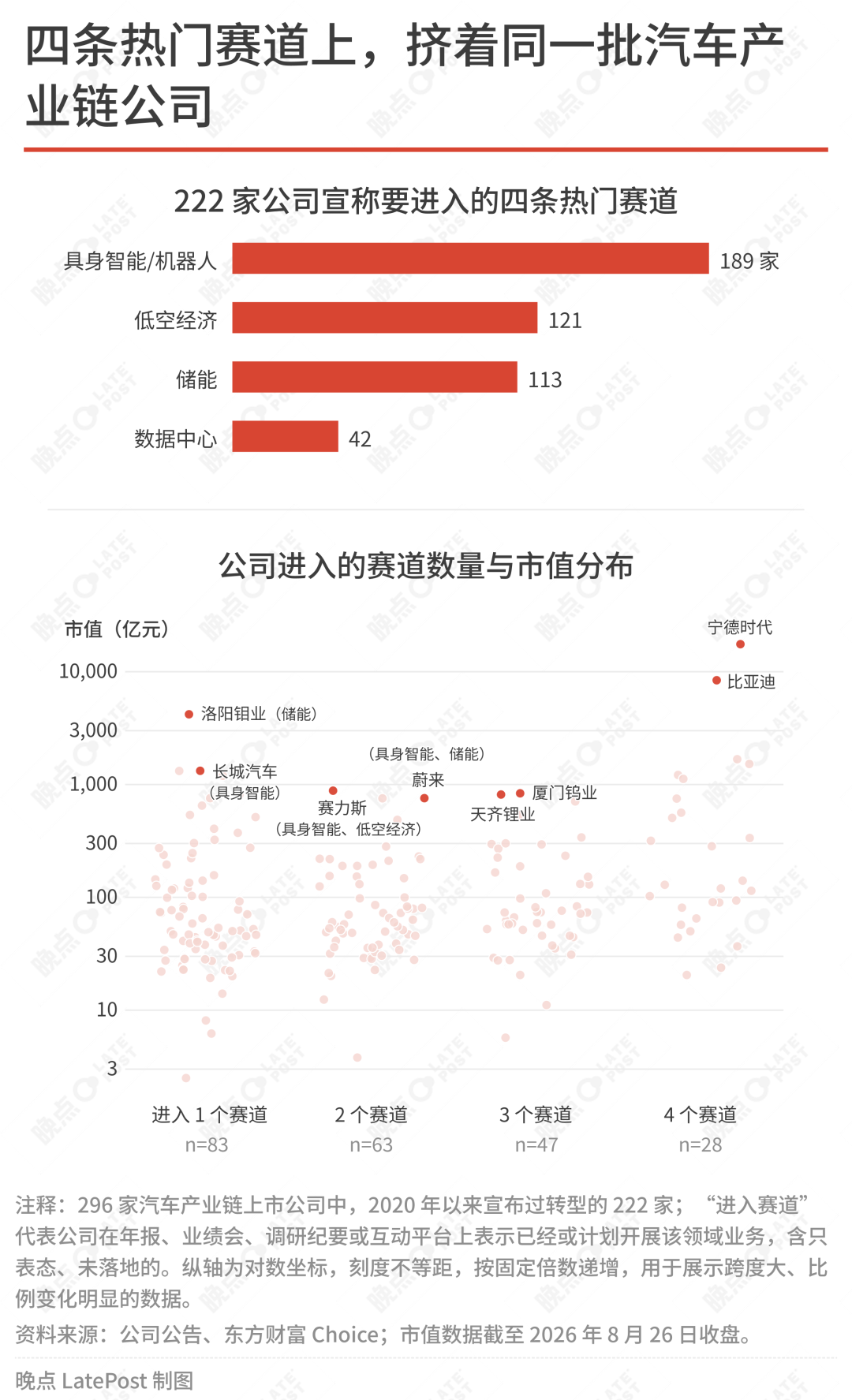
Companies that rely entirely on automotive revenue are the first to remove "automobile" from their names
"A high-tech enterprise dedicated to using technological innovation to meet people's aspirations for a better life."
"An intelligent low-carbon transportation technology company."
"A globally leading physical AI company."
"A comprehensive supplier of mobile transportation services and products."
These phrases come from the recent annual reports of BYD, Changan Automobile, Xiaopeng Motors, and SAIC Group. Although almost all revenues come from automotive business, they no longer define themselves using "automobile." Over the past seven years, from new forces to state-owned enterprises, almost all manufacturers have modified their self-introductions in annual reports, with a consistent direction: removing or downplaying "automobile" and "manufacturing," and adopting labels of technology, intelligence, and AI.
GAC included "world-class technology enterprise" in the chairman's address; Ideal announced in its 2026 mid-term report to "center on embodied intelligence"; Seres stated in its annual report to "actively promote the exploration of artificial intelligence + related directions in line with the trend of AI and physical terminal integration."
The company's website has traces of earlier modifications to the definitions by automakers. Great Wall Motors renamed itself as a "global intelligent technology company" in April 2022. Xiaopeng's Chinese website previously referred to itself as a "technology company for future mobility" and as an "intelligent technology enterprise." Even BYD has referred on its official website brand center since at least 2021 that "industries are not just automobiles, and businesses are not only in China."
However, changing the introduction is wishful thinking, as the capital market still prices car companies based on how many cars were sold. Vehicle sales are not just a scale metric for OEMs: factories, R&D, channels, inventory, and supply chains depend on the capital generated from it. As long as automobiles continue to provide the primary income and cash flow, "technology companies," "user enterprises," and "physical AI companies" can only raise market expectations for the future and cannot replace the operational results of automotive businesses.
Tesla has similarly not escaped this evaluation method. Musk has extended the company's story to artificial intelligence, Robotaxi, Optimus, and energy businesses, but Tesla's stock price largely still fluctuates with each quarter's delivery volume.
Renaming laser radar, changing gear products
How to change depends on what was originally done. These supply chain companies generally fall into three categories: intelligent supply chains, electrification supply chains, and traditional parts supply chains.
Suppliers in the intelligent supply chain change their positioning, especially products like laser radar, cameras, and domain controllers that can be installed in cars and robots. Earlier this year, Momenta referred to itself as a "physical AI company" during its pre-IPO roadshow; even earlier, Horizon proposed building a "super platform for the physical AI era," and Yuanrong Qixing aims to become "AI infrastructure for the physical world"; Hesai defines itself as a "full-stack infrastructure platform for robots and physical AI," and Suteng Juchuang rebranded as a "robotics platform company for the physical AI era."
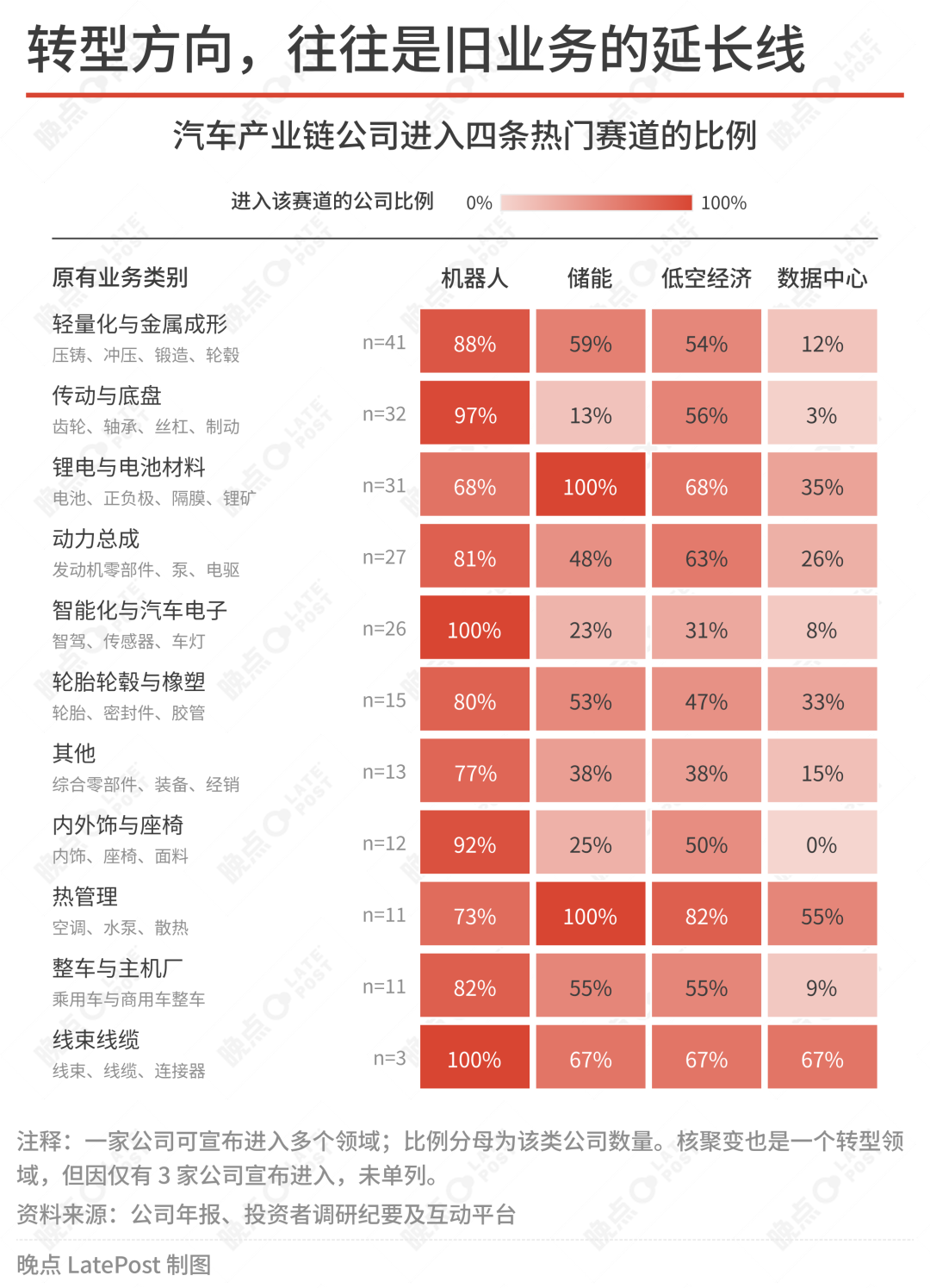
Electrification suppliers change their customers, extending upstream and downstream of their existing businesses, with the hottest direction being energy storage: all 31 lithium battery industry chain companies are engaged in this. Motors, electric controls, and thermal management products can also switch application scenarios; products from Huichuan Technology for humanoid robot components have been sent to robot manufacturers for samples.
Traditional parts suppliers must change the products themselves. Stamped parts, gears, and bearings originally designed for cars need to be transformed for the skeletons and joints of robots. They are clustering in the direction of embodied intelligence: of the 41 lightweight companies in A-shares, 36 have announced plans to make robots; among 32 transmission companies making gears and bearings, 31 will do so.
There are two paths to making robots. One is supplying structural parts and components: Topband's linear actuators and Shuanghuan Transmission's heavy-duty reducers have entered Yushun's supply chain—but generating revenue does not necessarily mean profit; Wuzhou Xinchun's robot screw's gross margin was -9.33% last year, meaning it lost money on each unit sold.
The other is whole machine OEM: Ningbo Huaxiang OEMd 1,198 bipedal robots for Zhiyuan, generating revenue of 24.97 million yuan last year, accounting for 0.1% of total revenue. Among the 36 lightweight companies announcing plans to make robots, nearly half have not taken further action.
All lithium battery companies want to do energy storage, two-thirds also want to pursue low altitude
Power batteries account for more than 30% of the total value of new energy vehicles. Both power batteries and energy storage batteries can use many of the same materials, production processes, production line capabilities, and upstream supply chains, but their product focus is different.
Onboard power batteries prioritize energy density and power, while energy storage batteries in power stations place more emphasis on cycle life and cost per kilowatt-hour. When power battery companies venture into energy storage, they can leverage existing capabilities, adjusting formulas and parameters based on application scenarios.
This is similar to clothing factories shifting to mask production in 2020, where equipment is readily available, production processes are similar, and slight adjustments to parameters allow for shipment. According to our statistics, all 31 lithium battery industry chain companies have claimed they will engage in energy storage. Leading power battery manufacturers like CATL, BYD, Yiwei Lithium Energy, Zhongchu Innovation, and Guoxuan High-tech are also major suppliers for energy storage batteries.
Energy storage is currently the fastest-growing main business for CATL. Its revenue growth rate in the first half of this year was 87.5%, nearly double that of the power battery business; its gross margin was 24%, which is 3.3 percentage points higher than that of the power battery business. This business is growing rapidly, yet CATL's stock price has not risen much alongside it recently.
After gathering a large number of manufacturers, the energy storage sector has experienced two years of price wars for battery cells. The mention of "energy storage" in the "Management Discussion and Analysis" section of listed company annual reports peaked in 2024 and then declined.
However, these companies are still seeking other avenues: two-thirds of lithium battery industry chain companies have announced their entry into the low-altitude economy to supply batteries for electric aircraft; and 11 companies are targeting backup power demands for data centers.
Companies that have successfully transformed rely on their old businesses
Valeo has produced automotive components for more than a hundred years, known for headlights, radars, and thermal management systems. Now, it has started selling cooling solutions to data centers, transporting technology for cooling engines and power batteries into server rooms.
Yuchai International's main business is manufacturing diesel engines for trucks and engineering machinery. In the past two years, AI has accelerated construction of data centers, igniting a decades-old product—the diesel backup generators that kick in during a power outage in data centers, for which Yuchai can supply the engines. Last year, Yuchai sold 2,000 such engines, a year-on-year increase of 1.7 times.
Companies that have developed new businesses share a common trait: they are leaders in their respective niches, with mature technology and stable mass production capabilities. When new demands arise, they have ready products to sell.
Suteng Juchuang has sold the original automotive laser radars to robot clients, achieving a gross margin close to 40%, higher by 20 percentage points compared to sales to automotive clients with extended payment terms. By the end of the first half of this year, Suteng Juchuang's robotics revenue had made up nearly half of the company's product income, contributing more profit than its automotive laser radar business.
Some companies have also applied core technology to different fields. Huichuan Technology specializes in servo motors, inverters, and automotive electric drives; the core of these three products lies in motor control technology, with differences in application scenarios and reliability standards. In 2024, Huichuan began producing parts for humanoid robots, having completed the development and sampling of the first generation of frame-less torque motors and planetary roller screws.
Similarly, Feilong Co. has applied its automotive water pump technology to data centers, using liquid circulation to cool servers. According to announcements, Feilong has contacted approximately 80 clients and is advancing more than 120 projects, with some already in mass production.
Cost-free transformations: changing names, setting up subsidiaries, signing investment agreements
Ruima Precision is a precision stamping company primarily producing automotive metal structural components. In its annual reports for 2024 and 2025, it announced its entry into four new sectors: data centers, embodied intelligence, robotics, and low-altitude economy.
Such companies are not uncommon in A-shares, as the cost of announcing a transformation is usually low. According to our statistics, if they want to step further, common practices include: changing the company name, establishing subsidiaries, and signing strategic cooperation agreements.
Changing names is the easiest. Hunan Oil Pump changed its name to "Hunan Meihu Intelligent Manufacturing" in 2024 and later changed its stock abbreviation from "Xiang Oil Pump" to "Meihu Co., Ltd." last year. "Zhejiang Siling Auto Bearings" was renamed "Zhejiang Siling Intelligent Drive Group" last year.
Establishing subsidiaries is also uncomplicated; many intermediaries offer one-stop services. In 2025, Xiangxin Technology established a robot subsidiary “Xiangxin (Dongguan) Intelligent Robotics” with a registered capital of 500 million yuan; as of the end of the year, Xiangxin's recorded investment in it was 8.5 million yuan, less than 20% of the registered capital.
Between 2024 and 2025, the automotive cable company Kabei Yi consecutively established three subsidiaries: Zhili Cable, robotics, and aerospace technology. By last year, it still derived 95.2% of its revenue from automotive components.
Going a step further requires capital investment, but as long as it stays at the cooperation negotiation stage, it generally doesn't impact the cash flow of listed companies. Huawei Technology holds a 3.33% stake in the agile hand company Hangzhou Jukun, after which they signed an agreement to jointly develop agile hands. At that time, Hangzhou Jukun's registered capital was 1.36 million yuan, less than 3% of Xiangxin's robot subsidiary's capital.
In April 2025, Wantong Intelligent Control signed an agreement with Zhejiang University to jointly establish an "Embodied Intelligence Perception Joint R&D Center," agreeing to invest a total of no less than 10 million yuan over three years, which was below 4% of Wantong's cash reserves at the time. Following that, almost every investor inquiry asked about progress. One month after the center was established, Wantong disclosed the progress as "clarifying the cooperation direction."
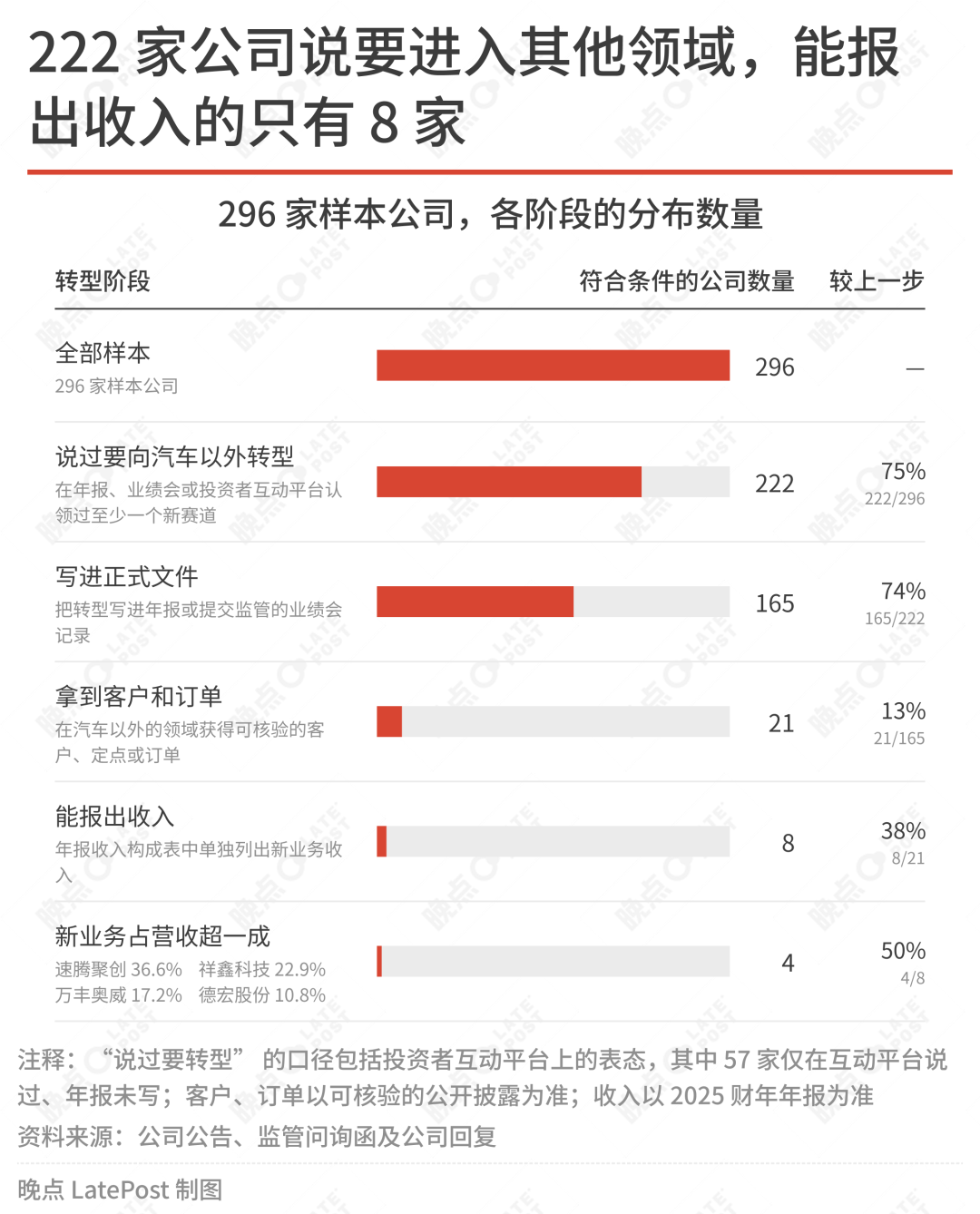
We've also seen that among the 21 companies announcing customer acquisitions or orders, the new business revenue of 13 companies did not appear in the revenue composition table of the 2025 annual report.
Limited revenue but very proactive capacity planning. Fulin Jinggong, with total robot sample revenue of 527,000 yuan, has constructed an annual production capacity of 100,000 units and also plans to invest another 200 million yuan to add an annual production of 500,000 units; Hengshuai Co.'s robot motors are still in the customer validation phase, and management has planned to produce 300,000 units annually.
However, research organization Counterpoint stated that by 2030, the global shipment volume of humanoid robots will only be about 256,000 units.
Stock price fluctuations, looking at market capitalization in the short term, and transformation effectiveness in the long term
In November 2024, the turbocharger shell supplier Lihu Shares, with a market value of over 2 billion yuan, first disclosed its robot components business, leading its stock price to rise 13% that day and continue to hit the limit-up the next day. This original low-trading stock was flipped around four times by funds that month.
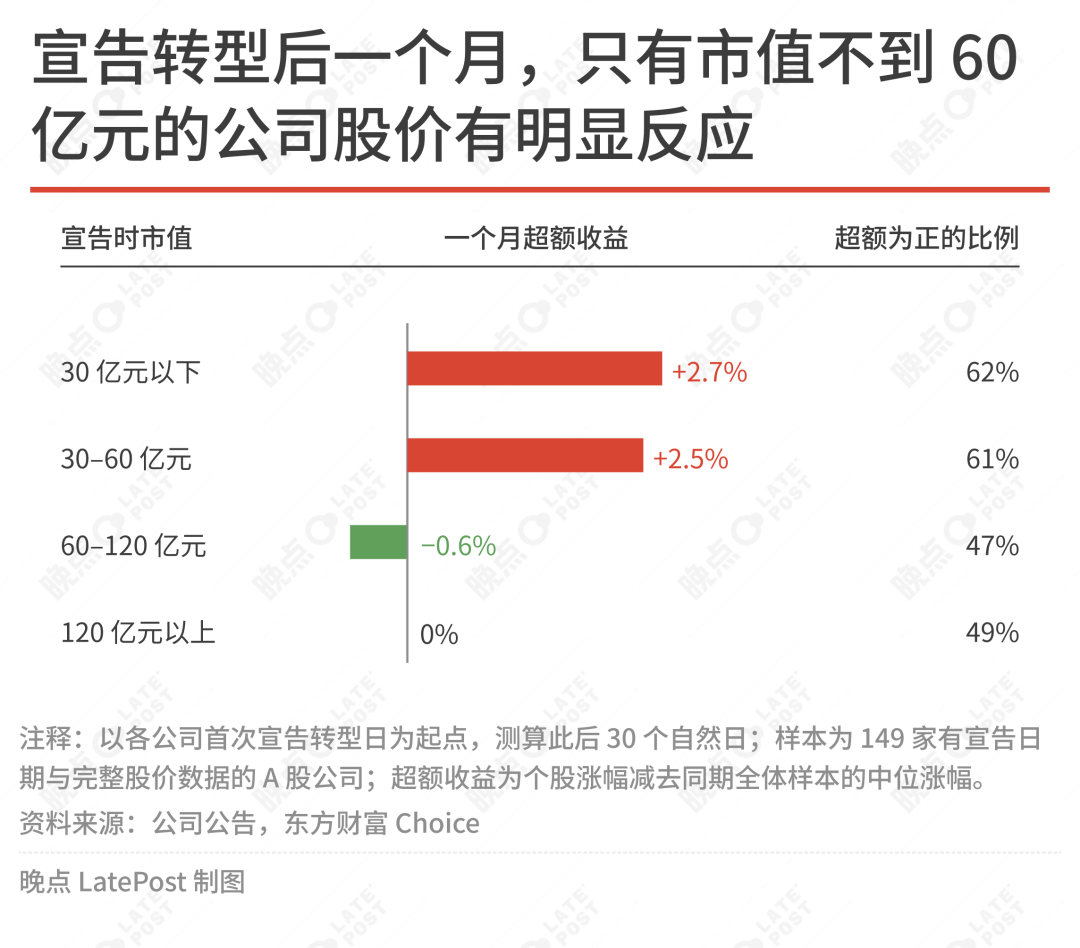
This short-term surge mainly occurs in small-cap companies with limited circulating shares, a common speculation method used by hot money. Companies with a market value below 6 billion yuan saw a 2.7 percentage point higher increase compared to other automotive chain companies in the same period one month after announcing transformation, with 61% of these companies outperforming.
Once the market capitalization exceeds 6 billion yuan, the outperformance rate hovers around fifty percent, not much different from flipping a coin. When Aotexia, with a market value of 11.7 billion yuan, indicated in its annual report that they would engage in energy storage heat management, the products had already been shipped in bulk, yet the stock price fell by 0.3% on the announcement date.
Looking at the long term, companies that have developed new businesses perform better in stock prices, and the capital market ultimately has some selective influence. Since 2024, companies that have secured customers, orders, or revenues for new businesses have a median stock price increase of 29.5%; companies that have only disclosed transformation directions saw 7.8%; those that never disclosed showed -6.6%.
There are also valuation discrepancies in the sectors. At the time of this article's statistics, the A-share Shenyin Wanguo automotive segment's price-to-earnings ratio (calculated based on the past 12 months' profits) was 23.8 times; the automated equipment sector populated by robot industry chain companies was 72.4 times, about three times higher than the former.
Among the 296 companies, 39 have seen their market value drop below net assets. After deducting liabilities, the net asset per share attributed to shareholders of SAIC Group is about 26 yuan, while the stock price is only 10 yuan.
The best transformation strategy: grab hold of the rocket, then invest in the rocket
On the path to transformation, it’s best to first find a big client. Topband Group, as Tesla's largest supplier in China, fully capitalized on the benefits of new energy vehicle localization. Over the four years since Tesla's localization in 2020, Topband's revenue doubled, and its market value also doubled.
“Wu Jianshu (founder of Topband) is quite old. During a company internal review of his career, he said the core reason is ‘good fortune,’ as they have latched onto Tesla, the thickest thigh of the new energy era, and Topband's strategy is to believe in Tesla and Musk,” said a person close to Topband.
By 2025, Topband's revenue growth rate dipped to a six-year low, yet by the end of that year, its market value surged by 60% year-on-year, surpassing 130 billion yuan. This time, the market's expectations were supported by the robotics business: Topband is a supplier of Tesla's humanoid robots and is now providing linear actuators and structural components to Yushun, along with liquid cooling technology and products integrated with Nvidia, Meta, and other companies. Topband stated in its annual report that non-automotive businesses such as liquid cooling servers and energy storage have secured initial orders worth 1.5 billion yuan.
Some companies, besides supplying, have also invested in their clients. Shuanghuan Transfer supplies servo reducers used in humanoid robots for Yushun and holds shares in Yushun through the Rongteng Fund. They invested 20 million yuan upon entering during 2024, and today the book value exceeds 600 million yuan.
Fulin Jinggong builds relationships with clients via equity stakes. It co-established Chengdu Annu with companies like Zhiyuan Robotics, holding a 12.4% stake, and plans to prioritize supplying electric joint modules to Chengdu Annu.
According to incomplete statistics, at least 19 A-share listed companies have indirectly invested in Yushun through industrial funds. Among automotive chain companies, besides Shuanghuan Transfer, there is also Xuelong Group, which produces engine cooling fans. Geely also invested 20 million yuan in Yushun's final round of funding before going public.
Policy hotspots change every year; last year's focus was on low altitude, this year's is on robots
In the spring of 2024, "low-altitude economy" was mentioned for the first time in the government work report. That year, related inquiries on investor interaction platforms increased from 68 the previous year to 1,530; the number of A-share companies listing low altitude as a business direction in their annual reports increased from 4 to 23.
Three weeks after the policy was published, Guizhou Tires stated on the interaction platform that they had developed two tire models suitable for 0.5-ton-class drones, which were being tested in flying trials. In the same year, Inbol and EHang signed a strategic cooperation and technology development agreement and stated in their annual report that they had achieved a "major breakthrough" in the low-altitude field.
A year later, inquiries related to the low-altitude economy dropped to 421, and robots took precedence. Especially after Yushun appeared on the Spring Festival Gala, 40 A-share companies listed robots as a business direction in their 2024 annual reports, four times that of the previous year; by the end of that year, robot-related inquiries on the investor interaction platform had surged to 3,020.
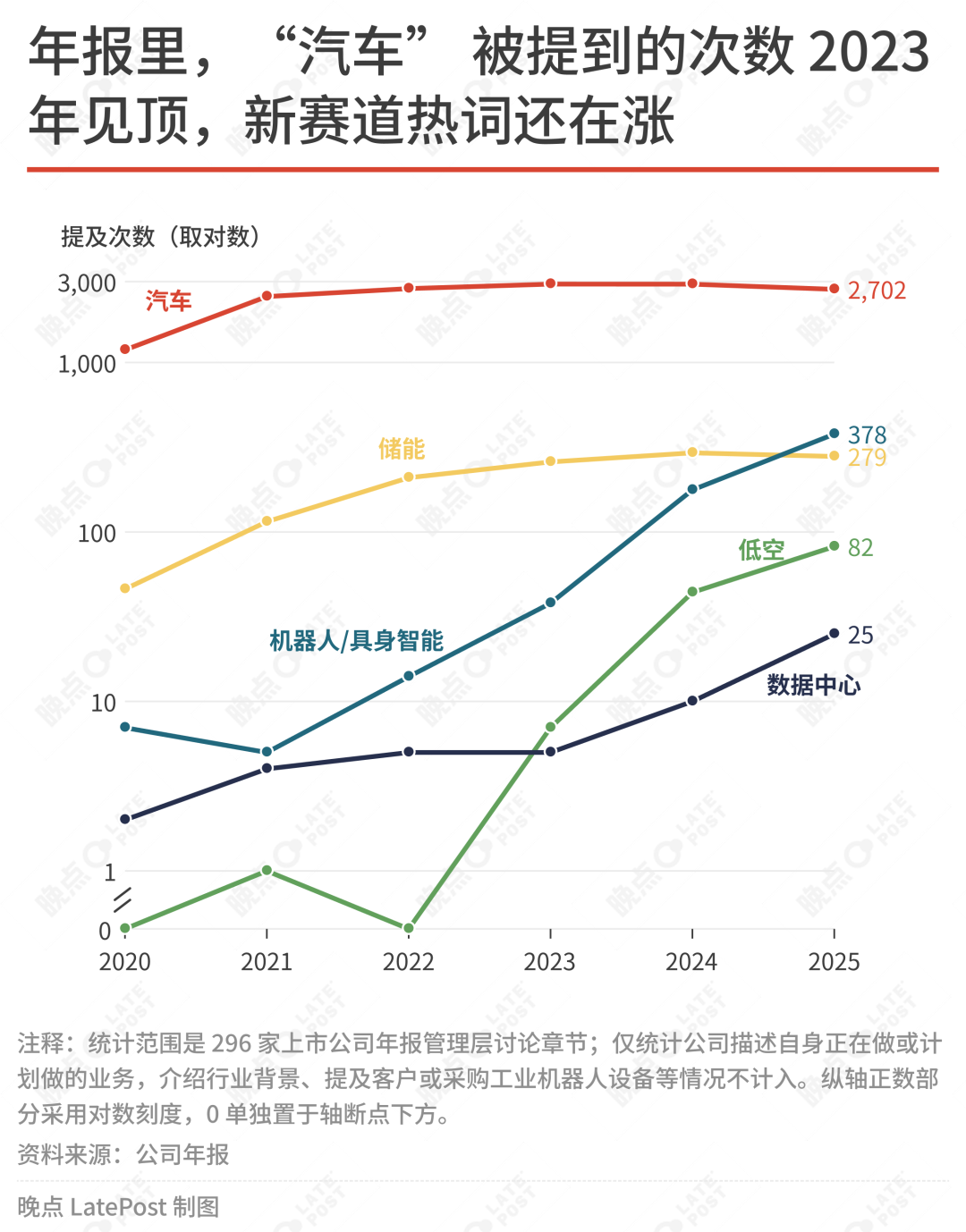
The trends that companies chase are often also directions encouraged by policy documents. The government work report boosted "low-altitude economy"; the Ministry of Industry and Information Technology's "Guiding Opinions on the Innovative Development of Humanoid Robots" heated up embodied intelligence; energy storage can be traced back to the National Development and Reform Commission and the National Energy Administration's "Guiding Opinions on Accelerating the Development of New Type Energy Storage."
Local governments subsequently incorporated these directions into their work reports and established industrial funds. By 2025, the "low-altitude economy" has appeared in the government work reports of 30 provinces; nearly 20 local governments have set up low-altitude industrial funds totaling over 110 billion yuan.
Some local governments have even directly become partners of businesses. Sanhua Intelligent Control signed a 5 billion yuan contract with Qiantang District of Hangzhou to collaboratively build a "Future Industrial Center"; Topband Group signed a 5 billion yuan investment agreement for a 300-acre robotics base with the Ningbo Economic and Technological Development Zone.
The heat comes quickly but fades just as fast. Fourteen listed companies once expressed optimism about the energy storage outlook, but by the time the 2025 annual reports were released, energy storage had disappeared from the "Management Discussion and Analysis" section. In the second quarter of 2025, US-listed company Weikong Power write down 32.5 million dollars (about 230 million yuan) for energy storage components; three quarters later, management shifted the focus of discussions in performance meetings to the safety of solid-state batteries in humanoid robots.
The last round of collective transformation for automotive chain companies occurred around 2020. At that time, the new energy vehicle sector was about to enter a high growth phase, leading traditional parts companies to shift intensively to electric drives, electronic controls, thermal management, intelligent cockpits, and intelligent driving. Just entering the supply chain of leading manufacturers like Tesla—or obtaining even one significant designated project—could lead to a dramatic increase in valuation.
As the latter part of the transformation unfolded, high valuations and strong demand attracted more companies to enter, leading to redundant capacity construction and product homogenization. Competition shifted from technology and product to price and payment terms. This year, while the penetration rate of new energy vehicles hit a new high, industry profit margins fell to historical lows.
Now, embodied intelligence is experiencing a similar frenzy, but the starting point for the two rounds of transformation is different: when new energy vehicles were booming, consumers were already spending money to buy cars; demand for humanoid robots is still hypothetical, with the entire industry having sold only a few tens of thousands of units, with no application scenarios yet formed that could create scaled demand.
According to a Morgan Stanley research report, Yushun, the largest in terms of shipment volume, sold only 5,215 units last year. Topband supplies for Tesla's Optimus, and analysts once estimated its supporting value at 8,000 yuan per unit, which has now dropped to around 1,600 yuan.
Huang Zhenxin also contributed to this article.
Cover image source: "The Revenant"
免责声明:本文章仅代表作者个人观点,不代表本平台的立场和观点。本文章仅供信息分享,不构成对任何人的任何投资建议。用户与作者之间的任何争议,与本平台无关。如网页中刊载的文章或图片涉及侵权,请提供相关的权利证明和身份证明发送邮件到support@aicoin.com,本平台相关工作人员将会进行核查。


