The information flow is too fast, and in-depth analysis articles are easily drowned out by hot topics. The "Weekly Editor's Picks" column extracts these content with judgment value from the massive amount of information, helping you filter out the noise, leaving insights and bringing inspiration.

Macroeconomic Situation
Wall Street speculates: What is Besson's next move to "rescue US bonds"?
Currently, mainstream institutions on Wall Street expect that the Treasury Department may release signals in November indicating that future borrowing increases will be accomplished through short-term treasury bills and shorter-term notes, while further expanding the scale of repurchases to ease the pressure on long-term yields. Some investment banks even point out that the possibility of a direct reduction in the issuance of long-term bonds, a radical option, is increasing.
As long-term treasury yields hover at their highest levels in years, the Treasury's deviation from the long-standing practice of "regular and predictable" is injecting new volatility into the market. Investors are facing a whole new era of US debt management and are reassessing their portfolio's risk exposure accordingly.
Central bank + ETF + option funds resonate, where will gold look after breaking 4600?
Goldman Sachs believes that the fundamental buying in gold is resonating with option funds, and that traders' hedging could become a short-term amplifier following a breakout in gold prices. Option positions can amplify upward movements as well as exacerbate corrections; if inflation heats up again and raises rate hike expectations, traders closing positions will create additional selling pressure.
Goldman Sachs maintains its gold forecast at $4900/ounce by the end of 2026, but this target does not yet account for the surge in macro policy hedging demand, leaving room for further upward movement. Goldman Sachs' trading desk has observed that Chinese and Western macro funds are increasing their positions synchronously, with clients betting on gold rising to $4800—$5500 through options and spot trading.
The silver market has seen demand for digital options with a three-month maturity and an exercise price of $90, but this represents customer bets and not an official target price from Goldman Sachs.
Also recommended: 《Besson's true calculations: forcing a short squeeze on US bonds CTA, pushing the 10-year yield to 4.3%?》.
Investment and Entrepreneurship
Arthur Hayes' extensive interview: ETH sees $30,000; FLOP will surpass ETH
Cryptocurrency is precisely the only release valve, the purest channel for central banks to print money. 2026 is replaying the script leading to 2008, recreating the path that gave birth to Bitcoin. Arthur believes the Clarity Act is a very poor thing for the domestic crypto ecosystem in the U.S., real innovation, and those useful projects that have market demand. The government only superficially pays occasional attention to crypto enterprises, while actually betting everything on AI.
Arthur does not pay much attention to technical analysis, focusing instead on Milton Berg, who does technical analysis on U.S. stocks, observing the linkage between Bitcoin and U.S. stocks following his trading rhythm.
Arthur believes that in this round of liquidity rebound in the crypto market, ETH will outperform all other large-cap crypto assets, as Ethereum boasts the largest developer community. The trigger point for BTC to break its previous high this year is the Federal Reserve's decision to eliminate the counterparty limit for repurchases in foreign and international monetary authorities (FEMA).
The biggest risk in the crypto market comes from war. Investors need to be particularly patient and focused. Arthur also introduced his latest project, Flop Network, which has a native currency's computing power spot market.
BTC surged 24% in a week, who are the strongest crypto leverage stocks?
MSTR is a leveraged Bitcoin bond, boasting the highest elasticity; COIN relies more on operational leverage, suitable for balanced investors looking for "industry growth + regulatory dividends"; CRCL's revenue has almost no direct relationship with the BTC price; HOOD has risen the least but may be the most "resistant to falling"; mining companies are the most leveraged and vulnerable.
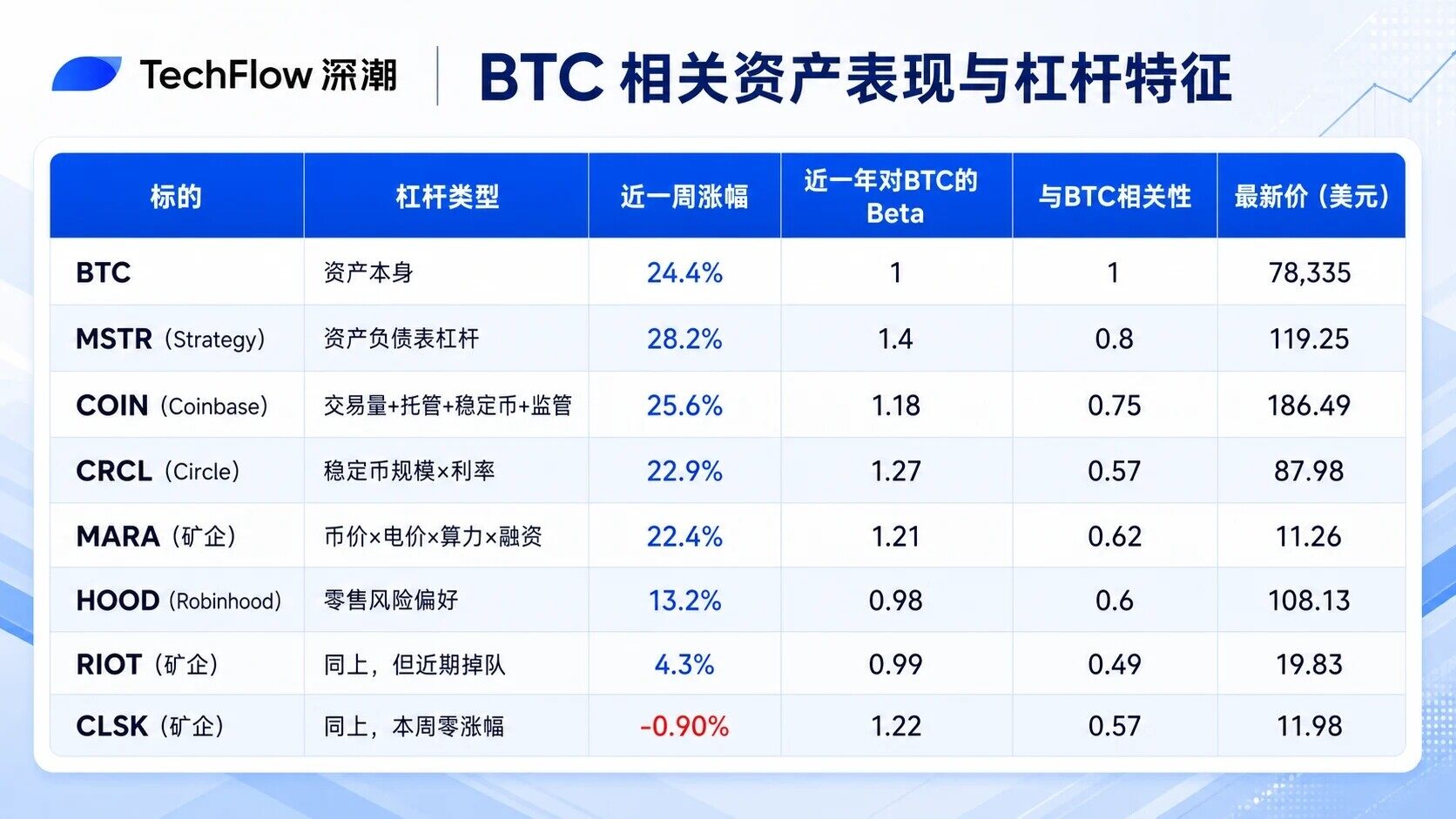
As of August 21, 2026, closing daily data
Circle surged 17% in two days, what is the market really betting on?
Aside from a general strength in crypto concept stocks, Circle itself has two fundamental points:
1. In the second quarter, the circulation of USDC and on-chain transaction volume continued to grow, but revenue growth has slowed, with over 85% of revenue still coming from interest generated by reserve assets. As interest rates decline, whether the scale expansion of USDC can offset the decline in reserve yields becomes a key factor affecting short-term profitability.
2. Longer-term variables include the Arc blockchain and Circle Payments Network (CPN).
Which valuation Circle ultimately receives (whether in 2030 a neutral scenario is $101 or $259) depends on whether Arc can bring real assets, transaction activity, and sustainable income after its launch.
The apparent recovery in the altcoin market has become a market consensus. Market funds will concentrate on leading projects, with trading volume in leading altcoins increasingly dominating the overall altcoin trading volume. Future altcoins will rely more on their fundamentals, application scenarios, and independent capital inflows to drive their rises, which is also one of the major characteristics of the current crypto market cycle.
Behind ZEC's new high: Grayscale Trust transitions to ETF acceleration, is TAO in the same script?
As Bitcoin surged over 24% this week, the privacy coin ZEC simultaneously reached an eight-year high of about $836-$855.
The direct catalyst is not merely the "return of privacy narratives," but rather Grayscale's ongoing push to convert the Zcash Trust into a spot ETF with the latest amended documents, disclosing that the parent company DCG subsidiary is discussing injecting about 200,000 ZEC into the fund.
Around the same time, Grayscale's approach for Bittensor (TAO) is also taking the "trust to ETF" route, but at a significantly slower pace. Market attention on this transition script remains insufficient.
Today, HYPE will activate the second repurchase engine
The Aligned Quote Assets v2 (AQAv2) mechanism of Hyperliquid will officially begin accruing income. This means that in addition to trading fees, Hyperliquid will add a new income source related to stablecoin reserve earnings, which will ultimately be used to repurchase HYPE. AQAv2 could bring an additional repurchase fund of $150 million to $200 million annually for Hyperliquid.
The official announcement from the Ethena Foundation contains two surgical actions for the supply side: repurchasing locked tokens of seed round investors; canceling all future monthly VC unlocks.
From now on, ENA's biggest supply-side nightmare is basically over, and the market no longer needs to focus on the unlocking calendar for transactions every month.
Also recommended: 《Interview with Robinhood CEO: The meme coin outbreak was unexpected, my portfolio is quite diversified》《Latest Interview with Shen Yu: In the AI era, human willpower is more important; Bitcoin is a better gold》《Reflections of an Entrepreneur: At the same starting point, why did FOMO run further than us?》.
AI & Storage
From the current revenue structure, the primary driving force for AI computing power demand remains the capital expenditure of large cloud vendors. The core business has not shown any sign of slowing, but rather continues to accelerate.
On the product side, NVIDIA is gradually transitioning from the Blackwell cycle to the Rubin cycle.
In the past year, AI computing power demand has mainly been driven by a few leading model companies, and now the demand is spreading to more cutting-edge models, open-source models, enterprise AI, agents, and robotics. Given such strong demand, supply has already become a limiting factor constraining NVIDIA's further growth. To break through this bottleneck, NVIDIA is extending its role to that of a "capital organizer" for AI infrastructure.
For high-beta targets, the pullback itself does not constitute a signal; where the pullback stops constitutes a signal.
The market shows great divergence in judgment over the memory cycle.
From company actions, on August 19, the company announced a share buyback plan worth 40 trillion won, which is one of the most important fundamental variables during this round of pullback.
Investors should be aware of three layers of risk: in terms of competitive landscape, Samsung Electronics has launched a new generation of high-bandwidth memory products, and if the second supplier achieves mass certification, the industry's price center will come under pressure; in terms of negotiations, if the renegotiated salary plans raise the cash proportion, company expenditures will increase; in terms of volatility, this stock's volatility is approximately 3.31%, with a beta around 1.77, daily volatility often exceeding 8%, and regular percentage stop-loss strategies are significantly less effective on such targets; the position size is more important than the stop-loss level.
CeFi & DeFi
DeFi sector rebounds strongly, which high-yield projects can be opportunistically invested in?
The intuitive fundamental indicator of DeFi is revenue. The market may fluctuate, and narratives may rotate, but being able to earn long-term money at least indicates that the protocol still has real demand.
The following high-yield token projects are worth looking for suitable opportunities to "get on board": UNI, JUP, MET, RAY, CAKE, AERO, WLFI (caution: current WLFI holders' net income is still 0), AAVE, ETHFI, LDO.
You can spend money without selling tokens: Galaxy turns BTC, ETH, SOL into personal credit lines
Galaxy Digital has launched a crypto asset portfolio line of credit on its retail platform GalaxyOne. Users can use BTC, ETH, and SOL (including staked SOL) as mixed collateral to borrow dollars or USDC at an annual interest rate of 8.99%, with no account opening fees, interest paid monthly, and available for instant use. The initial collateralization ratio is 50% (meaning that crypto assets worth $100,000 can borrow up to $50,000), currently covering 40 states in the U.S.
The core user profile of crypto collateralized lending is: holding a large amount of crypto assets, not wanting to sell (because they believe in long-term value or want to avoid triggering capital gains taxes), but needing cash flow in the short term.
The correct use of crypto collateralized lending is to treat it as a short-term liquidity tool, rather than a long-term leverage strategy.
Airdrop Opportunities and Interaction Guide
Variational, Extended, RISEx, Lighter & Robinhood Wallet, Entropy, Arcus, Trasia, GTE, Perpl, HelloTrade.
Also recommended: 《Kaito's first cooperative project after returning, is Axis Robotics about to TGE?》《Popular interaction collection | Flop Labs validator identity application; TermiX launches points system (August 27)》《EASY Residency season four list is out, these nine projects have interaction angles》.
Meme
Trump's "Pig Slaughtering Plan" Guide: Rumors pump, massive dump, son debunks rumors
The beginning and end of the rumor "Trump will issue a new coin on Robinhood".
Also recommended: 《BSC, Robinhood, and Base perform "Three Kingdoms Kill", popular Meme coins over the weekend》.
Ethereum and Scalability
BitMine is about to hold 5% of ETH, is the risk still favorable?
Holding 5% of ETH does not grant BitMine any direct control over the Ethereum network, as Ethereum's protocol upgrades are determined through the EIP process and rough consensus among core developers, unaffected by the amount of tokens held. Holding ETH does not equate to having voting rights, and Ethereum has no on-chain governance mechanism.
However, a 12% share of total network staking is not an insignificant number. Over-concentration by a single entity may trigger systemic risks, and as a publicly listed company constrained by U.S. securities law, BitMine's staking activities may be influenced by the SEC, CFTC, or other regulatory bodies.
BitMine has no substantial revenue sources other than ETH; this is a leveraged bet on a single asset, rather than a business with diversified revenue streams.
Completed entirely through equity financing, without debt or convertible bonds; Lee refers to this as "keeping the capital structure clean."
After buying 5%, they are unlikely to stop, provided institutions start treating ETH as a long-term asset; what truly needs to be evaluated is 2027.
BitMine does not rely on selling ETH to cover expenses, with annual staking yields of about $300 million, sufficient to cover annual dividends of about $30 million to $35 million for the 9.5% preferred stock (BMNP).
Lee compares ETH to "stocks/land," with the core property being value storage, rather than cash flow assets akin to bonds.
Multi-Ecosystem
A vote may cause SOL's daily burn volume to soar 14 times
Security
Weekly Hot Topics Recap
BTC returns to $80,000 after a hundred days;
"Sun Yuchen sues Jing Tian" draws attention;
Policies and Macroeconomic Markets
The U.S. plans to redeploy diplomats to the Middle East embassy, expecting that the Iranian conflict will not fully erupt again;
Trump: If I lose the midterm elections, I will be impeached;
The U.S. Treasury reportedly plans to tap into nearly a trillion treasury accounts? Besson emphasizes repurchasing bonds again on September 9;
Opinions and Voices
Standard Chartered Bank: ETF capital inflows combined with short liquidations could drive Bitcoin to $126,000;
Vitalik publishes "local mixing" cryptography research: exploring next-generation obfuscation techniques, which may become new basic primitives for cryptography;
Institutions, Major Companies, and Leading Projects
Former product head of X: X will soon support partial cryptocurrency trading functions;
Data
From August 19 to 22, the total market cap of altcoins surged by $215 billion in 3 days, catalyzed by Trump’s policy signals;
Glassnode: 85% of altcoin funding rates are above average levels, signaling a shift to an optimistic phase in the market;
After almost 500 liquidations, Brother Magi turned a $150,000 principal into $12.72 million in three days;
Security
Trump's second son denies that Trump will launch a new token, claiming the related news is fraudulent;
The largest buyer of the Trump family WLFI, Zhou Gu Ren (introduces linked) has been listed as a person subject to enforcement for being involved in six cases, owing tens of millions…
Attached is the portal for the "Weekly Editor's Picks" series link. See you next time~
免责声明:本文章仅代表作者个人观点,不代表本平台的立场和观点。本文章仅供信息分享,不构成对任何人的任何投资建议。用户与作者之间的任何争议,与本平台无关。如网页中刊载的文章或图片涉及侵权,请提供相关的权利证明和身份证明发送邮件到support@aicoin.com,本平台相关工作人员将会进行核查。


