
Author: Jae, PANews
A force that penetrates the traditional capital market is accelerating its formation.
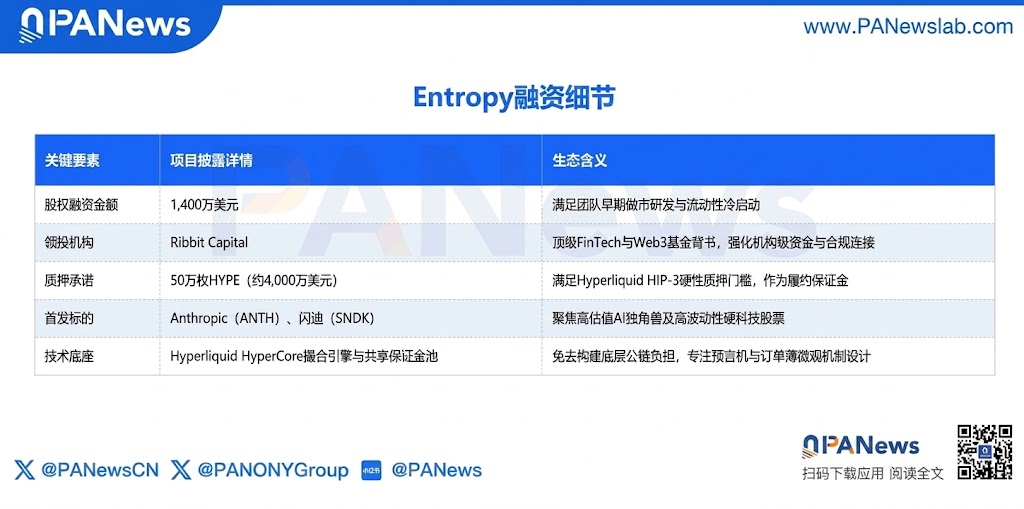
On August 25, the independent market deployer Entropy, based on the Hyperliquid HIP-3 framework, announced the completion of a $14 million financing round, led by leading VC Ribbit Capital, while locking up about $40 million worth of HYPE tokens as collateral.
As venture capital and staking funds are in place, the first Pre-IPO perpetual contract (ANTH) anchored to the equity valuation of the AI unicorn Anthropic officially launched on the Hyperliquid mainnet.
The significance of this transaction may not only lie in the birth of a new project. On one hand, top venture capitalists are betting real money on the vision of "on-chain all asset trading," while on the other hand, DeFi derivatives continue to push the boundaries of crypto assets, attempting to break the pricing barrier of primary market private equity.
Wall Street quantitative genes invading the on-chain derivatives market
The background of investors and teams carries significant weight in this financing for Entropy.
This financing round was led by Ribbit Capital, whose investment landscape spans both the fintech and crypto sectors: it has invested in leading crypto projects like Coinbase, Morpho, Arbitrum, and Lighter, and has also had successful exits such as Stripe's acquisition of the stablecoin platform Bridge. Its investment is not only a recognition of the single project Entropy, but also indicates that venture capital is betting on the trend of "traditional assets migrating to on-chain derivatives."
The team structure of Entropy is a classic cross-border combination of "Wall Street quant + crypto native," which is also the most crucial capability configuration for asset pricing. Key members from the technology and trading side come from large hedge funds like Citadel Securities, Optiver, and Millennium, bringing traditional financial experience in cross-asset high-frequency pricing, order book microstructure, and market-making risk control; the operations and business side has recruited talent from the decentralized prediction market Polymarket, possessing experience in cold-starting on-chain liquidity and event-driven derivative architecture.
This combination addresses the fundamental pain points of traditional asset on-chain derivatives: it must understand the pricing logic and risk control systems of traditional assets as well as the operational rules and user mentality of the on-chain ecosystem.
Liquidity-weighted + time-based rate, how to reconstruct the asset pricing mechanism?
Attempts at on-chain stocks and Pre-IPO pre-market contracts have existed, but are always hindered by three structural defects: external oracle pricing delays, insufficient order book depth, and unreasonable funding rates during the underlying's market closure.
Entropy has made targeted improvements in oracle pricing and funding rate mechanisms.
Liquidity-weighted oracle: depth determines price discovery
For Pre-IPO contracts of unlisted unicorns like Anthropic, there is no real-time spot price in the traditional sense. To address this, Entropy designed a liquidity-weighted oracle that dynamically integrates external private equity benchmark data with internal order book prices. The external price captures transaction data and financing valuations from multiple private secondary market platforms, while the internal price extracts the buy-sell midpoint from Entropy's own order book and performs smoothing.
The system will dynamically adjust the weight of the two based on the bilateral depth of the order book: the deeper the order book, the higher the weight of the internal price, allowing on-chain trading to dominate price discovery; the scarcer the liquidity, the higher the weight of the external valuation.
To prevent price distortion from extreme market conditions, the system also sets up a safety cushion: regardless of how sufficient the internal depth is, the weight of external data sources is kept at least 5% as a baseline valuation anchor.
For listed stocks like Sandisk, the system adopts a time-based pricing strategy: during US stock trading hours, the oracle uses public market real-time prices 100%, and the marked price takes the 3-minute moving average of the public market price and the on-chain midpoint, closely following the spot while reflecting on-chain supply and demand; during off-market hours, the system automatically switches to a liquidity-weighted mode, combining after-market transaction prices with real-time on-chain depth for pricing.
Time-based funding rate: dampening design during off-market periods
The funding rate of perpetual contracts was originally a tool to track spot prices, but during off-market hours, if on-chain prices fluctuate due to news, users may incur punitive high overnight rates, which has always been one of the pain points of on-chain derivatives.
Entropy optimizes this issue by introducing a time-based dampening mechanism.
During market hours, the funding rate multiplier for stock/index perpetual contracts only uses 0.5 times the Hyperliquid standard value; during off-market hours, the multiplier is further reduced to 0.125 times. This design significantly lowers the holding costs for users during non-trading hours and alleviates the unreasonable phenomenon of "high funding rates during market closures." The Pre-IPO perpetual contract, due to sparse private data, is not suitable to enforce a high funding rate to anchor external prices, so the multiplier is fixed at 0.00125.
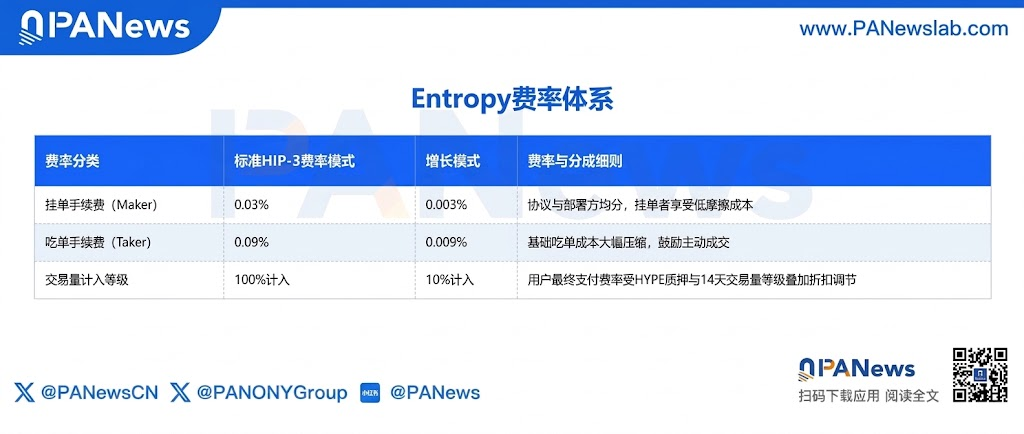
In terms of fees, Entropy adopts a standard revenue-sharing model based on the HIP-3 framework, with the protocol and deployer each taking 50%. To accelerate the cold start, the first batch of underlying assets has activated a "growth mode," reducing the base transaction fee by 90%, aiming to attract early market-making funds and traders with low trading friction.
Launching Anthropic, exploring new markets for Pre-IPO trading
Entropy chose to launch Anthropic as its flagship asset, hitting the biggest pain point for ordinary investors participating in the current primary market: the high entry barriers and low liquidity of AI unicorn Pre-IPO trading.
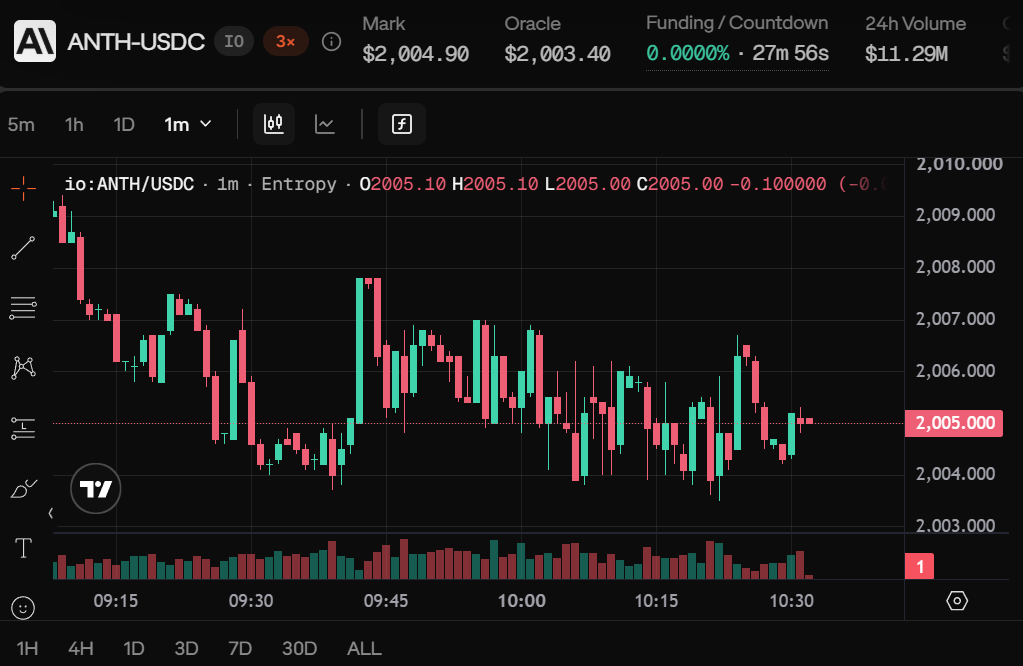
Anthropic is on the verge of a valuation explosion before its IPO. According to The New York Times, it plans to raise over $100 billion in its IPO, with a target valuation of up to $2 trillion. As of now, the trading price of ANTH on Entropy is $2,005, corresponding to a valuation of $2.005 trillion. According to Entropy's pricing rules, every $1 of the Pre-IPO perpetual contract's market price represents a market value of $1 billion for the underlying.
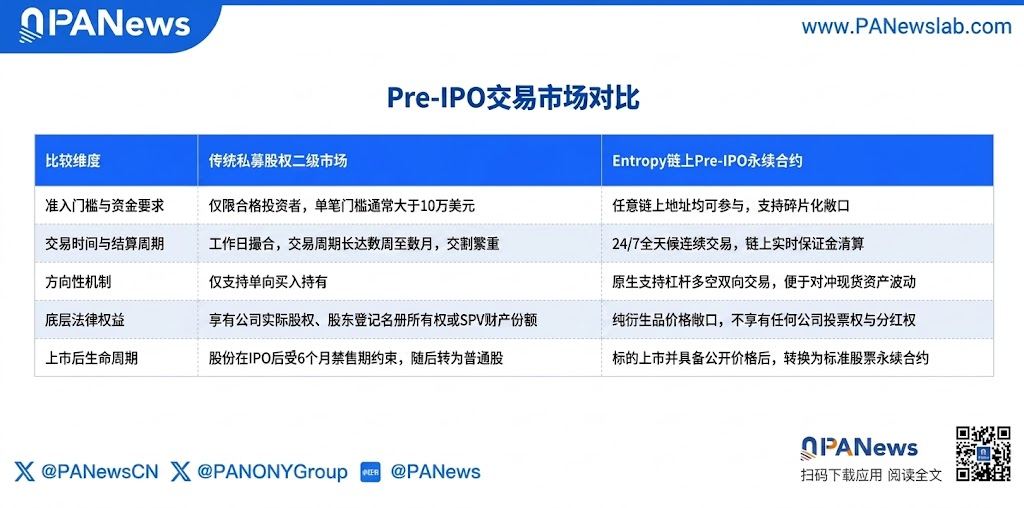
In the traditional private placement market, ordinary investors are almost unable to partake in this valuation feast. High thresholds for qualified investors, a minimum single investment limit of several hundred thousand dollars, months of priority purchase reviews, and strict transfer lock-up periods keep retail funds out. Furthermore, investors can only take long positions and cannot hedge against valuation volatility risks.
Entropy's ANTH perpetual contract effectively opens up a channel on-chain:
Zero threshold: Any on-chain address can participate, supporting fragmented exposure;
All-day: 24/7 continuous trading, not restricted by US stock hours;
Two-way trading: Natively supports leveraged long and short positions, allowing both long bets on valuations rising and hedging against primary market position risks;
Pure price exposure: No legal rights such as voting rights or dividends, only anchoring valuation volatility; after the underlying is listed, it will be converted to a standard stock perpetual contract.
This is precisely the value proposition that on-chain derivatives attempt to provide: not creating new assets, but breaking down originally high-threshold, low-liquidity assets into tradeable price exposures at lower costs.
Having the pitfalls of Ventuals before, and facing pricing and regulatory risks ahead
Although the market keeps a close eye on Entropy's efforts, multiple risks also lie ahead.
A cautionary tale: early glory ≠ long-term viability
The most direct warning comes from peers. Ventuals, which is also part of the Hyperliquid ecosystem and similarly focuses on Pre-IPO perpetual contracts, once received support of over 500,000 HYPE tokens in staking and set a historical trading volume of $650 million, but announced the termination of its operations in June this year due to a strategic adjustment, leading to a unified market liquidation. This case indicates that high staking and early explosion do not equate to the project's business closure.
Part of the reason for this is that Trade.xyz has gained absolute dominance in the HIP-3 market, creating strong pressure on competitors like Ventuals. This winner-takes-all market structure means that for new deployers, their return rates might be lower, and the payback period longer. Deployers may choose to shut down the market due to intense competition, insufficient liquidity, or strategic shifts. The staking mechanism in HIP-3 curtails violations but does not prevent voluntary exits at the business level.
Pricing flaw: inherent limitations of mapping exposure
Next is structural risk on the pricing level.
Pre-IPO perpetual contracts like ANTH lack true equity backing. When valuation discrepancies arise in the private market or the IPO timeline is delayed, on-chain contract prices may deviate significantly from the actual valuations in the primary market, becoming pure speculative games, especially with limited on-chain liquidity, where short-term fund inflows and leveraged trading may amplify price volatility.
The sword of compliance: regulatory scrutiny hanging overhead
The longer-term uncertainty stems from the regulatory aspect.
Trading derivatives of US stocks and Pre-IPO assets without a license is always under strict scrutiny from mainstream regulators like the SEC and CFTC. The potential targeted compliance strikes may serve as a sword of Damocles hanging over all similar projects.
For Entropy, ANTH is just an experiment; the real challenge lies in whether this mechanism can expand from a single hot asset to a broader traditional asset market while still maintaining sufficient liquidity and commercial sustainability after market cycle changes.
For traders, while embracing innovative asset exposures, fully considering liquidity depth, funding rate fluctuations, and operational risks of deployers remains an important prerequisite for participating in on-chain derivative trading.
Today, DeFi's penetration into traditional asset territory is an unstoppable trend. From cryptocurrencies to commodities, from stocks to private equity, the boundaries of on-chain derivatives are gradually being expanded, but the journey from "tradeable" to "forming a mature, reliable, and sustainable market" is still long.
免责声明:本文章仅代表作者个人观点,不代表本平台的立场和观点。本文章仅供信息分享,不构成对任何人的任何投资建议。用户与作者之间的任何争议,与本平台无关。如网页中刊载的文章或图片涉及侵权,请提供相关的权利证明和身份证明发送邮件到support@aicoin.com,本平台相关工作人员将会进行核查。


