Billionaire investor Stanley Druckenmiller publicly criticized his former mentee, U.S. Treasury Secretary Yellen, for expanding the long-term Treasury buyback program, calling the move a "mistake." He believes that current data on inflation, employment, and deficits do not support suppressing yields; the action is essentially price management rather than liquidity management, which will only subsidize fiscal procrastination and undermine the credibility of U.S. Treasury securities, and historically, yield management has never ended well.
By: Long Yue, Wall Street Journal
The guru and his disciple, who used to communicate almost daily, are now in direct confrontation over the management of the U.S. Treasury market.
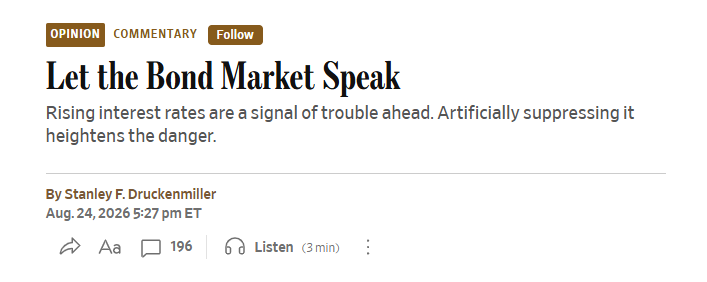
On August 24, billionaire investor Stanley Druckenmiller published a commentary article in The Wall Street Journal titled “Let the Bond Market Speak,” openly criticizing U.S. Treasury Secretary Yellen for expanding the long-term Treasury buyback, stating frankly that this is a "mistake."
Druckenmiller was Yellen's mentor in her early years in the hedge fund industry. According to Bloomberg, Yellen maintained daily communication with Druckenmiller while managing her own hedge fund. Both of them were trained under George Soros—who is himself a legendary figure known for shorting the pound and contesting with central banks and governments.
"Governments that defend prices against fundamentals always end up as losers," Druckenmiller wrote.
When a teacher begins to criticize a student, this strongly worded commentary is likely the most significant public opposition to Yellen’s attempt to influence bond yields to date.

Stanley Druckenmiller video screenshot
Fundamentals Do Not Support Yield Suppression
Druckenmiller further pointed out that current macro data completely contradicts the logic of suppressing long-term yields:
- Inflation is between 3%-4%, persistently above the Federal Reserve's target since 2021
- Unemployment rate is 4.1%, which under any definition is full employment
- Fiscal deficit is approaching 6% of GDP—"the U.S. has never seen this number during peacetime and full employment"
- National debt surpassed $40 trillion in the same week that the Treasury intervened
- Net interest payments this fiscal year will exceed $1.1 trillion, surpassing the defense budget
In this context, the 10-year Treasury yield is still at or below the level of nominal economic growth. Druckenmiller said:
This means that a borrower (the federal government) running a 6% deficit in a situation of full employment and inflation above target has financing costs that are roughly equal to economic growth. Historically, this is indicative of loose financial conditions, not tightening.
He wrote:
The bond market is not acting as a "bond vigilante," as some say. It is merely a soft target that has finally started to clear its throat, while the Treasury is in a hurry to suppress it.
"Each Basis Point of Artificial Suppression is a Subsidy for Procrastination"
Druckenmiller's core logic is: long-term yields are the only remaining mechanism for fiscal discipline in the U.S.
Over the past decade, both parties have been expanding commitments, ignoring financial arithmetic. A democratic system won't fix its finances just because the budget office releases a table; only when the costs of inaction become visible and urgent—when mortgage rates start to bite, when Treasury auctions show tailing, and when the political cost of rising long-term yields eventually exceeds the political cost of touching expenses—will action occur.
He directly pointed out the consequences:
Every basis point of artificial yield suppression is a subsidy for procrastination. Lowering long-term rates will obscure interest cost projections, reduce the apparent urgency, and allow current officials to assure voters that debt is someone else's problem.
He also noted that this round of expanded buyback operations happens to coincide with the last sprint before the midterm elections.
Even managing debt in a way that merely appears to follow the political calendar will erode the asset that has taken two centuries to accumulate: the credibility of the U.S. Treasury market. This asset will not easily regain its value.
Historical Precedents: How Yield Management Ends
Druckenmiller referenced history to warn of the end of this path:
From 1942 to 1951, the Federal Reserve suppressed long-term Treasury yields to finance World War II. This ceiling continued after the war to finance deficits through printing money, ultimately resulting in double-digit inflation. Only with the 1951 "Treasury-Fed Accord" was this mechanism dismantled, and the subsequent years of financial repression quietly taxed an entire generation of savers.
There is a reason why U.S. policymakers delineate the boundary between debt management and price management. This intervention begins to dissolve that line.
He also warned of the escalation path: a day after Yellen’s announcement, it was hinted that the scale of operations could exceed $4 billion; when the bond market did not respond, a senior Treasury official told reporters that the Treasury could intervene using the Treasury General Account (TGA).
Once the market believes the Treasury is defending a certain price, every increase in yields becomes a test of official resolve, and the scale of operations must continually expand to withstand these tests.
His Advice: Let the Market Speak
At the end of the article, Druckenmiller offered what he believes are the correct approaches:
- Return buyback operations to their original purpose: small-scale, regular liquidity management targeting non-current bonds, announced at quarterly refinancing meetings, and absolutely no ad hoc increases when yields rise
- Honestly extend the debt maturity, accept market pricing—"If the 30-year Treasury must be at 5.5% to be digested, that is not a crisis; that is a bill"
- The only real way to reduce long-term yields: address the fundamental deficit and advance social security reform
His conclusion is:
The government defending prices against fundamentals will always lose. The only variable is how much it spends before admitting defeat.
A credible fiscal consolidation plan will have a pull on long-term yields that exceeds the scale of this buyback program by a factor of 1000.
免责声明:本文章仅代表作者个人观点,不代表本平台的立场和观点。本文章仅供信息分享,不构成对任何人的任何投资建议。用户与作者之间的任何争议,与本平台无关。如网页中刊载的文章或图片涉及侵权,请提供相关的权利证明和身份证明发送邮件到support@aicoin.com,本平台相关工作人员将会进行核查。


