Author: Ilya Strebulaev
Translated by: Shen Chao TechFlow
Shen Chao Introduction: Stanford Business School professor reconstructs venture capital rankings using 230,000 investment data points, revealing that 90% of industry profits are captured by 5% of venture capitalists. For founders, choosing the wrong investor could mean a magnitude difference in returns; this article provides actionable criteria for selection.
This article is a guest piece by Ilya Strebulaev. He teaches venture capital and private equity courses at Stanford Business School and leads Stanford's venture capital program. He releases research on venture capital, investor rankings, and funding guides aimed at founders in his newsletter.
Every founder seeking funding from venture capitalists has heard the same names: Sequoia, Andreessen Horowitz, Benchmark. But one number should influence your funding strategy more than these names. According to my estimates, about 5% of venture capitalists generate approximately 90% of the profits in the entire industry. When choosing who to take money from, the most important question is: is your investor among this 5%? Fame does not accurately represent this.
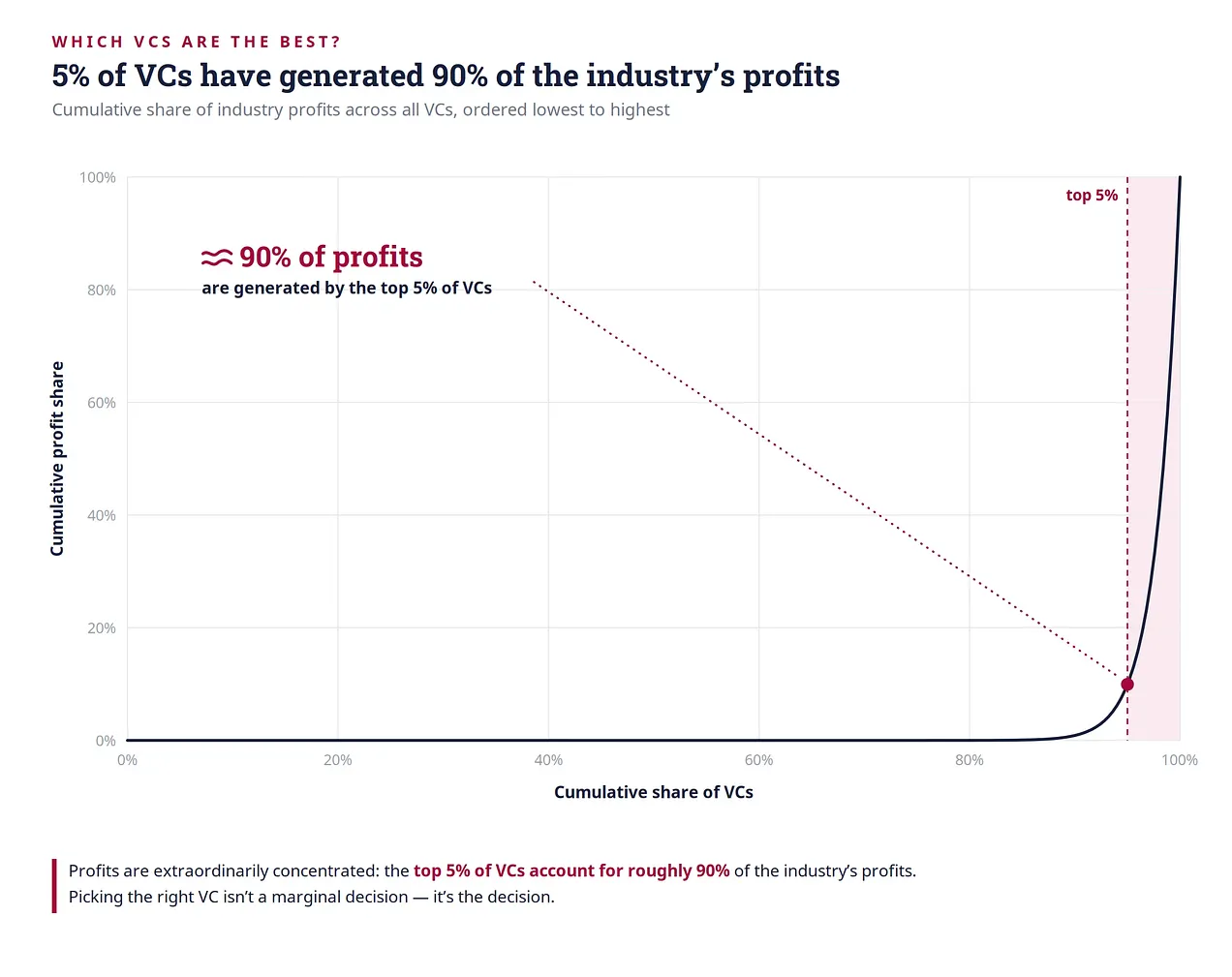
Figure: The top 5% of venture capitalists generate about 90% of the industry's profits; whether your investor belongs to this 5% is more important than their brand reputation
So far, there has not been a transparent, fully data-driven way to answer this question. The Forbes Midas list, which the industry relies on, is largely a black box. When we attempted to reverse-engineer it based on its public methodology, even our best-fit replicate result had 49 of its own top 100 not appearing on the actual list. Among the investors appearing on both our ranking and the Midas list, the correlation is only about 0.27.
Therefore, I, along with Blake Jackson, created an alternative: the 2026 Strebulaev-Jackson Venture Capital Ranking, based on nearly 13,000 venture capitalists making over 230,000 investments in more than 5,000 companies over 30 years. Each score can be traced back to a specific investment in a specific company on a specific date. We do not impose any editorial judgments, make manual adjustments, or rely on self-reported data from companies.
This article includes the complete top 100 list, the methodology behind it, and—because rankings alone do not guarantee good investors—what you should do after obtaining your ranking.
What This Score Measures
Six factors drive this score. They are worth reading carefully, as they together reward behaviors that founders hope investors possess.
Dilution. If the first round takes 10% of the shares, it is no longer 10% at exit. Both companies could sell for $1 billion, but if one raised four rounds during the process, its early investors are diluted in each round. We track the changes in equity of each investment in subsequent rounds.
Net Profit. Turning $10 million into $2 billion is a different accomplishment than turning $1 billion into the same $2 billion. We deduct the cost of each investment, rewarding capital efficiency and penalizing behaviors that spend heavily to create a few headline wins. In our data, about three-quarters of investment net returns are negative.
Value Addition. Lead investors who hold board seats contribute more than passive check-writers; we award additional points for these roles.
Credit Allocation Between Companies and Individuals. Investors move between companies, so when a partner makes the best deal at one company and moves to another, both companies should receive some credit. We split it, giving one-quarter to the company where the investment occurred and three-quarters to the company where the partner currently is. This reflects academic evidence that most return differences stem from individuals rather than firms.
2026 Results: Top Firms
Sequoia ranks first with a score of 10,158. Andreessen Horowitz ranks second with a score of 8,292. Accel, DST Global, and Tiger Global round out the top five. Among the top 20, two names are worth re-evaluating for any founder building a target list. Parkway Venture Capital, founded in 2019, ranks 19th with Figure AI. Notable ranks 20th. Neither is a household name, and both rank higher than much more well-known firms.
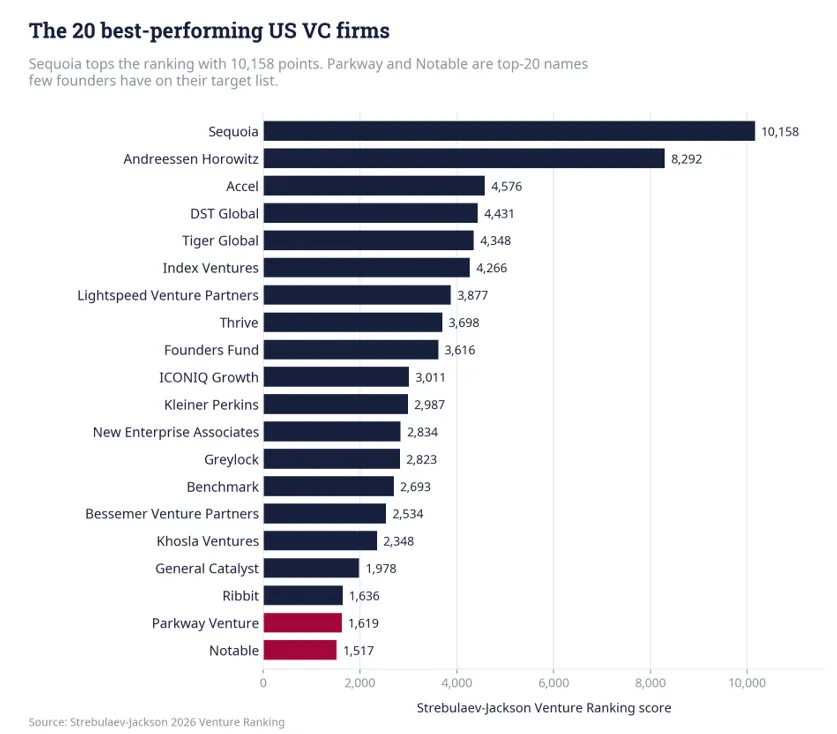
Figure: Sequoia ranks first with 10,158 points; two firms in the top 20 are names that most founders have never encountered
Rank, Company, Headquarters, Year Established, Ranking Score, and Top Deal. The top deal refers to the single highest-scoring investment according to our methodology, which may not necessarily be their most famous or highest-valued holding.
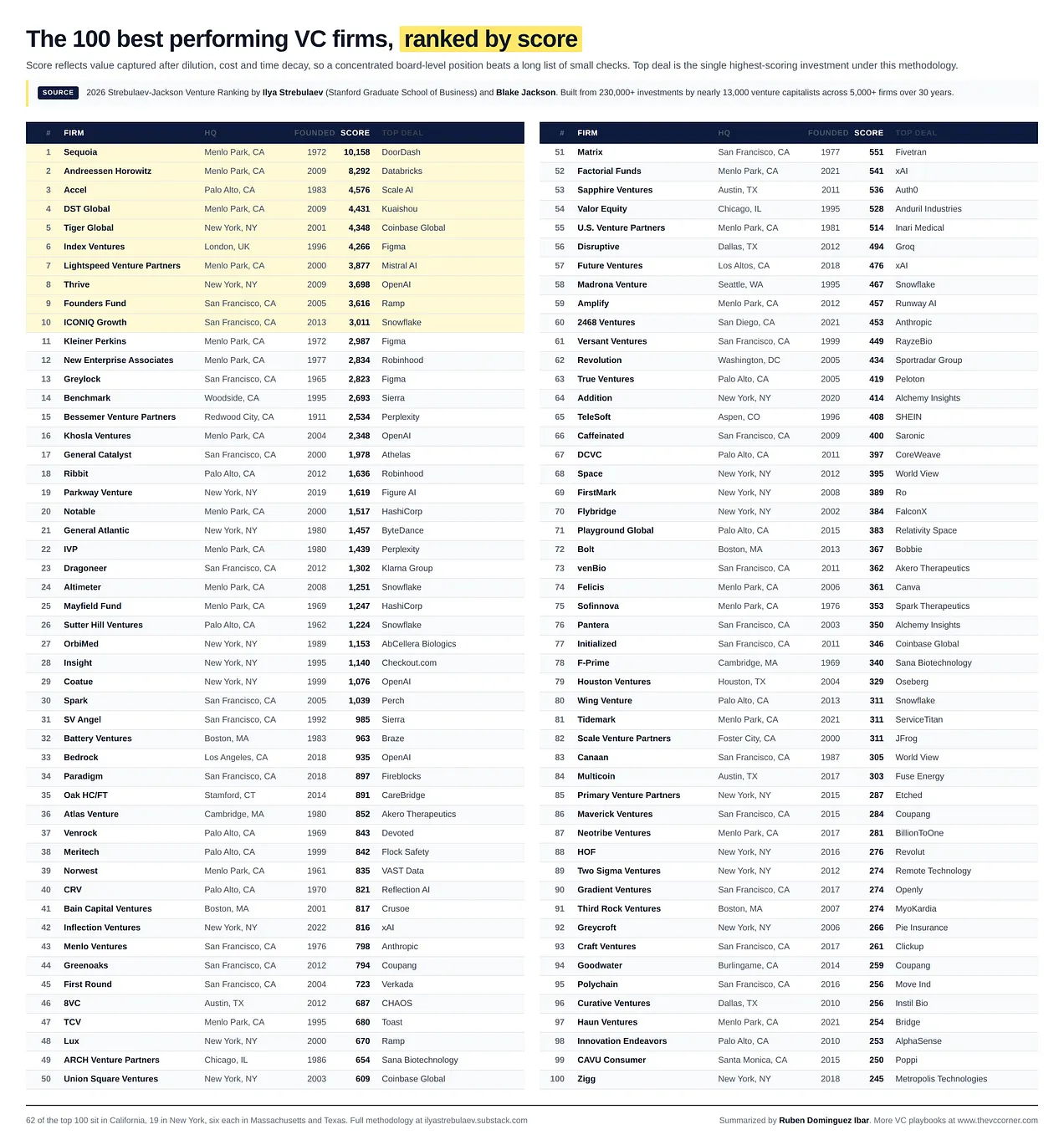
Figure: All 100 firms along with their headquarters, year established, scores, and top deals; 62 are based in California, 19 in New York, and 6 each in Massachusetts and Texas
Scores are rounded to integers. Geographically: of the top 100 firms, 62 are headquartered in California, 19 in New York, and 6 each in Massachusetts and Texas. Regardless of how seed and angel rounds have evolved, the institutional core of American venture capital has not left its historical base.
This table reveals four patterns that are more important for founders than the ranking order itself.
The Difference Between Good and Famous is a Magnitude
By the time we reach 10th place, the score drops to around 3,000, less than a third of Sequoia's. By the time we reach 100th place, the score is 245. The score of the company ranked first is about 41 times that of the 100th.
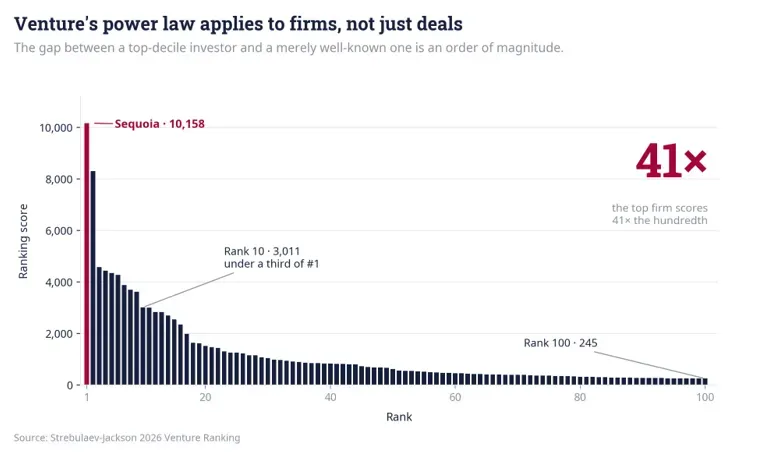
Figure: By the time we reach 10th place, the score is less than a third of Sequoia's; by the time we reach 100th place, the score is 245, with the first's score being 41 times that of the hundredth
The power law of venture capital is often described at the single-transaction level, but it equally applies to the companies themselves. For founders, this means the gap between a top-10 investor and merely a well-known one is a magnitude worth striving for.
The Number of Unicorns Says Almost Nothing
This ranking is not a unicorn-counting competition. SV Angel has invested in about 139 unicorns yet ranks 31st. Insight Partners has invested in about 124, ranking 28th. Felicis has 58 unicorns, ranking 74th. Meanwhile, DST Global has 62 unicorns, ranking 4th. Thrive has 47, ranking 8th.
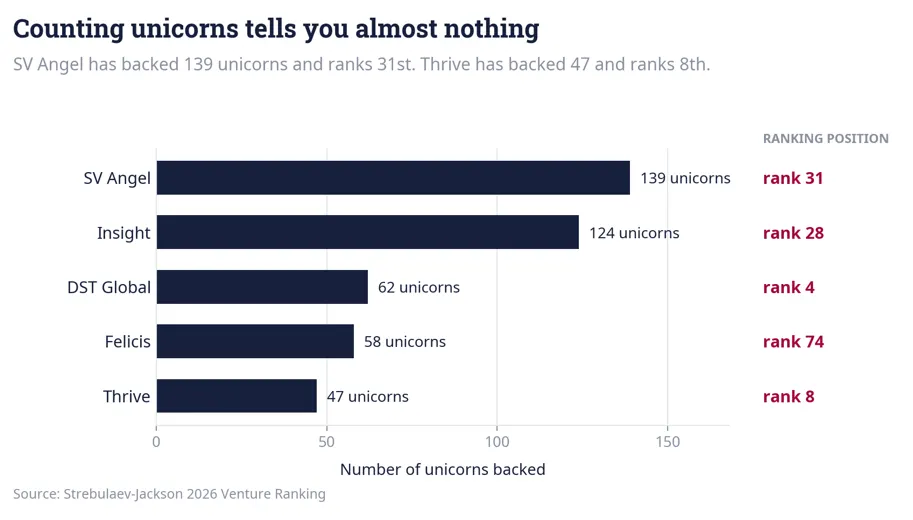
Figure: SV Angel has invested in 139 unicorns yet ranks 31st, while Thrive has invested in 47 and ranks 8th; the methodology rewards the actual value obtained after dilution, rather than the number of logos
Why do companies with far fewer unicorns rank much higher? Because the methodology rewards actual value obtained, rather than the number of top deals. If a firm wrote a small check to a company that later became a unicorn and that check got severely diluted, then their score drops: dilution adjustments reduce the shareholding, net profit adjustments deduct costs, and early small positions might not be worth much at exit among a crowded cap table. A firm that holds large, concentrated, board-level positions among a few winners will score significantly higher. In terms of score per unicorn, the highest quantity firms score about 6 points, while the most concentrated firms exceed 80 points.
For founders, this gap reveals which investors commit and continue to participate and which just write many small checks hoping one or two might hit.
Your Best Investor Might Be Someone You've Never Pitched To
The oldest firm in the top 100, Bessemer, has venture roots dating back to the 1970s. The youngest, Inflection Ventures, was established in 2022. Among the top 20, 8 firms were established before the year 2000. This illustrates the durability of a true venture brand. However, 21 of the top 100 were founded in 2015 or later. Some of these have rapidly risen based on a recent high-value bet.
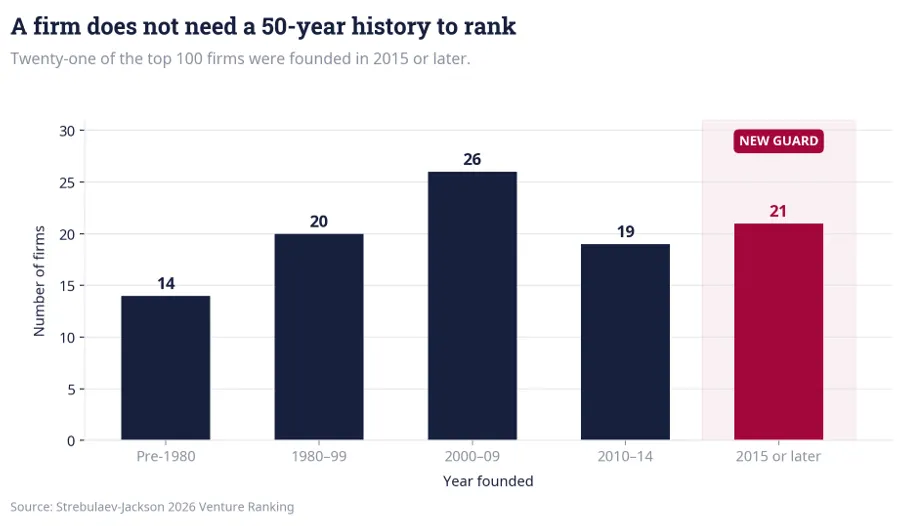
Figure: 21 of the top 100 were established in 2015 or later; performance records compound over time, and ten years is sufficient to establish one. Source: The VC Corner, 2026
A group of life sciences investment firms has made the list due to therapies rather than software: OrbiMed (27), Atlas Venture (38), ARCH (49), Versant (61), and Sofinnova (75) have all made the list through concentrated, capital-efficient bets. Crypto-native firms such as Paradigm (34), Pantera (76), Multicoin (84), and Polychain (94) have made it through another type of opportunity. The methodology is agnostic to any track; it only measures the value created, less cost and dilution, wherever it occurs.
If you're starting a business in a specific field, the best investor for you might be an expert who would never appear at the top of general media lists.
AI is Already Redefining the Top of the List
Among the top 100 firms, 23 have their highest single investment in cutting-edge AI or AI infrastructure companies. This accounts for almost a quarter of the list. The batch of companies they are anchored to mostly did not exist or were very small five years ago.
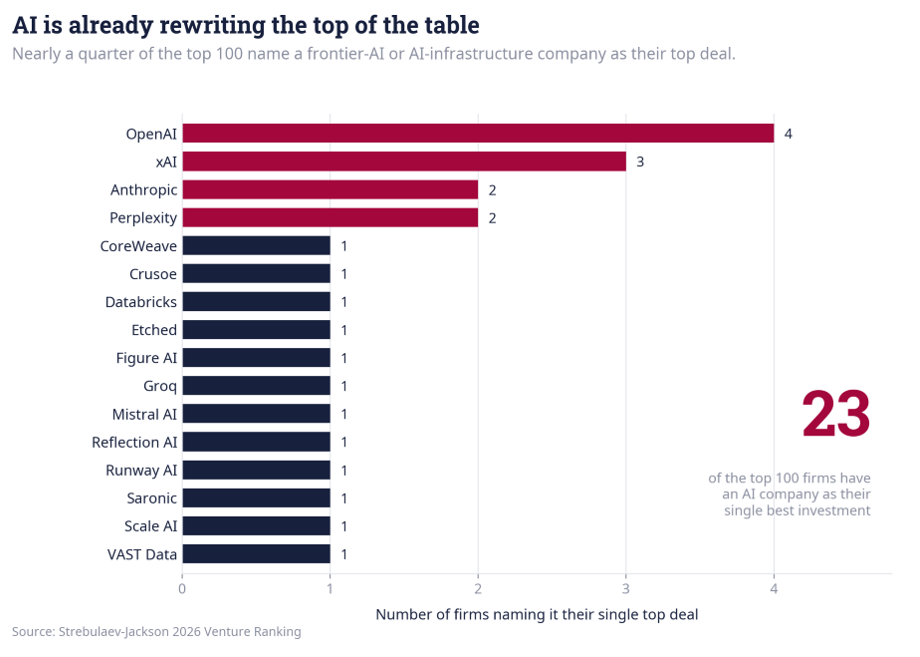
Figure: Nearly a quarter of the top 100 list cutting-edge AI or AI infrastructure companies as top deals; most of these companies did not exist or were very small five years ago
The decay factor means this reshaping happens in real time. Those early concentrated bets on leading AI companies, such as Thrive's investment in OpenAI, Menlo’s investment in Anthropic, and Lightspeed's investment in Mistral, will yield returns immediately, not years later.
What a Ranking Cannot Tell You
Somewhere, a founder is already pasting this table into a spreadsheet, sorting by rank. They are preparing to email the firms ranked 1 to 100 in order. I understand this impulse. Ranking lists are enticing precisely because they seem to think for you.
But if there is one thing you should not do, it is to use this list in that way. Nor should you use any lists published by Ruben, me, or anyone else in such a manner. Rankings are a narrative about what is good, compressed into a number. The order is the least interesting part of this. What matters is the reasoning behind it. See if that reasoning aligns with what you truly want to achieve. Also, see what your own research discovers when applied to your situation. Go read the methodology, challenge the parts you wish to oppose, and then do the work yourself.
Rankings can help you narrow your list down, but the final choice should be driven by three things. No score can fully capture any of them.
Consider fit, not just rank. This ranking measures various approaches with one ruler. Cross-sector and hedge fund-like firms, such as Tiger Global (5), DST Global (4), Dragoneer (23), Altimeter (24), Coatue (29), and Greenoaks (44) often take large minority stakes. They rarely or do not take board seats. Sequoia and Benchmark adopt a deeply involved, board-heavy model. Sutter Hill (26) basically incubates companies from scratch. These models all score high because they create value, but feel completely different from a founder's position. Founders seeking deep partnerships should choose different firms from those wanting funding alongside autonomy, even from the same top hundred. A high ranking cannot tell you which type you are facing.
Do due diligence on partners, not brands. One of the most striking facts in our data is that half of the top-performing firms do not have partners appearing in the individual top ranks. Institutional strength and individual competence are far from the same thing. This is precisely why our methodology separates the scores. Sitting on your board is not a brand, but individuals. Clarify specifically who will work with you, what else they have on their plate, and how long they have been with the company. Then, do background checks with founders they have invested in, including those whose companies failed. The performance of investors in down rounds is the information you need most. Any ranking, including ours, cannot provide that.
Remember, this is more like a marriage than a transaction. Investors will be your partners for seven, ten, sometimes fifteen years. That's longer than many marriages and much harder to exit from. You can sell a house, switch products, or change teams. But moving an investor out of your cap table or board is challenging. This asymmetry should slow you down, especially at the moment when competitive financing rounds push you to accelerate.
The value addition factor exists in our rankings because deeply involved investors clearly impact results. But the same board seat can open a door and also block a sale, overturn a strategy, or replace a CEO. So don't just ask if an investor will help you win; also ask if you want that person around on your worst day. An investor who ranks slightly lower but genuinely aligns with your interests is better than one who ranks higher but does not.
How to Use This List
Filter by performance. Those 5% of investors create 90% of the profits, worth the real effort to reach out to. The above table tells you where they are.
Filter by fit. Stage, sector, investment amount, and the type of involvement you desire.
Go deeper and look at individuals. The firm helps you get the meeting, but for the years that follow, you only collaborate with one person.
Do background checks on down-side risks. Talk to founders from those companies that have struggled, do not just look at the star case studies on the firm’s website.
What’s Next
We will expand the same six factors to individual investors rather than firms. The contrast with conventional wisdom is even more stark: over half of our top 100 individual venture capitalists do not appear on the 2026 Forbes Midas list. We will also expand the ranking to international levels, starting with industries from biotech and AI. Incorporating verified data from firms and investors, we will publish a historical sequence of around 25 years, allowing the rise and fall of firms to be visible directly.
Question: Which venture capital firm performs best?
Answer: Sequoia Capital leads the 2026 Strebulaev-Jackson Venture Capital Ranking with a score of 10,158. It is ahead of Andreessen Horowitz's 8,292 and Accel's 4,576. This score measures dilution, cost, and the actual value obtained over time after decay.
Question: How much better are top venture capital firms compared to ordinary firms?
Answer: The top-ranked firm scores about 41 times that of the 100th ranked firm. By the time we reach the 10th place, the score has dropped to less than a third of Sequoia's. This indicates that the power law of venture capital applies not only to single deals but also to firms themselves.
Question: Does funding more unicorns mean better venture performance?
Answer: No. SV Angel has invested in about 139 unicorns, ranking 31st. Thrive has invested in 47, ranking 8th. The ranking rewards actual value obtained after dilution, not the number of billion-dollar logos.
Question: How concentrated are venture capital returns?
Answer: The top 5% of venture capital firms generate about 90% of the industry's profits. So whether your investor belongs to this 5% is decisive, not marginal.
Question: Do you need a firm with decades of history to be a top venture capital firm?
Answer: No. There are 21 firms in the top 100 that were established in 2015 or later. Thus, a concentrated position with good timing over ten years is sufficient to rank alongside a firm with 50 years of history.
Question: Which AI companies do top venture capital firms cite as their best investments?
Answer: Among the top 100, 23 firms lists a cutting-edge AI or AI infrastructure company as their highest single investment. OpenAI was nominated by four firms, xAI by three, and both Anthropic and Perplexity by two.
Question: Where are the best venture capital firms located?
Answer: Among the top 100, 62 are headquartered in California, 19 in New York, and 6 each in Massachusetts and Texas.
免责声明:本文章仅代表作者个人观点,不代表本平台的立场和观点。本文章仅供信息分享,不构成对任何人的任何投资建议。用户与作者之间的任何争议,与本平台无关。如网页中刊载的文章或图片涉及侵权,请提供相关的权利证明和身份证明发送邮件到support@aicoin.com,本平台相关工作人员将会进行核查。


