The new L2 plan integrates token issuance, AMM liquidity, HyperCore spot order books, and HIP-3 perpetual contracts into a single pathway, using half of the sorter fees for repurchasing and burning KNTQ.
Written by: ChandlerZ, Foresight News
On August 24, Hyperliquid ecosystem project Kinetiq announced that it will launch the new Hyperliquid L2 network Elysium, aimed at addressing existing HyperEVM performance bottlenecks and the complexities of dual block architecture. Elysium will use HYPE as its native Gas token, enabling seamless integration with HyperCore and HyperEVM.
Kinetiq is a native liquidity staking and infrastructure protocol based on the Hyperliquid ecosystem. The three publicly known co-founders include Omnia, Magnus Lai, and Justin Greenberg, with Magnus serving as Co-CEO and Greenberg as CTO. The protocol initially built its business around the HYPE liquidity staking product kHYPE, and later expanded into institutional products iHYPE, yield products Earn, the HIP-3 deployment platform Launch, and the perpetual contract platform Markets, with Elysium further extending its product range to a general execution layer.
Kinetiq claims the network will provide higher processing speed and throughput than HyperEVM, focusing on serving spot trading, token issuance, and automated market making. The network is not yet live, and specific technical specifications and initial partners will be announced soon.
This plan appears unusual since Hyperliquid itself is a Layer 1 designed for trading and already has the HyperEVM, which is compatible with the Ethereum Virtual Machine. The gap that Elysium aims to address is between HyperCore and general smart contracts, with the former operating the spot and perpetual contract order books and the latter supporting DeFi applications. Kinetiq hopes to add a high-frequency EVM execution environment layer, redirecting pricing, liquidity, and trading demand back to HyperCore.
Currently, Hyperliquid has scaled in the perpetual contract market, but the liquidity for spot and long-tail assets has not reached the same level. Bankless cites Kinetiq’s assessment that HyperCore’s spot trading volume and HIP-2 liquidity are both at multi-month lows.
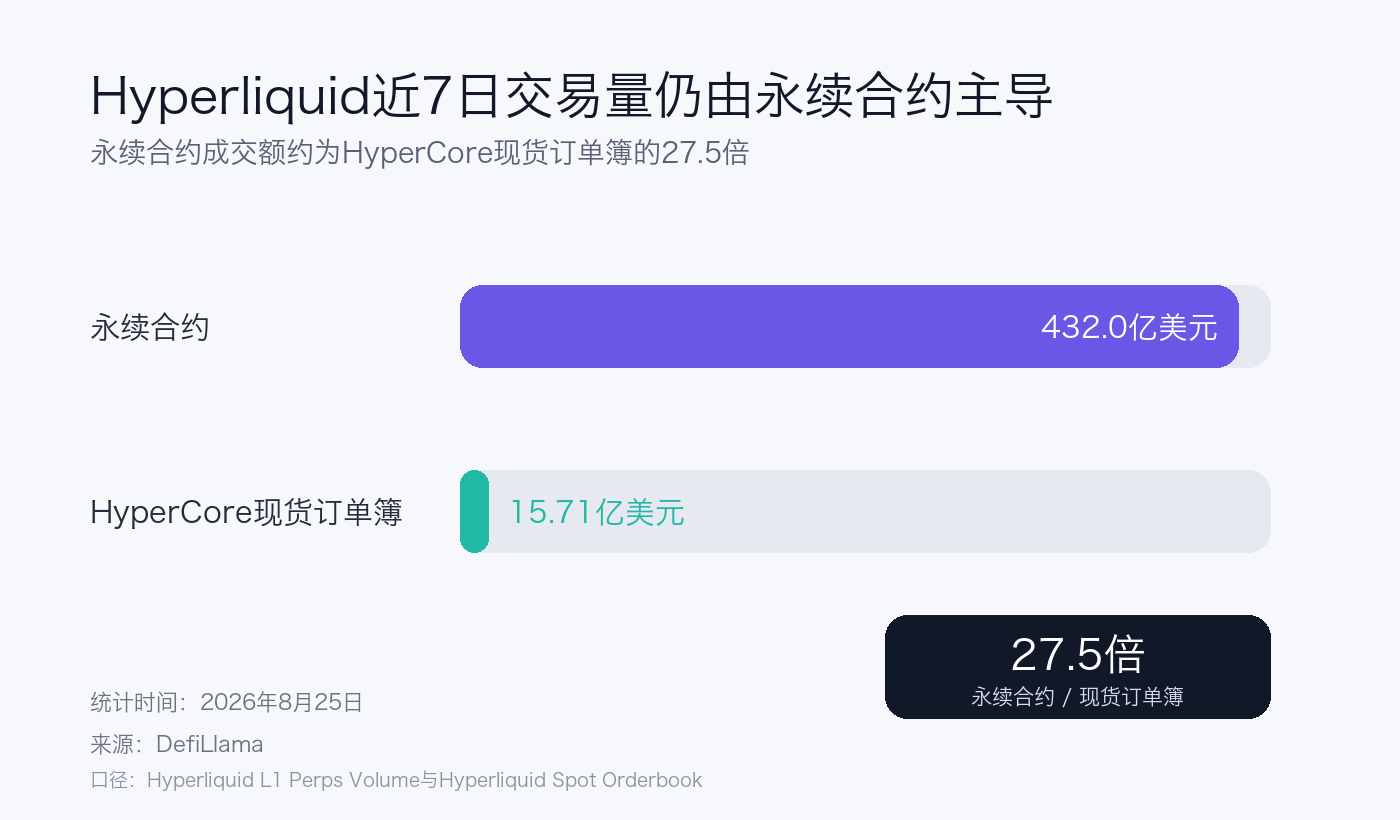
As of August 25, DefiLlama recorded that Hyperliquid L1 had a perpetual contract trading volume of $43.201 billion over the past seven days, while the HyperCore spot order book recorded a trading volume of $1.571 billion, a difference of 27.5 times. The spot figure only accounts for the Hyperliquid Spot Orderbook, excluding transactions from HyperEVM automated market makers (AMM) like Project X. Even including the total $4.023 billion from all spot DEXs on Hyperliquid L1, the scale of perpetual contracts is still 10.7 times greater.
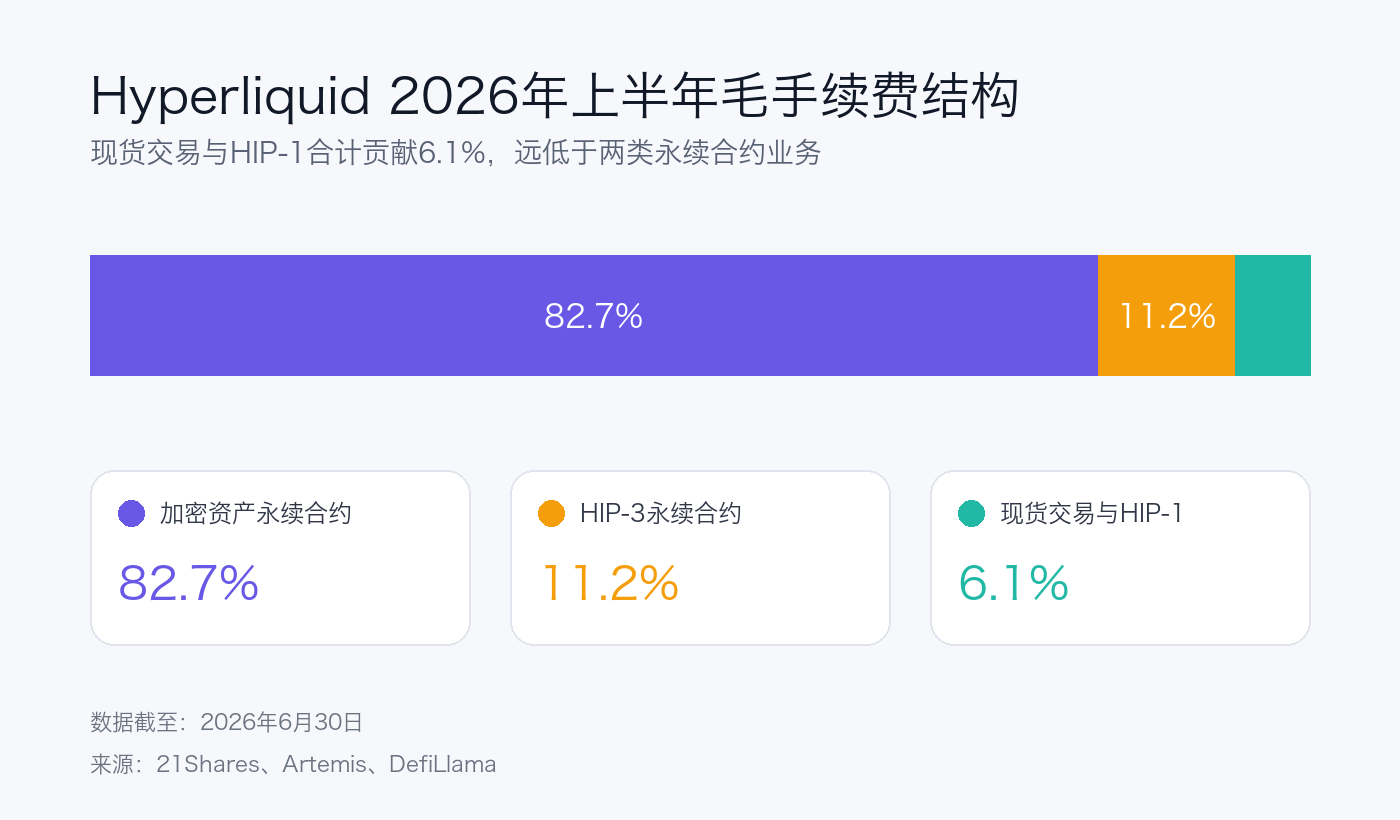
21Shares, in collaboration with Artemis and DefiLlama, statistics indicate that in the first half of 2026, crypto asset perpetual contracts will contribute 82.7% of Hyperliquid's total gross fees, HIP-3 perpetual contracts will contribute 11.2%, while spot trading and HIP-1 token deployments will make up only 6.1%. If Elysium can increase spot asset and market-making activities, it may introduce new spot order flow to HyperCore and provide pricing and hedging fundamentals for the subsequent HIP-3 market.
Elysium aims to enter the spot, market-making, and token issuance space, targeting the creation of on-chain liquidity for more assets before they enter the order book and derivatives market of HyperCore.
The dual block architecture of HyperEVM leaves space for high-frequency applications
Official documentation from Hyperliquid shows that HyperCore can currently handle 200,000 orders per second, with orders, cancellations, fills, and settlements provided single-block finality by HyperBFT consensus. HyperEVM shares the same consensus and state with HyperCore, allowing smart contracts to read order book data and send operations to HyperCore via system contracts.
To control the impact of general computing on the trading system, HyperEVM uses two types of blocks: small blocks generated once per second with a gas limit of 2 million; large blocks generated once per minute with a gas limit of 30 million. Hyperliquid states that the initial throughput settings are conservative, and high demand will drive up gas prices. For market makers and trading applications that require frequent quote updates, this structure still presents cost and response speed limitations.
Kinetiq describes Elysium as a high-performance EVM chain built on the OP Stack, aiming for block speeds comparable to HyperCore while continuing to use HYPE as gas. It also plans to customize L1Read precompiled contracts to directly provide market and order book information from HyperCore to Elysium applications. Precompiled contracts can be thought of as on-chain preset data interfaces, allowing developers to call Hyperliquid market data in smart contracts without needing an external oracle.
The existing L1Read can query states such as perpetual contract positions, spot balances, oracle quotes, and staking delegation, returning values corresponding to the latest HyperCore state when the HyperEVM block is generated. Kinetiq plans to expand the depth of readable data and provide market information close to the block top. For PropAMMs that need to frequently update inventory and quotes, such interfaces will determine whether market makers can timely hedge with HyperCore after transactions in Elysium.
A token moves from AMM to perpetual contracts
Additionally, Elysium will support token issuance, allowing new projects to initially launch in long-tail asset AMMs, accumulate trading and initial liquidity, then connect to PropAMM, and eventually establish a HyperCore spot order book and deploy perpetual contracts via HIP-3.
PropAMM is an automated market-making pool operated by professional market makers, where quotes can combine off-chain pricing models, inventory, and risk parameters, with on-chain settlement. Elysium plans to allow PropAMM to directly read HyperCore data, enabling market makers to manage hedging while quoting in Elysium, using the HyperCore order book as a reference. Compared to merely increasing block space, this mechanism is closer to building a token incubation and liquidity upgrade system for Hyperliquid.
Hyperliquid's existing HIP-1 allows for the deployment of native tokens, HIP-2 provides on-chain liquidity strategies for early spot markets, and HIP-3 allows external teams to operate their own perpetual contract markets after staking at least 500,000 HYPE. Elysium attempts to link these three disparate capabilities, allowing assets to form prices and trading records in the AMM stage before entering the order book and derivatives market.
Kinetiq’s previously launched Launch has already attempted to raise the required 500,000 HYPE for HIP-3 through independent staking pools, enabling project teams to reduce one-time capital lock-up. Elysium continues to extend towards the front end of the asset lifecycle, allowing projects to complete issuance and market-making before deciding whether to establish a HyperCore spot market and HIP-3 perpetual contract. Kinetiq simultaneously manages the three aspects of staking fundraising, market deployment, and execution layer fees.
50% of sorter fees will be used for repurchasing and burning KNTQ
Elysium also provides Kinetiq with an additional revenue stream. Kinetiq originally focused on HYPE liquidity staking as its core business, where users deposit HYPE and receive kHYPE that can continue to be used in DeFi. Bankless statistics show that the supply of kHYPE decreased from a peak of 41.5 million in August 2025 to 15.6 million on May 31, 2026, a decline of 62%; the proportion of liquid-staked HYPE among all staked HYPE fell from 10.42% to 4.42% in the same period. As of August 25, DefiLlama recorded that the total locked value of Kinetiq’s products is approximately $930 million, a decrease of 1.5% over the past 30 days.
According to the announced plan, 25% of Elysium's sorter fees will be allocated to application developers consuming block space, 25% will enter the Kinetiq treasury, and the remaining 50% will be used to repurchase KNTQ from the public market, with the repurchased tokens then burned and sent to the Hyperliquid assistance fund. The existing Kinetiq Markets and Launch products have already provided repurchase revenue for KNTQ, and Elysium includes fees generated from trading execution into KNTQ value capture. The actual repurchase scale will still depend on the trading volume after the network goes live and the fee revenue after deducting operational costs.
"Hyperliquid L2" still lacks a complete technical specification
OP Stack allows chain operators to adjust gas tokens, sorter policies, data availability, and settlement configurations, which means that networks using the same framework may have different security boundaries. Standard OP Stack L2 usually submits transaction data and state commitments to Ethereum, but Elysium's customized approach for Hyperliquid is still to be clarified. Kinetiq has not yet announced where data will be published, how the state will be submitted to Hyperliquid, the fraud proof and withdrawal mechanisms, who will run the sorter, and how assets will transfer between Elysium and HyperCore.
These details will determine whether Elysium can inherit Hyperliquid's security and will affect whether market makers can complete Elysium quoting and HyperCore hedging within the same time scale. Kinetiq's next milestone is to soon release technical specifications aimed at developers and traders, along with core partners and launch arrangements. Before these documents are made public, what is already clear about Elysium is its focus on spot and asset issuance direction, while how L2 will safely return execution results to Hyperliquid remains to be validated.
免责声明:本文章仅代表作者个人观点,不代表本平台的立场和观点。本文章仅供信息分享,不构成对任何人的任何投资建议。用户与作者之间的任何争议,与本平台无关。如网页中刊载的文章或图片涉及侵权,请提供相关的权利证明和身份证明发送邮件到support@aicoin.com,本平台相关工作人员将会进行核查。


