Counterattack.
Author / Xi Yun Editor / Zi Bu Yu
Source / Zhigu Trend
(ID: yuanfangguanchaju)
In 2026, which majors are the most valuable?
Recently, the Mycos Research Institute released the "2026 China Undergraduate Employment Report." Microelectronics Science and Engineering topped the list with an average monthly salary of 7,814 yuan, followed by Electronic Science and Technology and Automation in third place. Among the top ten, electronic information categories took up four spots in one go.
However, what was even more surprising were the changes in the rankings of other disciplines on the list.
Computer-related majors have collectively fallen from grace. Computer Science and Technology, Software Engineering, and Network Engineering have all fallen out of the top ten for the first time. Information Security, which had remained first for 11 consecutive years, dropped to fourth this year.
In contrast, some once considered "trap" majors have made a collective comeback.
Materials Science and Engineering has entered the top ten for the first time, while Mining Engineering ranked sixth with a monthly salary of 7,448 yuan—five years ago, it couldn’t even reach the average for undergraduates.
What signals does this major reshuffling of the most profitable industries convey?
How can ordinary families choose a major that keeps pace with the times?
1

Firstly, the "fall" of computer majors is indeed lamentable.
Ten years ago, everyone urged their children to study IT. That was the golden age of "Internet +," where Information Security, Software Engineering, and Network Engineering dominated the charts for several years.
What about today? The Zhaopin Report shows that the average monthly salary for computer majors has dropped from 8,192 yuan to 7,639 yuan, and their ranking has fallen out of the top ten. In Hebei Province, Software Engineering has even been included in the list of majors with poor employment prospects.
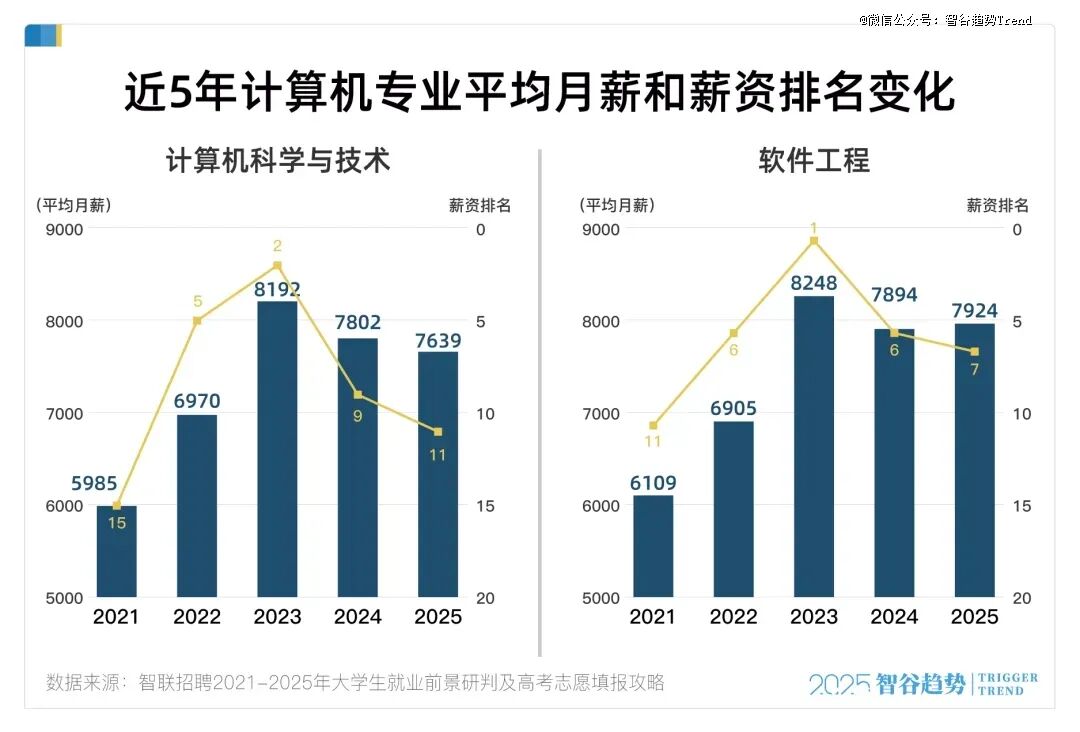
The reason for the salary decline is the collapse of the supply-demand balance for computer majors.

In 2026, the number of computer graduates nationwide will exceed 650,000, with regular undergraduates and non-first-tier institutions accounting for over 80%. There are still more than 990 universities offering Computer Science and Technology majors nationwide—more than double that of ten years ago, making it one of the most prevalent undergraduate majors.
However, the painful truth is that with the arrival of AI, fewer programmers are needed.
In April this year, Google CEO Pichai released a shocking statistic for the software engineering community—nearly 75% of the new code produced internally at Google is generated by AI, having tripled in a year and a half. Last year, Microsoft announced the layoff of 6,000 employees, with over 40% being engineers.
The position of junior coder is visibly disappearing. But what is worrying is that many uninformed students and parents are rushing towards computer majors, drawn by the "end of the universe" branding.
For example, Taiyuan University of Technology's Software Engineering program admitted 1,871 students in 2024, accounting for nearly a quarter of the entire school. The annual tuition fee is 16,000 yuan, more than three times that of other majors. Henan Normal University admitted 1,980 students into Software Engineering, with a teacher-student ratio of 200:1.
But the problem is: What kind of market will this batch of graduates face in a few years?
Students studying computer science now may think they have boarded the train of the times. But the train's final destination may be much closer than they think.
2

Meanwhile, another set of majors is quietly rising.
In the top ten highest-paying majors, electronic information categories took up four spots in one go. Microelectronics Science and Engineering topped the list, with Electronic Science and Technology in second place.
Electronic information is this year's biggest beneficiary of the AI wave.
AI has ignited demand for chips, and naturally, the related majors have risen alongside it. In the lists of urgently needed occupations in areas such as Beijing and Jiangsu, semiconductor chip manufacturers and integrated circuit engineers have been repeatedly identified as "urgently needed."
Even more surprising than electronic information is that some once "trap" majors are making a comeback.
Mining Engineering, with an average monthly salary of 7,448 yuan for the class of 2025, ranks sixth nationwide. Five years ago, it was lower than the average salary for undergraduate majors, having increased by more than 30% in five years.
Materials Science and Engineering, once referred to as one of the "four major traps," has now broken into the top ten for the first time.
A netizen commented: In 2016, graduates in materials faced numerous discouragement posts online. What happened? He graduated with a master's degree and went to CATL for battery material research and development, currently earning a salary of 350,000 yuan per year.
Relatives who discouraged him from changing careers are now asking if he can help their son get in.
Why did they stage a comeback? Because they correspond to the national "hard technology breakthrough" focus.
This year, the two sessions proposed six emerging pillar industries—integrated circuits, aerospace, biomedicine, low-altitude economy, new energy storage, intelligent robotics. Almost all of these hard technology industries are related to materials and mining.
New energy requires lithium, cobalt, and nickel; chips require silicon wafers and photoresist. Without these upstream materials, batteries and chips are castles in the air.
Today, mining is no longer just about "going underground to mine coal"; it involves smart mines and resource security behind it. Materials are also more than just bottles and jars in laboratories; they form the foundation of the entire hard technology.
Many universities are also shifting. This year, Sichuan University launched the country's first undergraduate program in "Semiconductor Technology and Equipment." Other universities have established new colleges focusing on integrated circuits, artificial intelligence, and aerospace science.
Meanwhile, the once popular "Internet majors" have almost disappeared.
Old kings fall, new kings are crowned. This round of reshuffling has just begun.
3

A saying that circulated online once went: "There are no eternal winners, only those who are in sync with the times."
This phrase sounds like motivational jargon, but the fate of Civil Engineering is a mirror.
In 2002, China Railway First Bureau came to schools to recruit graduates, without looking at their grades, they offered 10,000 yuan in settling allowance—at that time, the national per capita GDP was still less than 10,000. Today, in 2024, students in Ningxia only need 438 points to "pick up" Civil Engineering at Tongji University, just 6 points above the first-tier threshold.
From the golden age to "plummeting to the bottom", only a mere twenty years have passed. Behind this is the main theme of the times, which has shifted from large infrastructure to technology, and the flow of resources has already changed.
Returning to the present, two main lines are already clear for the next ten years:
One is the "chokehold" direction in hard technology. The national big fund's third phase, with a registered capital of 344 billion yuan, is all being invested in key areas such as semiconductor equipment and materials. Majors that break through "chokehold" technologies and support high-end manufacturing will continue to receive policy and capital tilt.
The second is tracks that resonate with population structure changes. China has 323 million people aged 60 and above, accounting for 23%. The market size of the silver-haired economy has exceeded 10.8 trillion yuan and is expected to reach 30 trillion by 2035. Long-term demand for silver-haired economy, health care, biomedicine, and intelligent nursing is increasing.
Therefore, the essence of choosing a major is betting on the era's cycle. Not just in higher education, but ordinary people's employment and investments also need to closely follow the trends of change and act accordingly.
Individual effort is undoubtedly important, but one must not use the old world’s map to seek a way out in the new world.
References:
1. Mycos Research China’s highest-paying undergraduate majors change ownership!
2. Zhigu Trend The majors that have dropped the most in China this year have completely collapsed
免责声明:本文章仅代表作者个人观点,不代表本平台的立场和观点。本文章仅供信息分享,不构成对任何人的任何投资建议。用户与作者之间的任何争议,与本平台无关。如网页中刊载的文章或图片涉及侵权,请提供相关的权利证明和身份证明发送邮件到support@aicoin.com,本平台相关工作人员将会进行核查。


