
World Robot Conference Site.
Author/Wang Lu
Report/Investment Circle PEdaily
Huang Renxun's daughter makes a rare appearance in Beijing.
On the day of the opening of the 2026 World Robot Conference, Huang Minshan (Madison Huang) arrived in Yizhuang, Beijing, visiting robot companies such as Yujian, Lightwheel Technology, and UBTECH along the way.
This 90s "NVIDIA heiress," now serves as the Senior Director of Product and Technology Marketing for NVIDIA's Physical AI platform, with an annual salary of $1.2 million, equivalent to more than 8 million yuan. Little is known that she initially studied cooking, worked as a chef, and even worked at LVMH. After some twists and turns, she ultimately entered the NVIDIA founded by her father as an intern.
Her visit to Beijing coincided with the busiest moment in China's robotics industry. Yushu Technology had just rung the bell, and the IPO team for Chinese robots was on its way. The second half of the robot game has already begun.
Huang Renxun's Daughter
Coming to Beijing to See Robots

The world's attention on robots once again focuses on Beijing.
On August 19, the 2026 World Robot Conference opened in Yizhuang, Beijing. In the crowd, a familiar face appeared—Huang Minshan (Madison Huang), daughter of Huang Renxun.
She moved between several robot booths in the exhibition hall. At Yujian Robotics, Huang Minshan watched a demonstration of the "one brain, multiple bodies" embodied intelligence platform and robots playing table tennis.
At the Lightwheel Technology booth, Huang Minshan focused on the company's progress in human data collection, physical simulation, large-scale assessment, and real-deployment feedback. During this time, the NVIDIA team also personally experienced the physical simulation equipment and discussed details such as simulation scene generation and parameter calibration with the team.
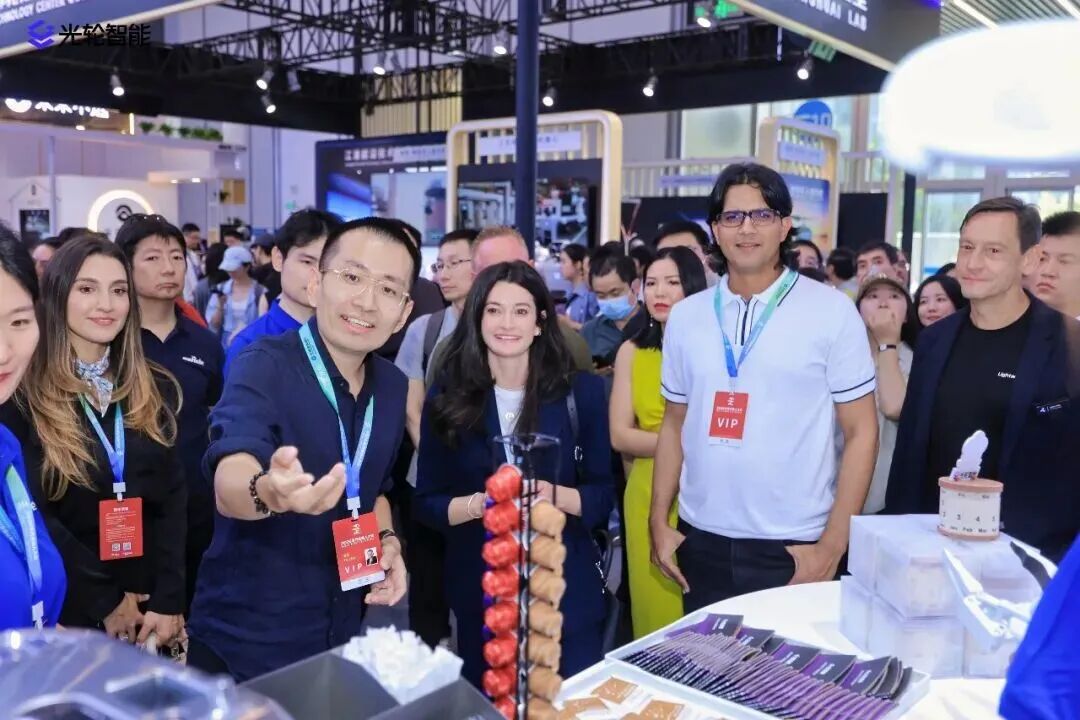
Afterward, she went to booths of UBTECH and Huazhi Jian, where the commercial service humanoid robot Walker C1 walked up to Huang Minshan with flowers, presenting her with flowers and shaking hands. She then stopped in front of the ultra-bionic humanoid robot U1 to experience it for a long time. At the Kepler Robotics booth, Huang Minshan experienced the heavy-duty Qilin series quadruped robot; when she arrived at the JD booth, she continued to learn about real-world robot operations and data training systems, watching the robot's action demonstrations in specific scenarios, frequently exclaiming “Amazing.”
Many recognized the "NVIDIA heiress," with some taking out their phones to take photos and others coming up for a group photo. Compared to her father Huang Renxun, who frequently appears in China, Huang Minshan has not often been in the public eye before.
Just a day before arriving in Beijing, Huang Minshan led a tour of LG's robot data factory being built in Seoul, South Korea. The itinerary has always revolved around robots, which is also related to her current position at NVIDIA.
Huang Minshan is currently the Senior Director of Product and Technology Marketing for NVIDIA's Physical AI platform, covering products such as Omniverse, Cosmos, Isaac, and humanoid robot basic model GR00T. In recent years, these businesses have gained increasing importance within NVIDIA, and this is also the next wave repeatedly mentioned by Huang Renxun: Physical AI.
In simple terms, large models enable AI to learn to understand and generate text, while Physical AI aims to enable machines to understand the real world and truly come to life. Robots are one of the most important carriers of this.
Therefore, this trip to Beijing also has deeper significance. Huang Minshan’s route was through the most active group of robot companies in China, which is also the ecosystem that NVIDIA cannot avoid when betting on Physical AI.
Looking back over a decade, her life trajectory was far from chips, AI, and robots. At that time, she chose to enter the kitchen.
From Chef to NVIDIA
Annual Salary of 8 Million

Huang Minshan is a post-90s. When NVIDIA was founded, she was merely a one or two-year-old child. Growing up in an engineering family, she considered pursuing an electrical engineering major when she graduated from high school.
Unexpectedly, the first person to persuade her to change her mind was Huang Renxun himself. In his view, his daughter did not have such a strong passion for engineering; what she truly loved was cooking. So, Huang Minshan withdrew her original application and turned to the Culinary Institute of America.
After graduating in 2012, Huang Minshan worked in restaurants in New York and San Francisco, then went to Paris to study pastries, and later continued her studies in wine at Le Cordon Bleu in London. After leaving the food and beverage industry, Huang Minshan entered the LVMH group, beginning to engage in marketing and brand management.
Several seemingly unrelated experiences, however, have one underlying thread. The kitchen emphasizes time, temperature, and detail, while luxury goods also care about product and experience. Huang Minshan discovered that what truly fascinated her was refining a product to perfection – being almost obsessive about details and enjoying the process of making products outstanding.
What brought her back to the tech industry was in 2019. At that time, Huang Minshan participated in an MIT AI course with her brother Spencer, after which she pursued her MBA at London Business School.
The following year, while still in school, Huang Minshan joined NVIDIA as an intern. At first, she did not adapt well, as technical terms in meetings often left her confused. She shared that she created a document where she noted every term she didn’t understand, and after the meetings, she would research each one to catch up. Gradually, the unfamiliar terms in her document decreased, and her work became more effortless.
After a few years, Huang Minshan rose from intern to Senior Director. Reflecting on her experience, she mentioned in a recent speech that the AI era does not require a straight path in life; the detours could ultimately lead to new accumulations.
Interestingly, her brother Spencer also took a similarly winding road. After graduating from college, Spencer opened a cocktail bar with friends. There was no fixed drink menu; customers would state their tastes, and the bartenders would create on the spot, once ranking among the “Asia's 50 Best Bars.”
Huang Minshan entered NVIDIA first, and Spencer later closed the bar and returned to campus, completing his MBA and also joining NVIDIA in 2022 as an intern. He now primarily focuses on robotics software and simulation products, including robotics learning simulation and synthetic data generation.
According to NVIDIA's disclosure, in the fiscal year 2026, Huang Minshan's total compensation was approximately $1.232 million, equivalent to about 8.3 million yuan; Spencer's total compensation was about $1.32 million.
This makes it difficult for the outside world to avoid a particular topic: nepotism. At an NVIDIA all-hands meeting in 2025, Huang Renxun did not shy away from the issue, admitting the company does employ many children of employees, but parents usually would not easily recommend children who would embarrass them. He even joked that some "second-generation heirs" have already outperformed their parents.
After various turns, the siblings returned to NVIDIA and gathered at the company’s next battleground—robotics.
China's Hottest Track

This year’s World Robot Conference is still bustling.
Nearly 400 companies brought more than 3,000 exhibits, and over 300 new products were launched. Beyond dancing, boxing, and playing table tennis, an increasing number of robots are now handling materials, sorting items, and operating equipment, appearing in real-world scenarios such as automobile manufacturing, logistics, and commercial services.
The changes on the booth also reflect the entire industry. In recent years, Chinese humanoid robots have swiftly completed the transition from 0 to 1. Startups have emerged densely, machine iterations have become increasingly fast, and the core component supply chain is gradually taking shape. Capital has flowed in, setting records for financing and valuations.
Now, the first batch of companies has started ringing the bell.
On the day the World Robot Conference opened, Yushu Technology officially landed on the Sci-Tech Innovation Board, with its stock price increasing by over 600% on the first day.
The IPO lineup is accelerating. Zhiyuan Robotics announced the initiation of its overseas listing process, Yundong's Sci-Tech Innovation Board IPO has been accepted, and companies like Leju Intelligent, Zhifeng Square, Variable Robot, Zhujidi Power, Zhongqing Robotics, Xingchen Intelligence, and Galaxy General are also advancing their capitalization processes.
According to incomplete statistics, more than 50 robotics-related companies are already queued at the Hong Kong Stock Exchange entrance. However, the bell tolling is not the end. The capital market can provide valuations, but in the end, it is the industry that must provide the answers.
In the first half of this year, China’s humanoid robot shipment volume has surpassed 40,000 units. Following rapid growth in quantity, a more important question begins to surface: Can robots adapt to more tasks, understand instructions, and perform actions in unfamiliar environments?
The real competition among robots has thus moved from "bodies" to "brains."
Wang Xingxing noted at this World Robot Conference that a robot's true "ChatGPT moment" should be entering an unseen environment and being able to complete most tasks solely based on voice or text instructions. He predicts that this day may still require two to ten years.
This brings competition to a deeper level.
China already possesses one of the most complete manufacturing systems globally. A robot completes research, development, production, and iteration of components to a whole machine at an extremely fast pace. More importantly, vast industrial scenarios such as automotive, 3C, logistics, and retail provide a rare testing ground for robots.
Robots are created here and sent into the real world. When global tech giants turn their gaze toward China's robotics industry, what they see is not just a dense emergence of startups but a true industrial race.
Moving forward, the real test is just beginning.
免责声明:本文章仅代表作者个人观点,不代表本平台的立场和观点。本文章仅供信息分享,不构成对任何人的任何投资建议。用户与作者之间的任何争议,与本平台无关。如网页中刊载的文章或图片涉及侵权,请提供相关的权利证明和身份证明发送邮件到support@aicoin.com,本平台相关工作人员将会进行核查。


