Author: shaundadevens
Translated by: White Paper Blockchain
Hyperliquid still implements a geoblock on the US market, as its permissionless on-chain infrastructure conflicts with US market structure laws — these laws strictly limit futures trading to registered trading platforms, clearinghouses, and brokers. The Hyperliquid Policy Center has urged the CFTC (Commodity Futures Trading Commission) and SEC (Securities and Exchange Commission) to modernize these regulatory frameworks, arguing that as long as regulated entities undertake corresponding compliance obligations, they should be allowed to build products on HyperCore through builders and deployers. With confirmation from Trump’s statement, achieving local onshoring of Hyperliquid through a licensed HIP-3 DEX has become a likely pathway.
Core Details
Over the past year, much of our work on Hyperliquid has been redefining its positioning from a “decentralized perpetual contract trading platform” to “modern market infrastructure”: a globally accessible, composable financial tool platform encompassing perpetual contracts, spot trading, and prediction markets.
Unlike fully integrated self-operating cryptocurrency platforms such as Coinbase and BN (which cover user access, custody, and trading execution), Hyperliquid's infrastructure layer is more akin to the separation of duties across entities in traditional finance (TradFi): the trading platform (DCM) is responsible for listing contracts and matching trades, the clearinghouse (DCO) is responsible for providing margin and guaranteeing settlements, and brokers (FCM) are responsible for user access and routing trades.
Similarly, Hyperliquid's modular tech stack reflects the exact same separation of duties. HyperCore (the trading platform and clearing layer) operates the matching, margin accounting, and settlement as fundamental logic of the protocol, with positions marked to market based on validator oracles, executing liquidations through a deterministic clearing waterfall mechanism. Deployers must stake 500,000 HYPE collateral that can be forfeited, responsible for token launches, setting contract specifications, leverage limits, and oracle configurations, while retaining up to 50% of the market-generated fees. Builders act as brokers, responsible for guiding user access and routing trading flows to HyperCore to earn a portion of trading fee shares.
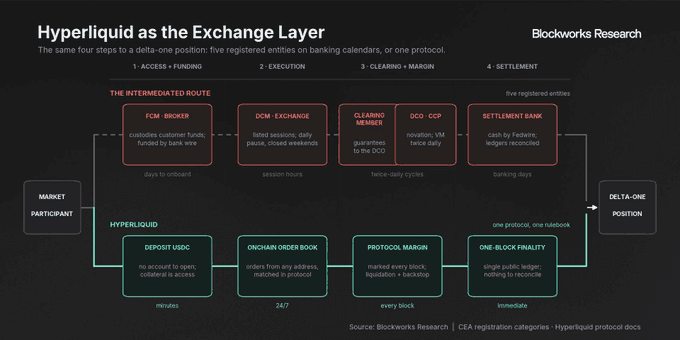
However, Hyperliquid has restructured these layers on-chain and enforced them through program code: both user access and market creation can be permissionless, assets are fully self-custodied by users, and other applications can be built on top of it, with all assets traded 24/7 on a single global platform, eliminating the geographical and legal fragmentation found in traditional finance.
Hyperliquid's Regulatory Predicament
In this context, Hyperliquid's biggest challenge lies in regulation: US market structure laws are tailored for traditional architectures, and each statutory registered role conflicts structurally with Hyperliquid's underlying design. For example:
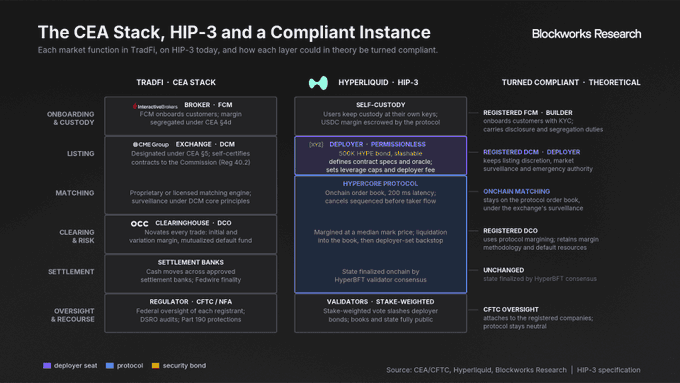
Designated Contract Markets (DCM) must adhere to the 23 core principles under Section 5(d) of the Commodity Exchange Act (CEA), including market surveillance and customer identity verification. However, anyone can access HyperCore simply by holding a wallet.
Derivative Clearing Organizations (DCO) must calculate margins using a board-approved model with a 99% confidence level and settle through approved clearing banks (17 CFR §§39.13–39.14). HyperCore, on the other hand, relies on protocol logic to calculate margins and completes settlement at the consensus level.
Futures Commission Merchants (FCM) must perform segregated custody of customer funds as per Section 4d of the CEA. Hyperliquid's users are self-custodied, which greatly deviates from custodial FCM models.
It is precisely these stringent requirements that compel centralized trading platforms like Coinbase, which implements centralized KYC, to register as FCMs for domestic operations and acquire existing DCM companies. Hyperliquid cannot adopt this model as acquiring a DCM and aligning with existing regulations would contradict its intent to “innovate underlying infrastructure”; thus, it has chosen to impose a geoblock on itself and exit the world's largest capital market.
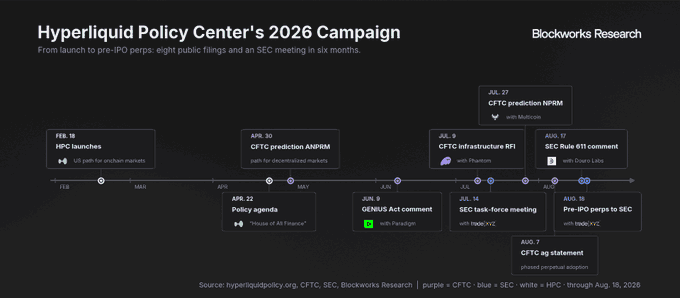
Nonetheless, Hyperliquid's goal is not to remain permanently in offshore markets: in February 2026, it announced the establishment of the Hyperliquid Policy Center (HPC), with an investment of 1 million HYPE (equivalent to about 72.5 million dollars at current prices), dedicated to incorporating this new market structure into the US legal system. In July, HPC, together with Phantom, requested the CFTC to confirm that the release of on-chain software itself does not trigger licensing registration requirements, allowing existing licensed entities to conduct matching, settlement, and margin accounting on on-chain infrastructure and establishing exemptions for non-custodial wallets routing users to regulated derivatives. In August, HPC, along with TradeXYZ, brought the same logic to the SEC, proposing a regulatory framework for Pre-IPO perpetual contracts (such as pre-listed targets like SpaceX and Cerebras that have already traded on Hyperliquid) and accompanying the necessary disclosures and qualification rules required for opening to US investors. Early signs indicate that this strategy is taking effect and the US regulators are open-minded, with the most obvious sign being Trump announcing that Chairman Selig plans to promote Hyperliquid's onshoring.
The HPC strategy does not require directly opening Hyperliquid to US investors without KYC, but argues that it should be seen as a neutral infrastructure: if US companies can fulfill their regulatory duties while using it, then it should be available as an option alongside traditional DCMs. For example, brokers can route customer trading flows to HyperCore as long as they fulfill KYC obligations; or deployers can take on the role of registered trading platforms, retaining discretion over token listing, market surveillance, and emergency measures.
Hyperliquid's Compliance Examples
With the advancement of lobbying in Washington, Hyperliquid Labs has begun testing updates in the testnet, theoretically providing a pathway for this compliant access. The most typical example is HIP-3 deployers with permission management: unlike Hyperliquid’s native markets and existing HIP-3 deployments being completely open, these new deployments are only available to whitelisted users. Such deployments provide a clear path for regulated entities to launch markets, conduct KYC, and whitelist compliant users for trading.
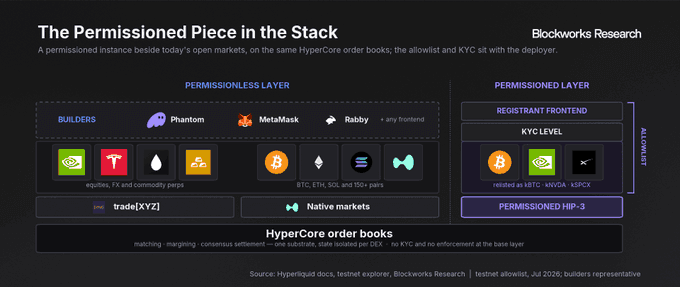
These compliance examples will manifest as decentralized order books, as all markets (e.g. BTC and RWA markets) need to be relisted. However, whitelisted market makers will build liquidity bridges between the two order books, thereby eliminating liquidity fragmentation, allowing the new deployments to inherit Hyperliquid's deep liquidity while maintaining independent order books. This independent order book model has precedents (such as early BN US and the current deployment of Lighter on the Robinhood Chain), but the difference is that, since both markets on Hyperliquid operate on the same L1, sharing collateral and margins, there is no need to cross chains or trading platforms, thus enabling liquidity to flow seamlessly between order books instead of being isolated.
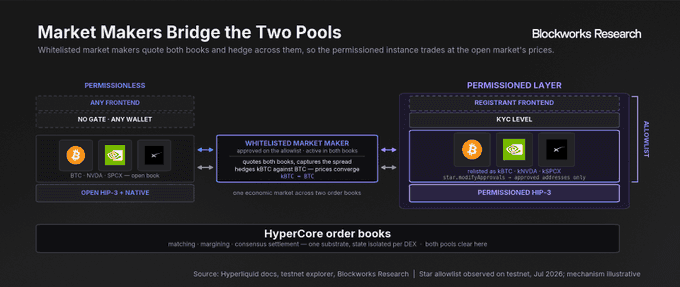
These trading platforms also include other parameters, such as the “PA” operational permissions in the payload, which allow DEX to directly perform actions on user accounts: submitting reduce-only orders, canceling orders, and internal transfers of USDC within the DEX, which is very similar to FCM's forced close-out authority over customer accounts. These elements collectively construct the evolution path of the future: US brokers and institutions now have the tools to build compliant Hyperliquid products on HyperCore. This option is complementary and accumulative — Hyperliquid's native markets remain permissionless, with its role as neutral infrastructure unchanged.
Research Perspective
Hyperliquid's recent actions in Washington indicate that entering the US domestic market compliantly is currently a core priority; however, it is also clear that operating directly through its native non-KYC front end is not compliant under existing US laws. We believe that HPC's efforts outline a pathway to achieve KYC compliant access: permitting the use of Hyperliquid's underlying technology as long as entities providing access services fully comply with regulatory requirements. As empowering tools land on the testnet (with permissioned HIP-3 deployers and PA account control), we anticipate that this approach will provide a compliant pathway for US investors to participate in Hyperliquid markets while retaining the protocol itself as a neutral infrastructure.
Link to the article: https://www.hellobtc.com/kp/du/08/6420.html
Source: https://x.com/shaundadevens/status/2090530384668745830
免责声明:本文章仅代表作者个人观点,不代表本平台的立场和观点。本文章仅供信息分享,不构成对任何人的任何投资建议。用户与作者之间的任何争议,与本平台无关。如网页中刊载的文章或图片涉及侵权,请提供相关的权利证明和身份证明发送邮件到support@aicoin.com,本平台相关工作人员将会进行核查。


