If you were born between 1997 and 2012, then congratulations, you likely belong to Generation Z.
This group of young people, currently around 14 to 29 years old, may be the generation most easily labeled as "adventurous."
They grew up alongside social media, familiar with MEMEs, FOMO, leverage, and stories of "getting rich overnight."
Therefore, in the crypto circle, many people imagine Generation Z as: chasing trends, trading contracts, and daring to go all in.
However, a recent set of data from Binance Research may raise a question mark over this impression.
In direct stock accounts, about 22% of Generation Z users have never placed a sell order—only buying, not selling.
In bStocks, 76% of Generation Z accounts are net accumulators, the highest across all generations.
Interestingly, they also have the lowest turnover rate and show more restraint in their use of leverage and inverse products.
This is quite interesting.
We thought the most adventurous generation might be investing in the most "boring" way.
And this holds greater significance in the crypto realm than it may seem.
1. Who exactly is Generation Z? Do they really love trading that much?
First, let's clarify the concept.
Generation Z typically refers to those born between 1997 and 2012.
This means that the Generation Z of 2026 will be approximately between 14 and 29 years old.
They are the first true "internet natives": having grown up with smartphones, social media, and digital content, they also encountered online investment products like stocks and crypto at an earlier age than the previous generation.
As a result, many people naturally assume:
Internet natives = more willing to take risks = prefer trading.
But the data does not fully support this judgment.
22% of Generation Z's direct stock accounts have never incurred a sell order, higher than the 19% of Generation X and 9% of the Baby Boomer generation.
In bStocks, 76% of Generation Z accounts are net accumulators, with a ratio of 77% in direct stocks.
The trading frequency is also relatively low.
In bStocks, Generation Z trades about 3 times a month on average, and approximately 8 times for direct stocks.
In other words, many young people are not buying and selling every day.
They seem to be doing something very simple:
buy in, then hold.
2. Liking crypto does not mean liking high leverage
This may be the most important reminder from this data for the crypto industry.
Among all product types, Generation Z's usage rates for leverage and inverse products are lower than those of the millennials and are also lower than Generation X and the Baby Boomer generation in traditional financial products (TradFi-Perps).
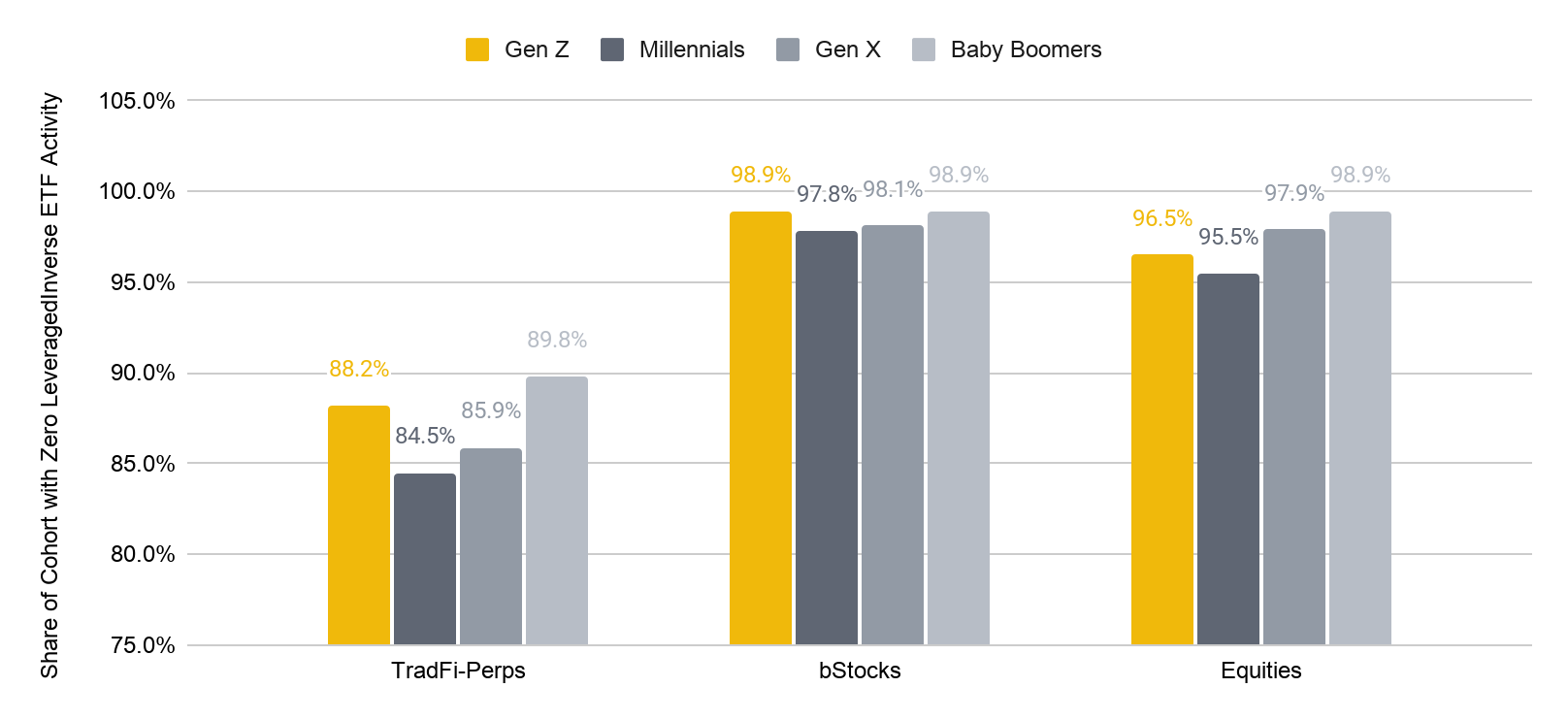
The report indicates that 88.2% of Generation Z accounts have not used leverage or inverse ETFs.
In bStocks, this figure even reaches 98.9%.
This suggests that risk preference and leverage preference are actually two different things.
A young person may buy BTC, tech stocks, or even MEME coins, accepting significant price fluctuations.
But that doesn't mean they are willing to gamble on the next candlestick with 20x leverage.
Especially for young investors who are newly entering the market and have limited capital, the risks of spot losses and margin calls are entirely different.
So they may be forming a rather interesting investment style:
willing to bear asset fluctuations but trying to avoid liquidating all at once.
In the crypto market, this means: you can buy BTC, but not necessarily open a 20x contract; you can follow narratives but not necessarily engage in high-frequency trading for the long term.
This might be a more accurate profile of future young crypto users.
3. What would happen if they start holding BTC long-term?
This is where it gets interesting for crypto.
The proportion of non-leveraged ETFs in Generation Z's net inflows rose from 18.5% in June to 21.9% in July.
During the same period, overall net investment in stocks decreased by 17.4%, but the funds flowing into non-leveraged ETFs declined by only about 2%.
Simply put: the market is not good, but they have not fully retreated; instead, they are adjusting their funding structure.
This is somewhat similar to the changes happening in the BTC market.
In the past, crypto resembled a trading market:
chasing trends, making swings, trading contracts, seeking the next hundredfold coin.
But as products like spot ETFs gradually mature, BTC is increasingly resembling an asset that can be allocated long-term.
For young investors, entering crypto does not necessarily mean:
"I need to learn how to do contracts."
It could just mean: buying a little BTC every month, then holding it.
If this behavior becomes more widespread, the funding structure of the crypto market may also change.
4. Why do we still think Generation Z loves speculation?
Because the ones who truly love trading are the loudest.
A person who invests regularly in BTC every month and does not engage in trading for half a year will not showcase their account on X every day.
But someone whose MEME coin rises 5 times in a day will; a person who experiences a margin call with 20x leverage will; someone who earns $100,000 from contracts will even more so.
Thus, what we most easily see on social media is always the most extreme part.
This is a typical visibility bias.
There’s another often overlooked issue:
trading volume does not equal funding preference.
Leverage can create massive trading volumes, but the actual net funds may not be that significant.
Therefore, rather than looking at how much money young people "traded," it is more insightful to see:
where they ultimately leave their money?
If more funds start flowing into BTC, ETFs, and other non-leveraged assets and remain long-term in accounts, then this actually signifies a structural change among crypto users.
5. Crypto might be welcoming a batch of young people who are "not very into trading"
Of course, data from the Binance platform cannot represent all of Generation Z.
It also cannot prove that all young people have become long-term investors.
But at least it can illustrate:
the formula "Young people = high risk = high leverage = high-frequency trading" does not hold true.
There are certainly Generation Z individuals chasing MEMEs, trading contracts, and fearing missing out.
But there are also many who are reducing trading, lowering leverage, and increasing long-term holding of assets.
This could be a significant change in crypto worth watching:
crypto is slowly transforming from a "trading market" to an "asset allocation market."
In the past, platforms competed on leverage, fees, and trading experiences.
In the future, they may also compete on:
long-term BTC holding, dollar-cost averaging, ETFs, asset allocation, and a more complete wealth management experience.
Therefore, what Generation Z truly changes may not be the price of crypto.
But rather the way crypto users engage.
Some are still searching for the next hundredfold, while others simply buy a little BTC each month and quietly hold.
The latter may be the group of people worth paying attention to in the coming years.
Of course, holding long-term does not mean completely ignoring market conditions. Changes in BTC prices, market sentiment, and fund flows are still worth continuous attention.
For those new to crypto, it may be more important to find a trading and asset allocation strategy that suits them rather than blindly chasing trends.
If you are also paying attention to the crypto market, you can participate in trading and asset allocation through Binance:
👉 Registration link: https://jump.do/zh-Hans/xlink-proxy?id=3
(Invitation code: aicoin668, enjoy a 10% rebate)
Additionally, we have also organized a welfare group that will share market hotspots, platform activities, and occasional incentives; feel free to join if interested.
👉 Welfare group:
https://www.aicoin.com/link/chat?cid=gmLgwvKD1
After all, there are new stories in the market every day.
But what's truly important is not to chase every trend.
Rather, it’s about finding a way of engaging that suits you and sticking to it long-term.
Join our community to discuss and grow stronger together!
Official Telegram community: t.me/aicoincn
AiCoin Chinese Twitter: https://x.com/AiCoinzh
Binance welfare group:
https://www.aicoin.com/link/chat?cid=gmLgwvKD1
Risk Warning: The content is merely a market observation share and does not constitute investment advice. The crypto market is highly volatile, please participate within your own risk tolerance.
免责声明:本文章仅代表作者个人观点,不代表本平台的立场和观点。本文章仅供信息分享,不构成对任何人的任何投资建议。用户与作者之间的任何争议,与本平台无关。如网页中刊载的文章或图片涉及侵权,请提供相关的权利证明和身份证明发送邮件到support@aicoin.com,本平台相关工作人员将会进行核查。