Written by: Prathik Desai
Translated by: Luffy, Foresight News
In the past year, every leading public Bitcoin miner has faced a survival crisis. A look at their financial reports shows that they are shedding the identity of "miners."
Today, they are rebranding themselves, calling themselves "energy infrastructure platforms," "vertically integrated AI cloud service providers," or "digital infrastructure companies built on electricity, land, and computing power."
Behind this branding overhaul is a shift in revenue structure; their market valuation has surpassed that of when they were strictly Bitcoin mining companies.
On the surface, the story seems promising. Struggling miners seize opportunities and embrace the explosive demand for AI inference computing power, finding a way to save themselves. But if viewed from a broader perspective, they are also giving up some crucial aspects.
This article will explain why miners' 180-degree turnaround and complete departure from Bitcoin mining may backfire in the future.
What prompted this transformation?
The halving of Bitcoin block rewards in April 2024 has forced miners to make a choice: either mine Bitcoin and hold it for selling at a higher price later, or upgrade hardware and shift to high-performance computing (HPC) to diversify their business. Bitcoin's price rose from below $70,000 in October 2024 to over $124,000 in October 2025, prompting some miners to continue mining and hoarding their Bitcoin output.
However, the market liquidation event on October 10, which saw $19 billion in market value evaporate in 24 hours, triggered a downturn phase that has not fully recovered yet.
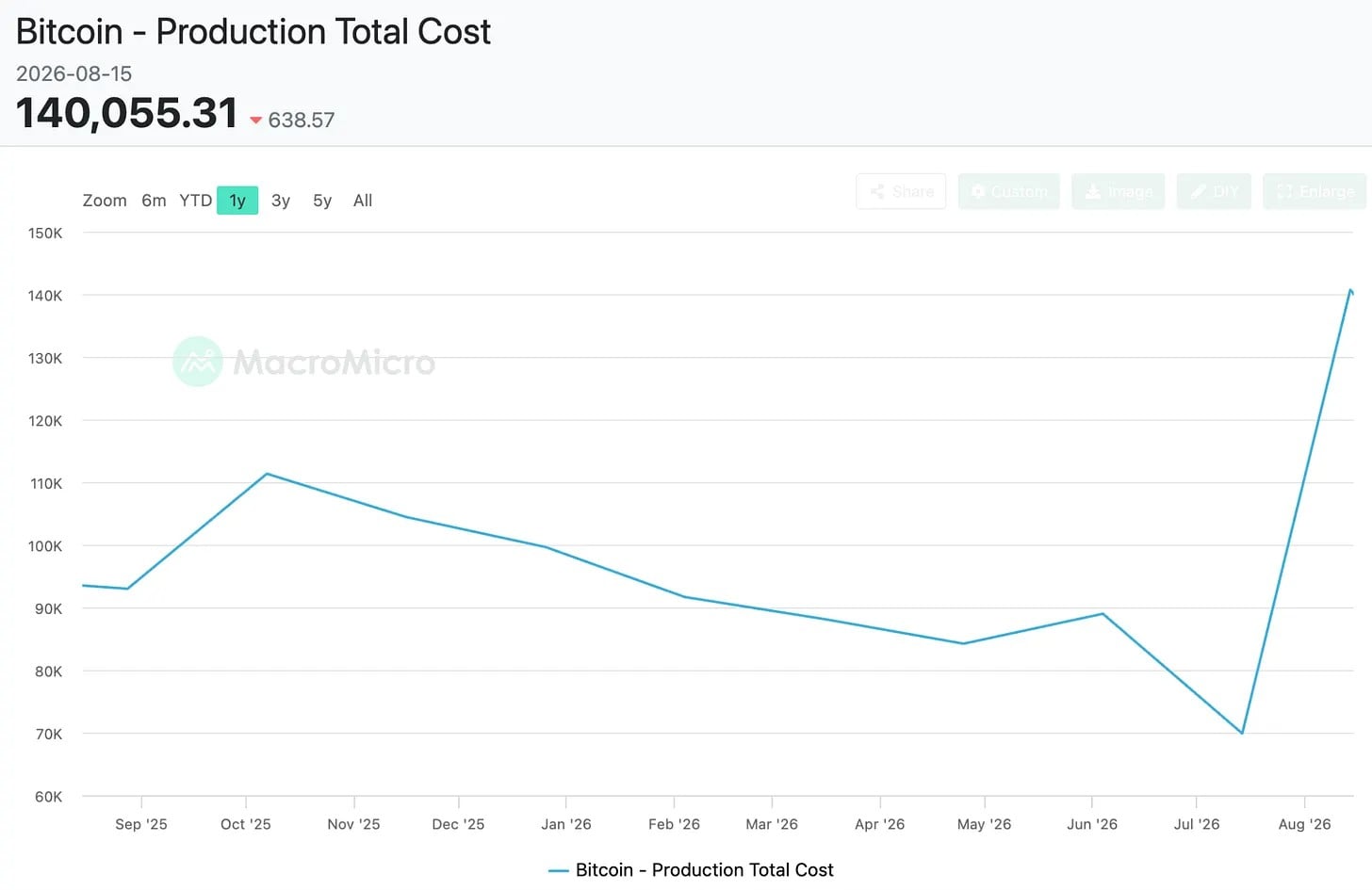
The current Bitcoin price has nearly halved from the October high last year, standing at around $63,000. At this price point, selling Bitcoin after mining is almost unprofitable. The cost of Bitcoin mining is affected by electricity prices and the overall network difficulty. Overall mining costs have risen from about $40,000 in February 2024 to reach between $90,000 and $110,000 between October 2025 and July 2026; by August of this year, the comprehensive Bitcoin mining cost reached a new high of $140,000.
Source: MacroMicro
During the same period as the deteriorating Bitcoin mining environment, a massive influx of capital flooded into the AI inference sector.
Bitcoin miners utilize ASIC chips to run complex algorithms to receive block rewards. This hardware infrastructure closely resembles the foundational conditions required for high-performance computing and AI inference. This similarity makes it easier for miners to transition to AI inference without starting from scratch, significantly lowering the entry barrier. For miners looking for profitable alternatives, turning to AI appears to be a logical choice.
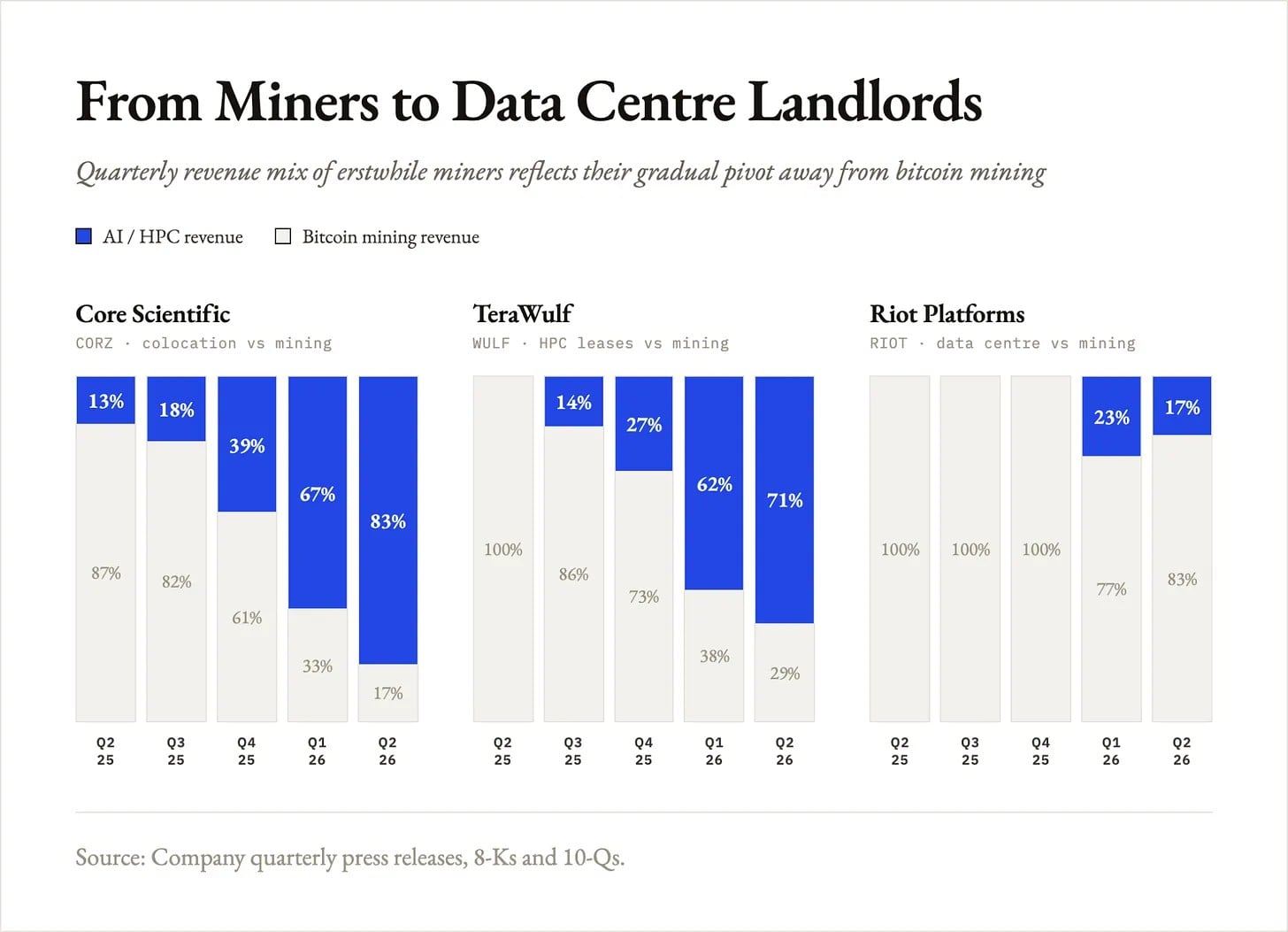
Almost the entire public mining sector has collectively changed course. The revenue structure changes over the past few quarters reflect the scale of this transformation.
For example, Core Scientific saw its revenue from data center hosting for AI and high-performance computing reach only $10.6 million in the second quarter of 2025; during the same period, mining and selling Bitcoin generated $62.4 million in revenue. Twelve months later, the statuses of the two have almost completely reversed. In the second quarter of 2026, hosting business revenue reached $136.7 million, while mining revenue shrank by 65%, down to $21.5 million.
The proportion of hosting business in total revenue surged from 14% last year to 83%.
TeraWulf's high-performance computing leasing revenue now accounts for 71% of total revenue. This business had no revenue in the same period last year but reached $32 million in Q2 2026; meanwhile, cryptocurrency mining revenue shrank by about 75%, leaving only $13 million.
Many miners are also repurposing their existing mining facilities and hardware to support AI and high-performance computing.
A race to seize territory warrants caution
The shift from Bitcoin mining to AI computing has become a collective frenzy. Besides allocating existing capacity to AI, former Bitcoin miners are aggressively securing electricity and land, signing numerous demand contracts. The total value of executed contracts has reached hundreds of billions of dollars.
Core Scientific has committed to AMD and CoreWeave a maximum of 2.5GW of available computing capacity, with total potential revenue exceeding $24 billion over the contract period. Hut 8 holds contracted computing power of 949 megawatts, with a baseline contract value of $26.6 billion, while also securing $7.5 billion in new project financing.
TeraWulf has signed a 20-year lease agreement worth approximately $19 billion with Anthropic and acquired a gigawatt-level campus in Kentucky to accommodate the computing demand. In the past six months, Riot Platforms has completed multiple leases totaling 241 megawatts, corresponding to about $10 billion in contract value. Just last week, IREN delivered its first batch of AI cloud deployment nodes to Microsoft under a five-year contract worth $9.7 billion; it also reached a 5GW partnership with Nvidia and continued acquiring power stations in Texas and Spain to meet computing demand.
This series of sizable contracts has ignited market enthusiasm. Compared to miners' past business, signing 20-year leases with leading cloud providers represents more stable cash flow. After experiencing a year of continuous losses in mining, securing a fifteen-year contract appears to be a reliable reality.
However, many market commentators underestimate the risks lurking within.
Although mining has been fraught with challenges, Bitcoin mining possesses a self-correcting mechanism that the AI hosting business does not have. When mining becomes unprofitable, miners will shut down their machines; when enough miners exit, the overall Bitcoin network difficulty will automatically adjust downward. The remaining miners, with the same equipment and the same electricity costs, can earn higher rewards.
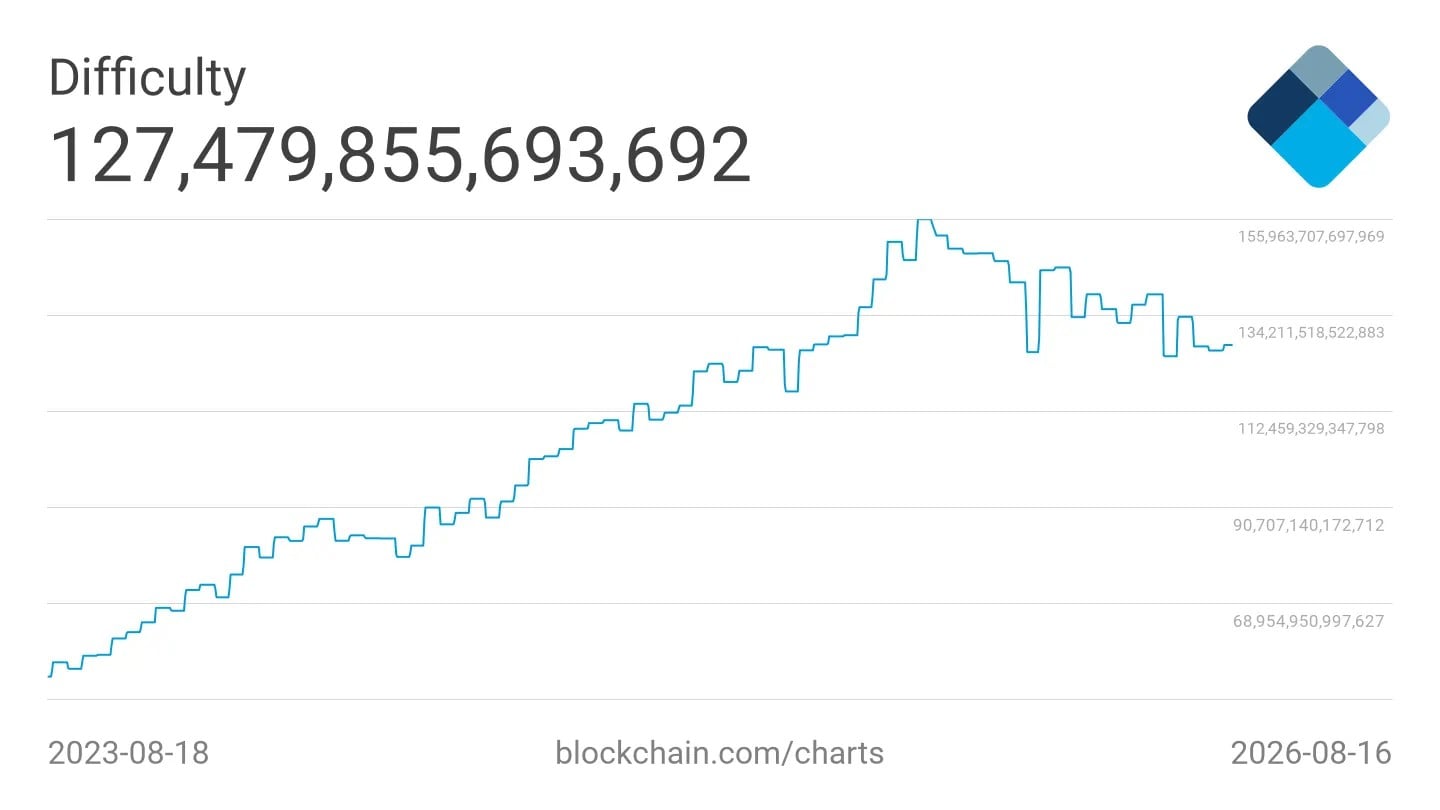
After a significant number of miners pivoted to AI, the overall Bitcoin network difficulty has fallen from a peak of approximately 156 trillion in 2025 to 127.5 trillion. Each company that withdraws from mining increases the mining rewards for those who remain.
But the AI computing industry lacks this automatic adjustment mechanism. If a large number of players flood into the market, an oversupply of computing power will lead to continuously decreasing prices.
Although overall demand for AI computing is rising, prices could very well decline instead of increase — a seeming contradiction to basic economic principles. In fact, several AI companies have already started to reduce service prices. In the early stages of the industry, hardware and supporting resources were scarce, allowing providers to charge high premiums; now, major cloud providers worldwide are competing for megawatt-level electricity resources, and this scarcity has attracted many Bitcoin miners and data center operators to expand capacity. Once the new supply fills the supply-demand gap, computing prices will rapidly decline.
When prices fall, miners locked into long-term leases at current high prices will look back and realize the costs are high.
This transformation has another tricky aspect: this path is essentially one-way. It is easy to convert a mining facility into an AI computing park; the electrical infrastructure is already in place. However, once you replace ASIC mining machines with H100 GPUs and sign a twenty-year lease, you will be tightly bound by this contract for the next twenty years and can no longer easily revert to mining.
In the future when market cycles reverse, and Bitcoin prices rise above the $60,000 low, combined with a drop in overall network difficulty, mining will inevitably become profitable again. By that time, the former miners who have completely transformed will be trapped by long-term contracts, helplessly watching opportunities slip away. Worse, if the actual returns from AI computing do not meet the ideal expectations at the time of signing, they could face a double whammy.
So, should miners not transform to AI and wait patiently for a reversal in the mining cycle? I don't think so. For most companies, transformation is a survival-driven choice. With comprehensive mining costs reaching $140,000 while the Bitcoin price is only $63,000, continuing to mine does not make commercial sense; AI is the only lifeline available.
However, the desire to survive could drive companies to make extreme choices. The risk arises precisely from those players who have gone all-in on AI: under pressure to survive, they completely abandon Bitcoin mining, demolishing or replacing all ASIC mining machines and locking themselves into decades-long contracts in a nascent industry that is still subject to price corrections.
However, not all miners have chosen to turn around completely; some companies are taking more cautious paths.
Those holding hedging options hold the advantage
Marathon Digital, the listed company with the largest Bitcoin treasury, has opted for a cautious route. In the second quarter of 2026, it sold 30% of its Bitcoin holdings to reduce debt, but it did not abandon its Bitcoin mining equipment; instead, it chose a different way to fund its AI expansion.
MARA used its remaining Bitcoin as collateral to obtain $150 million in funding through its 2026 credit line to support its AI business expansion. As of June 30, it still holds over 35,000 Bitcoins on its balance sheet while maintaining a flexible mining operation.
Hut 8 also did not give up mining. It spun off its Bitcoin mining business into a new subsidiary, American Bitcoin Corp, which is wholly controlled by the parent company, while the parent company shifted its focus to high-performance computing and AI infrastructure.
By retaining mining operations and maintaining Bitcoin inventory, these companies hold an option that has been entirely abandoned by those who have gone all-in on transformation. When mining becomes profitable again, they can switch their electric load back to mining; those deeply tied to AI long-term contracts can only watch from the sidelines.
Treating the old mining business as a burden, fully betting on AI computing power amounts to gambling on an unproven future. However, historical patterns are not difficult to predict: with the maturation of each emerging technology — chips, computers, smartphones — prices of products continually decline, and signs of price loosening have already appeared in the AI computing industry.
Companies like Marathon and Hut 8 are not missing out on AI's dividends. They have not liquidated everything to purchase GPUs, but rather retained some mining capacity and Bitcoin inventory, treating AI as a diversification strategy rather than placing all capital on an immature field that will still undergo price reevaluation. As long as ASIC mining machines are still operational, when mining profits are higher and AI computing premiums diminish, they can switch their loads back to mining Bitcoin.
From a broader perspective, these companies are essentially power operators; the only difference is whether the hardware they deploy is ASIC miners or H100 graphics cards. Companies that can flexibly allocate power resources between mining and AI computing based on which business is more profitable will not be fully dictated by market cycles and narratives.
免责声明:本文章仅代表作者个人观点,不代表本平台的立场和观点。本文章仅供信息分享,不构成对任何人的任何投资建议。用户与作者之间的任何争议,与本平台无关。如网页中刊载的文章或图片涉及侵权,请提供相关的权利证明和身份证明发送邮件到support@aicoin.com,本平台相关工作人员将会进行核查。


