Author: Su Yang, Tencent Technology
OpenAI is securing computing power for the next 20 years in advance, while NVIDIA extends its reach beyond chips.
On August 17, local time in the United States, NVIDIA, OpenAI, and SoftBank’s SB Energy confirmed their cooperation to build a large data center in the United States. SB Energy is responsible for development and operation, with OpenAI as the client, and the data center will exclusively use NVIDIA computing power.
The most noteworthy aspect of this tripartite deal is the role that NVIDIA plays. It is both the computing power supplier and provides a guarantee of up to $105 billion for OpenAI's long-term lease, while also directly investing in the project construction. This transaction, originally belonging to developers, tenants, and financing institutions, adds a layer of the chip company's involvement.
Why is NVIDIA taking on such risks, and why is OpenAI locking in a 20-year computing power lease?
One fact and trend is: under the explosive demand for computing power, land, electricity, and data center capacity have become "bottleneck" resources, prompting competition among parties to secure them. However, according to Jensen Huang, the assets and liabilities of cutting-edge AI laboratories do not match those of cloud giants, leading to the approach of "chip company participation guarantees."
However, in reality, cloud giants are also "carrying heavy loads."
According to an analysis by The Wall Street Journal of the latest financial reports from nine large technology companies, the off-balance-sheet commitments (not included in the balance sheet, primarily arising from chip procurement and long-term data center lease payment obligations) related to AI have totaled nearly $3 trillion, which is three times the total of current lease liabilities and long-term debts.
10GW lease, NVIDIA provides guarantee
The data center project in collaboration with OpenAI, SoftBank's SB Energy, and NVIDIA is located in the PORTS-Pike park in Ohio, USA. It plans to build at least 10GW of new energy generation capacity, with the park exclusively deploying NVIDIA's computing infrastructure, ultimately forming an AI factory capacity of about 8GW.
The project construction is divided into two phases. The first phase has a planned capacity of 4.25GW, with the first 800MW expected to be operational in 2028, primarily utilizing existing AEP Ohio infrastructure. After that, additional construction is needed for power plants, transmission lines, and other grid facilities, followed by the expansion of data center capacity to the target goal.
NVIDIA can also fulfill an additional 3.75GW capacity guarantee based on future demand, but this part currently has uncertainties in infrastructure and permit approvals, and NVIDIA is not obligated to lease the entire amount.
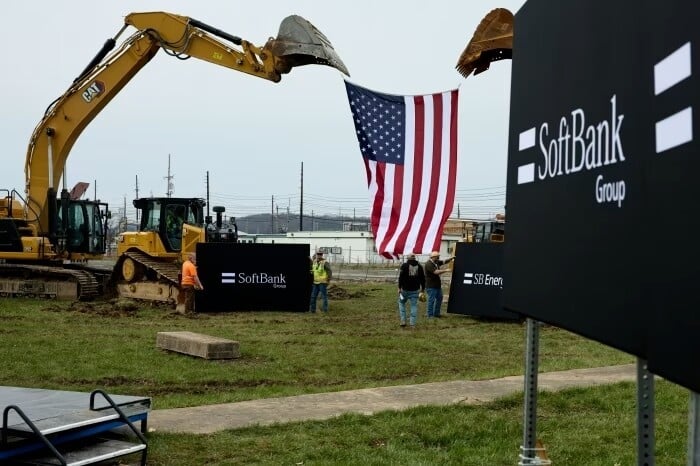
The data center park in southern Ohio began construction in March this year
SB Energy and SoftBank plan to invest at least $4.2 billion to build new regional power grid infrastructure. SB Energy is responsible for the construction, ownership, and operation of the data center, with OpenAI using the capacity that has been built and delivered.
Currently, OpenAI has signed a 20-year lease with SB Energy. The agreement states that OpenAI will begin paying rent only after the corresponding capacity is completed and ready for lease.
By signing a long-term capacity lease in advance, OpenAI can lock in future computing power needs. However, this does not mean that NVIDIA must pay all of OpenAI's rent for 20 years.
According to the agreement, the maximum payment responsibility (or total payment obligation cap) that NVIDIA承担 for this deal is $105 billion, primarily aimed at land, power, and data center infrastructure costs.
NVIDIA employs a residual value guarantee structure: if OpenAI stops leasing, SB Energy will have to find a new tenant. If there is no new lease, they may consider selling the related assets. NVIDIA will only fill the gap if the minimum value agreed upon is not met.
Thus, the $105 billion guarantee corresponds to the remaining value of the already built data center assets and will come into effect gradually in line with project construction and utilization, roughly covering the period from 2028 to 2030. As OpenAI pays rent and the data center capacity comes online, the actual risk exposure borne by NVIDIA will also gradually decrease.
NVIDIA is willing to do this, primarily due to this risk exposure. Even if OpenAI reduces usage in the future, the already built computing capacity can still be transferred to cloud service providers, enterprises, AI laboratories, and startups.
Preemptively "seizing" land and power
On the same day this news was released, Jensen Huang published an article explaining why NVIDIA would participate in such a project. His judgment is based on the fact that AI factories are requiring more and more resources. In the past, advanced chips, packaging, memory, and networking were the main inputs for AI infrastructure. Now, land, electricity, and data centers must also be secured in advance.
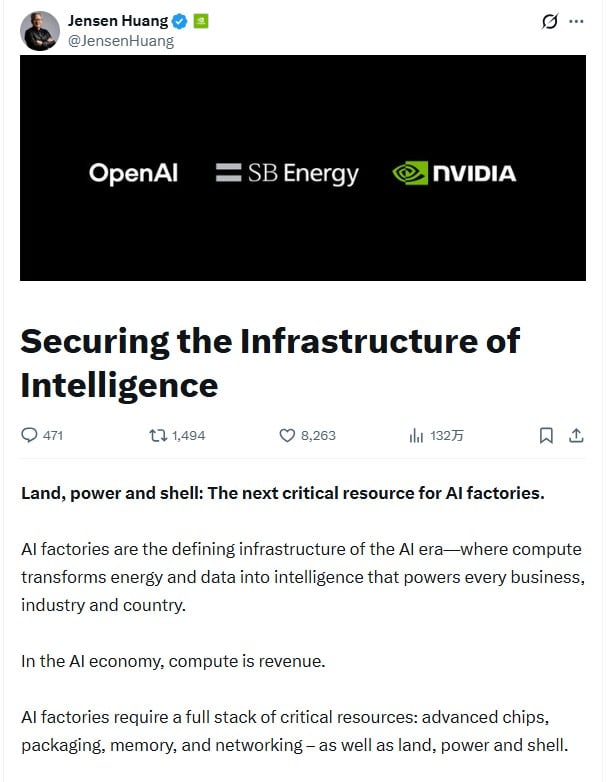
According to Huang, large cloud service providers and investment-grade companies typically have sufficiently large balance sheets and can sign long-term contracts and build their own infrastructure. However, cutting-edge AI laboratories may not possess such conditions.
The training and inference needs of these companies are growing rapidly, and revenue may increase accordingly, but securing decades' worth of land, power, and data center capacity in advance requires stable cash flow and strong financing capability, which many AI laboratories currently lack.
Thus, a new bottleneck emerges.
Huang wrote that the growth of these companies "is not limited by algorithms or customer demand, but by the availability of computing power."
NVIDIA’s involvement in data center infrastructure (LPS, Land, Power, and Shell) aims to solve this issue. However, this does not mean that NVIDIA is ready to provide similar services to all clients. Huang emphasized that NVIDIA will only select a few high-quality sites with clear and long-term computing needs.
Huang revealed that each generation of NVIDIA AI factory systems deployed in the PORTS-Pike park could correspond to about 1.5 million NVIDIA GPUs or approximately $150 billion to $200 billion in NVIDIA revenue.
The term "each generation" is important here. For NVIDIA, the infrastructure locked in during the 20-year agreement cycle is intended for long-term support of its computing systems, rather than fixed orders for a certain generation of GPUs.
OpenAI's long-term commitment further amplifies this opportunity.
Huang stated that OpenAI's existing and planned commitments correspond to about 12GW of NVIDIA computing power. If PORTS-Pike continues to expand, the relevant capacity will also increase. At this scale, by 2030, OpenAI's related deployment opportunities will correspond to about $600 billion worth of NVIDIA computing power.
In the past, chip companies would "invest" in clients, triggering discussions about circular financing. Now the relationship has evolved further, with chip companies directly laying out data centers, providing guarantees for their construction; on one hand, this offers "guarantee endorsement" for the computing power needs of cutting-edge laboratories, and on the other, building data centers will bring ongoing orders for themselves.
$3 trillion in off-balance-sheet commitments
The computing power story of PORTS-Pike is not just about NVIDIA and OpenAI.
In the past two years, AI companies and large tech firms have been frantically building data centers, but more and more infrastructure is not directly purchased by them; instead, it has been secured through leasing, long-term procurement agreements, joint ventures, and other financing structures.
A recent analysis by The Wall Street Journal of the latest securities documents from nine major tech companies, including Alphabet, Amazon, Microsoft, Meta, Oracle, NVIDIA, Broadcom, SpaceX, and AMD, found that as of the most recent filing, these companies’ off-balance-sheet commitments related to AI total approximately $3 trillion.
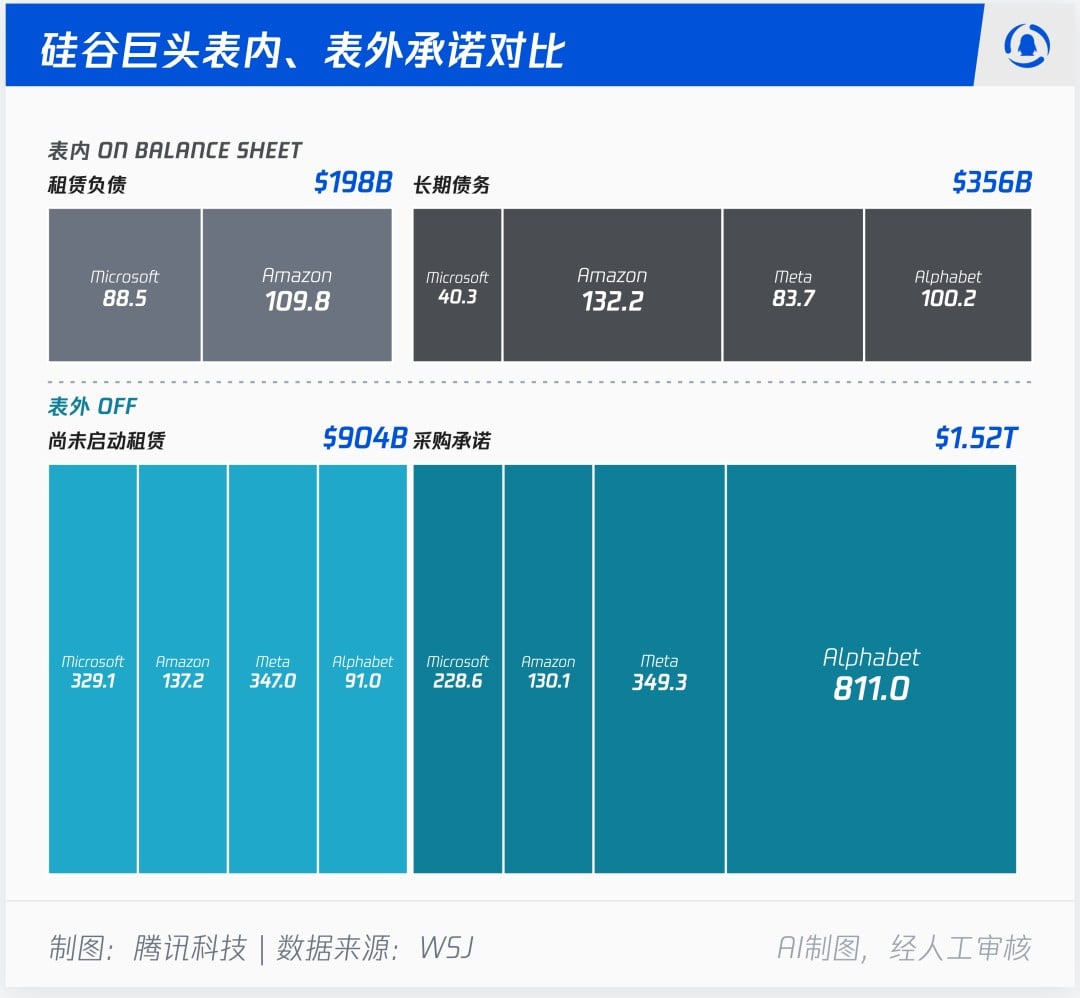
Compared to about $600 billion in capital expenditures over the past year, the off-balance-sheet commitments signed by these companies are much larger.
Meta’s Hyperion data center is a typical case in point.
Located in Louisiana, this data center covers an area equivalent to 1,700 football fields and is managed by a joint venture held by a fund from Blue Owl Capital. Meta is one of the few partners and is a tenant, providing cash flow for bondholders' rent.
Before rent payments commence, this obligation will not be fully reflected on Meta’s balance sheet. As of June this year, Meta disclosed that its total undisclosed leasing obligations reached $347 billion, including the Hyperion project.
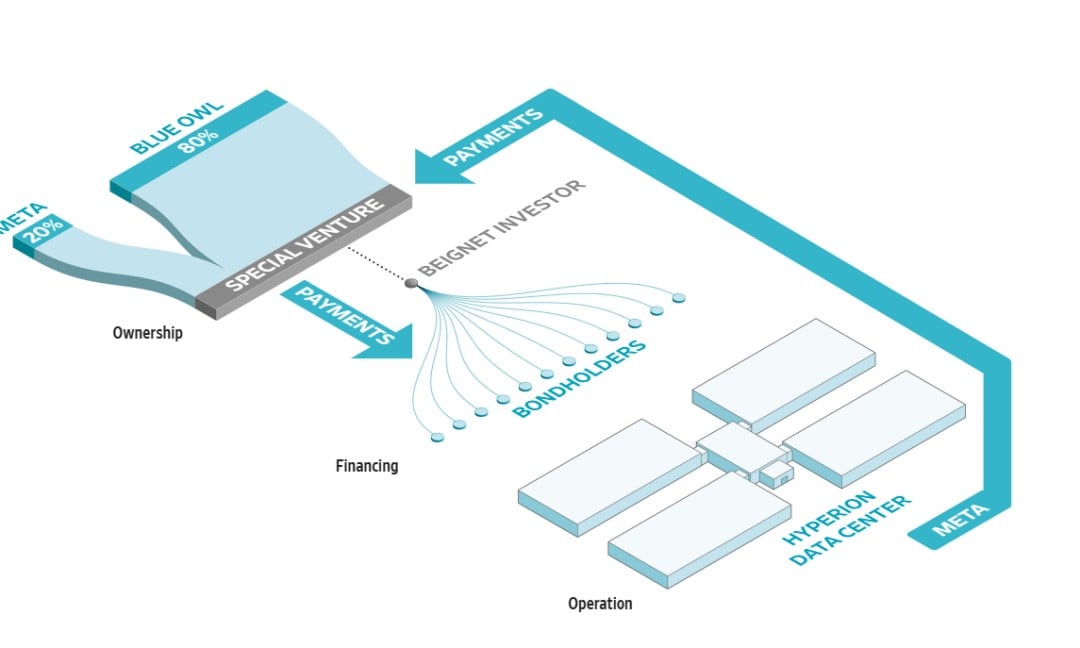
By June, Meta had leased the Louisiana Hyperion data center, but rent payments had not yet begun, and the related leasing obligations had not been fully accounted on the balance sheet
According to statistics, the nine companies' undisclosed leasing payment commitments total about $1.2 trillion, which is about four times the amount disclosed a year ago. Purchase commitments and other contractual obligations amount to approximately $1.9 trillion.
Among these, the changes at Alphabet are particularly notable.
As of June 30, Alphabet's purchase commitments and contractual obligations reached $811 billion, up from $332 billion three months ago. Alphabet explained that these obligations primarily relate to "technical infrastructure and inventory" and agreements ensuring energy supply for data centers. Some energy agreements will even extend to 2054. However, Alphabet did not elaborate on why related commitments increased by nearly $480 billion in just one quarter.
The risks of expansion are not limited to leasing data centers and chip procurement. Some companies' commitments also include purchasing stocks of other companies or providing guarantees for other tenants' leases. NVIDIA itself has committed to undertake a $27 billion equity investment between April 26, 2026, and the end of the 2027 fiscal year.
But another risk lies in the expansion of debt. Some tech companies have already started to frequently enter the capital market for debt financing. In the recent performance announcements, Alphabet and Amazon reported negative free cash flow, with capital expenditures exceeding the cash generated from operating businesses.
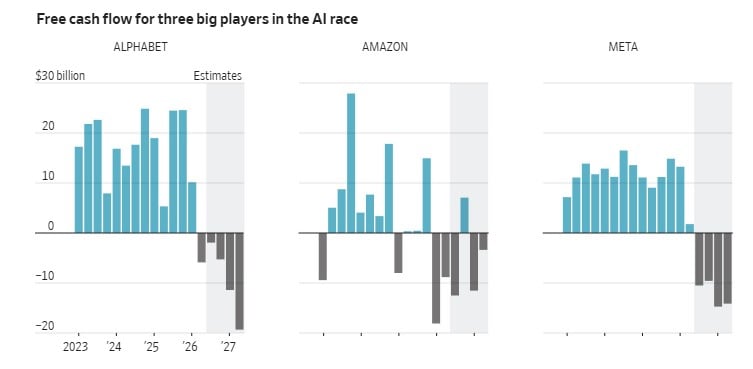
Alphabet, Amazon, and Meta's originally healthy cash flows (cyan bars) are expected to collectively turn negative during the remainder of 2026 and 2027 (grey bars)
Moreover, these figures do not fully reflect the cash flow pressures that may arise from future off-balance-sheet commitments worth trillions. Worse still, many purchase commitments and long-term leases cannot be easily canceled. This means that even if future AI demand does not meet expectations, the agreements signed must still be fulfilled. In this case, the giants will be forced to cut other expenditures and may further borrow money to maintain these infrastructures.
Morgan Stanley's accounting analysts warned in an April report that as such off-balance-sheet commitments become more frequent, larger, and more complex, it will become increasingly difficult for investors to assess a company's true leverage levels.
Now, PORTS-Pike stands at the forefront of this trend. But who can guarantee that the demand for computing power will continue to expand aggressively and not slow down?
免责声明:本文章仅代表作者个人观点,不代表本平台的立场和观点。本文章仅供信息分享,不构成对任何人的任何投资建议。用户与作者之间的任何争议,与本平台无关。如网页中刊载的文章或图片涉及侵权,请提供相关的权利证明和身份证明发送邮件到support@aicoin.com,本平台相关工作人员将会进行核查。


