Author: Nancy, PANews
While the US stock market is still waiting for the "opening bell," on-chain stocks have already been traded for several hours. Over the past year, tokenized stocks have rapidly transitioned from marginal experiments to the forefront of the market, expanding in scale to billions of dollars and starting to compete for a share of traditional exchanges.
Now, Nasdaq is not only actively promoting the on-chain operation for US stocks but is also about to press the bell button. Starting from December 6 of this year, the US stock market will enter an extended trading era of 5 days a week and 23 hours a day. This move aims not only to compete for trading traffic in the Asian timezone and consolidate global asset pricing power but also to respond to the multiple impacts of financial innovations such as tokenized stocks and on-chain settlements.
As authentic US stocks begin to converge towards an "always open" model, the next phase of competition for tokenized stocks will no longer just be a comparison of time differences but a comprehensive contest of compliance rights, liquidity depth, and infrastructure efficiency.
Nasdaq to Extend Trading Hours by Year-End, US Stocks Enter Sleepless Nights
Nasdaq is about to push back Wall Street's "closing bell."
Recently, Nasdaq submitted an 8-K filing to the US SEC indicating its plan to implement a nearly round-the-clock "23-hour trading system," expected to officially launch on December 6, 2026. At that time, the trading hours for US stocks will be extended from the current approximately 16 hours to 5 days a week and 23 hours a day, reserving only 1 hour for system maintenance.
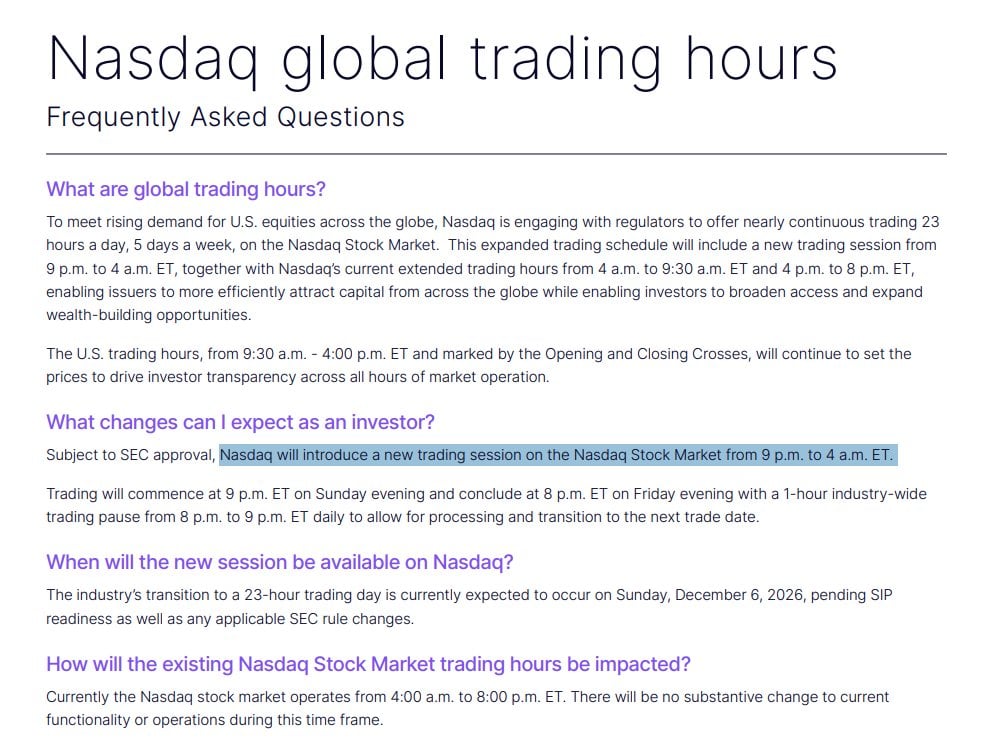
The US SEC approved the related proposal on April 10 of this year, but its implementation still depends on system upgrades of the DTCC clearing system and the securities information processor (SIP) infrastructure.
According to Chuck Mack, Senior Vice President of Nasdaq North America, under the new system, Nasdaq will divide the trading times into day and night sessions. The day session will run from 4 AM to 8 PM Eastern Time, followed by a one-hour break for system maintenance and transition activities; the night session will run from 9 PM to 4 AM the next day.
"What we are doing is not just extending trading hours; it is about expanding investors' channels into the world's most vibrant and liquid markets," Chuck Mack previously stated.
For Nasdaq, the 23-hour trading is superficially an extension of trading periods, but behind it lies its proactive response to changes in the competitive landscape of global capital markets.
On one hand, as the weight of US stocks in global investment portfolios continues to rise, especially in technology and AI-related assets, extending trading hours allows investors in different time zones to participate in trading at convenient local times, thereby expanding market participation and liquidity, and further competing for global order flow and price discovery rights. Particularly in the Asian market, the new night trading window will cover the daytime trading periods of major Asian markets. This not only means that Asian investors can more easily trade US stocks, but Nasdaq also has the opportunity to capture more cross-border allocation funds and trading flows from the Asia-Pacific region.
Chuck Mack has also pointed out that mobile-first platforms and the increasingly tight interconnectivity of global markets are driving capital markets to provide higher accessibility. Since 2019, the value of US stocks held by foreign investors has grown by 97%, reaching $17 trillion by mid-2024. For global investors spread across different time zones, further extending trading hours means they no longer have to adjust their trading rhythms around New York time.
On the other hand, Nasdaq is facing competition not only from other traditional exchanges but also from the all-weather trading models in the crypto market. The traditional US stock market has about 16 hours of trading each day, with full closures on weekends, meaning investors cannot adjust related positions in a timely manner after the US stock market closes. As tokenized stocks gradually rise, the 24/7 trading, global accessibility, and faster settlement features intrinsic to crypto markets are turning it into a crucial battleground for stock trading, with platforms like Hyperliquid and Binance attracting numerous users to migrate to on-chain platforms, especially younger investors. From this perspective, Nasdaq is actively compensating for the time shortcomings of the traditional securities market, reducing the diversion of funds and users to on-chain operations.
Moreover, this move is also paving the way for Nasdaq's tokenized stock layout. In March 2026, the US SEC approved Nasdaq to pilot tokenized stock trading, allowing Russell 1000 components and major index ETFs to trade and settle in tokenized form. The large-scale implementation of stock tokenization and on-chain settlements will require the 23-hour trading system to test the stability of clearing, market-making, data systems, and risk control during nighttime hours, accumulating real-world experience for future continuous trading and on-chain settlements of tokenized stocks.
Almost Tripled Year-To-Date, US Stocks and On-Chain Stocks to Clash
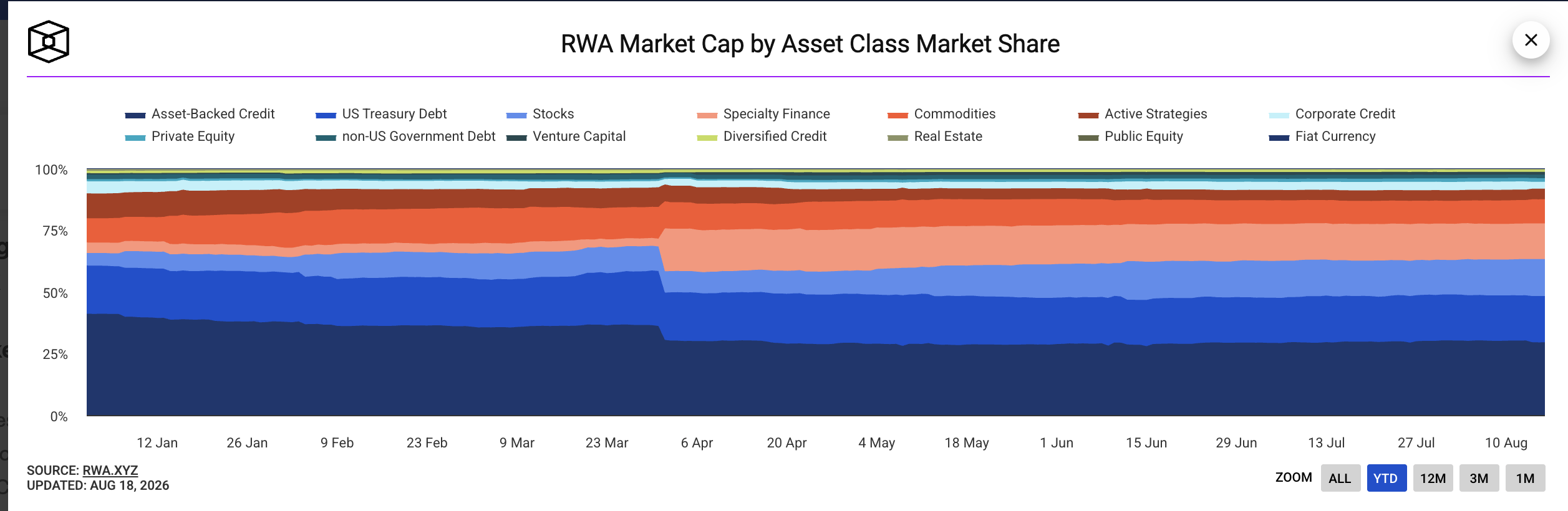
In the Real World Assets (RWA) market, tokenized stocks have become one of the few sub-segments maintaining rapid growth. According to data from The Block, the share of tokenized stocks in the RWA market has increased to 14.9%, more than 2.9 times up from 5.1% at the beginning of the year.
In terms of market activity, data from RWA.xyz shows that in the past 30 days, the number of tokenized stock holders has increased by 90.33%, reaching 1.35 million; monthly transfer volume has surged by 191.1%, reaching $23.81 billion; the number of active addresses has grown by 34.62%, exceeding 631,000; and distributed value has increased by over 3.8%, reaching $2.34 billion.
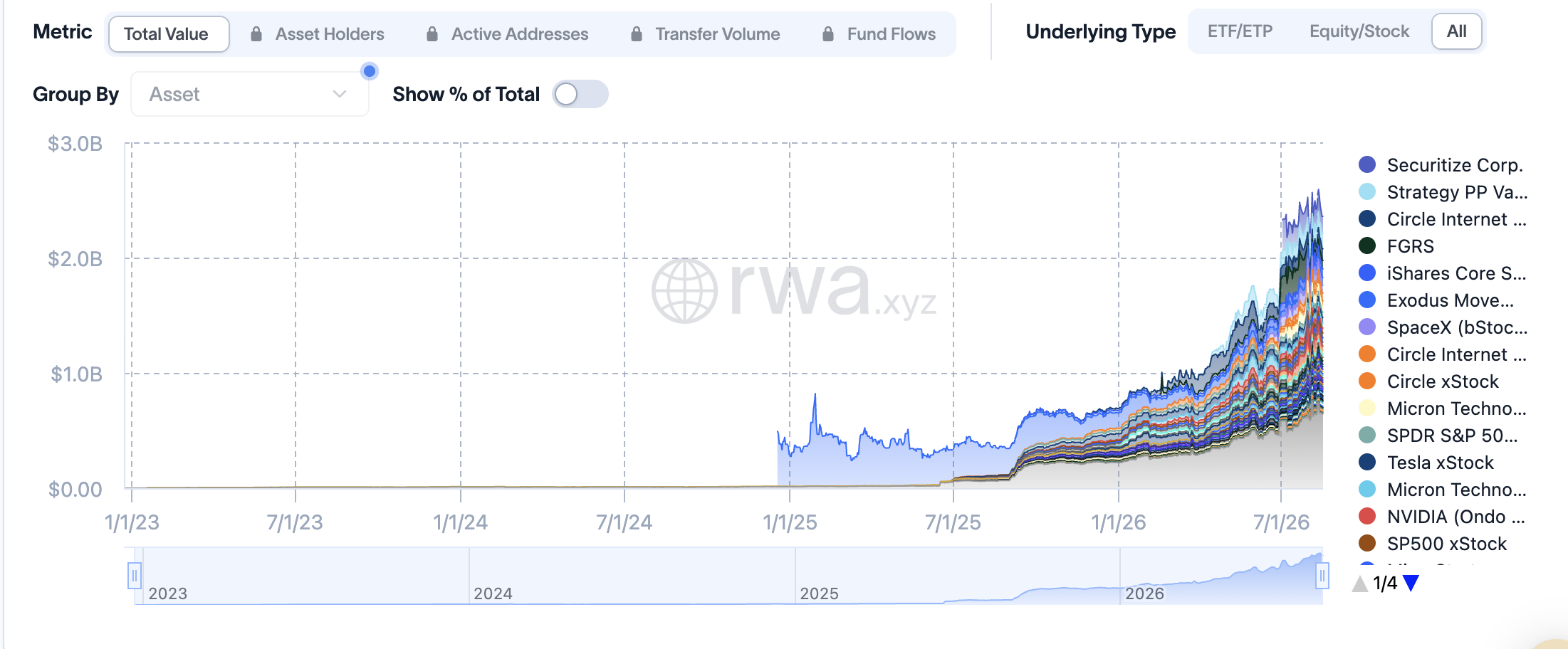
In terms of market landscape, Ondo Finance, Binance (bStock), and xStocks currently occupy the top three positions, with a combined market share of about 77%. Among them, Ondo leads with a scale of $870 million, while xStocks and bStock exceed $550 million and $480 million, respectively.
The US SEC also plans to introduce an innovation exemption for tokenized stocks, allowing tokenized versions of stocks from companies like Apple, Tesla, and Nvidia to trade on-chain around the clock, supporting fragmented trading and near-instant settlements. If the related policies are implemented, it is expected to further lower the barrier for traditional stocks entering the on-chain market, opening up greater growth space for tokenized stocks.
As the authentic US stocks in the traditional market gradually approach all-weather trading, the tokenized stocks track will also face a direct confrontation and enter a new phase of competition.
In the short term, Nasdaq's addition of night trading may provide a more stable price anchor and hedging window for tokenized stocks. In the past, after the traditional market closed, market makers for tokenized stocks lacked continuous spot price references and often had to bear higher hedging costs, which could lead to wider bid-ask spreads and increased price volatility, even affecting the quality of data for DeFi oracles.
With the opening of night trading, this issue is expected to see some improvement. Longer traditional trading windows mean that on-chain market makers can conduct price discovery and risk hedging in an environment closer to the real stock market, thereby reducing the likelihood of extreme price deviations, improving liquidity, and providing more continuous and reliable price data for DeFi applications such as lending and derivatives.
But in the long term, as the real US stocks in traditional exchanges also gradually approach all-day trading, the original time difference advantages of tokenized stocks will gradually diminish, and the focus of competition will inevitably shift to who can offer more complete asset rights, deeper compliance capabilities, more efficient settlement systems, and stronger on-chain composability.
For tokenized stock products that only provide synthetic exposure or simple price tracking, as the trading hours of traditional markets are extended, their space for differentiation may further narrow. In contrast, truly competitive tokenization solutions will be those that can provide complete shareholder rights, including voting rights and dividend rights, within a compliance framework while achieving efficient settlement and deeply integrating with DeFi protocols.
Of course, this competition will further drive the integration of TradFi and Crypto, and promote global asset trading into a more efficient, transparent, and composable stage.
免责声明:本文章仅代表作者个人观点,不代表本平台的立场和观点。本文章仅供信息分享,不构成对任何人的任何投资建议。用户与作者之间的任何争议,与本平台无关。如网页中刊载的文章或图片涉及侵权,请提供相关的权利证明和身份证明发送邮件到support@aicoin.com,本平台相关工作人员将会进行核查。


