Hyperliquid can no longer be simply referred to as a “on-chain perpetual contract exchange.” A more accurate positioning is: it uses the high-performance native order book HyperCore as the trading and liquidity base, HyperEVM as the composable finance layer, with HYPE assuming security, governance, and value recirculation functions. Through HIP-3, builder code, native spot and stablecoin mechanisms, it connects external developers, frontend distributors, market makers, and asset issuers to the same account and margin system. This design has formed a clear positive feedback loop: trading depth attracts users ↔ users attract frontend and developers ↔ new order flow enhances market-making efficiency and generates fees ↔ fees recirculate HYPE through mechanisms like assistance funds. Its path is “first create a high-frequency, high-income core product, then expand the application layer,” rather than the traditional L1 “first issue tokens, then add applications” model.
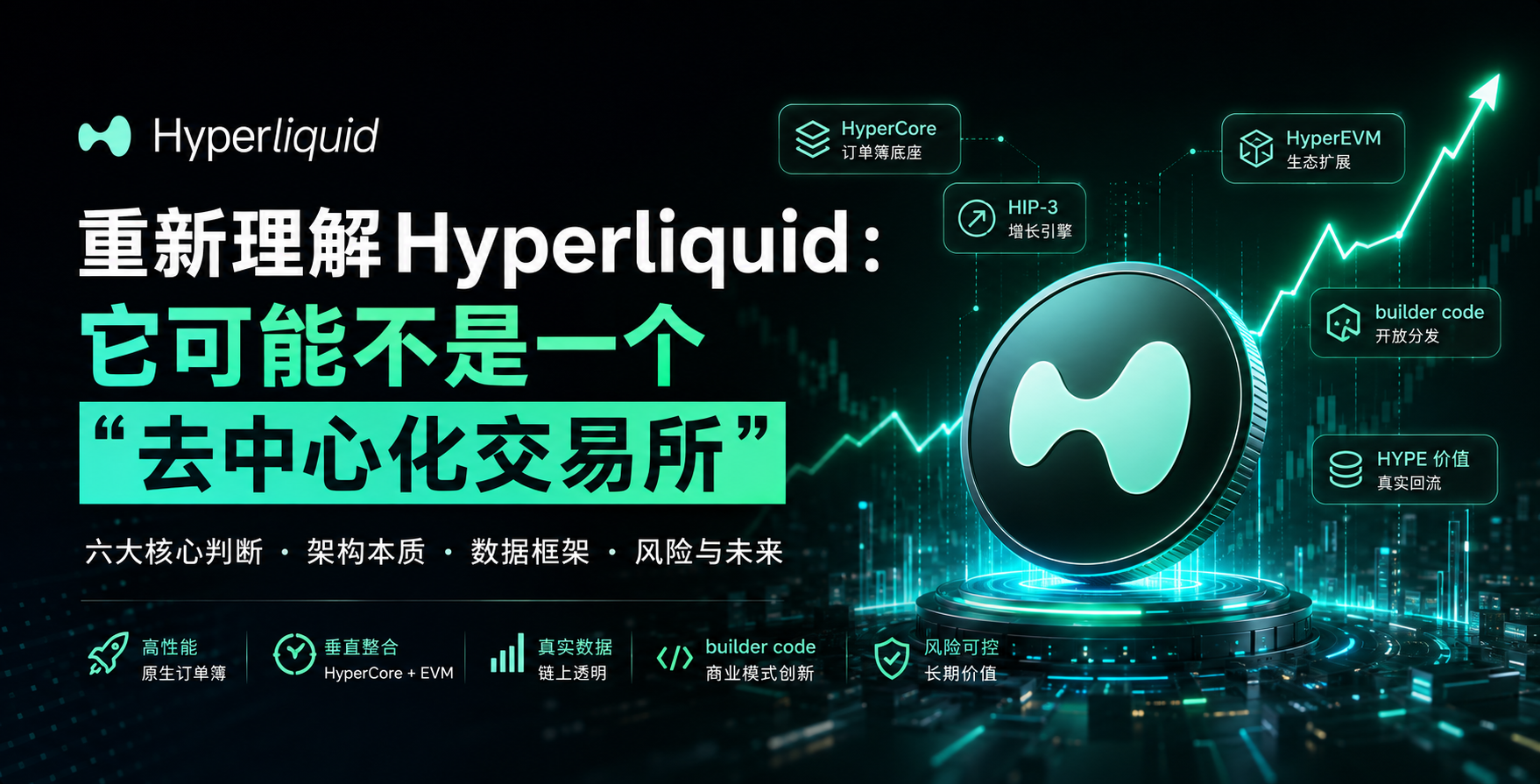
Six Core Judgments
1. HyperCore's product-market fit has been validated
The official Info API snapshot shows: cumulative transaction volume of approximately $5.31 trillion, cumulative users around 2.405 million, total platform perpetual open interest approximately $12.06 billion, and snapshot day total platform transaction volume around $6.68 billion (with perpetual around $6.59 billion). Coinbase Institutional (July 2026) estimates its on-chain perpetual transaction share increased from about 16% at the beginning of the year to about 37%, with open interest share about 57%; different windows from CoinGecko also conclude around 40% transaction and nearly 60% open interest. Specific ratios may vary with statistical windows, but the judgment of "absolute leader" does not rely on a single source.
2. HIP-3 has become the second growth engine, but highly reliant on a single deployer
Native perpetual contributes approximately $2.85 billion in daily transactions and $7.65 billion in open interest; 10 HIP-3 deployers collectively contribute about $3.74 billion in daily transactions and $4.41 billion in open interest, accounting for about 56.8% of total platform perpetual daily transactions and about 36.5% of open interest. Among these, trade[XYZ] alone contributes over 99% of HIP-3 transactions and open interest. A more accurate conclusion at present is: one successful deployer has validated the demand for open market infrastructure, while other deployers have not yet proven scalable capability.
3. The scale of HyperEVM ecosystem assets is real, but cannot be simply summed up
DefiLlama shows the TVL of Hyperliquid L1 on-chain applications around $1.264 billion; on-chain stablecoins around $6.178 billion (with USDC around $6.042 billion). Hyperliquid Bridge has approximately $5.43 billion locked, and HLP around $187 million. These numbers measure application collateral, stablecoin supply, bridging assets, and market-making treasury, with different metrics and overlaps present. Kinetiq's kHYPE alone has a TVL of around $850 million, a considerable amount is deposited into lending, yield, or AMM, and mechanical addition would severely overstate external capital.
4. The builder code is the most underestimated commercial model innovation
It allows third-party frontends to distribute HyperCore liquidity without building their own matching, clearing, and market-making networks, and to charge users customized frontend fees. Phantom, Based, and pvp.trade have accumulated builder revenues of approximately $20.63 million, $15.06 million, and $7.95 million respectively (based on May 2026 HyperTracker data). This proves that Hyperliquid can not only be a terminal product but can also become a “wholesale liquidity layer” for wallets, trading applications, and social frontends.
5. The quality of the HYPE value recirculation is strong, but the valuation is not inherently cheap
Fees over the past 12 months amount to approximately $977 million, with about $41 million in the last 30 days (annualized about $499 million), indicating the current monetization speed is below the peak of the previous year. With a circulating market value of approximately $13.1 billion and FDV of $59.1 billion, the circulating market value to fees over the past 12 months is about 13.5 times, and FDV about 60.5 times; using the latest 30-day annualized figures, this equates to about 26 times and 118 times respectively. Fees are not net profits, and there are discrepancies in circulating volume measurements, so these can only serve as a thermometer for valuation, rather than a stock-like price-to-earnings ratio.
6. The main contradiction has shifted from “Can the product run through?” to “Can expansion offset centralization and cyclical risks?”
The most critical validation points in the next 12–24 months include: whether HIP-3 sees a second or third effective deployer; whether non-crypto assets and HIP-4 result markets form stable open interests; whether AQA stablecoin yields become sustainable income; whether HyperEVM produces external demand not relying on HYPE circular staking; whether validator and code openness, as well as bridge and oracle governance improve. The benchmark judgment is: Hyperliquid is currently one of the on-chain trading infrastructures with the highest quality fundamentals, but HYPE resembles a pricing of high-growth risk assets, rather than an undervalued “fee stock.”
Architectural Essence: L1 Designed Around Trading
Hyperliquid consists of HyperCore and HyperEVM, sharing the HyperBFT consensus. HyperCore is a native state machine optimized for trading, accommodating perpetual orders, spot order books, margin, clearing, treasury, oracles, and staking, with official performance estimating around 200,000 orders per second and possessing single-block finality. This unified environment avoids common cross-contract calls of on-chain order books but also means that core code openness, validator governance, and upgrade processes deserve more attention. HyperEVM is not an independent chain but a composable layer sharing consensus. Developers can interact with HyperCore by using CoreWriter and precompiled reads, allowing lending protocols to read native spots, treasuries to hedge perpetuals, and LST to act as collateral. Officials still describe it as being in alpha phase, with application TVL exceeding $1 billion, but professional funds cannot equate it to mature EVM. HIP-1/HIP-2 resolve long-tail asset initiation issues; HIP-3 changes “opening a perpetual exchange” into protocol permissions where external teams can stake 500,000 HYPE to deploy independent markets and share fees, while users still use a unified USDC account; builder code turns customer acquisition into an open alliance network; HLP and assistance funds bear market-making, clearing, and fee recirculation; HIP-4 further expands to outcome markets.
Data Imaging and Valuation Framework
Perpetuals exhibit a dumbbell structure: on one end transaction volume and stablecoin supply, on the other end HYPE staking and LST. USDC accounts for about 97.8% of stablecoins, indicating clear system-level dependency. Much of the TVL in HyperEVM consists of HYPE/LST cyclic usage, necessitating a distinction between “internal financialization” and “external asset inflow.” Fees and valuations need to be dissected: total fees distributed to protocols, deployers, builders, etc.; recirculation relies on the assistance fund's purchases and burns. A more practical approach is to maintain revenue—supply bridging tables—tracking protocol net retention, staking emissions, verifiable burns, and business lock-ins, while conducting sensitivity analyses on transaction volume, effective fee rates, retention rates, and circulating volume. Approximately 437.3 million HYPE is staked, with foundation nodes accounting for about 48.6%, strong economic security but concentrated equity.
Ecological Layering and Participation Paths
Top projects are scored by track (scale, commercial quality, strategic importance, differentiation, security transparency, token capture), forming clear hierarchies:
- Capital Layer: Kinetiq, stHYPE
- Lending and Collateral: HyperLend, Morpho, Felix, etc.
- Order Flow and Frontend: trade[XYZ], Phantom, Based, pvp.trade
- Spot and Asset Entry: Unit, Project X, etc.
- Yield and Options: Rysk, Liminal, Derive, Pendle, etc.
Traders can upgrade from directional trading to multidimensional yield management (native perpetual, HIP-3 cross-asset, funding rate basis, option volatility, market-making); developers can conduct builder distribution, HIP-3 deployment, HyperEVM applications, or data infrastructure; whales and fund managers must focus on managing HYPE/LST cycles, exit capacities, and related tail risks.
Moat, Competition, and Major Risks
The real moat is composable liquidity (capital network + distribution network + development network), rather than pure TPS. Compared to other perp DEX, Hyperliquid has a stronger OI and unified capital layer; compared to centralized exchanges, there is still significant room, but faces fiat currency, compliance, and regulatory boundaries. HIP-3 and builder code expand transactions while also diluting net protocol rates. Major risks include: validator centralization, core code openness, clearing and ADL, oracle and non-crypto asset dependencies, bridge and stablecoin centralization, HyperEVM composable contagion, token supply and cyclical volatility, regulation, and market integrity.
Future Scenarios and Final Qualitative Assessment
- Bull Market: HIP-3 sees multiple effective deployers, AQA yield realization, significant external asset inflow, governance improvement.
- Benchmark: maintains on-chain leadership, growth and fee dilution coexist.
- Bear Market: transaction cycles decline compounded by systemic events.
Monitoring priorities: platform-wide OI dispersion, HIP-3 concentration, net protocol fees, external stablecoin/asset net inflow, HyperEVM composition, builder quality, validator concentration, and risk events.
Final Judgment: Hyperliquid has completed the most challenging step—establishing an on-chain order book network capable of supporting professional positions and generating nearly a billion-dollar annual fee. It unifies trading, asset issuance, development, frontend distribution, and staking management rights into a platform. What is most valuable to traders is the unified capital and cross-asset market; to developers, utilizing existing liquidity for distribution and new markets; to fund managers, managing related tail risks. The three most decisive numbers in the future are: non-XYZ HIP-3 OI, non-HYPE/LST driven HyperEVM capital, and net protocol income after all share deductions. If all three rise simultaneously, it will upgrade from an excellent exchange to a financial network; if stagnates long-term, it may still be an outstanding high-profit on-chain exchange, but struggles to fully realize infrastructure-level valuations.
Exclusive Benefits for AiCoin Users
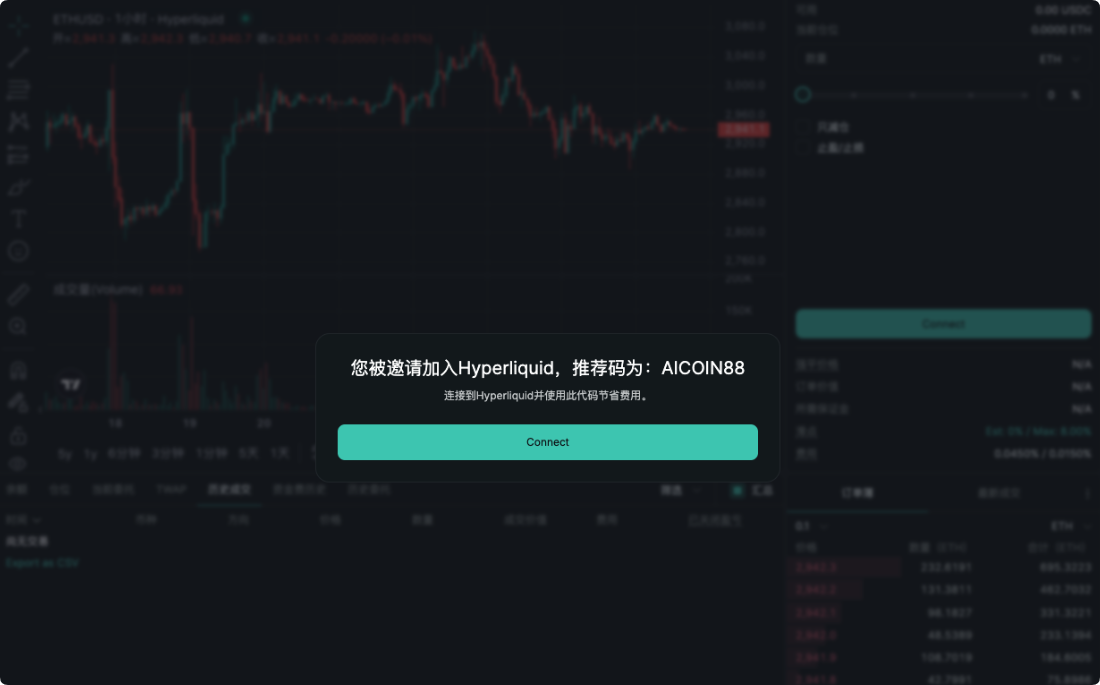
👉 Enter invitation code AICOIN88 when binding your Hyperliquid account for a 4% fee rebate.
🔗 Exclusive registration link:
https://app.hyperliquid.xyz/join/AICOIN88
📖 Beginner's Tutorial:
- “AiCoin PC Hyperliquid Authorized Trading Tutorial”:
https://www.aicoin.com/zh-Hans/article/514197
- “AiCoin Mobile Hyperliquid Authorized Trading Tutorial”:
https://www.aicoin.com/zh-Hans/article/541383
- “Getting Started from Scratch! Hyperliquid First Trade Ultra-Detailed Tutorial”:
https://www.aicoin.com/zh-Hans/article/510225
📖 Community Communication:
- Telegram:
https://t.me/AiCoinWhaleData
- Discord:
https://discord.gg/5XSXjXSpz
- AiCoin-Group Chat:
https://www.aicoin.com/link/chat?cid=N6OVMor5g
The content of this article solely represents the author's personal opinion and does not reflect the position of this platform. The opinions, conclusions, and suggestions in the text are for investors' reference only and do not constitute any investment advice related to this platform. Investing in US stocks still requires one to bear market risks, regulatory risks, and local legal compliance risks (especially regarding foreign exchange controls, offshore investment declarations, etc.).
免责声明:本文章仅代表作者个人观点,不代表本平台的立场和观点。本文章仅供信息分享,不构成对任何人的任何投资建议。用户与作者之间的任何争议,与本平台无关。如网页中刊载的文章或图片涉及侵权,请提供相关的权利证明和身份证明发送邮件到support@aicoin.com,本平台相关工作人员将会进行核查。