Author: Deep Tide TechFlow
What is it like for a project to be sold twice in one year?
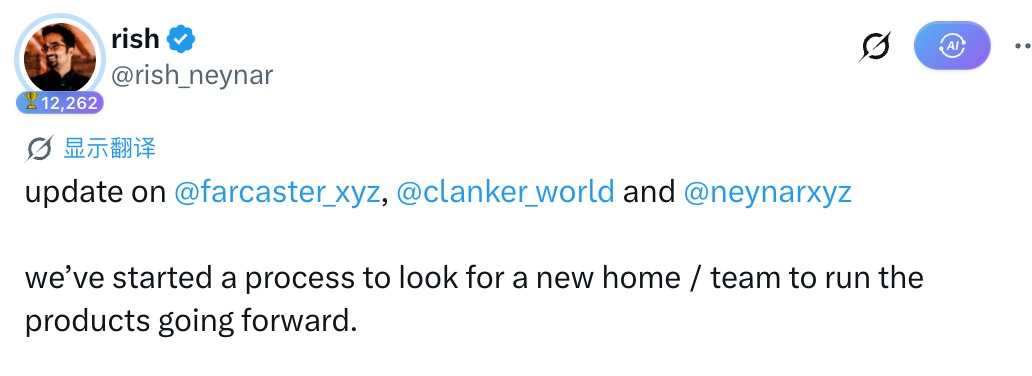
On August 17, rish, the co-founder of Neynar, the operator of Farcaster, announced: Looking for a new team for the Farcaster protocol, the official application, and the token issuance platform Clanker. The company returned the remaining funds, and the team was subsequently dissolved.
It has only been 7 months since Neynar took over the project from the founding team. That handover was already the first time Farcaster was "sold".
This once Web3 social star, which was invested in by Paradigm and a16z, with a valuation that once reached 1 billion dollars, entered the process of finding a buyer for the second time within a year.
Founding Team That Left Early
On January 21 of this year, Farcaster's founding team Merkle Manufactory did something rather uncommon: they handed over the protocol contracts, code base, official app, and Clanker all to Neynar, and returned all of the 180 million dollars they raised to the investors.
The two founders, Dan Romero and Varun Srinivasan, then joined the payment chain Tempo (a project incubated by Stripe and Paradigm).
The money was returned, the people left, but the project remained.
Neynar, which took over, is a middleware company that develops tools for Farcaster, having raised 11 million dollars in Series A funding in 2024. When they took over, they saw: a developer-focused social network and a cash-printing machine for token issuance.
Seven months later, they also began looking for a buyer.
In the announcement, rish wrote that at the beginning of the year, this acquisition seemed like a good choice, but later the changes were too significant, and Neynar "was no longer suitable for the needs of the next phase." The announcement was posted in advance on Farcaster, and his statement was, let's not make it so sudden this time.
Cash Printing Machine Temporarily Shut Down
Among the assets Neynar took over, the most valuable was Clanker, an AI token issuance bot. At the beginning of this year, when AI token issuance hype was at its peak, it was the cash cow of the Farcaster ecosystem, raking in 35 million dollars in on-chain issuance service fees in one quarter.
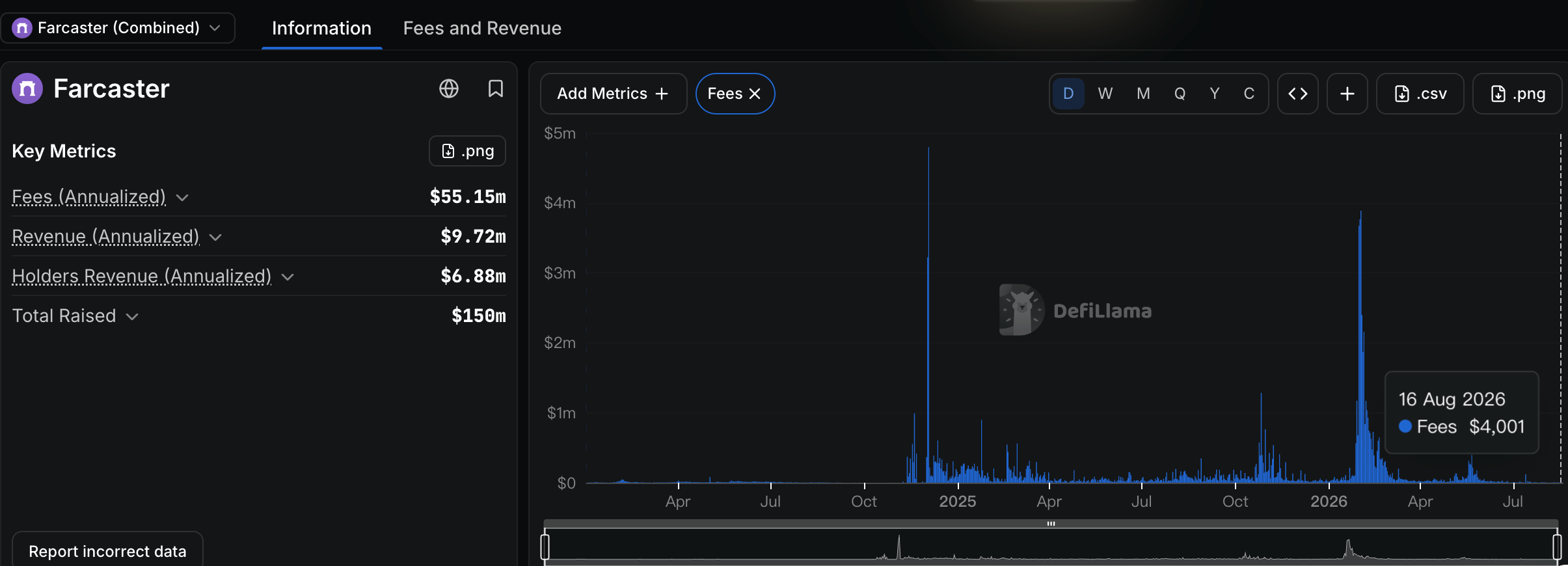
According to DefiLlama data, the protocol fees of the Farcaster ecosystem:
In the first quarter of 2026, 35.43 million dollars. In the second quarter, 4.67 million dollars. From July 1 to August 17, 377,000 dollars.
However, in the past 24 hours, the protocol fees were only 4,001 dollars.
From a single quarter of 35.43 million down to a single day of 4,000, a decline of 99%. The accumulated 94.1 million dollars in fees earned since its launch has become a monument sitting on the peak of the mountain.
At the same time, CLANKER token repurchases, which relied on service fees, have also stopped.
The cost side is also a problem. According to Rish, maintaining this full-stack social network costs 100,000 dollars per month, peaking at 500,000. In the last 30 days, the entire ecosystem's revenue was 120,000 dollars, which can only be said to barely cover the project's monthly expenses.
At the same time, Rish also mentioned on Farcaster:
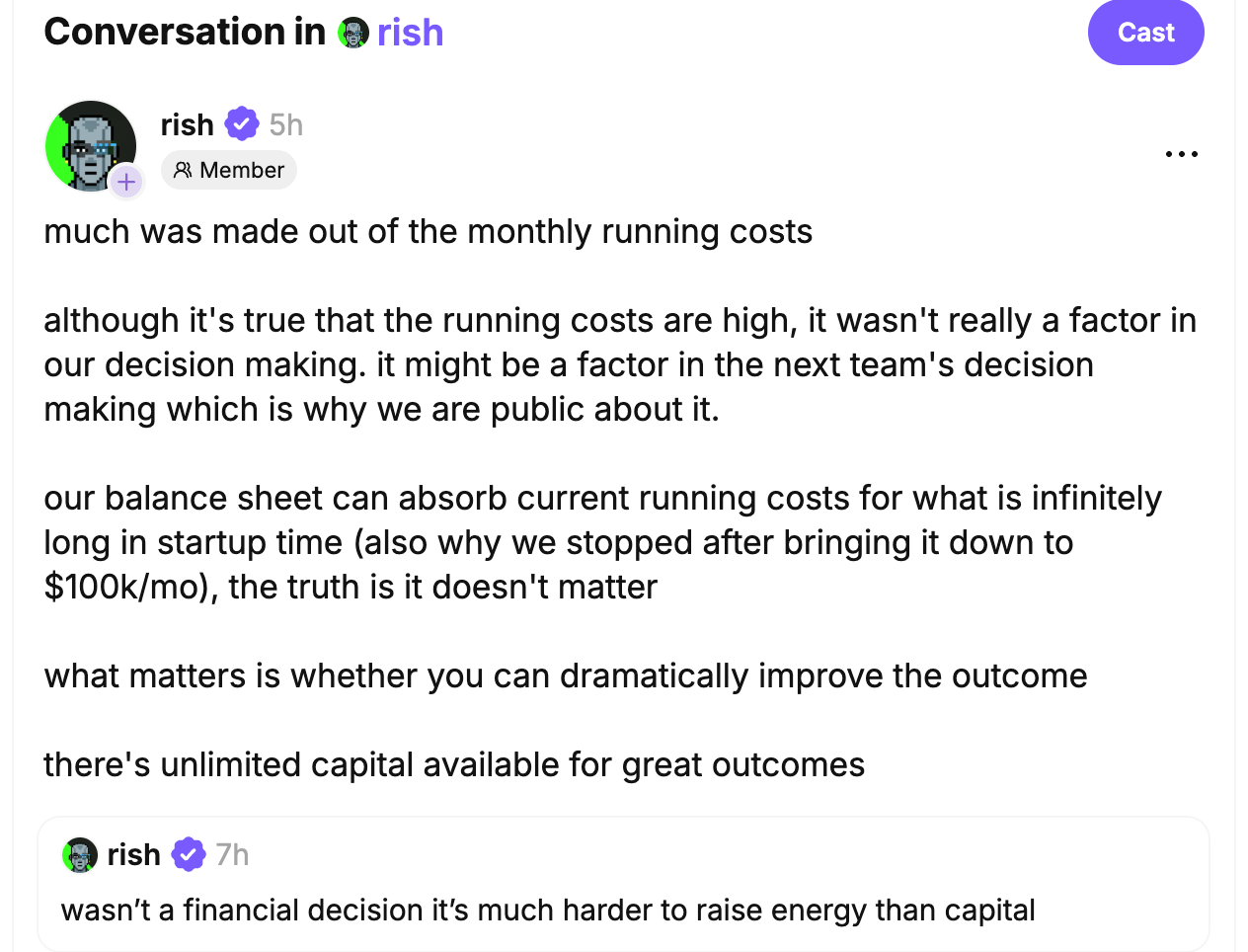
Operational costs are indeed high, but they were not the deciding factor for us. We made this number public because it might impact the decision-making of the next team. Our balance sheet can absorb the current costs indefinitely.
Another statement was even more straightforward:
"This is not a financial decision. Raising energy is much harder than raising capital." (It's much harder to raise energy than capital.)
This sentence may be the most accurate reflection of Farcaster's development over the past seven years.
Consumer-Level Social Illusion
The problem with Farcaster may really not be cost.
After the market turned bearish, how much money the project burns this month is not critical, because the available funds can still cover this part. But there is a question that is hard to avoid in terms of direction and demand: Why would users leave X and come to you?
Alliance co-founder Imran's evaluation is very direct: Farcaster is a useful infrastructure experiment, but relying solely on a decentralized social graph cannot attract users away from X and Instagram.
He believes that the real established direction is social trading, creating a native product loop that combines new coin discovery, speculative trading, and reputation for gains and losses, which is precisely what the X's cannot replicate.
Looking back, the most glorious moment of Farcaster was precisely when it resembled a social product the least. When Clanker exploded in popularity, people came here to issue tokens and trade coins, not to socialize.
As the hype faded, revenue vanished, and social narratives resurfaced, leading to today’s story.
However, below Rish’s announcement, the on-chain lottery project Megapot on the Base chain has already publicly stated its intention to take over Farcaster. A previously star project will obviously not completely disappear, as it can still leverage its already established products and brand assets to continue seeking transformation after the transfer of control and interests.
But as liquidity continues to dwindle, more small projects with no demand should also face elimination.
免责声明:本文章仅代表作者个人观点,不代表本平台的立场和观点。本文章仅供信息分享,不构成对任何人的任何投资建议。用户与作者之间的任何争议,与本平台无关。如网页中刊载的文章或图片涉及侵权,请提供相关的权利证明和身份证明发送邮件到support@aicoin.com,本平台相关工作人员将会进行核查。


