Author: Lian Ran
Tencent's AI story is entering a more costly phase.
On August 12, Tencent released its Q2 2026 financial report. This quarter, revenue reached 204.79 billion yuan, a year-on-year increase of 11%; Non-IFRS operating profit was 75.64 billion yuan, a year-on-year increase of 9%; Non-IFRS net profit attributable to the parent company was 68.4 billion yuan, also a year-on-year increase of 9%.
Looking at the numbers alone, this is still a robust financial report. However, when isolating AI, Tencent's growth curve shows a clear bifurcation: excluding the revenues, costs, and expenditures from new AI products such as MixBay, YuanBao, CodeBuddy, WorkBuddy, and XiaoWei, Tencent's Non-IFRS operating profit this quarter would stand at 86.1 billion yuan, a year-on-year increase of 19%.
This means that the profitability of Tencent's existing business has not weakened; rather, it is improving. The new AI business, however, had a net impact of approximately 10.5 billion yuan on Non-IFRS operating profit this quarter, an increase from about 8.8 billion yuan in Q1. Consequently, Tencent's overall profit growth rate, after excluding the new AI products, dropped from 19% to 9%.
A more intuitive change comes from cash flow. This quarter, Tencent's capital expenditure hit 52.78 billion yuan, far exceeding the expected 32.1 billion yuan, marking a year-on-year increase of 176% and a quarter-on-quarter increase of 65%; R&D expenses were 27.28 billion yuan, a year-on-year increase of 35%. Due to large-scale purchases of computing power and prepayments, free cash flow turned negative to -13.8 billion yuan; however, excluding prepayments for computing power purchases, free cash flow was still 37.6 billion yuan.
Tencent has decided to convert more of its cash flow this quarter into GPUs, models, agents, and next-generation product entrances. So, when will these increasingly expensive AI investments bring matching returns?
1. 52.8 Billion Yuan Invested in AI
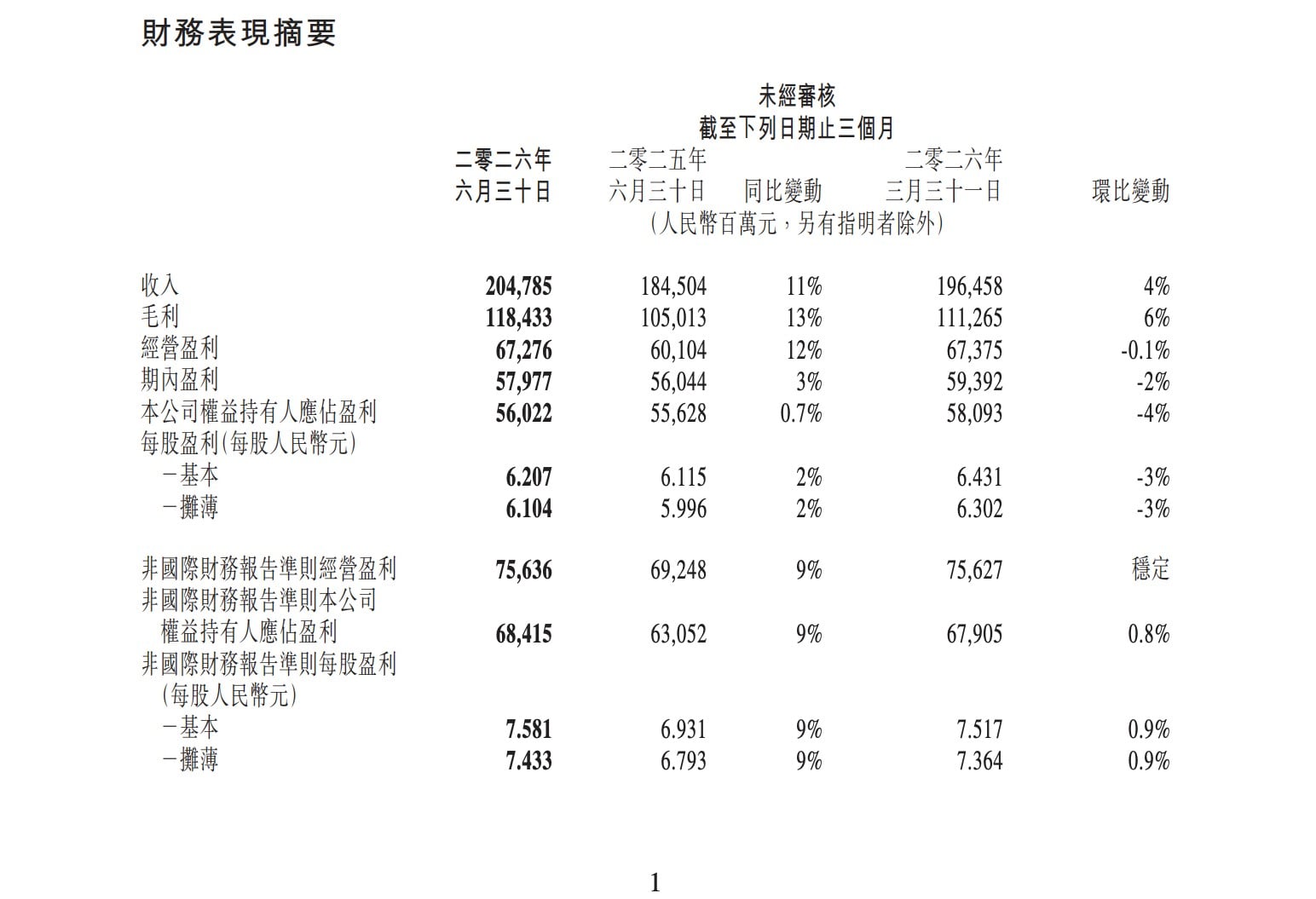
Image source: Tencent Financial Report
In the past few quarters, when Tencent talked about AI, the focus remained on rebuilding the R&D system, catching up with models, and integrating products; by this quarter, AI has begun to substantively change Tencent's financial statements.
The most striking change is the jump in capital expenditure. Tencent's Q2 capital expenditure reached 52.78 billion yuan, a year-on-year increase of 176% and a quarter-on-quarter increase of 65%; R&D expenditure was 27.28 billion yuan, a year-on-year increase of 35%. Due to extensive prepayments for computing power purchases, free cash flow turned to -13.8 billion yuan; excluding related prepayments, free cash flow was still 37.6 billion yuan.
With this over 50 billion yuan capital expenditure, will future depreciation pressures continuously erode profits?
James Mitchell, Tencent's Chief Strategy Officer, responded during a conference call, stating that with strong demand for computing power and rising rental prices, Tencent could easily lease computing power externally, almost immediately recouping depreciation costs and achieving good returns in the short term.
However, Tencent opted for a different route. He indicated that the company is utilizing most of the newly acquired computing power for self-developed large models and AI applications, first refining the models to industry-leading levels and developing market-leading applications. Then, through methods such as token sales for WorkBuddy, they intend to convert superior intelligent capabilities into longer-term, higher economic returns, "this is the path we have chosen."
President Liu Zhiping further elaborated on this investment logic. He suggested that the market view Tencent's business and capital expenditure as two separate parts:
One part consists of existing core businesses like gaming, advertising, and fintech, which show steady growth and sufficient operating leverage; the corresponding capital expenditure is still covered by operating cash flow, maintaining a high-quality cash cow;
The other part is the AI-native new business, encompassing self-developed large models, new applications, and supporting computing infrastructure, where the corresponding capital expenditure essentially represents a concentrated investment during the startup phase—used to purchase model training computing power and reserve reasoning capacity for AI computing and cloud businesses, which will not necessarily grow linearly every year.
In his view, this investment has a very thick safety cushion: on one hand, the growth momentum of large models and applications is favorable; on the other hand, computing power itself is a hard asset, "the portion of computing power pre-purchased a few months ago can now be resold for over 30% profit."
Internally, there is a clear priority for computing power allocation: priority goes to training self-developed large models, then supporting the reasoning consumption of proprietary applications like WorkBuddy, with any remaining computing power rented out through Tencent Cloud. "We believe that by configuring in this order, we can create a large-scale AI-native business in the long term, with profitability, cash flow, and returns being very substantial," said Liu Zhiping.
This explains why Tencent dares to increase investment, but it does not prove that higher returns will definitely occur.
Currently, the closest to a commercial closed loop seems to be WorkBuddy and Tencent Cloud. Tencent stated that the gross profit margin of paying users and the MaaS business of WorkBuddy has already reached Tencent Cloud's overall level; the revenue growth rate of cloud business has also accelerated from about 18% in Q1 to approximately 21% in Q2, with AI demand boosting GPU leasing, model services, and token revenues from WorkBuddy and CodeBuddy.
Investment in AI products rose from 8.8 billion yuan in Q1 to 10.5 billion yuan in the current quarter, closely related to WorkBuddy. James Mitchell pointed out the structural changes within: the allocation of resources over the two quarters differed greatly in areas such as user acquisition. The increase in Q2 was due to the observation of explosive user growth for WorkBuddy, prompting a proactive allocation of resources toward this product while simultaneously lowering the priority of other AI products.
Liu Zhiping further clarified the overall investment principles: the current phase of investment is dynamically adjusted; Tencent always maintains prudence, increasing investment only when clear opportunities for explosive growth are visible. In the long term, the business model will gradually mature, ultimately achieving profitability. The core confidence in Tencent's willingness to invest lies in the fact that they always have a backup plan: "If we switch our strategy and lease out all computing power externally, we can immediately become profitable and not suffer losses. We always have this fallback option."
This is very Tencent. Compared to betting on user scale with a single-point product, it prefers to invest in directions that show real usage signals.
Tencent has proven that the market is willing to pay for computing power and is also beginning to demonstrate that users are willing to pay for productivity tokens. The truly challenging aspect moving forward is whether the incremental value created by self-developed models and first-party applications can consistently exceed the opportunity costs of directly leasing computing power.
2. XiaoWei in Gray Mode: What WeChat Wants is Not Just an AI Entrance
WorkBuddy is tasked with exploring the commercialization of AI in productivity scenarios for Tencent, while the WeChat AI assistant "XiaoWei," still in gray mode, embodies another larger vision: transforming WeChat from a super app where users actively click, search, and navigate, into an intelligent agent ecosystem capable of understanding commands, scheduling services, and completing transactions.

Image source: Visual China
XiaoWei was repeatedly questioned during this conference call. A very realistic concern is whether intelligent agents simplify transaction paths by creating new transactions or merely shifting operations that users previously completed themselves in mini-programs to a more costly AI channel?
Liu Zhiping's response denied the "shift" of existing transactions, asserting that this represents a re-amplification of WeChat's ecological value.
He drew an analogy with the evolution of QQ and WeChat. In the PC era, QQ served as a communication and social tool; during the mobile era, WeChat did not merely transport QQ to mobile devices, but amplified the overall ecological value through capabilities like mobile payments, public accounts, mini-programs, and video accounts. Tencent believes that the significance of AI for WeChat is similar—it’s not just about reducing the number of buttons users need to click, but that it has the opportunity to reconstruct the way users discover content, access services, and complete transactions.
Today, completing a complex task often requires users to search, filter, jump between multiple pages, compare, and place orders themselves; in the future, users might only need to say a sentence to XiaoWei, allowing the intelligent agent to understand their needs, call services, and assist in completing transactions. For users, this signifies a change in interaction methods; for WeChat, this means that service provision, content distribution, and transaction conversion could attain new efficiencies.
Clearly, Tencent does not want XiaoWei to simply be an additional chat entry in WeChat. Its longer-term goal is the so-called "agent-agent transaction closed loop."
According to Liu Zhiping's description, in the future, not only will users have their own intelligent agents, but merchants, mini-programs, and service providers will also gradually have their respective agents. After users issue complex commands to XiaoWei, the user-side agent can directly collaborate with the merchant-side agent to complete information queries, product filtering, service matching, ordering, and even payment. In the past, the basic logic of the WeChat ecosystem was that users actively interacted with content and mini-programs; in the future, the subjects of interaction may shift to collaboration between intelligent agents.
This is, of course, still a long-term vision. Making intelligent agents truly execute tasks on behalf of users is only the first step; more complex issues such as permission authorization, identity verification, payment security, privacy protection, service standards, and merchant integration still lie ahead. Tencent's current statements remain quite restrained: it is not about building a fully autonomous intelligent agent ecosystem all at once, but rather "building the underlying framework for this system step by step."
XiaoWei is still in gray mode, which means Tencent is still validating product experience, demand density, and cost models. However, from the management's statements, one key advantage is that the underlying framework does not rely on cost-unconstrained calls to flagship models.
XiaoWei uses WeChat's self-developed WeLM, emphasizing privacy, WeChat scene adaptation, and inference efficiency. Tencent has clearly distinguished the paths of XiaoWei and the MixBay flagship model: the former does not need to relentlessly pursue the limits of universal capabilities but should seek to find sufficiently good experiences at sufficiently low costs in a billion-level user base with high-frequency interactions and complex ecosystems.
This also ties to Tencent's long-term judgment on edge-side inference. Liu Zhiping believes that in the early stages of AI development, due to insufficient end-device computing power, inference had to be centralized in the cloud. Still, with enhancements in GPU capabilities for phones and computers, and ongoing improvements in model efficiency, more and more inferences will return to user devices. At that point, the capital expenditure on computing power will no longer be primarily borne by large model companies but will be collectively shared by the entire hardware and software ecosystem.
This is a long-term layout. WeChat's self-developed WeLM, refining scene capabilities, and exploring edge-cloud collaboration are, to some extent, reserving a place for this transformation. For Tencent, what XiaoWei embodies as most important may not be becoming an independent monetization product in the short term, but rather enabling WeChat to possess its modeling capabilities, service scheduling abilities, and ecological interfaces before the next round of changes in human-computer interactions arrive.
As for costs, Tencent is also attempting to dispel market concerns in advance. In response to Morgan Stanley's inquiries about computing power prioritization, Liu Zhiping stated that the long-term operational costs for XiaoWei will be lower than the investments in YuanBao over the past year, making it overall manageable; as experiences continue to optimize, returns are expected to quickly cover the investments.
This perhaps is what makes XiaoWei more deserving of attention: it has not yet proven how much new revenue it can bring, but Tencent no longer views it as a simple AI product; it resembles an experiment about the next stage of WeChat's evolution—from "users using applications" to "intelligent agents calling services" and from a super app to the service scheduling layer of the AI era.
3. Gaming Returns to Double-Digit Growth; the Steadiest Foundation Has Accelerated
The other side of the significant investment in AI is the accelerated growth of Tencent's core cash cow business.
In Q2, Tencent's gaming revenue reached 65.9 billion yuan, a year-on-year increase of 11%, marking a return to double-digit growth. Among this, domestic game revenue was 47.3 billion yuan, a year-on-year increase of 17%, significantly faster than the 6% growth rate of Q1; international game revenue was 18.6 billion yuan, a decrease of approximately 1% year-on-year as per report standards, but a 4% increase when computed at fixed exchange rates.
The domestic gaming sector is one of the most noticeable growth highlights this quarter.
PC versions of "Delta Force" and "Valorant" set historical highs for daily active users this quarter, while "Valorant: System Breach" and "King of Blox: World" contributed new product growth. Tencent is forming a more balanced product portfolio compared to the past: on one hand, there are long-lasting products like "Honor of Kings" and "Game for Peace", and on the other hand, there are ongoing breakthroughs in the shooting genre and new IP products to attract younger users.
This round of growth is primarily attributed to product cycles, content updates, and operational capabilities; however, AI has started to integrate into the core production and operation chain of Tencent games.
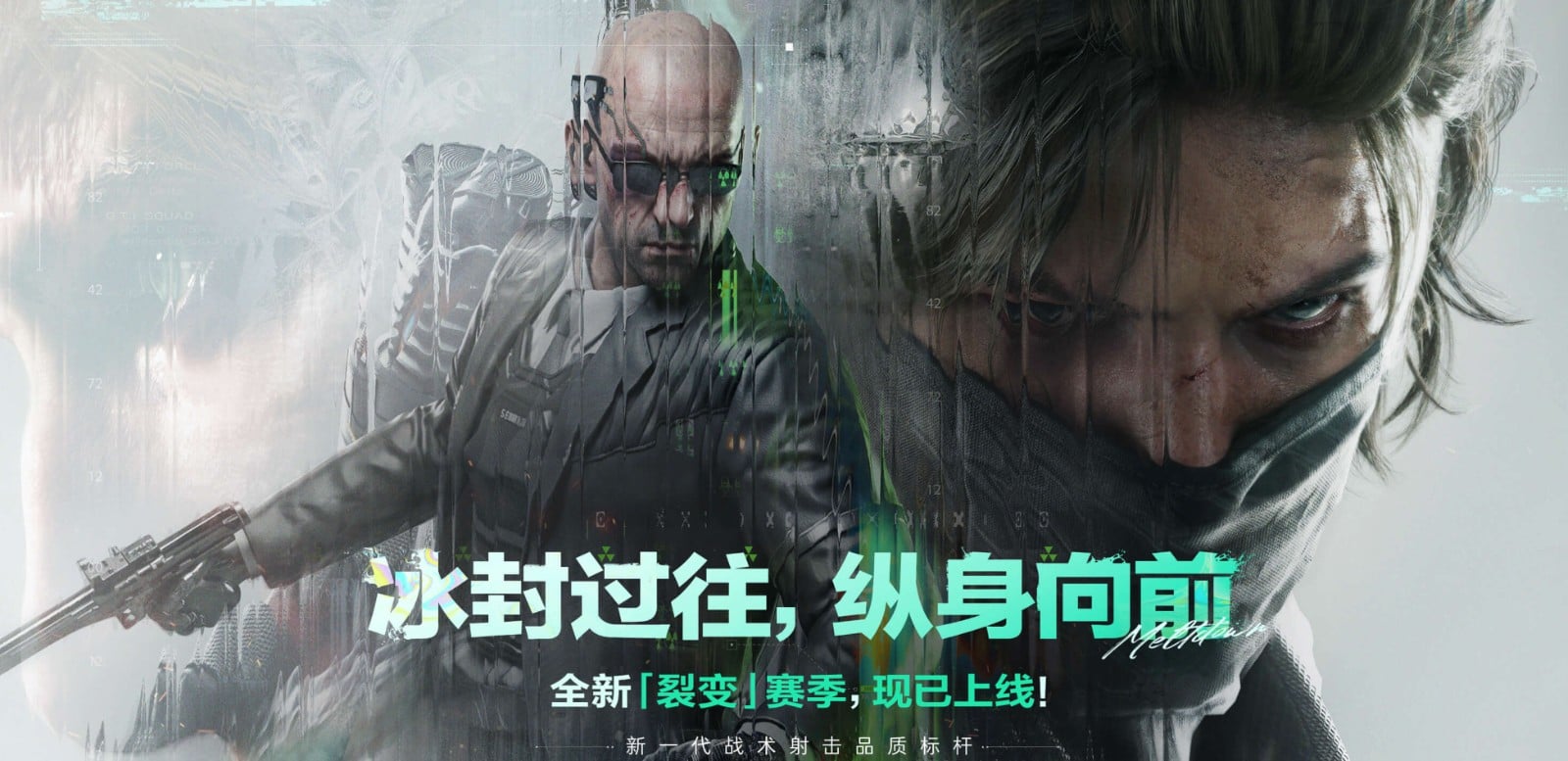
Image source: Delta Force official website
"Delta Force" utilizes data intelligent agents for performance analysis and generates some assets through MixBay 3D modeling; "Game for Peace" has introduced AI NPCs into actual gameplay, reporting a cumulative user experience of 167 million and a peak daily active user count of 17.7 million; "King of Blox: World" has launched a Coach Agent named "Scarlett" aimed at aiding complex gameplay decisions, with Tencent stating that this feature improved PVP activation rates by 20%.
The gaming industry has always been a business constrained by content costs and the speed of content supply. The larger the development scale, the higher the players' demands for update frequency, and the greater the long-term operational costs. Generating 3D assets, code reviews, data analysis, and automated operations primarily changes production efficiency; AI NPCs, AI teammates, and Coach Agents begin to change the nature of the content itself.
In the previous phase, AI primarily helped gaming companies "produce content faster", while the next phase will determine whether it can create dynamic content that previously did not exist—adjusting teammates and opponents in real time based on player abilities, integrating continuously interactive NPCs, generating maps and gameplay by ordinary players, and providing lower-threshold UGC tools.
For Tencent, this may be more crucial than simply lowering R&D costs. The true strength of Tencent's gaming division lies in its ability to operate products for a decade or more. If AI can enhance content supply density, lower long-term operational costs, and lead to continuous gameplay variation, it will ultimately influence the life cycle and user value of long-lasting games.
This path is still in its early stages. The independent contribution of AI to gaming revenue cannot yet be isolated from the financial report, but the acceleration of the gaming business at least provides Tencent with a thicker cash flow foundation to continue investing in AI, and gives it a foothold closest to commercial returns.
4. After Profit Growth Slows, AI Must Start Proving Returns
So far, Tencent's share price in Hong Kong has fallen 26% this year, down nearly 30% from its 52-week high. What the market is most concerned about is not whether Tencent will venture into AI but how much it will spend on AI, for how long, and who will be accountable for this expenditure.
During the conference call, management repeatedly conveyed signals: this is not limitless cash burning, but rather investments with boundaries, safety nets, and dynamic adjustments.
AI-related capital expenditure is defined as a concentrated investment in the next two years, rather than a long-term burden that grows linearly every year; there is an overall budget constraint internally, and resources will continuously be directed towards products showing clear growth signals; even in the most conservative scenarios, new computing power can be leased out through Tencent Cloud to cover costs and generate returns.
Management even provided stronger statements: under current market conditions, some of the previously pre-purchased computing power could generate considerable profits if shifted towards leasing.
This also distinguishes Tencent from many other AI companies betting on single-hit products. It uses the mature cash flows from gaming and advertising as a safety net, leverages cloud business to capture the spillover value of computing power infrastructure, explores the commercialization path for productivity scenarios through WorkBuddy, and bets on XiaoWei shaping the next form of the WeChat ecosystem in the AI era.
With several lines advancing in parallel, resources will continue to concentrate on whichever line first achieves positive feedback loops between user growth, revenue, and costs.
With over 50 billion yuan in capital expenditure at stake, a turning point has become clear: starting from this quarter, Tencent's AI narrative is moving away from the traditional internet company model of "light R&D, quick iteration" towards one of "heavy computing power, long cycles, and ecological integration."
The slowdown in profit growth may just be the beginning. In the next year or two, the market will need to gradually adapt to a Tencent that still possesses strong cash cow businesses while converting more current profits into GPUs, model capabilities, and tickets to the next generation of the internet.
Ultimately, whether this investment pays off will not depend on the depreciation expenses in a single quarter, but on several more long-term questions: Can WorkBuddy truly grow into a productivity platform? Can XiaoWei propel the WeChat ecosystem into the AI era? Can MixBay stand firmly in the leading tier amid continuous technological iterations?
Answers to these questions remain on the way.
免责声明:本文章仅代表作者个人观点,不代表本平台的立场和观点。本文章仅供信息分享,不构成对任何人的任何投资建议。用户与作者之间的任何争议,与本平台无关。如网页中刊载的文章或图片涉及侵权,请提供相关的权利证明和身份证明发送邮件到support@aicoin.com,本平台相关工作人员将会进行核查。


