Written by: Thejaswini M A
Translated by: Saoirse, Foresight News
In February 2025, the market anticipated that the United States would soon introduce tariff policies, prompting traders to withdraw gold from the Bank of England's vault to transport to New York. The waiting time for gold bar withdrawals extended from several days to 4 to 8 weeks, with all withdrawal appointment slots fully booked.
Dave Ramsden, Deputy Governor for Market Operations at the Bank of England, told reporters that the process of entering the building that morning was particularly cumbersome due to a freight truck parked in the gold and silver vault area.
The daily trading in the London gold market involves ownership certificates for gold, while physical gold is securely stored in the vault. However, during that period of uncertainty, the extractability of gold directly impacted its price: the price of gold belonging to the Bank of England fell due to the long withdrawal queue lasting weeks; the price of gold in commercial vaults rose as buyers were willing to pay a premium to extract and transport physical gold immediately.
On an ordinary trading day in May, the scale of gold trading on the floor reached $73.7 billion, handled by various banks responsible for London gold clearing, without the need to move physical gold. By the end of July, gold stored in London vaults totaled 9,534 tons, valued at $1.2 trillion, equivalent to approximately 762,000 gold bars. Clearing institutions indicated that this mechanism was designed to operate this way — transporting physical gold incurs high costs and carries security risks.
This article will discuss why the Financial Conduct Authority (FCA) is beginning to formulate regulatory rules for tokenized gold and why the relevant regulations focus entirely on the ledger system.
London is the global center for gold trading. The London Bullion Market Association (LBMA) is the industry's trade organization responsible for setting industry standards. The final clearing of debts and credits among trading parties is completed by four clearing banks: HSBC, ICBC Standard Bank, JPMorgan Chase, and UBS Group. The electronic matching and clearing institution operated by these banks is the London Precious Metals Clearing Limited (LPMCL, also known as AURUM).
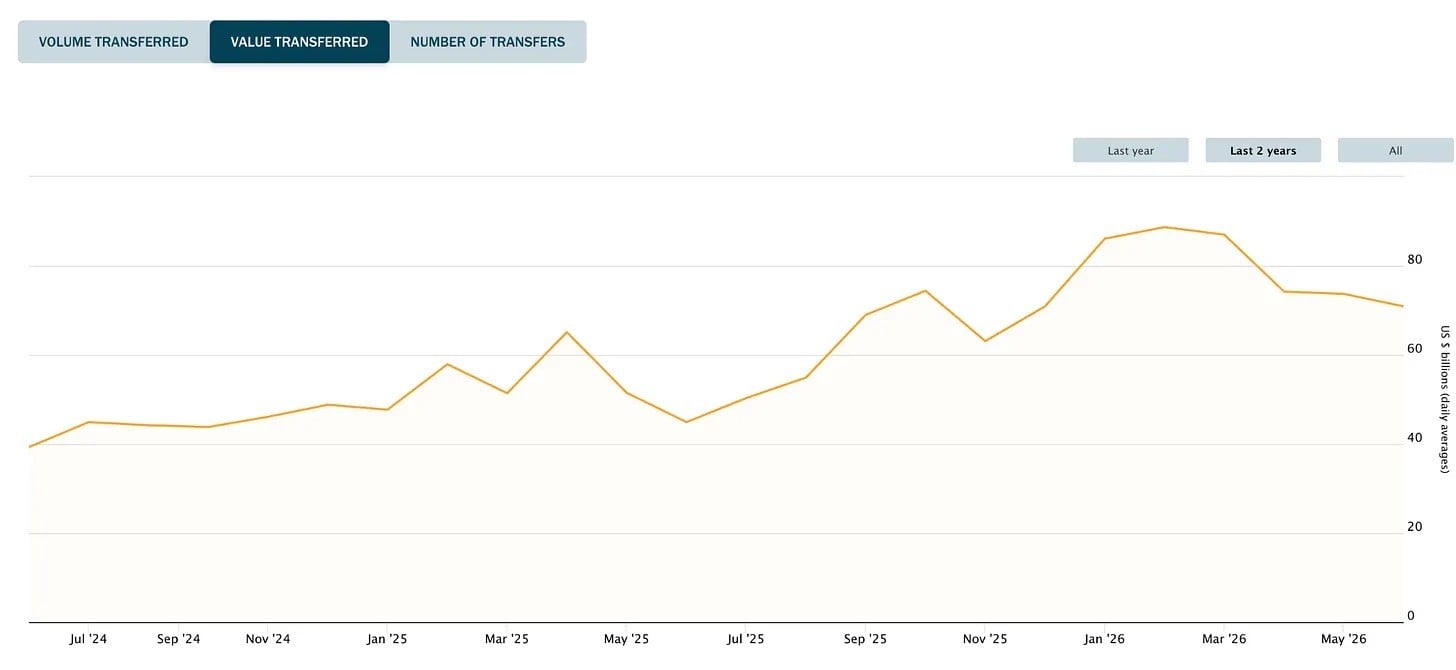
@lbma
The FCA has been communicating with major banks to discuss how to regulate tokenized gold and whether such assets can be used as collateral in the wholesale market. Prior to this, the FCA, the Bank of England, and the Prudential Regulation Authority jointly released a report on May 18, 2026, stating that tokenized gold can be used as collateral for non-cleared over-the-counter derivatives, citing precedents in this area.
In April, the FCA published a policy statement confirming that various money market funds (including tokenized funds) are eligible to become collateral for non-cleared transactions under the UK’s version of the European Market Infrastructure Regulation (UK EMIR).
Currently, there are 16 institutions in the UK conducting tokenization-related pilots in the regulatory sandbox. The UK government estimates that by 2035, tokenization technology could add £33 billion to the UK economy annually. The first tokenized government bond is expected to be launched in early 2027, coinciding with the Bank of England upgrading its collateral system; by 2028, various digital ledgers are expected to achieve interoperability with the digital pound.
There is a common view that London's push for gold tokenization is driven by concerns over business loss to Asian markets. However, the fact is that this technology was independently developed by London-based clearing banks. At the end of 2023, HSBC split standard 400-ounce gold bars in the London vault into smaller digital shares, facilitating trading for institutional investors. Subsequently, the bank launched a version for retail customers in Hong Kong, achieving a total trading volume of $2.2 billion, but this innovation originated in London.
The London gold market fulfills four core functions: the first two are physical storage (vault and security) and quality verification. Quality verification ensures the purity of the gold complies, so buyers do not need to melt gold for re-testing.
Tokens clearly cannot perform these two tasks and must rely on physical infrastructure to operate. The third function is to register ownership of the gold. Tokens perform excellently in this aspect, being low-cost, which has become a consensus.
The fourth function is credit business, which is also the crux of the contradiction. Gold tokenization would render the existing banking credit system obsolete. With tokens, ownership of physical gold can be transferred instantly, allowing investors to avoid lodging gold with banks in exchange for convenient trading channels.
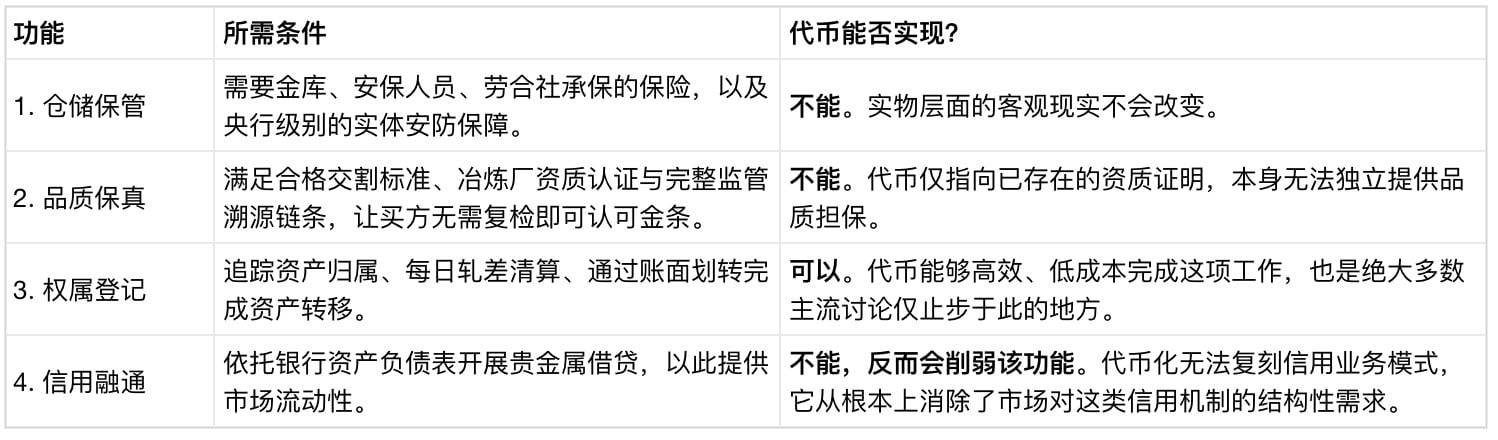
The vast majority of gold in the London market is held and traded in an unallocated account model. Clients do not own specific gold bars but have a general entitlement to a corresponding amount of gold. The LBMA likens this model to bank deposits priced in ounces. Clients are unsecured creditors of the clearing members. The gold in the vault is consolidated on the bank’s balance sheet, maintaining the operation of the entire trading system. After a transaction is completed, the bank can immediately finalize account entries, leaving a few days to process physical delivery in the background.
Buyers have two choices: the first is to claim specific physical gold bars, which requires payment of storage fees and has a slow asset transfer process; the second is to hold unallocated gold, which is essentially a loan receipt issued by the bank. Investors bear the bank's credit risk, but transactions can be completed instantly. The vast majority of market participants choose the second option. In February, the average single transaction size was approximately equivalent to five gold bars, relying on this mechanism, and the gold never leaves the vault.
What would happen if it were converted to a token model? Tokens would combine the transaction speed of receipts with the ownership confirmation of corresponding physical gold bars. When both advantages are present, investors have no reason to bear bank credit risk. The London market itself has already become highly electronic, so merely upgrading settlement technology is not the biggest change.
The FCA prioritizes focusing on collateral scenarios rather than trading scenarios because collateral business heavily relies on speed. The notification for additional margin is given to institutions with a very short time limit, and the traditional gold settlement system's circulation speed is too slow, resulting in $1.2 trillion worth of gold being unable to be used as collateral, forcing institutions to resort to cash or UK government bonds as collateral. Regulators understand that recording gold information on-chain can address this pain point: ownership can be split and transferred instantly and precisely, allowing all vault gold to be used as high-quality collateral.
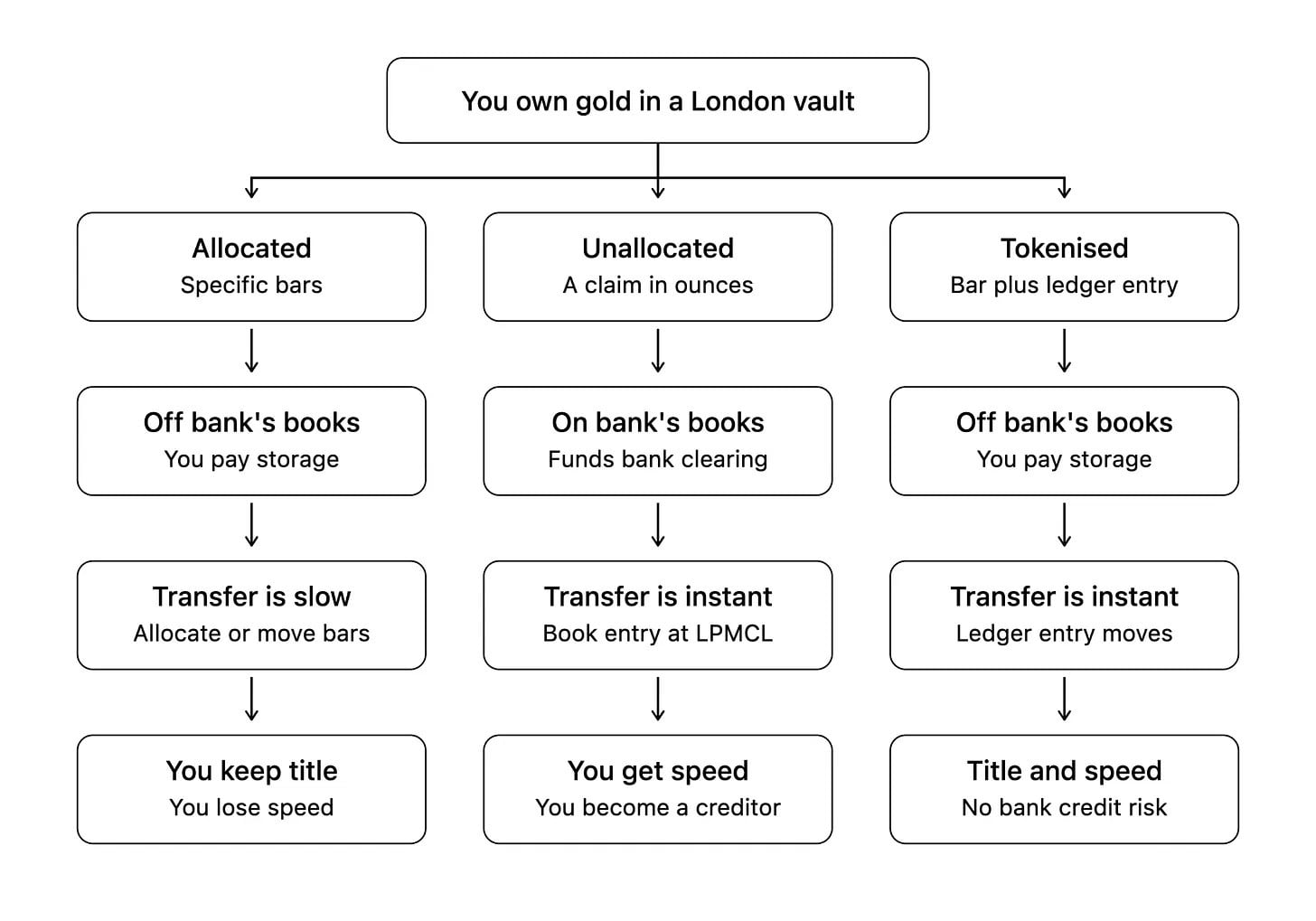
Comparing the three gold holding methods in the London vault: allocated gold has physical ownership but slow transfers; unallocated gold has quick transfers but only represents a bank creditor, bearing credit risk; tokenized gold combines physical ownership with instant transfer capability, with no bank credit risk.
The securities industry has already implemented similar solutions. HQLAX services support major institutions such as BNP Paribas, Morgan Stanley, and JPMorgan Chase, trading ownership of collateral without moving the underlying physical assets. The SEC even allowed U.S. broker-dealers to access this service in May 2026, with a pilot period of 36 months.
This transformation was foreseen long before the rise of cryptocurrencies, stemming from stringent banking regulatory rules. When global regulators launched Basel III's Net Stable Funding Ratio (NSFR) rules, they classified unallocated account gold as a non-liquid asset, requiring banks to hold an 85% stable funding buffer. The London precious metals industry strongly protested, warning that clearing banks might exit the market. Now, tokenization technology is completing the transformation initiated by Basel III.
I have a concern: the banks that are driving the implementation of this technology are precisely those that once strenuously defended the old system.
The vault business storing 12.5-kilogram gold bars was originally outside the FCA's regulatory scope; however, holding gold tokens in the future will require obtaining full regulatory qualifications.
In February this year, the UK Parliament passed a new regulatory framework for crypto assets, leading to changes in the legal environment. The FCA then officially regulates crypto asset custody and trading platforms. Companies will have a 5-month window starting from September 30 to submit qualification applications, and the entire set of regulations will come into effect in October 2027. Relevant rules are still being refined, and the FCA continues to optimize client asset custody regulations, with lawmakers attempting to extend traditional market exemption rules to the tokenized field.
The underlying physical gold itself will not undergo any changes; vaults, insurance, and security personnel will continue to operate as usual.
Once the ownership records are converted to tokenized form, related businesses will immediately fall under regulatory scope. This is precisely the boundary delineated by regulators: the core of regulation is the legal rights corresponding to the gold. Tokens transfer ownership in a new way, so the FCA must introduce entirely new regulatory rules.
If accounting costs are compressed to nearly zero by software, value will flow directly toward scarce physical assets. The barriers to entry in the London vault market are extremely high, with only four clearing banks and three security transporters, and no new entrants for over a decade. Tokens will not disrupt these physical service providers; code cannot replicate the security systems of physical vaults. In fact, tokens may further enhance the importance of physical custody institutions, as every digital certificate must rely on physical custody services. Related companies only need to adjust their business models, shifting revenue sources from customer gold deposit services to standardized service fees for storage, auditing, and collateral support services.
The concept of gold tokenization in London has a long history. Paxos and the European Clearing Bank attempted to implement it as early as 2016, but the project was shut down 13 months later. Now, the model is feasible, with a key difference being that the leading parties are now major clearing banks rather than external startups forcibly pushing technological solutions.
Taking HSBC as an example, the bank has built an in-house system to handle all transactions, creating a closed ecosystem and controlling the pace of the transformation independently. The ultimate direction of this market change depends on the FCA. Regulators need to make a critical ruling: whether gold tokens issued by HSBC are allowed to circulate outside the HSBC system. If regulation allows circulation, the market structure will be completely rewritten; if prohibited, the old banking model will simply continue to operate under a new shell.
How can we determine whether tokenization is genuinely widespread? We can track the transformation process through publicly available data from the LBMA.
The LBMA has released two sets of data: total market trading volume and traditional central ledger clearing volume. Once the market extensively uses tokens, total trading volume will remain high, with investors continuously buying and selling; however, traditional clearing volumes will decline. This is because token transactions are completed with instant transfers on the blockchain, completely bypassing the traditional London clearing system.
At this stage, the old system's trading volume remains substantial. The clearing ledger experiences ownership changes of about 20 million ounces of gold daily, while approximately 306 million ounces of gold remain static in the vaults long-term. This means that on average, about every 15 ounces of gold, 1 ounce circulates solely through paper transactions, without any physical gold moving.
Humans have created mathematics, cryptography, and global networks, ultimately resting on the quietly stored gold in underground vaults, isn’t it?
免责声明:本文章仅代表作者个人观点,不代表本平台的立场和观点。本文章仅供信息分享,不构成对任何人的任何投资建议。用户与作者之间的任何争议,与本平台无关。如网页中刊载的文章或图片涉及侵权,请提供相关的权利证明和身份证明发送邮件到support@aicoin.com,本平台相关工作人员将会进行核查。


