Written by: Xiaobing
Someone built a processor on the chain.
Not a simulation, not a proof of concept, but a real four-bit processor built according to the specifications of the 1971 Intel 4004, running on the BNB Chain, clocked by block generation, with a frequency of 2.22 Hz. Its creator named it: Behemoth.
This is probably the slowest CPU in the entire universe, but it might be the most interesting new species in on-chain storytelling.
What is TapeOut?
"Tape out" is an ultimate milestone in the semiconductor industry, meaning the chip design is completed, the layout files are sent to the wafer fabrication plant, etched into silicon wafers, and from then on, it cannot be changed and exists permanently.
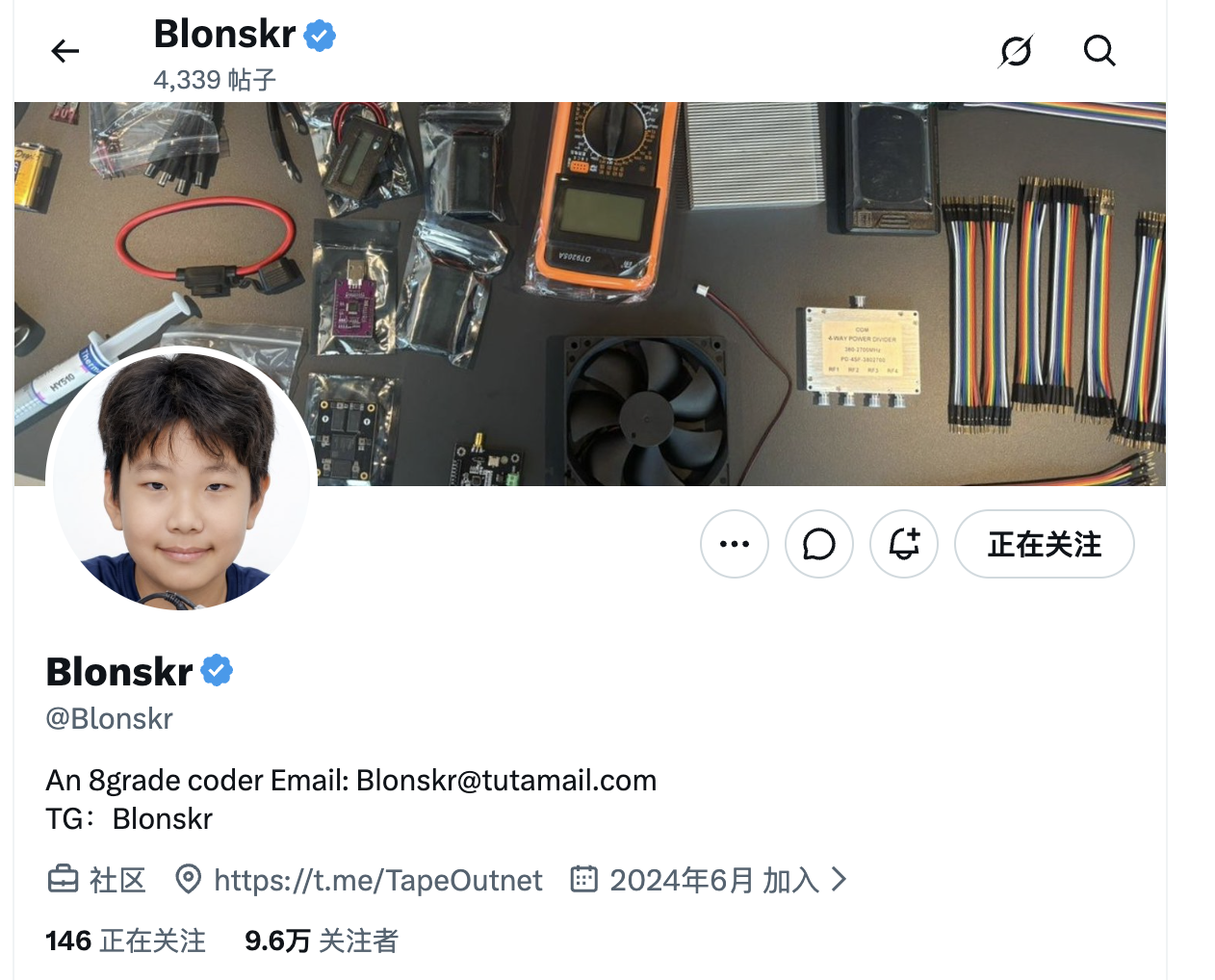
A young developer named Blonskr brought this concept onto the chain.
The TapeOut protocol can be summarized in one sentence: treating the blockchain as silicon, using Tokens as transistors, allowing anyone to "tape out" real, runnable logic circuits on-chain.
Sounds like a fairy tale? Let's break it down.
The Origin of Everything: A NAND Gate
All digital computation can be reduced to a minimal logic unit, a NAND gate, which is common knowledge in computer science: given enough NAND gates, you can build adders, decoders, registers, up to an entire CPU.
The TapeOut protocol does one thing: it turns NAND gates into Tokens.
One Token = one transistor (more accurately, one NAND gate), based on the ERC-1155 standard, 7 bytes, which can be minted; it is the atom in the TapeOut world.
In this world, you have only two things: NAND gates (for processing logic) and triggers (for storing a state bit, updated every time a block is generated). One is responsible for computation, the other for memory. Blonskr wrote an ambitious line in the white paper: From these two things, the entire universe can be built.
From Transistor to Circuit: Lego on the Chain
With transistor Tokens, the next step is to connect them together.
TapeOut.net provides a "processor canvas system". You drag transistors in your browser, pulling a wire from one output to another input; on the chain, this signifies a pointer assignment. All operations run in real-time locally, without gas fees, allowing for trial and error.
Once satisfied, you hit that button: "tape out".
What happens at this moment is: your transistor Token is truly burned, and an electric circuit NFT is born. Using the ERC-721 standard, the logic of the circuit is recorded as a pure data segment, with no call permissions, and can only be used for computation.
Here are some intuitive figures:
- 5 transistors → one half adder
- 9 transistors → one full adder
- 36 transistors → one four-bit adder, capable of performing addition
- 100 transistors → one seven-segment decoder, digits can "light up"
- 2300 transistors → equivalent to the Intel 4004, the historically groundbreaking commercial microprocessor from 1971
The key design: when you create the next circuit, you don’t have to start with basic components. You can treat any circuit made by others as a black box and directly drag it into the canvas to continue wiring. This is Lego-like, combinable processor manufacturing.
"Behemoth" is powered on
Blonskr built a chain-based CPU with 2300 transistors, according to the real specifications of the Intel 4004, and named it "Behemoth".
Its clock source is the block generation of the BNB Chain. Every time a new block is created, the processor moves forward one clock cycle. The current block generation time of BNB Chain is 0.45 seconds, so this CPU has a default clock frequency of 2.22 Hz.
For comparison, the chip in your phone probably runs at around 3 GHz, which is approximately 1.35 billion times faster.
But speed isn't the focus; the key features of this processor are:
Permanently running. As long as the BNB Chain is still generating blocks, this CPU will not stop. No one can turn it off, not even Blonskr himself, because the core factory contract of the TapeOut protocol relinquishes all permissions after deployment.
Free calling. Anyone can call the circuits on the chain. Evaluation is a read-only query, generates no transaction, incurs no gas fees, and nodes return results directly after computation. It can be called with five lines of front-end code, a terminal command, or even by filling in two boxes in a block explorer.
Absolutely safe composability. This might be the most interesting design of TapeOut. On-chain circuits don't involve "calling others", have no writable state, and gas consumption can be checked before the call. Receiving the circuit written by a completely unfamiliar person, the worst outcome is that it returns an error answer; there’s no way it can harm you.
This is the first time on-chain that you can confidently execute logic written by a stranger.
Who is playing, and how to play?
TapeOut has launched a transistor trading market. According to publicly available data, within 5 hours of launch, 237 addresses completed 543 transactions, with a total transaction volume of 58.41 BNB, and the protocol collected 0.58 BNB in fees.
The scale is not large, but for an extremely niche experimental protocol, this early level of participation indicates something: someone is willing to pay for the idea of "building a CPU on-chain".
Even more interesting is a direction proposed by Blonskr: future mining will no longer be based on electricity costs and the number of mining machines, but on the sophistication of circuit design, using your own designed dedicated circuits for mining. If this idea holds, it will change the definition of "miners" from "energy consumers" to "logic designers".
The core of the TapeOut protocol is a factory contract. Anyone can call it to deploy their own on-chain processor. The initial state is a blank silicon wafer; your first decision is: how many transistors does this CPU have?
Intel 4004 had 2300. Pentium had 3.1 million. Apple M1 had 16 billion. What about yours?
Every CPU bytecode cloned by the factory is identical, meaning your circuit can naturally call circuits on any processor in the world. This is an open, permissionless on-chain processor network.
Why is it worth paying attention to?
TapeOut may not become the next billion-dollar narrative; it's too geeky, too slow, and too far removed from the needs of ordinary users.
But it has done something no one has done before: reducing computation to the lowest level of physical logic, and then re-wrapping it using the persistence and openness of blockchain. It is different from DeFi Lego and on-chain gaming; it is an extreme answer to the question of "what can be supported on-chain".
From a NAND gate Token, to a circuit NFT, to a processor that will never shut down, each layer uses the same structure, completely open and fully combinable.
Blonskr wrote a line at the end of the white paper: not knowing what fun twists the TapeOut protocol will evolve into in the future, but looking forward to it.
For a developer who is said to still be a child, this restraint and curiosity might be more noteworthy than a clock frequency of 2.22 Hz.
Disclaimer: This article is for information sharing and technical interpretation only and does not constitute any investment advice.
免责声明:本文章仅代表作者个人观点,不代表本平台的立场和观点。本文章仅供信息分享,不构成对任何人的任何投资建议。用户与作者之间的任何争议,与本平台无关。如网页中刊载的文章或图片涉及侵权,请提供相关的权利证明和身份证明发送邮件到support@aicoin.com,本平台相关工作人员将会进行核查。


