Guide
The first cross-chain arbitrage: gross profit +0.01U, cost -0.11U, net loss 0.10U.
The price difference capture was successful, so why is there still a loss? Because gas fees and bridge fees are fixed costs that do not scale with position size.
Open the Five Questions Verification Method to determine the authenticity of any “magical trading post” and share a real, hands-on cross-chain arbitrage example.
The amount is very small, merely 0.10U in tuition, but it demonstrates the most core truth behind arbitrage.
Conclusion first: This trade successfully captured a price difference, with positive gross profit, but ultimately a net loss of 0.10U. The reason for the loss was not a wrong direction judgment but that the position size was too small, smaller than the fixed cost line of this pathway.
This article will break down this bill and tell you what to calculate before placing each trade order in the future.
👉 Click to enter Bybit and explore the new world of arbitrage:
https://jump.do/zh-Hans/xlink-proxy?id=15

1. A Real Cross-Chain Arbitrage Bill
Action: Transfer 0.004 ETH (approximately 7.51U at the time) from one chain to another to take advantage of the price difference for a small arbitrage.
📌 Original Bill Breakdown
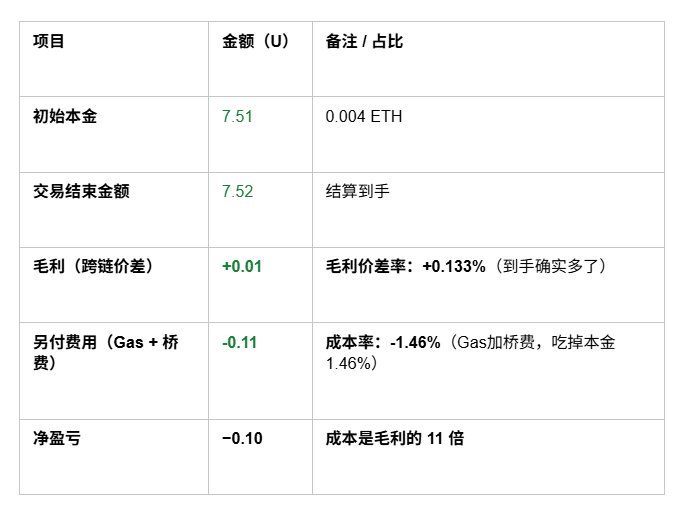
There is a common misconception here: if you only look at the gross profit, you might think, “this arbitrage logic is valid, just that there is little money involved.”
Wrong! This trade is structurally a loss because it is far below the minimum effective scale for this path.
2. Why Small Positions Must Fail: Fixed Costs Do Not Scale with Position Size
What type of fees are gas and bridge fees? Fixed costs.
Crossing 0.004 ETH is almost the same gas cost as crossing 1 ETH;
The fixed service fee for the cross-chain bridge remains the same, and it does not get cheaper just because you have less money.
And what about price difference rates? They basically do not change with position size. +0.133% remains +0.133%, regardless of whether the principal is 10,000 U.
Thus, a fatal contradiction occurs:

💡 Backtrack to Find the Breakeven Point and Optimal Scale
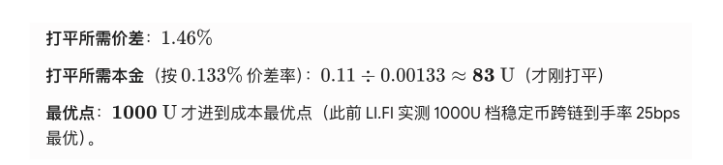
Core formula:

If it's below this number, even if the gross profit is genuine, it will still result in a net loss. Scale is not optional for arbitrage; it is a parameter itself.
3. Just Because It Looks Profitable Doesn't Mean It Is
This tuition of 0.10U, when compared with two larger numbers recently seen, is about the same thing. Three independent matters pointing to the same lesson within 48 hours:
Case 1: Grid system earning 1300U in a month
Four exchanges and six accounts running a grid. An assessment of OKX BTC over 13 months of real market conditions: in declining months, 8 out of 8 lost, while all 5 in non-declining months made a profit; yet with 0 fees throughout, still resulted in a net loss of 1122U. The 1300U was generated in a low-volatility month, indicating status selection bias rather than strategy effectiveness.
Case 2: Polymarket Monthly Leaderboard
The leaderboard shows a PnL of 1.09 million U, with the fifth place at 454,000 U. Rebuilding the real accounting with public event streams: the fifth place lost 121,000 U purely from trading in recent 11 days, and the 74.6K is rebate income, not trading capability. The leaderboard figures are pre-tax, without expenses and rebates included.
Case 3: This Cross-Chain
Gross Profit +0.01U, Net Loss 0.10U. Costs are 11 times the gross profit.
The deviation mechanisms in the three cases are different (status selection bias, pre-tax figures, fixed costs not scaling), but the conclusion is consistent: When costs and gross profits are of the same level, all "gross" figures are illusions.
🛡️ Insights: The "Five Questions Method" to Evaluate Any Profitable Cases
In the future, when you see any trading posts, revenue screenshots, or any "annualized 20%", first go through these five questions:
1. Pre-tax or post-tax? Are costs, rebates, and subsidies included in the numbers?
2. What percentage of gross profit do costs occupy? Less than 10% is safe; over 50%, the figures are illusions, and on the same scale, they will turn negative.
3. What is the dependence on rebates/subsidies? Rebates are based on expense ratios. More rebates mean more expenses, which is reliance on liquidity rather than profitability.
4. What is the market condition of the sample window? Conclusions validated only in low-volatility/bull markets are untrustworthy.
5. Has the position reached minimum effective scale? If not, even a genuine gross profit results in a net loss.
4. The Correct Approach for Beginners: Understanding Processes with Small Amounts
Is this tuition of 0.10U worth it? Absolutely worth it. What it brings is not profit but process understanding.
“It is highly recommended to first choose a strategy and practice it with small amounts, whether you lose or gain is secondary, mainly to experience the process and how AI works.”
The positioning of small-amount practices is to buy “process understanding” at the lowest cost: Select strategy → Quote → Place order → Reconcile → Review, go through the entire process.
This cross-chain, although it lost 0.10U, has completed the whole process: cross-chain, settlement, reconciliation, with each step having Tx Hash, fee breakdown, and profit/loss figures. The understanding gained (minimum effective scale = 83U) far exceeds the tuition.
🛠️ Three Practical Tips:
1. Amount: Keep it within 1%-2% of the budget, losing it all should not hurt.
2. Purpose priority: Process > Data > Profit. Profit comes only after the process has been successfully completed.
3. Each transaction must produce: Tx Hash + Fee Breakdown + Reconciliation Table, let AI handle scripts, reconciliation, and reviews.
Small-amount practical testing validates the process, not real profit. Do not regard testing as income, and do not negate a successfully practiced process just because you lost 0.10U.
Evaluate any profitable case by going through the five questions: parameters, cost ratios, reliance on rebates, market conditions, minimum effective scale.
Small-amount practice buys process understanding: Purpose priority is Process > Data > Profit.
The first unchanging principle of risk control: Arbitrage is a game of probabilities, black swans are everywhere, and managing exposure takes precedence over seizing opportunities.
AiCoin Official Telegram Community: t.me/aicoincn
AiCoin Chinese Twitter: https://x.com/AiCoinzh
Bybit Benefit Group: https://aicoin.com/link/chat?cid=7JmRjnl3w
Disclaimer: This article is for strategy popularization and activity information sharing only and does not constitute any investment advice. Cryptocurrency is a high-risk asset, past performance does not predict future results, and please invest rationally based on personal risk tolerance.
免责声明:本文章仅代表作者个人观点,不代表本平台的立场和观点。本文章仅供信息分享,不构成对任何人的任何投资建议。用户与作者之间的任何争议,与本平台无关。如网页中刊载的文章或图片涉及侵权,请提供相关的权利证明和身份证明发送邮件到support@aicoin.com,本平台相关工作人员将会进行核查。