

Author: Emily, Bitget Wallet Researcher
Preface: A Contract Unknown and Unsigned by Anyone
In the past decade, you may have been promoted, received pay raises, and learned to spend money more wisely—using cashback rules with credit cards and various "money-saving" techniques to minimize the marginal costs of every expenditure. You have done all the "right" things.
But if you convert the numbers on your paycheck into purchasing power from ten years ago, you will discover something quite uncomfortable: wages are rising, account balances are rising, but the things you can purchase—the same house down payment, the same family vacation, the same dinner you once thought was "a bit expensive but still affordable"—are quietly becoming more expensive.
This is not an illusion, nor is it due to your insufficient financial management skills. This is the result of executing a contract, one you have never read, never signed, but fulfill obligations every day. The other party of the contract is the major central banks around the world, and the terms are very simple: every year, the currency in your hands will depreciate by about 2%. This is not an accident or a mistake, but a policy goal that has been collectively established by almost all major economies in the world over the past thirty years.
The question is: if we had known the terms of this contract ten years ago and chose not to use cash but to fulfill the function of "saving" with valuable assets, how different would today’s situation be? This article aims to calculate this matter seriously.
2%, an Open "Devaluation Commitment"
Inflation is not a fault; it is by design
In the minds of most people, inflation seems like a fault of the economic machine, a state of imbalance that needs to be "cured." However, the actual evolution of monetary policy over the past thirty years has been quite the opposite: major central banks around the world have gradually viewed stable positive inflation (around 2%) as an important target of monetary policy.
This turning point can be traced back to New Zealand in 1990. At that time, New Zealand had just struggled out of the high inflation quagmire of the 1970s and 1980s. The Reserve Bank of New Zealand Act 1989 established the independence of the central bank and the inflation targeting framework. The first Policy Targets Agreement (PTA) signed by New Zealand in 1990 set a CPI inflation target of 0-2%, making New Zealand often regarded as the birthplace of "inflation targeting."
This framework has since proven to be highly "contagious." Countries such as Canada, the UK, and Sweden followed suit in the early 1990s. However, what truly made "2%" the default language of global monetary policy were several larger economies belatedly making impactful statements:
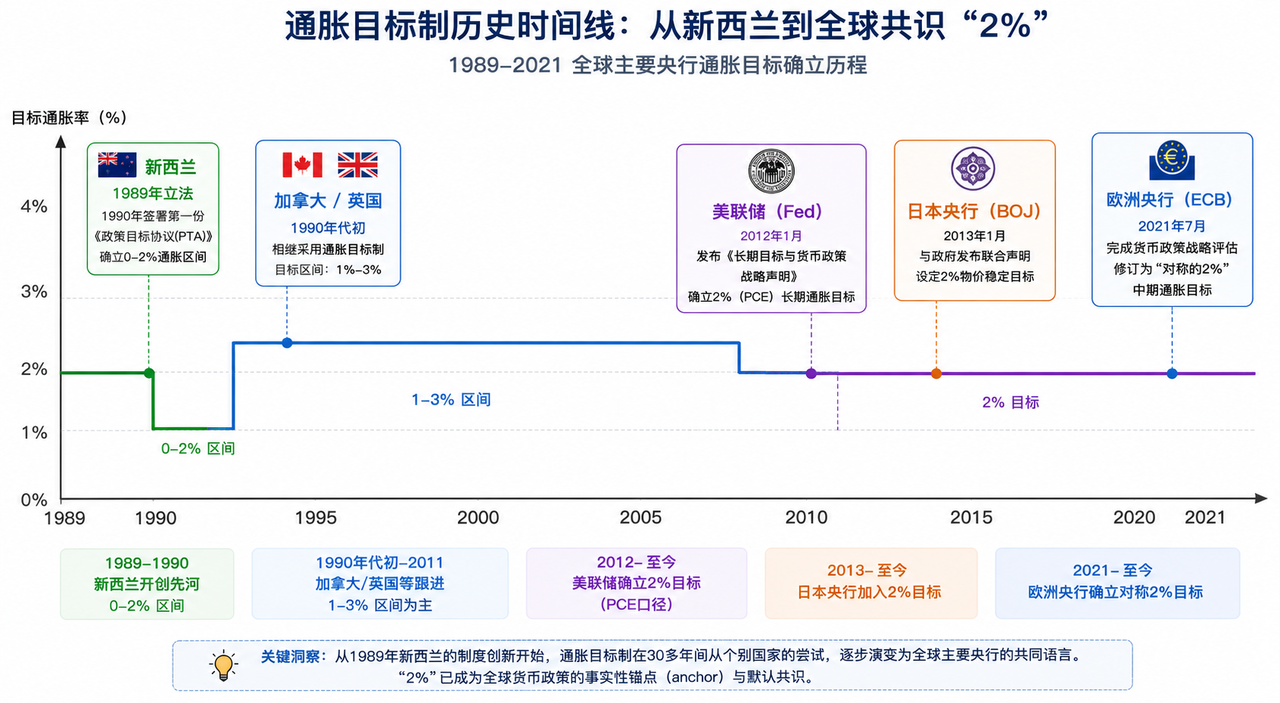
The Federal Reserve officially published its Statement on Longer-Run Goals and Monetary Policy Strategy in January 2012, establishing 2% (as measured by the PCE price index) as the "long-term" inflation target for the first time in its history. Notably, the Federal Reserve was founded in 1913 but did not formally announce this number in an official statement until nearly a century later, highlighting that "inflation targeting" is a relatively young institutional invention rather than an innate characteristic of monetary policy.
The Bank of Japan issued a joint statement with the government in January 2013, setting a 2% "price stability target," serving as the core anchor of the monetary policy pillar of "Abenomics" to end nearly twenty years of deflation and slow growth.
The European Central Bank completed its monetary policy strategy review in July 2021, revising its prior vague statement of "below but close to 2%" to a clearer "symmetric 2% medium-term target," which means that inflation above or below 2% is viewed as a deviation, not "the lower, the better."
Why central banks "had to" make such choices
If we just look at the results, "actively choosing to let the currency depreciate every year" sounds like a form of negligence. However, from the central banks' own policy logic, this is almost a reluctant but rational choice, constrained by three layers of reality:
First, avoiding a deflationary spiral. The reason why deflation is more terrifying than mild inflation lies in the psychological mechanism: if people anticipate that tomorrow's prices will be lower, the most rational choice is to postpone consumption and investment, which will further dampen demand, causing prices to continue to fall, forming a self-reinforcing spiral. Japan’s "lost two decades" from the 1990s to the early 2010s is often cited as the most painful case study of this logic.
Second, adapting to the rigidity of nominal wages. A repeatedly validated phenomenon in economics is that companies find it extremely difficult to cut nominal wages of employees directly (even during tough business periods), as it would lead to severe morale blows and legal/contractual friction. However, mild inflation provides an "invisible" adjustment channel—nominal wages remain unchanged, but real purchasing power can be quietly adjusted downwards with inflation, allowing companies to complete real wage adjustments flexibly without triggering employee backlash.
Third, reserving policy space for interest rate cuts. Nominal interest rates are difficult to drop significantly below zero (known as the "zero lower bound" issue). If the target inflation is 2%, then nominal interest rates usually maintain a positive level, enabling central banks to "cut rates" when a recession hits. If the long-term target inflation is 0%, nominal interest rates may linger near zero for years, leaving central banks no traditional room for interest rate cuts when a crisis occurs.
The Cruelty of Compound Interest: 2% is Not a Small Number
"2% per year" sounds mild and harmless, but compound interest is never mild. According to the compound interest formula, a 2% annual inflation rate means:
In 10 years, cumulative prices will rise by about 21.9% (i.e., 1.02^10 ≈ 1.219), corresponding to a purchasing power decline of about 18%.
In 35 years, according to the "Rule of 72" approximation (72÷2=36), purchasing power is approximately halved every 35 years. This means that a young person just starting their career will find that by the time they retire, the same amount of savings will have a purchasing power of only about half of what it was during their working years.
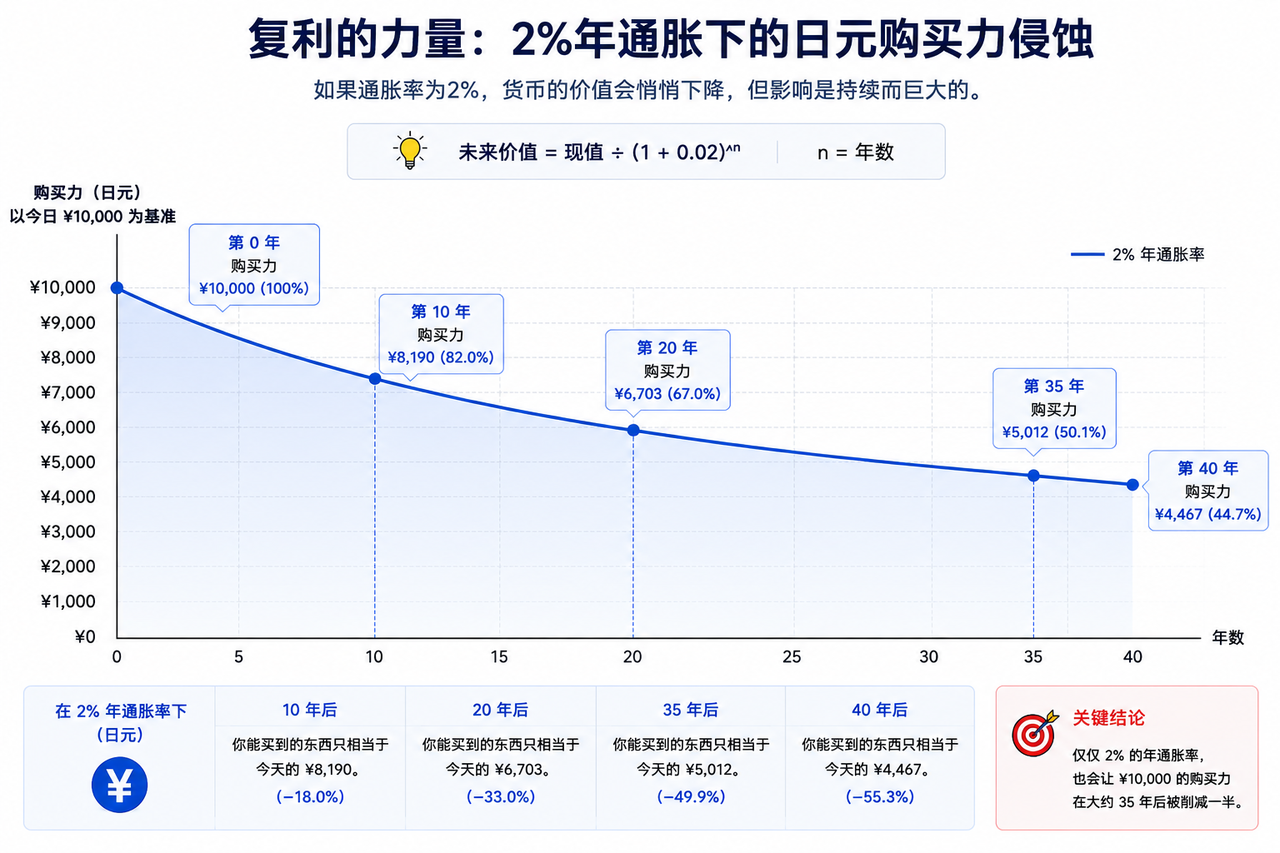
This is the true weight of the "2%" contract: it is not a one-time loss but a continuously operating, ever-running devaluation machine. The 10,000 yuan you save today is not "sitting there idle," but rather "burning slowly every day" in front of this machine.
Unfinished Performance: The Huge Gap Between Commitment and Reality
If central banks could accurately control inflation at 2%, then "2%" would at least be an honest contract where you know the rules and can plan accordingly. However, what has truly happened over the past decade is far more complex and brutal than "mild 2%."
The global inflation shock after 2020 is the most intuitive manifestation of this gap. Supply chain disruptions, soaring energy prices, and overlapping fiscal and monetary policy loosening caused actual inflation rates in major economies like the U.S. and the Eurozone to significantly exceed the 2% target between 2021-2023; U.S. CPI peaked at 9.1% in June 2022, while Eurozone HICP peaked at 10.6% in October 2022, reaching three to four times the target level.
Even with a rollback in inflation in 2024-2025, the cumulative inflation path over the past decade has most likely significantly deviated from the ideal curve of "precisely 2% per year." This means that if you plan your savings depreciation speed entirely according to the "officially promised 2%," you are almost certain to underestimate the actual loss of purchasing power.
And this is just an example of "mild deviation." More extreme samples occur in economies where there are structural problems with currency credit itself:
The Japanese yen has experienced a historic currency collapse over the past decade. Due to the Bank of Japan's long-term adherence to ultra-loose monetary policy and the significant interest rate differential with the Federal Reserve, the yen fell to a historically low level against the dollar after 2022.
The Turkish lira has seen extreme depreciation over the past decade: persistent high inflation and unconventional low-interest rate policies have caused a dramatic decline in the lira's purchasing power against the dollar.
The Argentine peso represents another version of "fiat currency credit collapse": repeated histories of debt default and malignant inflation cycles have made the peso one of the most frequently cited samples in global currency depreciation case studies.
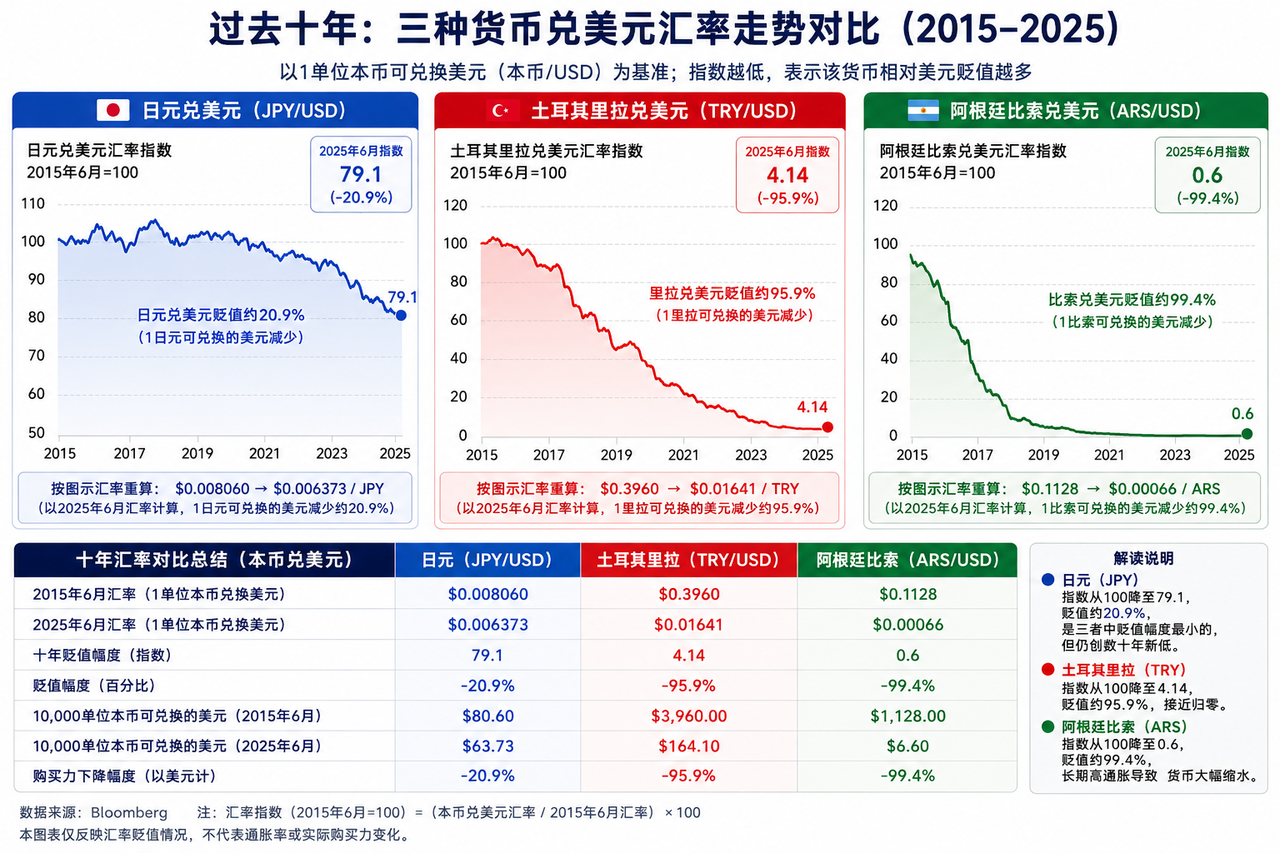
These extreme samples remind us of an easily overlooked truth: "2%" has never been a number guaranteed by physical laws; it is merely a policy commitment— and the credibility of such policy commitments depends on the independence, discipline of the institutions executing that commitment, and the fiscal and political environment they are in.
Commitment but No Guarantee
This is indeed the most easily overlooked yet fatal point in the entire logic: the central bank promised 2%, but this commitment has no guarantee.
If you lend money to a company, you typically receive collateral, priority payment order, or at least a contract stating the consequences of default. But when you "deposit" your life savings in the form of your national currency, there is no collateral, no penalty clauses, and certainly no legal recourse between you and the "issuer of this currency." If actual inflation significantly deviates from the target—whether due to external shocks, policy errors, or fiscal pressure forcing monetary policy concessions—when currency depreciates, you have no contractual tools to demand compensation. All you can do is endure.
This asymmetry originates from the three classic functions of money: unit of account, medium of exchange, store of value, which exist with vastly different levels of legal compulsion.
The first two functions are almost institutionally bound: your wages must be denominated and paid in legal tender, your taxes must be paid in legal tender, and your long-term debt contracts such as mortgages and car loans are almost all settled in legal tender. This is the basic infrastructure of modern economic operation; you cannot opt out of it and have little bargaining power.
However, the "store of value" function has never been enforced. In most countries, the law does not require individuals to hold assets in the form of domestic cash for long-term savings. You can legally convert your savings into gold, stocks, real estate, or any other form of assets you believe will preserve value better.
Who is "packing for currency"?
The answer is not that currency is suitable for "store of value"; in fact, the data from the past ten years repeatedly prove the exact opposite. Rather, it is because the barrier to switching savings from "domestic currency cash" to "other assets" is too high:
Opening a securities account or an overseas assets account involves cumbersome identity verification and compliance processes;
The minimum investment threshold for many high-quality assets keeps ordinary wage earners out;
When to buy, how much to invest, and whether to time the market requires professional knowledge that ordinary people may lack;
More importantly, there is a psychological barrier— the act of "saving money" has implicitly been equated with "putting money in the bank" for decades; switching to "buying assets" may intuitively be perceived as "speculation" rather than "saving."
This dual barrier of operation and recognition is the invisible wall that locks the vast majority of people onto the track of "saving in devaluing currency." But the cost of this wall has been infinitely magnified over the past decade.
The Fates of Three Types of People
The theory now calls for a look at the real numbers. Over the past ten years, the differences in results brought about by different "savings vehicle choices" are no longer of the magnitude of "beating inflation" or "falling behind inflation," but represent a distinct divide that changes one's fate.
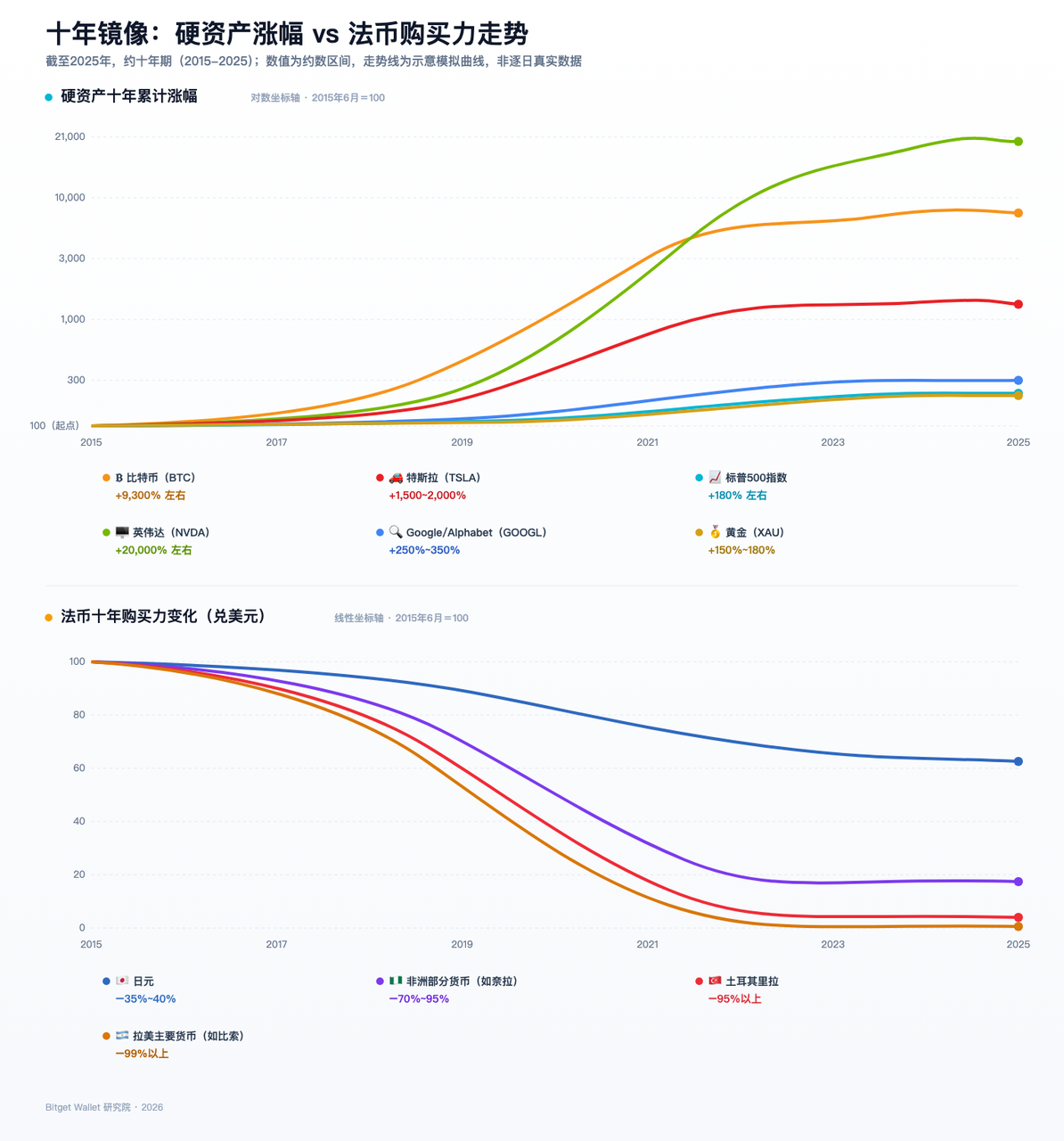
Assuming we turn back time to 2015. You have 100,000 yuan and make no trades, time your investments, but only take one action: buy an asset and hold it until 2025. What will the approximate result of this 100,000 yuan be after ten years?
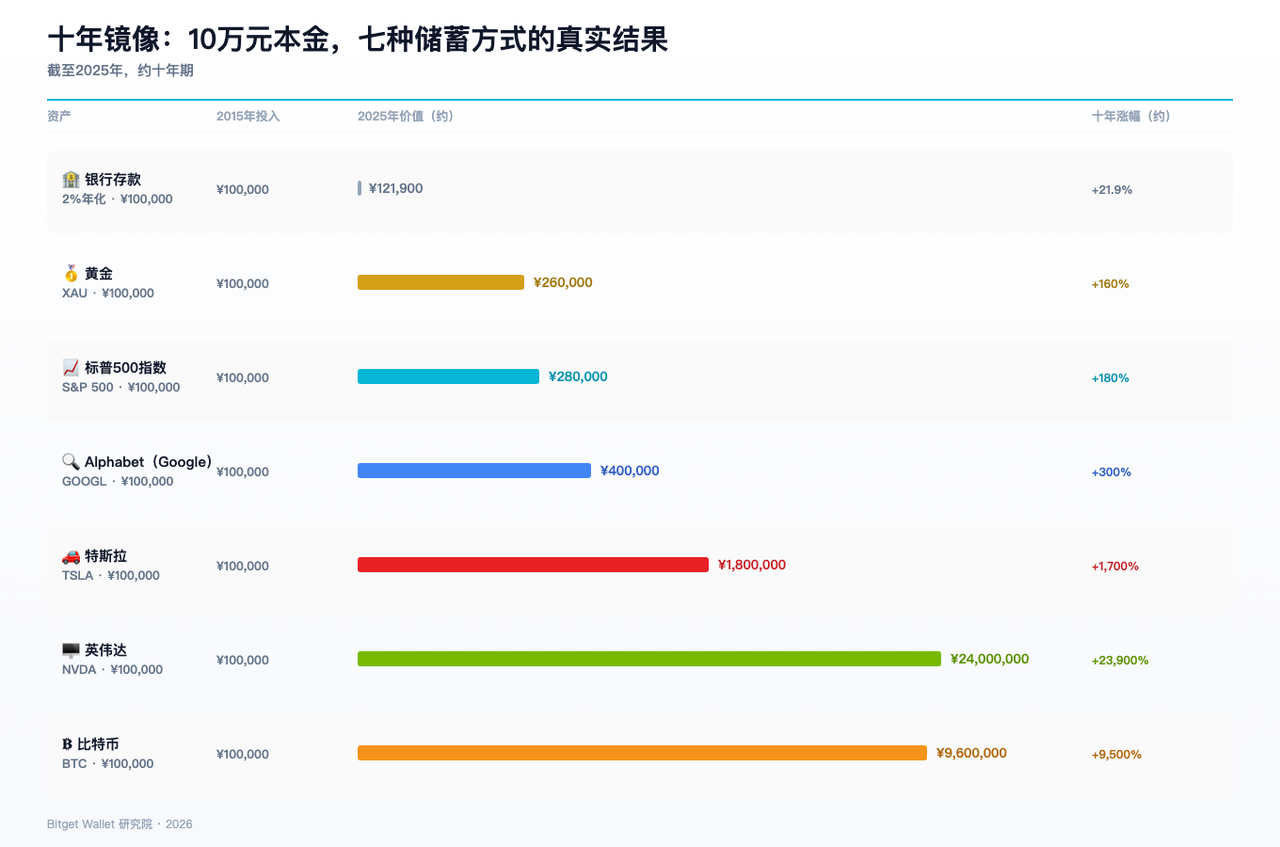
Many people's choices over the past ten years have essentially been to leave their money in the bank, earning stable nominal returns. The problem is that, during the same period, cumulative inflation in the U.S. was about 30%, while Japan's cumulative inflation also exceeded the long-term average significantly. In other words, turning 100,000 yuan into 121,900 yuan seems like a profit of 21,900 yuan, but the actual increase in purchasing power may be very limited.
This is the most easily overlooked fact of the past decade: wealth growth depends not only on how much you earn but also critically on where you put your money. The widening gap is often not due to trading ability but rather the choice of savings vehicle.
Looking at these two sets of data together produces a conclusion that is far sharper than "inflation is annoying": over the past decade, smart money has already completely decoupled the functions of "exchange" and "storage" of currency.
The Decade of Fates for Three Types of People
If we translate these numbers into three real-life choices, we can roughly outline three trajectories:
Type A: Fiat Currency Financial Managers. They are diligent, cautious, and risk-averse, depositing their hard-earned money in bank fixed deposits or buying "conservative" money market fund products recommended by banks. After ten years, the numbers in their accounts indeed grow slowly, and the nominal yield seems to have "beaten" regular savings. However, when adjusted for actual purchasing power, their ten years of hard accumulation largely merely barely offsets inflation erosion, and they often experience a net loss of purchasing power in years of unexpected inflation. They did not do anything "traditionally right," yet they remain the most burdened group in this decade-long game.
Type B: Asset Players. What they do is fundamentally very simple: they rapidly convert idle fiat currency liquidity into hard assets like gold, quality stocks, or Bitcoin, and hold them for the long term, without engaging in frequent timing trades. These individuals may not necessarily be professional investors; many simply happen to be "too lazy to manage" and do not mess with their investments after buying. However, it is precisely this "laziness" that allows them to fully enjoy the substantial premiums brought about by the global asset price expansion cycle over the past decade.
Type C: Altcoin Speculators. This is a group that tends to be overlooked but is equally important; they too attempt to "escape fiat currency devaluation," but their chosen vehicle lacks fundamental value support and relies purely on narrative and liquidity-driven altcoins. Over the past decade, the overwhelming fate of most altcoins has been to zero or near zero. The significance of this sample serves as a reminder: "escaping fiat currency" is rational in itself, but the choice of "where to escape" is equally crucial. Not all "non-fiat assets" inherently possess value-preserving attributes; the asset's own scarcity, consensus strength, and real demand are crucial in determining whether it can withstand the test of time.
The Most Honest Signal: What Are Central Banks Buying?
Here is an observational angle that could almost be termed "dimension reduction": you do not need to trust any analysts, or any research reports; you only need to look at what central banks have done with their balance sheets over the past few years.
Global central banks' official foreign exchange reserves management institutions have been continuously increasing their gold reserves at a historical scale over the past few years. According to a report from the World Gold Council, gold prices will repeatedly hit record highs by 2025, and the total volume of gold purchases by central banks worldwide has reached a very impressive scale.
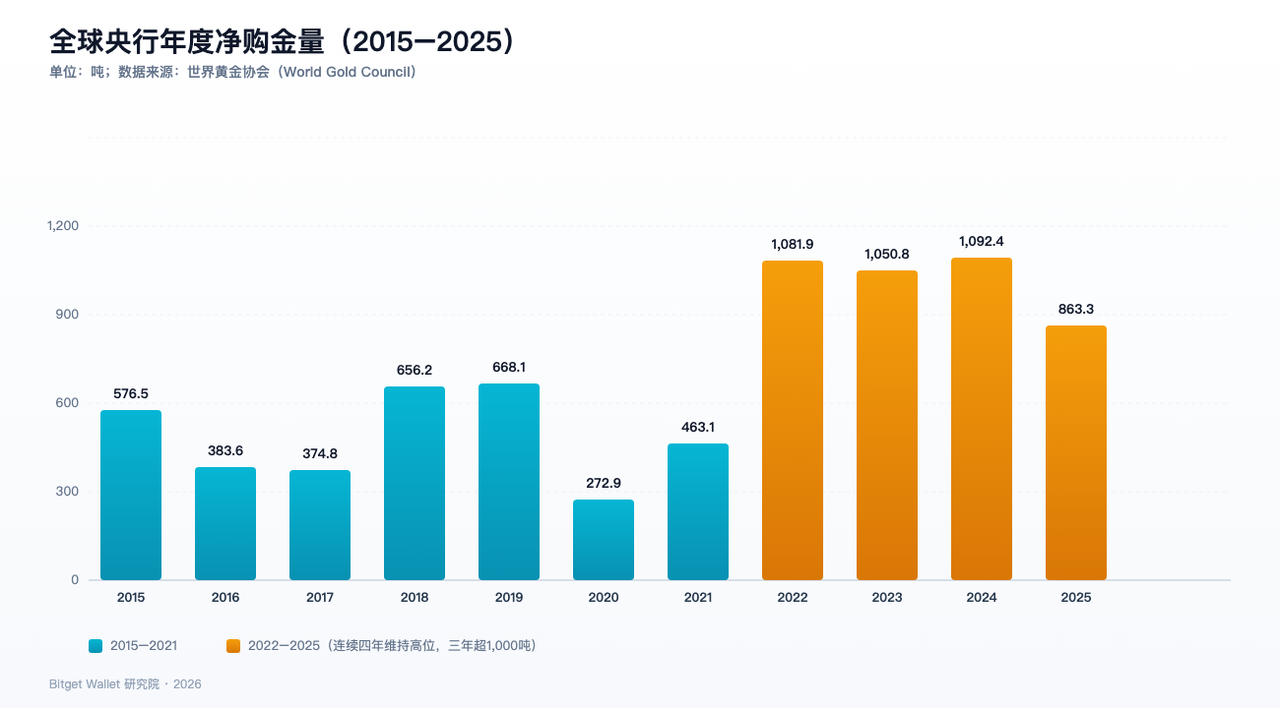
This phenomenon itself is more persuasive than any theoretical deduction; central banks are not unaware of the inherent flaws of fiat currency in its role as a "store of value." They are more aware than anyone else. They simply do not have, and do not need, to convey this awareness to every ordinary saver.
From Crash to Asset Accumulation: How Crypto Can Promise
In the practice of the crypto world over the past few years, we can actually see this evolutionary path. Taking cash-back credit cards as an example, most projects promise users high cash-back rates while obscuring the ultimate fate of tokens and their inevitable crash:
Fiat/Stablecoin Cash-Back: Spending → Consuming fiat currency → Remaining fiat currency sitting in the account, depreciating instead of appreciating. Every purchase you make gradually erodes your savings base due to inflation; you have not "earned" anything, just completed a pure value consumption.
Token Cash-Back: Spending → Consuming stablecoins → Merchants or platforms return altcoins as "rewards." This model superficially introduces a "cash-back" incentive structure, but if the returned assets themselves lack real scarcity and demand support, this "cash-back" is highly likely to dilute to zero over time, in essence merely rebranding value loss.
However, RWA and tokenized real-world assets provide crypto with another choice. In the past, the only truly globally recognized crypto asset was Bitcoin, but the tokenization of real-world stocks has changed everything. For example, if we utilize an asset cash-back model to return hard assets with genuine long-term value support to users, it can bind users to the accumulation of value assets.
This is the ultimate conclusion this article seeks to demonstrate, as well as its only intended application scenario: we cannot change the central banks' process of setting a 2% inflation target, nor can we change the fact that this commitment has no guarantee. But what we can completely change is the asset that catches it the moment fiat currency flows out of our hands. This may be the most straightforward yet effective way for ordinary people to navigate the "2% game" that has lasted over thirty years and shows no signs of terminating.
免责声明:本文章仅代表作者个人观点,不代表本平台的立场和观点。本文章仅供信息分享,不构成对任何人的任何投资建议。用户与作者之间的任何争议,与本平台无关。如网页中刊载的文章或图片涉及侵权,请提供相关的权利证明和身份证明发送邮件到support@aicoin.com,本平台相关工作人员将会进行核查。


